

Farm machinery · Buyer guide
Repossessed Tractors for Sale: Where to Buy, What to Pay
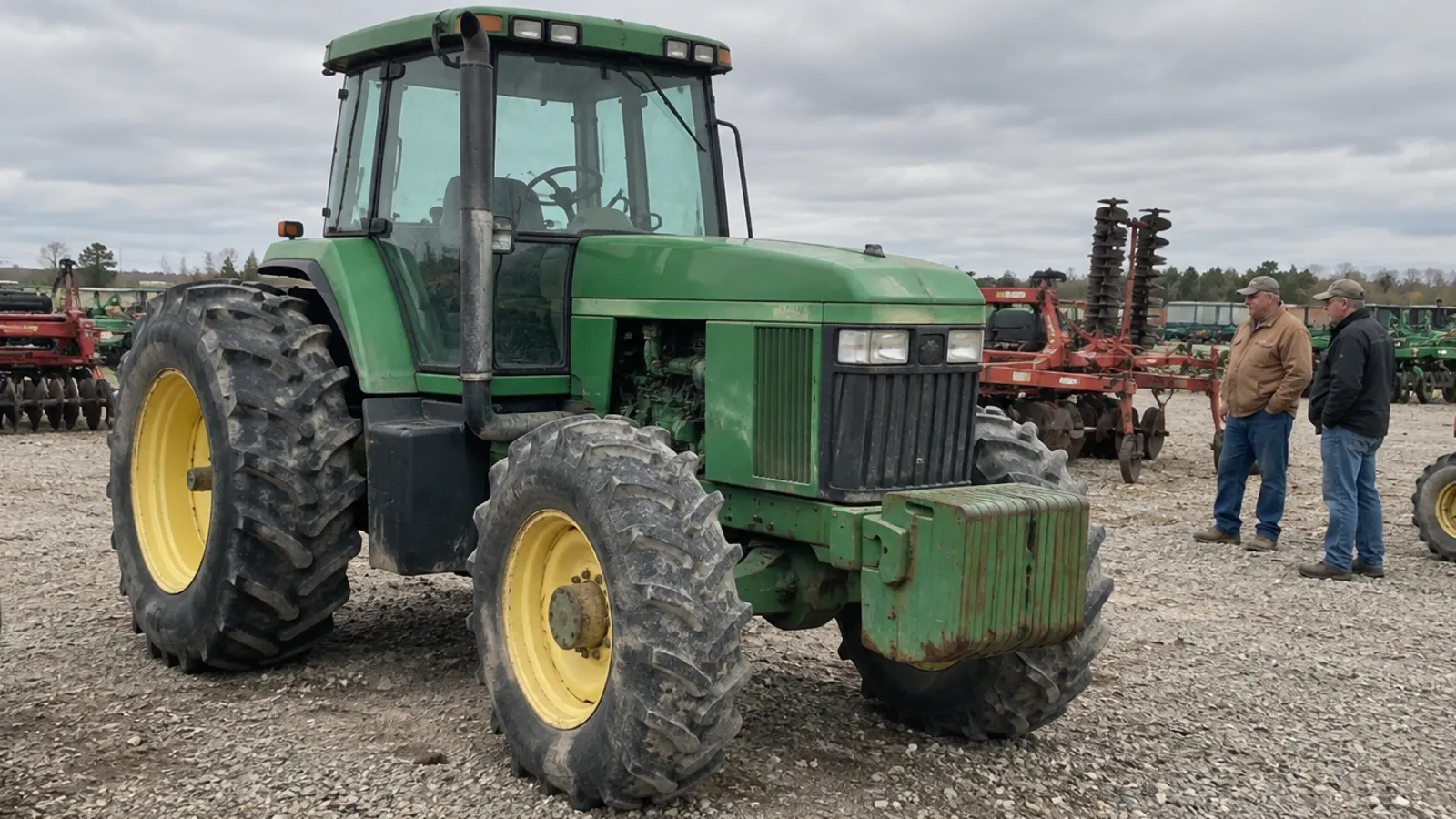
Repo tractors sell in the same auction rings as other used machines, so price depends on hours and condition, not the repo label. Here is where to find them, how to check them and what recent sales fetched.
Key takeaways
- Chapter 12 farm bankruptcies rose 46% to 315 in 2025 (AFBF), and April 2026 had 62 filings, the most in a month since February 2020 (Epiq AACER via Farm Policy News).
- Auction hammer prices on 18 September 2026 included a 2025 John Deere 8R 250 with 991 hours at $241,500 and a 2008 John Deere 7330 Premium at $136,500 (AgWeb).
- Machinery Pete’s rule of thumb: a well-kept late-model used machine sells at auction for about 70-75% of the new dealer advertised price.
- Add buyer fees, tax, transport and repairs to the bid; Ritchie Bros. charges US buyers 10% on bids up to $30,000 for events from 1 August 2026.
- Run a UCC lien search under the seller’s legal name before you pay; filings last five years and can be continued.
In this article
- Why more repossessed tractors are coming to market
- Where to find repossessed tractors for sale: 7 options
- Where the options differ
- What repossessed tractors sell for at auction
- How to check a repossessed tractor before you bid
- Repo tractor cost calculator
- How we chose and checked the numbers
- Picking the right size of tractor
- After you buy: keep track of the machine
- FAQ
Repossessed tractors for sale in the US, Canada, the UK and Australia usually reach buyers through lender-run auctions, online timed sales and dealer lots that take back financed units. Recent auction results show what they really fetch: on 18 September 2026 a 2025 John Deere 8R 250 with 991 hours sold for $241,500 at a BigIron dealer auction, according to AgWeb’s Pete’s Pick of the Week. A repo tractor can be a good buy, but only after you add buyer fees, tax, transport and repairs, and after you check that no lender still has a claim on it.
This guide lists seven places to find repo and auction tractors, a step-by-step check before you bid, dated auction prices with their basis, and a calculator that turns a winning bid into a true landed cost. It is about buying the machine. If you need money to buy it, our separate guide on tractor loans covers finance.
Why more repossessed tractors are coming to market
Farm finances have been under strain, and that is when lenders take back more equipment. The American Farm Bureau Federation counted 315 Chapter 12 family farm bankruptcies in 2025, a 46% rise on 2024, according to AFBF Market Intel. The Midwest (121 cases) and the Southeast (105 cases) filed the most.
The pace rose again in spring 2026. There were 62 Chapter 12 filings in April 2026, the highest monthly total since February 2020 and 82% more than the 34 filed in March, based on Epiq AACER data reported by Farm Policy News at the University of Illinois. Not every bankruptcy leads to a repossession, and not every repossession is a bankruptcy. But the trend means more lender-owned machines are moving through sale rings.
Lenders also report tighter credit. The Federal Reserve Bank of Kansas City’s second-quarter 2026 survey found that under 10% of farm loan balances had major or severe repayment problems, with more lenders tightening terms, according to the Kansas City Fed Agricultural Credit Survey. Crop farms were under more pressure than cattle ranches.
New tractor sales are falling at the same time. Year to date to July 2026, US dealers sold 105,185 farm tractors, 13.1% fewer than a year earlier, according to Association of Equipment Manufacturers data reported by Farm Policy News. Four-wheel-drive tractor sales fell 27% over the same period. Fewer new machines sold today can mean fewer late-model trade-ins later.
Chart
Chapter 12 farm bankruptcy filings per month
US filings, March and April 2026
Where to find repossessed tractors for sale: 7 options
Each option below has a “Best for” line. Fees, terms and what you can inspect differ a lot between them, so read the terms of each sale before you register.
1. Lender and bank auctions through national auction houses
Best for: buyers who want many machines in one place and clear sale terms.
Banks, finance companies and the captive finance arms of tractor makers send repossessed units to large auction companies. Ritchie Bros. (part of RB Global), BigIron, Purple Wave and regional firms run these sales on site and online. Listings often say “lender-owned” or “bank repo”. Check the buyer fee schedule for each sale. For example, Ritchie Bros. lists a US buyer fee of 10% on winning bids of $30,000 or less, 5.5% from $30,000 to $75,000 and a flat $4,125 above $75,000 for events opening on or after 1 August 2026, per its buyer fees page. Fees exclude sales tax.
2. Online timed auctions
Best for: buyers who cannot travel and are happy to judge a machine from photos, videos and reports.
Timed online sales run for several days and close lot by lot. Many include inspection reports and engine start videos. Some allow viewing at the seller’s yard before the close. The risk is that you cannot test a tractor under load. Budget a repair reserve and read whether the sale is “as is, where is”.
3. Dealer lots and repo sections
Best for: buyers who want a warranty option, servicing and financing in one place.
Dealers take back units from lease returns and their own finance programmes. They often recondition them before sale. You pay more than at auction, but you may get a short warranty and a known service history. Ask the dealer whether the tractor came from a repossession, a trade-in or a lease return.
4. Government surplus auctions
Best for: compact and utility tractors at modest prices.
In the US, federal agencies sell surplus equipment, including tractors and mowers, through GSA Auctions. State and county agencies run their own sales. These machines are not usually repossessed, but they reach buyers through the same auction process, often with maintenance records.
5. Farm dispersal and on-farm sales
Best for: buyers who want to see the whole farm’s equipment and how it was kept.
When a farm closes, retires or settles debts, the whole line of machinery is sold on the farm. Some of these sales are ordered by a lender or a bankruptcy trustee. You can often see sheds, records and the other machines, which tells you a lot about care.
6. Bankruptcy trustee and court-ordered sales
Best for: experienced buyers who can act fast and accept legal paperwork.
In a Chapter 7 case, a trustee may sell farm equipment to pay creditors. The sale is usually run by an auction firm approved by the court. Court approval can protect the buyer, but terms are strict and sales are final. Ask an attorney if you are unsure how the sale order treats existing liens.
7. Classified listings and private sellers
Best for: patient buyers who will do their own lien and condition checks.
Listing sites carry tractors from dealers, auction houses and private sellers. Some private sellers are trying to sell a machine before a lender takes it. That is where lien risk is highest, so the checks in the next section matter most here.

▶ Six plain steps to start precision farming without buying a robot. · 4:18
Where the options differ
| Option | Typical price level | Can you inspect? | Main risk |
|---|---|---|---|
| Lender auctions | Market auction price plus fee | Yes, before sale day | As-is condition |
| Online timed | Market auction price plus fee | Photos and reports, some yard visits | Hidden faults |
| Dealer repo lot | Above auction, dealer ask | Yes, with test drive | Paying for reconditioning |
| Government surplus | Low to modest | Often yes | Older, high-hour units |
| Farm dispersal | Market auction price | Yes, on the farm | Bidding fever |
| Trustee sales | Market auction price | Limited | Strict, final terms |
| Private sellers | Negotiated | Yes | Undisclosed liens |
What repossessed tractors sell for at auction
Auction results are the best guide to what a repo tractor is worth, because a repossessed unit sells in the same rings as any other used one. The prices below are auction hammer prices reported by Machinery Pete in AgWeb, with the sale date. They do not include buyer fees or tax.
Chart
Tractor auction prices, BigIron dealer sale
Hammer price in US dollars, 18 September 2026, excluding buyer fees and tax
- 18 September 2026, BigIron dealer auction: 2018 John Deere 8295R, 655 hours, $270,000; 2008 John Deere 7330 Premium with loader, 1,285 hours, $136,500; 1987 John Deere 4650, 6,556 hours, $53,500 (AgWeb).
- 30 June 2026, Schmid Auction, Moweaqua, Illinois: 2008 Kubota M108X with loader, 1,780 hours, $45,200 (AgWeb, July 2026).
- July 2026 auction in Memphis, Missouri: two 2024 John Deere 8R 370 tractors, 124 hours at $385,000 and 534 hours at $356,000 (AgWeb, July 2026).
The same AgWeb reports show a shortage of five- to 12-year-old machines in 2026. Buyers are paying strong prices for late-model units, so a well-kept repo tractor in that age band is not likely to be cheap.
How auction prices compare with new
Machinery Pete uses a simple ratio. A well-kept, late-model used machine at auction should usually sell for about 70% to 75% of the dealer advertised price for the same machine new, according to an AgWeb report from June 2025. At that time a used John Deere 8R 410 averaged $334,578 at auction against an average dealer price of $450,430 new, about 74% (AgWeb rounded it to 76%). In July 2026, the 2024 8R 370 averaged $377,059 at auction against an average dealer advertised price of $435,050. Dealer advertised prices are asks, not transaction prices.
So the old claim that repossessed tractors sell at 30–50% below market is not something we could verify. A repo label does not cut the price by itself. Condition, hours, age and how many bidders turn up decide the price.
Chart
Used auction price vs dealer advertised price
US dollars; 8R 410 figures from June 2025, 2024 8R 370 figures from July 2026
How to check a repossessed tractor before you bid
Use these steps for every repo or auction tractor. They take an hour or two and can save thousands.
- Get the serial number and model year. Match the serial plate to the listing and the paperwork.
- Run a lien search. Most tractors have no title, so lenders record their claim with a UCC financing statement at the state filing office. Search the seller’s exact legal name and any farm business names. A UCC filing lasts five years and can be extended by a continuation filed in the six months before it lapses, under laws such as Ohio Revised Code 1309.515. Ask for a lien release or payoff letter if anything shows up.
- Read the sale terms. Check “as is, where is”, payment deadlines, buyer fees, pickup dates and whether the auction gives clear title.
- Start it cold. Ask that the engine is not warmed before you arrive. Watch for hard starting, blue or white smoke and knocks.
- Check for leaks and wear. Ritchie Bros. advises looking for leaks from the engine, hoses and hydraulics, cracked lines, a dirty air filter and mud in the cab, which can signal poor care, in its used tractor inspection tips.
- Look past the hour meter. The same guide notes that some tractors with 4,000 to 5,000 hours can still be in very good shape if they were well kept. Ask for service records.
- Test the electronics. Guidance displays, receivers and controllers are costly to repair. Check that they power up and that any subscriptions or gain codes go with the machine.
- Check emission rules. Find the engine plate and confirm the engine meets the emission rules where you will use it.
- Set your top bid in advance. Use the calculator below and stop when the bid reaches your limit.
Legal and financial rules vary by state, province and country. This guide is general information, not legal or financial advice. Check local rules and get professional advice before a large purchase.
Repo tractor cost calculator
Enter a winning bid and the extra costs to see the landed cost and how it compares with a dealer’s asking price for a similar tractor. The default numbers are examples only.
Try the numbers for your own farm below.
Calculator
What will this repo tractor really cost?
Enter the bid, fees and extra costs, and a dealer ask for a similar tractor.
- Buyer fee: 3,300 $
- Landed cost: 69,800 $
- Highest bid to match the dealer ask: 62,085 $
Example values only, not a quote or benchmark; every number is your input. Buyer fees differ by auction house and by bid size (Ritchie Bros. US: 10% up to $30,000, 5.5% from $30,000 to $75,000, flat $4,125 above, for events from 1 August 2026). Tax rules vary; farm exemptions may apply. Check local rules and get professional advice.
How we chose and checked the numbers
We listed the seven buying routes that sell lender-owned or court-ordered tractors to the public in our main markets. We took prices only from auction results with a named sale and date, and we say when a figure is a dealer ask rather than a sale. Fee figures come from the auction house’s own published schedule. Farm finance numbers come from the American Farm Bureau Federation, the Kansas City Fed and Farm Policy News. We removed the old page’s untraceable savings claims and brand lists.
Picking the right size of tractor
Match the tractor to your jobs before you look at price. A compact or utility tractor under 100 horsepower covers mowing, loader work, small hay and livestock chores. Row-crop tractors from about 150 to 400 horsepower pull planters, tillage tools and grain carts. Four-wheel-drive models are for large tillage and seeding.
Count your hydraulic outlets too. Ritchie Bros. notes that many air drills need at least three hydraulic outlets and one auxiliary line with about 38 gallons per minute of flow, and some need far more. A cheap tractor that cannot run your implements is not a bargain.
Small tractors and side businesses
Smaller repo tractors can also earn their keep outside your own farm, for example in custom work or renting to neighbours. If you are thinking about that, compare local custom rates first.

▶ Ten small agriculture businesses, including renting out a tractor. · 6:03
After you buy: keep track of the machine
Once the tractor is home, record its hours, service dates and the jobs it does. That record raises its resale value and helps you spot problems early. Farms with several machines can use fleet management tools to log location and use.
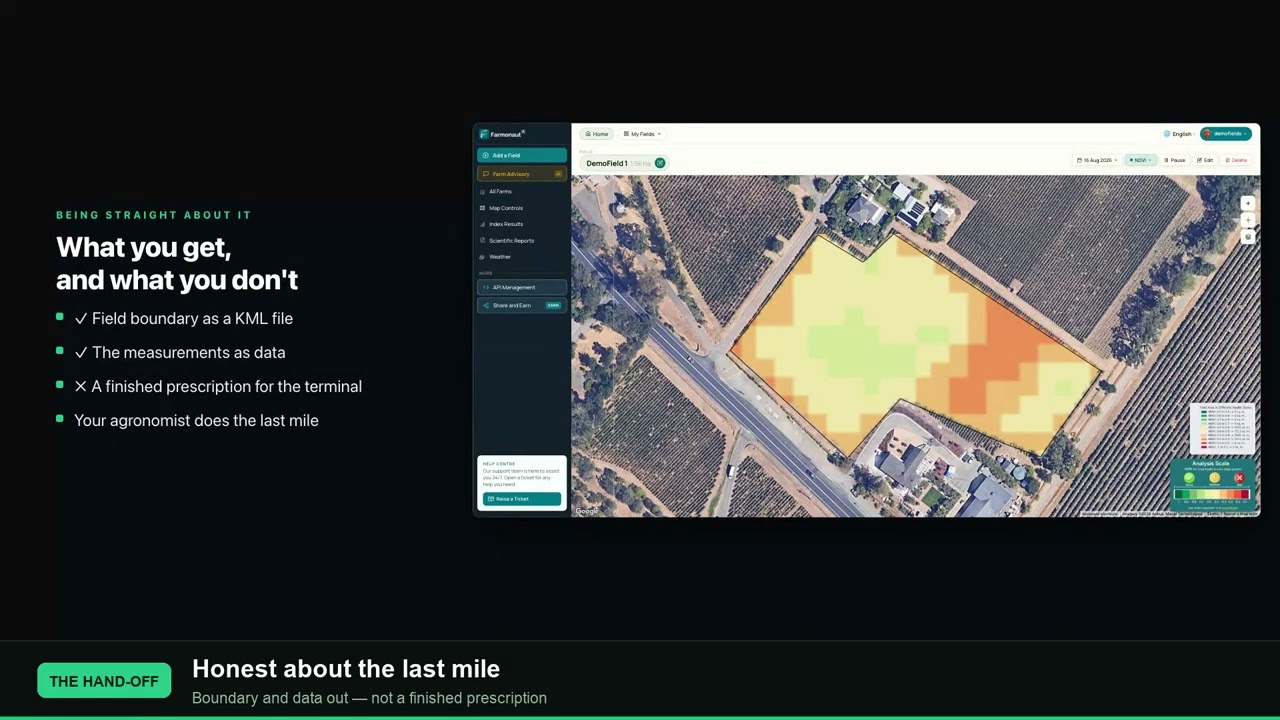
▶ How satellite crop maps tell farm equipment where to apply inputs. · 2:12
We cover a connected topic in Grain Bin for Sale: 7 Smart Storage Innovations.
For a closer look at a related question, see our guide: 2nd Hand Tractors for Sale & Used Farm Equipment Deals.
FAQ
Are repossessed tractors cheaper than other used tractors?
Not by default. Repo tractors sell at auction alongside other used machines, so the price depends on hours, condition, age and demand. In 2026, AgWeb reports strong prices for late-model units because there is a shortage of five- to 12-year-old machines.
Where do banks sell repossessed tractors?
Mostly through national auction houses and online timed auctions, and sometimes through dealer lots. Listings may say “lender-owned” or “bank repo”. Government surplus and trustee sales are other sources of auction tractors.
How do I know a repo tractor has no lien?
Run a UCC search at the state filing office under the seller’s exact legal name and business names. Ask the auction house whether it gives clear title. If a filing appears, get a written lien release before you pay.
What fees should I add to the winning bid?
Add the buyer fee, sales tax where it applies, transport and a repair reserve. For example, Ritchie Bros. charges US buyers 10% on bids up to $30,000 for events opening on or after 1 August 2026. Other auction houses use their own rates.
Can I test drive a tractor at auction?
Often you can start and move it on inspection days, but you cannot usually test it under load. Online timed sales may only give photos, videos and an inspection report.
Related pages on our site: crop loan and insurance tools, farm management for large operations, carbon footprinting, product traceability, satellite data API and API documentation.
Farmonaut crop monitoring
See your own fields from space
Draw your field once. Farmonaut sends satellite crop health maps and advice for it on web, Android or iOS.




Sources
- AgWeb, Pete’s Pick of the Week: 2025 John Deere 9RX 710 Sells for $626,350 (September 2026): agweb.com
- AgWeb, Pete’s Pick: John Deere S780 and S670 Lead Record-Breaking June Auctions (July 2026): agweb.com
- AgWeb, Pete’s Pick: International 1468 Shatters Record at $77,250 (July 2026): agweb.com
- AgWeb, Swathers to Sprayers and the Machinery Pete Ratio (June 2025): agweb.com
- American Farm Bureau Federation, Farm Bankruptcies Continued to Climb in 2025: fb.org
- Farm Policy News (University of Illinois), Farm Bankruptcies Hit Six-Year High in April (2026): farmpolicynews.illinois.edu
- Farm Policy News (University of Illinois), Tractor Sales Fall in July Amid Continued Ag Economy Pressure (August 2026): farmpolicynews.illinois.edu
- Federal Reserve Bank of Kansas City, Steady Tightening of Agricultural Credit Conditions Persists (Q2 2026): kansascityfed.org
- Ritchie Bros., Buyer fees: rbauction.com
- Ritchie Bros., Used farm tractor inspection: key tips: blog.ritchiebros.com
- US General Services Administration, GSA Auctions: gsaauctions.gov
- Ohio Revised Code 1309.515, Duration and effectiveness of financing statement: codes.ohio.gov
Discussion
Questions, corrections or field experience? Share them below. First-time comments are reviewed before they appear, and your email is never published.
No comments yet. Be the first to add a question or your experience.

 Adgrid
 eKGIS
 Mostas Tech
 Native Seeds
 Andex
 FCF India
 Unifrutti Gulf
 Deluxe Conseil
 TVS Electronics
 BW Pipelines
 WICO
 Chimera Innovation
 SkyHarvest
 Polaris Digitech
 Teledarbas

 Licence holder · Niger · Gold










