

Reviewed August 2026 against USDA NASS, U.S. Census Bureau, and University of Illinois farmdoc daily.
Try it: Run your own numbers →
U.S. farm machinery data shows a market in contraction: annual tractor sales fell from 288,187 units in 2020 to 195,857 units in 2025, combine sales dropped from 5,030 to 3,579 units over the same span, and manufacturer inventory value slid from a peak of $7.23 billion in October 2022 to $5.72 billion in December 2025. Layered onto that is a farm tire market built on 28.5 million agricultural tires produced annually and a $798.26 million U.S. tractor tire segment. This page pulls together the tractor, combine, tire, employment, and inventory numbers into one place, with the exact government and industry sources behind each figure so you can pull the next update yourself.
Table of Contents
- Farm Machinery Data: The Core Numbers
- Farm Machinery Production Data: Sales, Inventory & Manufacturing
- Farm Tire Market: Production, Value & Segments
- Data Farm: What “Farm Data” Actually Means Here
- How to Verify and Refresh Every Figure Here
- Fleet Downsizing Calculator
- Buying and Selling Machinery Using This Data
- How Farmonaut Uses Fleet and Field Data
- Video Insights: Smart Farming, Tech & Satellite Solutions
- FAQ: Farm Machinery Data
- Try it: Run your own numbers
Farm Machinery Data: The Core Numbers
The United States has 1.86 million farms averaging 469 acres each, according to USDA NASS’s 2025 farm count and acreage figures published through its Statistics by Subject portal. That farm base is the demand pool behind every tractor, combine, and tire number in this article — fewer, larger farms buying bigger equipment less frequently is the structural story underneath the sales declines below.
The headline trend across every dataset we could source is the same direction: down from a 2020 peak, but not collapsed. Tractor sales are off 32% from 2020 to 2025, combine sales are off 29%, and manufacturer inventory value is off 21% from its October 2022 peak to December 2025. None of these are single-year blips — farmdoc daily’s analysis ties the decline to elevated interest rates, softer farm income, and tariff-driven cost uncertainty on imported steel and components.
Key Insight
Farm machinery data is not one number — it’s at least four separate series (unit sales, dollar inventory, tire production, and manufacturing employment) tracked by different agencies on different schedules. Treat any single “market size” figure with suspicion unless it names which of these it’s measuring.
Farm Machinery Production Data: Sales, Inventory & Manufacturing
“Farm machinery production data” splits into two distinct things people usually conflate: how many units get built and sold each year, and how much manufacturing capacity and inventory sits behind that. Both are tracked, but by different sources.
Unit sales: tractors and combines
University of Illinois farmdoc daily’s February 2026 analysis, built on dealer reports and the Creighton Equipment Index, puts annual U.S. tractor sales at 195,857 units in 2025, down from 288,187 units in 2020. Combine sales — a smaller, more cyclical category tied directly to grain harvest capacity — fell from 5,030 units in 2020 to 3,579 units in 2025. That’s roughly one combine sold for every 55 tractors sold in 2025, a ratio that has held fairly steady because combine purchases track large-farm grain acreage rather than the broader replacement-cycle demand that drives tractor sales.
Manufacturer inventory value
The U.S. Census Bureau’s M3 Survey (Manufacturers’ Shipments, Inventories, and Orders) tracked farm equipment inventory value peaking at $7.23 billion in October 2022 — the tail end of the post-pandemic supply crunch, when dealers and manufacturers were holding elevated stock to hedge against parts shortages. By December 2025, that figure had fallen to $5.72 billion, a $1.51 billion drawdown as manufacturers matched output to the weaker retail sales numbers above.
Manufacturing employment and payroll
Behind the sales and inventory numbers is a workforce the Census Bureau counted at 67,750 people employed in U.S. farm machinery and equipment manufacturing in 2023, drawing $4.9 billion in annual payroll. That’s an average of roughly $72,300 per employee across the sector for 2023 — a useful sanity check when comparing farm-equipment manufacturing wages against other durable-goods manufacturing segments, though the Census source does not break payroll down by role or region.

Two gaps are worth naming plainly rather than papering over. First, the Census of Agriculture publishes detailed farm equipment ownership by type (combine, planter, sprayer counts) and by farm size tier, but its most recent detailed tables are from the 2022 Census — the next full Census of Agriculture with equipment-type breakdowns runs on a five-year cycle, so a 2025-specific unit-type breakdown does not yet exist in published form. Second, there is no uniform national source for state-by-state tractor sales or adoption rates; individual state agricultural departments publish their own figures with inconsistent methodology, so a reader wanting state-level detail needs to check that state’s own department of agriculture rather than expect a federal series.
Farm Tire Market: Production, Value & Segments
The farm tire market is measured two ways in the data we have: physical production volume and dollar market value for a specific sub-segment. ResearchAndMarkets puts annual U.S. agricultural tire production at 28.5 million units for 2024. That figure covers all agricultural tire types — tractor drive tires, implement tires, combine and sprayer tires, and flotation tires — not tractor tires alone.
Within that broader category, ResearchAndMarkets sizes the U.S. tractor tire market specifically at $798.26 million for 2023. That’s a dollar figure for one equipment-type segment (tractor tires), not the whole farm tire category, so the two numbers aren’t directly comparable — one is a unit count across all agricultural tire types for 2024, the other is a dollar value for tractor tires alone for 2023. Readers building a market-sizing model should not add them together.
What the tire data does not cover, per the research gaps identified: there’s no government statistical series breaking down agricultural tire adoption by technology — radial versus bias-ply versus IF/VF (Increased Flexion/Very High Flexion) construction. Market research vendors publish estimates on this split, but none of it is confirmed against an official statistical source, so we’re not repeating an unverified number here. If you need that breakdown for a purchasing decision, ask tire manufacturers directly for their current radial-adoption share in your equipment class — it’s a question dealers can usually answer from their own sales mix even where no public dataset exists.

Common Mistake
Quoting “the farm tire market” as one number without specifying whether it’s unit production, dollar value, or a single equipment sub-segment. The 28.5 million and $798.26 million figures above measure different things for different years — cite both, but never merge them into a single total.
Data Farm: What “Farm Data” Actually Means Here
Anyone searching “data farm” in an agricultural context is usually looking for one of two things: the statistical data collected about farms (what this article assembles), or the practice of using satellite, telemetry, and equipment data to run a farm more precisely. Both meanings converge on the same underlying need — knowing what your fleet, tires, and equipment budget actually look like against sector-wide benchmarks, rather than guessing.
On the statistical side, USDA NASS is the authoritative source for farm counts, acreage, and (every five years) equipment ownership by type through the Census of Agriculture. On the operational side, precision-agriculture platforms that track fleet usage, machine hours, and field conditions are what most farms now mean when they talk about their own “farm data” — and that data is what determines whether the sector-wide sales declines above apply to your specific operation or not.
| Data type | Source | Update frequency | What it covers |
|---|---|---|---|
| Farm count & acreage | USDA NASS | Annual (detailed Census every 5 years) | 1.86 million farms, 469 acres average (2025) |
| Tractor/combine unit sales | University of Illinois farmdoc daily | Monthly dealer data, full-year release Feb/March | 195,857 tractors, 3,579 combines (2025) |
| Manufacturer inventory | U.S. Census Bureau M3 Survey | Monthly, 2–3 week lag | $5.72B farm equipment inventory (Dec 2025) |
| Manufacturing employment/payroll | U.S. Census Bureau | Annual | 67,750 workers, $4.9B payroll (2023) |
| Tire production & market value | ResearchAndMarkets | Per report cycle | 28.5M units (2024), $798.26M tractor segment (2023) |

How to Verify and Refresh Every Figure Here
This is the part of the article that won’t go stale: the method for pulling a current number, even after every figure above has been superseded.
- Tractor and combine sales — farmdoc daily updates monthly using dealer reports and the Creighton Equipment Index, with a full prior-year figure published every February or March at farmdoc daily. Check for the newest post in that series rather than reusing this one once a new year closes.
- Manufacturer inventory value — published monthly by the U.S. Census Bureau via the M3 Survey, with a 2–3 week reporting lag. Search “Manufacturers’ Shipments, Inventories, and Orders farm machinery” on census.gov for the current month.
- Farm count and average acreage — USDA NASS Statistics by Subject refreshes these annually each March, with the full Census of Agriculture (including equipment-by-type detail) every five years.
- Tire production and market value — ResearchAndMarkets reissues its United States Farm Tire Market and United States Tractor Tire Market reports periodically; search the report titles directly for the current edition, since these are commercial reports rather than a standing government series.
- Manufacturing employment and payroll — Census Bureau’s County Business Patterns and Annual Survey of Manufactures update annually; search NAICS code 333111 (Farm Machinery and Equipment Manufacturing) on census.gov for the latest year.
Verification Checklist
Before citing any farm machinery figure, confirm: (1) the exact year or quarter it covers, (2) whether it’s a unit count or a dollar value, (3) whether it covers all farm equipment or one category like tractors or tires, and (4) the publishing agency. Mixing these up is the single most common error in secondary reporting on this sector.
Fleet Downsizing Calculator
Use your own fleet size and the sector-wide 2020-to-2025 sales decline rates above to estimate how much your replacement budget has shifted if you’re buying at today’s lower unit volumes but current price levels.
Run your own numbers
Assumptions: uses the tractor tire market’s $798.26 million value (2023, ResearchAndMarkets) only as a reference point for the default price-per-tire suggestion — enter your own quoted price for an accurate result. This excludes labor, disposal fees, financing costs, and any regional price variation, and does not account for tire wear rates specific to your soil type or annual hours of use.

Buying and Selling Machinery Using This Data
The inventory drawdown from $7.23 billion to $5.72 billion between October 2022 and December 2025 signals manufacturers cutting production to match weaker retail demand — which typically means less discounting pressure on new equipment than during the inventory glut, but also fewer incentives than dealers offered when stock was high. Buyers and sellers can use the same data points differently:
- Track the farmdoc daily sales series before committing to a purchase timeline — a further decline in unit sales usually precedes softer used-equipment resale values within 12–18 months.
- Check current Census M3 inventory levels; falling manufacturer inventory (as seen through 2025) generally means less negotiating room on new-unit pricing.
- Factor tire replacement into total cost of ownership using the $798.26 million tractor tire market context above — tires are a recurring cost line that scales with fleet size, not a one-time purchase decision.
- Provide detailed hours of operation and service logs when selling — this is a documentation practice, not a data point, but it’s the one lever a seller controls directly.
- Use Farmonaut’s traceability tools to build a verifiable service and usage history that supports resale value.

Pro Tip
Align major machinery purchases with your own farm’s cash flow rather than trying to time the national sales cycle — the farmdoc data shows a multi-year decline, not a seasonal dip, so waiting for a rebound is not a reliable strategy on current figures.
Procurement and fleet planning checklist
- 🛒 Compare your planned purchase against current farmdoc daily sales trends before ordering; review Farmonaut Large-Scale Farm Management for fleet-level planning tools
- 🛒 Factor total landed cost — including tires, freight, and service access — not just sticker price
- 🛒 Check technician and parts availability in your region for the equipment line you’re buying
- 🛒 Use digital fleet tracking to monitor usage and depreciation against sector benchmarks (Fleet Management by Farmonaut)
- 🛒 Track carbon and compliance data alongside purchase decisions via Farmonaut’s Carbon Footprint Monitoring


How Farmonaut Uses Fleet and Field Data
The sales and inventory numbers above describe the national market. What happens on your own operation — which tractor is due for tires, which field needs the combine first — is a separate question that satellite and fleet-tracking tools are built to answer. Farmonaut combines multispectral satellite imagery, AI-driven advisory, and blockchain-based traceability, accessible via:
- Satellite imagery for crop and machinery-readiness monitoring
- Jeevn AI advisory for harvest timing and weather-responsive maintenance windows
- Resource management and fleet tracking to optimize tractor, planter, and harvester usage
- Blockchain-based traceability for equipment and input records
- APIs connecting real-time field data to farm management and insurance workflows (see Farmonaut API)
See how Farmonaut’s Fleet Management tools support scheduling and usage tracking for your machinery fleet, and discover Farmonaut’s satellite-based crop loan and insurance verification for equipment-adjacent financing needs.
Developers can review integration options in the API Developer Docs.

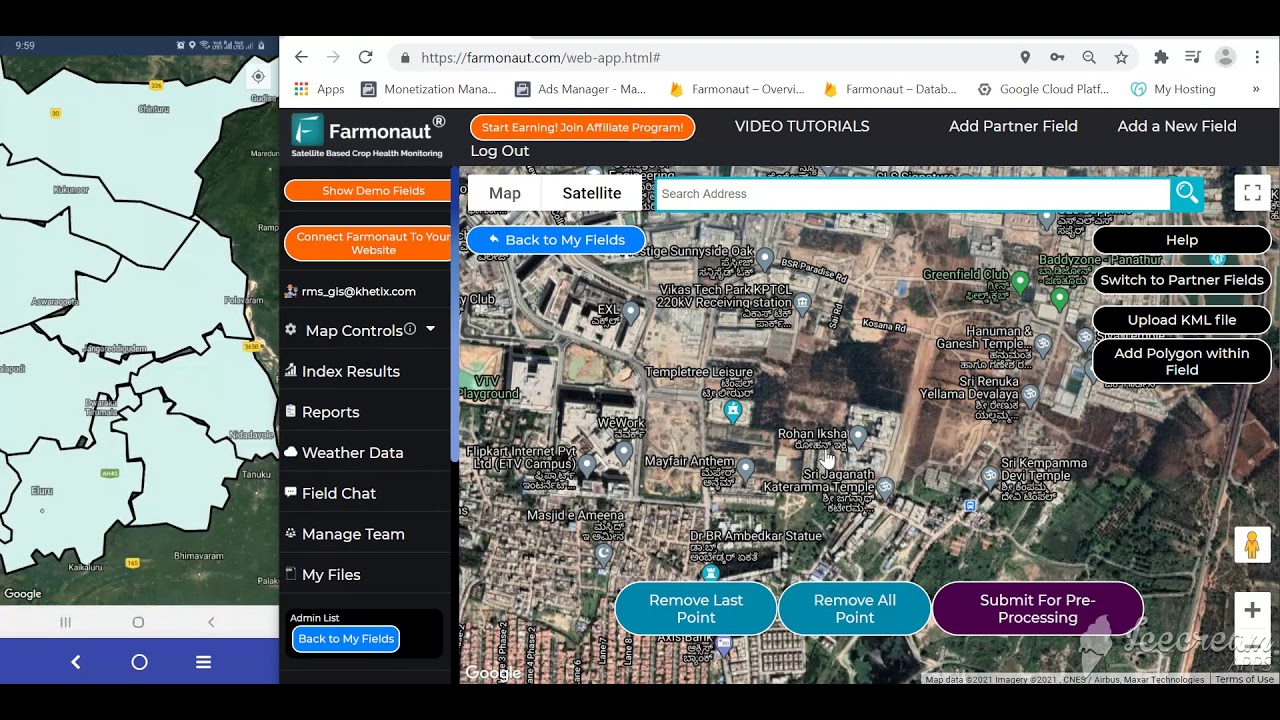
Video Insights: Smart Farming, Telematics, and Satellite Solutions

FAQ: Farm Machinery Data
1. What is the current size of the U.S. farm tire market?
By two separate measures: U.S. agricultural tire production totaled 28.5 million units in 2024, and the tractor tire segment specifically was valued at $798.26 million in 2023, both per ResearchAndMarkets. These are different metrics (units vs. dollars) for overlapping but non-identical categories, so don’t add them together.
2. Where can I find farm machinery production data?
Unit sales data (tractors, combines) comes from University of Illinois farmdoc daily, updated monthly with a full-year figure each February or March. Manufacturer inventory value comes from the U.S. Census Bureau’s M3 Survey, updated monthly with a 2–3 week lag. Both are linked in the “How to Verify” section above.
3. How many tractors are sold in the U.S. each year?
195,857 units in 2025, down from 288,187 units in 2020 — a 32% decline over five years, per farmdoc daily’s analysis of Creighton Equipment Index dealer data.
4. How many farms are there in the United States, and how big are they?
1.86 million farms averaging 469 acres each, per USDA NASS’s 2025 figures.
5. How does Farmonaut use this kind of data?
Farmonaut applies satellite imagery, AI advisory, and fleet-tracking tools at the individual-farm level — helping you monitor equipment usage, schedule maintenance, and time upgrades against your own field and machine conditions rather than only national averages.
Take the Next Step: Smart Farm Fleet Management
Ready to plan your machinery budget with real usage data behind it?
Start with digital crop and machine management tools—explore the Farmonaut platform today on web, Android, or iOS.


 Esri North East Africa
 Farmer Amigo
 Cresol
 Atur Kuliner
 MDCV UK
 Zerella Group
 Etech Consulting Madagascar
 Vestlandsforsking
 Agritein
 Delicio
 WB Dev
 Sama Premium
 Prochecker
 Tres Valles
 LACOS Geoinformation
 Magrifly
 LatConnect 60
 Blickwinkel
 Agricultural Credit Policy Council
