

What Does AI Stand for in Agriculture? 2026 Guide
“By 2026, over 60% of large farms are projected to use AI-driven management systems for sustainable agriculture.”
Table of Contents
- Introduction: Demystifying Acronyms in Modern Agriculture
- What Does AI Stand for in Agriculture in 2026?
- AI-Driven Technologies in Agriculture: Applications & Benefits
- What Does IPM Stand for in Agriculture?
- The Role of IPM & Data-Driven Pest Management in 2025+
- What Does EPA Stand for in Agriculture: Safety & Oversight
- What Does the US Secretary of Agriculture Do? Policy Levers & Sector Development
- Comparison Table: Key Agricultural Acronyms (2025–2026)
- Farmonaut: Satellite, AI & Data Solutions for the Future
- Callout Highlights & Insights
- Bullet Points & Visual Lists
- Frequently Asked Questions (FAQ)
- Conclusion: Shaping Sustainable Success in Agriculture
Introduction: Demystifying Acronyms in Modern Agriculture
The landscape of agriculture is undergoing a digital renaissance. As we progress toward 2026, understanding essential acronyms like AI (Artificial Intelligence), IPM (Integrated Pest Management), and EPA (Environmental Protection Agency) is vital for everyone involved in farming, rural management, and agricultural policy. These frameworks are not just buzzwords—they are the cornerstones of sustainable farming practices, advanced food supply systems, and rural economic development.
This comprehensive guide will cover:
- What AI stands for in agriculture and how it revolutionizes management across crops, livestock, and resources.
- How IPM blends modern technology with biological and cultural controls to optimize pest intervention and reduce chemical inputs.
- The EPA’s regulatory role—how it ensures environmental safety and shapes 2025’s compliance targets for pesticides, water, and soil.
- Major responsibilities of the Secretary of Agriculture and the frameworks guiding rural and agricultural innovation in 2025 and beyond.
- The technologies, services, and benefits platformed by Farmonaut for 2026’s data-driven sector.
What Does AI Stand for in Agriculture in 2026?
AI in agriculture stands for Artificial Intelligence. It’s a suite of technologies that enables machines to learn from data, recognize patterns, and make decisions with minimal human intervention. From soil health monitoring to autonomous harvesters, AI-powered platforms are shaping sustainable farming practices, improving resource use, and maximizing yields.
What does AI stand for in agriculture? In 2026, AI is synonymous with artificial intelligence—the technology that empowers the entire sector to move from intuition-based to evidence-based, scalable, and high-resilience farming.
- Artificial Intelligence (AI): Applied across crops, livestock, forestry, and even mining-adjacent supply chains.
- 2025+ Focus: Used to improve yields, reduce inputs (chemical, water, fertilizer), and bolster sustainability via advanced algorithms and real-time monitoring.
-
Examples:
- AI-driven crop health monitoring via drone and ground-based sensors
- Predictive maintenance for farm equipment
- Automated irrigation and nutrient application
- Autonomous harvesters and weeders for labor optimization
By interpreting multispectral imagery, climate data, soil moisture, and phenotypic information, AI enables farmers to optimize planting dates, irrigation schedules, fertilizer management, and pest control with pinpoint precision.

Video: How AI Drones Are Saving Farms & Millions in 2025 🌾 | Game-Changing AgriTech You Must See!
AI-Driven Technologies in Agriculture: Applications & Benefits
The practical side of artificial intelligence in agriculture extends to every aspect of resource management: from precision irrigation to real-time health monitoring and forecasting of disease outbreaks. As farmers and companies move toward sustainability and efficiency, the deployment of AI-powered tools and services becomes standard.

Video: Farmonaut Web System Tutorial – Monitor Crops via Satellite & AI
- ✔️ Automated Monitoring: Drones and satellites provide continuous crop and field data to inform real-time decisions.
- 📊 Data Insight: Predictive algorithms help forecast yields and disease/pest outbreaks, improving planning and profitability.
- 🛡️ Resource Protection: Automated systems allocate water and nutrients only as needed, reducing waste and runoff.
- 💧 Precision Irrigation: Soil sensors and AI models optimize schedules and quantities for water use efficiency.
- 🌱 Yield Optimization: AI interprets multispectral and weather data for maximizing both volume and quality of produce.
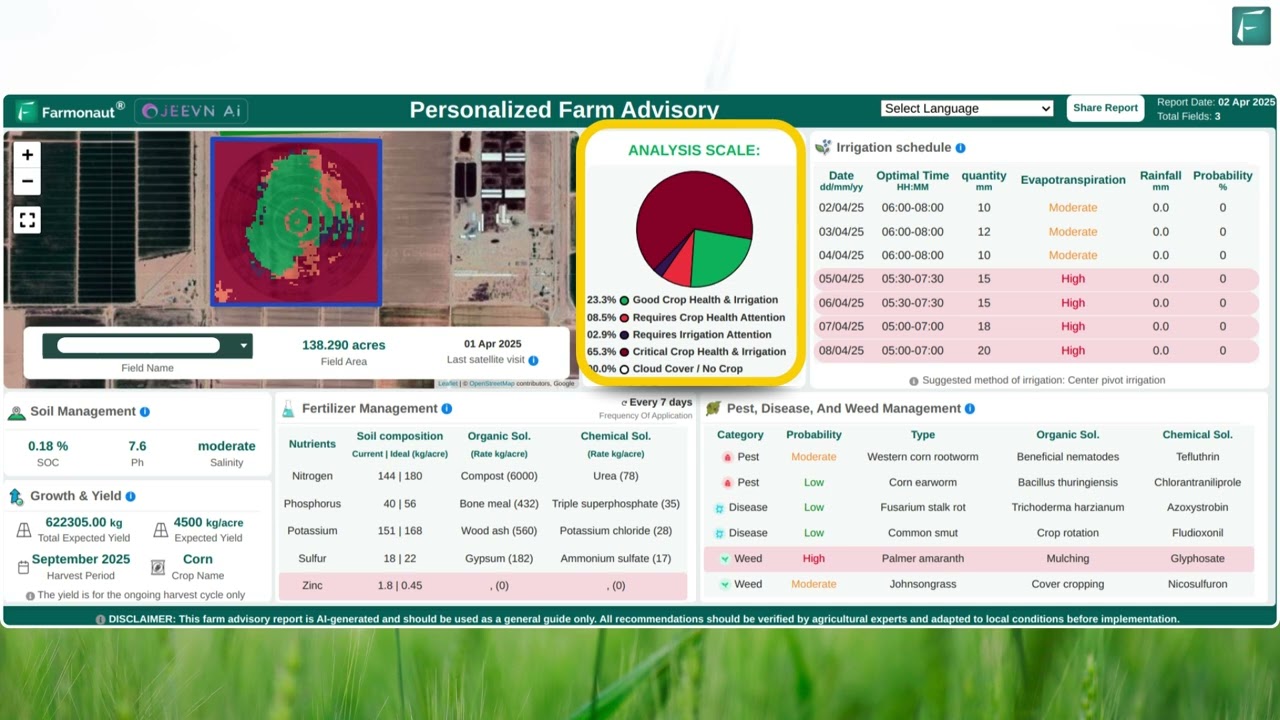
For instance, using the Jeevn AI Advisory System (featured on platforms such as those provided by Farmonaut), users receive real-time weather and health advice based on satellite and AI correlations. This enables:
- Precision planting: Determining ideal dates and locations per field
- Fertilizer optimization: Adjusting application rates based on NDVI and nutrient analysis
- Pest and disease monitoring: Early scouting and intervention

Video: JEEVN AI: Smart Farming with Satellite & AI Insights
We at Farmonaut empower agriculture through satellite-based monitoring, AI-driven advisory, and blockchain-based traceability. Our platform delivers advanced, affordable large-scale farm management resources for crop, mining, and infrastructure professionals.
What Does IPM Stand for in Agriculture?
IPM in agriculture stands for Integrated Pest Management. This is a comprehensive framework blending biological, cultural, mechanical, and chemical controls for pest management. IPM focuses on:
- Prioritizing prevention—crop rotation, choosing resistant varieties, enriching soil health
- Rigorous monitoring—scout programs and threshold-based actions
- Deploying targeted interventions only when pest populations threaten yields

Video: Smart Plant Solutions: AI – Driven Pest Detection for Intelligent Agriculture
- 🦋 Biopesticides: Leveraging natural predators and disease-specific agents to control pest populations
- 🔬 Pheromone traps & beneficial predators: Maintaining the ecological balance in the fields
- 🔄 Cultural & mechanical actions: Crop rotation, field hygiene, and selective tilling for pest prevention
What does IPM stand for in agriculture in 2026? It stands for a data-informed approach to managing pests—where chemical treatments are the last, not first, line of defense.
The Role of IPM & Data-Driven Pest Management in 2025+
With the proliferation of satellite-based agriculture and sensors feeding real-time data into AI-powered platforms, the role of IPM continues to expand globally. Farmers and agronomists now use AI tools to:
- Scout and map pest populations via imagery and on-ground data
- Trigger targeted interventions only when predetermined risk thresholds are reached
- Reduce overall chemical use and thus minimize environmental impact
- Monitor efficacy to refine strategies each growing season

Video: Smart Crop Solutions : AI-Powered Field Scouting for Enhanced Productivity
IPM frameworks increasingly use near-real-time observations gathered via smartphone apps, field sensors, and satellite-based platforms. This gives farmers eco-friendly options to optimize inputs and maximize quality yields—a must for agriculture in 2025 and beyond.
What Does EPA Stand for in Agriculture: Safety & Oversight
EPA in agriculture stands for Environmental Protection Agency. In an agricultural context, this federal agency governs everything from the registration and safe use of pesticides to the oversight of soil, water, and air quality as impacted by farming. Its mission:
- Approve and regulate agrochemicals: Ensuring maximum allowed residues and safety standards
- Monitor surface and groundwater: Safeguarding ecosystems from runoff and contamination
- Enforce worker protection rules: Oversight on safe chemical storage and application practices
- Set and promote ecological risk standards: Encouraging sustainable practices and conservation programs
What does EPA stand for in agriculture? In the 2025 context, EPA stands for more than enforcement. It represents the central authority aligning public safety, environmental stewardship, and responsible innovation in farming.
Video: Smart Farming Future: Precision Tech & AI: Boosting Harvests, Enhancing Sustainability
- ⚠️ Risk: Noncompliance may result in penalties, lost market access, and environmental liabilities
- 🔎 Monitoring: Digital records, satellite-based verification, and drone imagery streamline EPA compliance workflows
- 🌿 Sustainability: EPA’s 2025+ guidelines mandate increasingly strict runoff, erosion, and drift-reduction practices
What Does the US Secretary of Agriculture Do? Policy Levers & Sector Development
What does the US Secretary of Agriculture do? As head of the USDA, the Secretary is the architect of American agricultural, rural, and nutrition policy, overseeing food security, farm safety nets, research and innovation funding, and more.
- 🏛️ Policy & Oversight: Advises the President and oversees all federal programs related to farming, food safety, and rural economic development
- 🌾 Food Security & Nutrition: Administers SNAP, school meal programs, and market stabilization efforts
- 🌎 Trade & Market Access: Champions agricultural exports, defends producer interests, and mitigates supply chain shocks
- 🧑🌾 Rural Workforce & Innovation: Invests in extension services, broadband access, and cutting-edge technology like AI and IPM-driven diagnostics
- ☂️ Risk Management: Supports insurance and disaster relief to boost farm resilience
The Secretary’s 2025–2026 priorities are tightly aligned with sustainability, green infrastructure, and international trade competitiveness—making their role central in shaping an innovation-ready, resilient farm sector.
Video: JEEVN AI: The Future of Smart Farming with Satellite & AI Insights
Comparison Table of Key Agricultural Acronyms and Their Impact (2025–2026)
Farmonaut: Satellite, AI & Data Solutions for the Future of Agriculture
In 2026, the drive toward data-driven farming and sustainability means embracing platforms that merge satellite technology, AI analytics, and digital resource management. At Farmonaut, our mission is to make satellite insights accessible and affordable for producers, businesses, and governments.
- 🛰️ Carbon Footprinting: Track, report, and reduce your carbon emissions using real-time satellite and AI data—vital for compliance and sustainability programs.
- 🔗 Traceability Solutions: Ensure transparent and secure supply chains in agriculture and mining with blockchain-backed monitoring.
- 💸 Crop Loan & Insurance: Satellite-based verification streamlines financing and insurance access, combating fraud and boosting trust.
- 🚜 Fleet Management: Optimize agricultural vehicle and equipment fleets to maximize ROI and ensure safety.
- 🌳 Forest Advisory & Plantation Insights: Real-time advisory to improve forestry yields and ecological restoration.



As a leader in satellite and AI-driven agricultural tools (visit our API and developer documentation), we provide:
- Real-time monitoring and decision support: Multispectral satellite imagery for instant field health checks
- Blockchain-based traceability for authenticating produce from seed to shelf
- Fleet & resource management tools for cost-effective operations
- Environmental impact analytics for carbon tracking and reporting
- Subscription-based access to powerful insights via apps or API

Video: Smart Farming Future: Precision Tech & AI Boosting Harvests, Enhancing Sustainability
Callout Highlights & Insights
Visual Lists & Bullet Points: Maximizing Your AI-Driven Agriculture Strategy
5 Bullet Points to Guide Your 2026 Agriculture Tech Decisions:
- ✔ Adopt AI-powered management tools to maximize yield, minimize inputs, and automate compliance with evolving EPA standards.
- 📊 Analyze field data patterns using multispectral imaging and climate models for precision resource allocation.
- 🛑 Reduce reliance on chemical inputs via IPM frameworks, favoring biological and digital interventions.
- 💡 Incorporate blockchain traceability to guarantee supply chain integrity and open access to premium markets.
- 🔎 Continuously monitor crop and environmental health, enabling data-based interventions, crop insurance verification, and transparent reporting.
Visual List: The Evolution of Agricultural Technologies (2020 ➔ 2026)
- ➡ 2020: Manual scouting, calendar-based irrigation, hand-recorded pesticide applications
- ➡ 2023: Digital sensors introduced, partial satellite monitoring, basic farm-management apps
- 🌐 2026: Full integration: AI, real-time satellite analytics, IoT-connected equipment, complete digital compliance, end-to-end traceability
Visual List: AI-Driven Decision-Making for Sustainable Farming
- Field monitoring (drones, satellites, IoT sensors)
- Data interpretation (AI identifies trends, stress, anomalies)
- Actionable insights (automated irrigation, targeted spraying, harvest optimization)
- Continuous improvement (machine learning refines each season’s management plan)
Frequently Asked Questions (FAQ)
What does AI stand for in agriculture?
AI stands for Artificial Intelligence in agriculture. It includes technologies and tools that enable machines to process data, recognize field conditions, and make autonomous or semi-autonomous decisions to optimize farm yields, reduce inputs, bolster sustainability, and minimize labor.
What does IPM stand for in agriculture?
IPM means Integrated Pest Management—a holistic, data-driven framework blending biological, cultural, and mechanical controls with targeted, as-needed chemicals to manage pests in an ecologically sound, profitable way.
What does EPA stand for in agriculture?
EPA stands for the Environmental Protection Agency. For agriculture, the EPA regulates pesticides, chemicals, soil and water conservation programs, and environmental compliance requirements.
What does the Secretary of Agriculture do?
The Secretary of Agriculture leads the USDA, overseeing food security, farm policy, research funding, international trade, disaster recovery, and innovation initiatives, ensuring resilient agricultural and rural economies.
How will AI and satellite technology shape agriculture in 2026?
By 2026, AI and satellite technology will provide real-time monitoring, predictive analytics, and operational automation—enabling precision management, minimizing risks, and supporting compliance and transparency from field to market.
Conclusion: Shaping Sustainable Success in Agriculture
In summary, AI in agriculture stands for artificial intelligence, transforming every facet of farming—yield optimization, data-driven management, and input reduction—for a more sustainable, resilient sector in 2025 and 2026. IPM frameworks enable precise, eco-optimized pest controls, while EPA oversight ensures that agricultural practices are both safe and forward-thinking.
The Secretary of Agriculture serves as the linchpin, orchestrating policies and funding streams for food security, climate resilience, and innovation. As satellite, AI, and data integration become foundational tools—with platforms like Farmonaut providing affordable, scalable access—producers, governments, and industries are empowered to meet rising compliance expectations, reduce risks, and lead on sustainability.
Take the next step in your agricultural management journey: embrace data, harness technology, and commit to evidence-based success in 2026 and beyond!

 Godrej Agrovet
 Hayleys Agriculture
 Linx Agritech
 Adinet
 Save Your Soils
 GalaxEye Space
 Grandstream Algérie
 XOS Realty
 Geospatial Lab Africa
 Agro La Gándara
 HIPSAC
 ZOL Zimbabwe
 Juligerm
 AdBio
AdBio MISE Maroc
 NWNS
NWNS Red August Group
 Farm Inc
 WeMe Global
 Agrotoken
 Blue BearX
 Insignito
 DnCubed
 Indosistim Teknologi
 Liquify Digital
 CU Foods
 BeyondTech Global
 Rouge VC
 AgroRisk
 Oath Inc
 Esri North East Africa
 MDCV UK
 Etech Consulting Madagascar
 Vestlandsforsking
 WB Dev
 Sama Premium
 Tres Valles
 Blickwinkel
 Agricultural Credit Policy Council
 eKGIS
eKGIS Mostas Tech
 Andex
Andex Deluxe Conseil
 WICO
WICO Chimera Innovation
 SkyHarvest
 Teledarbas
 Exurbia Geospatial
 FieldZero

This is a clear and informative guide explaining the role of AI in modern agriculture. It effectively shows how technology is transforming farming into a smarter and more efficient system.