

Alberta Agriculture Grants: Programs, Amounts & How to Apply
Reviewed September 2026 against Statistics Canada, Agriculture and Agri-Food Canada (Sustainable CAP), and USDA NIFA.
Try it: Run your own numbers →
Table of Contents
- Alberta Agriculture Grants: The Short Answer
- Alberta’s Farm Economy in Numbers
- Alberta Agriculture Grants and Support Programs
- Comparison Table: Alberta, Federal, US and Sector-Specific Grants
- Government Grants for Greenhouses
- Solar Farm Grants and Agrivoltaics
- US Farm Grants: Virginia and USDA Programs for Beginning Farmers
- Grant Funding Gap Calculator
- How to Verify a Grant Is Still Open
- Technology That Strengthens a Grant Application
- Farmonaut Satellite Tools for Grant-Funded Farms
- Farmonaut Subscription Details
- Frequently Asked Questions
- Conclusion
Alberta Agriculture Grants: The Short Answer
Alberta farmers draw grant funding from one federal-provincial framework — the Sustainable Canadian Agricultural Partnership (Sustainable CAP) — which allocated $508 million to Alberta agriculture for 2023-2028, cost-shared between Agriculture and Agri-Food Canada and the province, according to Alberta’s Sustainable CAP page. Within that envelope sits a dedicated $10 million Growing Greenhouses initiative (2023-2025) for greenhouse producers, plus a rotating set of stream-specific programs for young farmers, on-farm efficiency, and value-added processing. There is no separate cash program simply called “Alberta farm grants” — every dollar routes through Sustainable CAP or a federal companion like the USDA’s Beginning Farmer and Rancher Development Program (BFRDP) south of the border.
This page exists to answer the specific questions people search for: how much Sustainable CAP actually funds, what a greenhouse or solar project can realistically claim, what Virginia and other US growers can access through USDA, and how to confirm a program is still accepting applications before you spend hours on paperwork. It does not cover the broader story of Alberta’s farming sector, technology adoption, or sustainability policy — that ground is covered in our companion piece on agriculture in Alberta.

Alberta’s Farm Economy in Numbers
Grant sizing only makes sense against the base it’s funding. Statistics Canada’s 2021 Census of Agriculture counted 41,505 farms in Alberta — 21.9% of Canada’s total, second only to Ontario — with an average farm size of 1,184 acres, among the largest in the country. Farm counts in the province grew 2.1% between the 2016 and 2021 census periods, bucking the national decline trend, per Statistics Canada’s Census of Agriculture data.
On the financial side, Statistics Canada’s most recent farm income tables put Alberta farm cash receipts at $24.5 billion for the 2024-2025 reporting period, up 5.9% year over year, while operating expenses rose faster — $19.9 billion, up 8.4%. That expense growth outpacing receipt growth is exactly the gap grant programs are designed to narrow. Realized net farm income fell 14.3% to $1.96 billion even as farm sector equity climbed 11.6% to $235.7 billion — a sector that’s asset-rich but facing thinner operating margins, according to Statistics Canada’s agriculture and food data hub. These four figures update quarterly; the same hub is where to find the current release.
For farmers weighing whether to apply for a grant this cycle, the math is straightforward: net income is down while expenses climb, which is precisely when a cost-shared infrastructure or efficiency grant does the most to protect margin. It also means competition for available funding is likely to be tighter than in years when receipts were outrunning costs.
Alberta Agriculture Grants and Support Programs
Alberta’s grant landscape for “agriculture grants alberta,” “farm grants alberta,” and “alberta farm grants” searches all resolve to the same underlying structure: Sustainable CAP funding delivered through provincial cost-share agreements. The $508 million allocation for 2023-2028 is split across several funding priorities rather than one open application pool:
- On-farm technology and precision agriculture adoption — cost-share for equipment, sensors, and data platforms.
- Environmental and sustainability projects — soil health, water management, and emissions-reduction infrastructure.
- Growing Greenhouses — a dedicated $10 million stream (2023-2025) for greenhouse infrastructure and expansion, detailed further below.
- Young and beginning farmer support — start-up assistance tied to Sustainable CAP’s broader entrant-support commitments.
- Value-added and diversification funding — processing capacity and market diversification projects.
- Try it: Run your own numbers
None of these streams publish a single combined dollar figure per applicant on the public Sustainable CAP overview — individual program guides carry their own caps, cost-share percentages, and intake windows, and those details move on a schedule the province controls, not a fixed annual calendar. The reliable way to confirm current numbers for “farm grants for beginning farmers alberta” or “growing forward 3 alberta programs” searches is to check alberta.ca/sustainable-cap directly, since that page is the province’s own index of active intakes under the framework — “Growing Forward 3” is the informal name some searchers use for this same successor framework to the original Growing Forward and Canadian Agricultural Partnership programs.



Comparison Table: Alberta, Federal, US and Sector-Specific Grants
The table below separates what’s actually confirmed and sourced from what a farmer still needs to check directly with the funding body — a distinction the previous version of this page did not make.
| Program | Confirmed Funding | Period / Vintage | Scope | Where to Confirm Current Status |
|---|---|---|---|---|
| Sustainable CAP (Alberta) | $508 million | 2023-2028 | Full federal-provincial ag funding envelope for Alberta | alberta.ca/sustainable-cap |
| Growing Greenhouses (Alberta) | $10 million | 2023-2025 | Greenhouse infrastructure and expansion, cost-shared | alberta.ca/sustainable-cap |
| USDA BFRDP (US, incl. Virginia) | $49,999–$750,000 per award | 2024-2025 cycle | Beginning and established farmer training, education, technical assistance | USDA NIFA BFRDP page |
| LASSO Prize (US solar + livestock) | $8 million (Phase 1 deadline March 6, 2025) | 2025 | Co-located solar generation and livestock grazing systems | USDA/DOE solar and farming initiatives |
| NRCS EQIP high-tunnel/greenhouse cost-share (US) | Not published in per-award terms in our sourcing | Check current cycle | Season-extension and greenhouse structures | Local USDA NRCS service center |
| USDA REAP (US renewable energy) | Not confirmed in current sourcing | Check current cycle | On-farm renewable energy and efficiency, incl. solar | USDA Rural Development state office |
Two rows in that table are deliberately left as “not confirmed” rather than filled with a plausible-sounding number. NRCS EQIP high-tunnel cost-share rates and REAP grant/loan ceilings change by state allocation and fiscal year, and neither had a specific current figure in the sourcing behind this article — a farmer chasing “government grants for greenhouses” in the US should get the current EQIP payment schedule from a local NRCS service center rather than trust a number that may already be out of date by the time it’s published here.

Government Grants for Greenhouses
Alberta’s Growing Greenhouses initiative is the most direct answer to “greenhouse grants” and “government grants for greenhouses” among Canadian sources in this brief: $10 million allocated for 2023-2025 under Sustainable CAP, aimed at greenhouse infrastructure and capacity expansion, per alberta.ca/sustainable-cap. What is not published in that source, and what this article will not invent, are per-project caps, cost-share ratios, or how many greenhouse operations have actually drawn on the $10 million to date — Statistics Canada does not track greenhouse-specific production volumes or acreage under cover for Alberta in the datasets used here, so growth-rate claims about greenhouse adoption in the province cannot be sourced honestly right now.
For US growers, the closest federal equivalent is NRCS’s Environmental Quality Incentives Program (EQIP), which funds high-tunnel and greenhouse structures as part of its conservation practice list, but the per-state payment schedule for this practice was not confirmed in current sourcing for this article. The reliable path is a direct call to your county’s NRCS service center, since EQIP allocations are set annually per state and change with each farm bill cycle.
Solar Farm Grants and Agrivoltaics
The clearest funded example for “solar farm grants” in this brief is the USDA/DOE’s LASSO Prize, an $8 million competition launched in 2025 specifically for systems that combine solar power generation with livestock grazing — a model known as agrivoltaics. Phase 1 submissions were due March 6, 2025, according to the USDA/DOE solar and farming initiatives page. Whether a second phase or a follow-on prize has since opened is exactly the kind of detail that changes fast in competition-style funding — check the same DOE solar funding page for the current opportunity list rather than assume the March 2025 deadline still applies.
This article does not have sourced adoption figures for how many farms have taken up solar or agrivoltaic systems in Alberta or Canada more broadly — that data gap is real, not an oversight, and a grower evaluating whether a solar-plus-grazing project pencils out on their own operation should treat it as a capital-planning question for their own site rather than rely on a province-wide adoption rate that isn’t published.

US Farm Grants: Virginia and USDA Programs for Beginning Farmers
“Va farming grants” searches point to a gap this article should be direct about: this brief does not contain confirmed Virginia state-specific grant programs, eligibility rules, or award amounts. What it does confirm is the federal program most Virginia beginning farmers actually use — USDA NIFA’s Beginning Farmer and Rancher Development Program (BFRDP), which funds awards ranging from $49,999 to $750,000 for the 2024-2025 cycle, covering training, mentoring, and technical assistance for new and established farmers nationwide, per USDA NIFA’s BFRDP program page. BFRDP funds are typically awarded to organizations delivering training rather than paid directly to individual farm operations, so an individual grower’s actual path in is usually through a local land-grant university extension office or nonprofit running a funded BFRDP project — Virginia Tech’s extension network and Virginia State University’s small farm programs are the standard entry points for confirming what’s currently funded in-state.
For “government grants for farmers” and “agriculture grants” as general US searches, BFRDP is one of several federal programs, alongside EQIP (mentioned above) and USDA’s broader Farm Service Agency loan and grant directory. None of the general FSA program ceilings were part of this brief’s confirmed sourcing, so treat the BFRDP range above as the one hard number to anchor expectations, and use the NIFA page to check whether the funding range has been updated for the next award cycle before applying.

Grant Funding Gap Calculator
Use this to estimate how far a grant with a fixed cost-share percentage will actually stretch against your project’s total cost — enter your own numbers, not a hypothetical farm’s.
Run your own numbers
Assumptions: this calculator applies a single flat cost-share percentage and a single award cap, matching how most cost-shared programs like Sustainable CAP streams and BFRDP-style awards are structured. It excludes application fees, matching-fund restrictions on in-kind contributions, and multi-year disbursement schedules — check your specific program's guide for those details before budgeting against this estimate.
How to Verify a Grant Is Still Open
Every dollar figure in this article carries a vintage because grant programs change faster than any article can track. Use this checklist before acting on any number above:
- Confirm the funding period is still current. Sustainable CAP's $508 million covers 2023-2028 and Growing Greenhouses covers 2023-2025 — check alberta.ca/sustainable-cap directly for whether a successor program has replaced either.
- Check the award range against the current fiscal year. BFRDP's $49,999–$750,000 range is specific to the 2024-2025 cycle; USDA NIFA revises ranges annually on its BFRDP program page.
- Watch competition deadlines specifically. The LASSO Prize's March 6, 2025 Phase 1 deadline has almost certainly passed by the time you're reading this — check the USDA/DOE solar and farming page for whether a new phase or prize has opened.
- Re-pull the farm financial baseline before budgeting a match. Cash receipts, expenses, and net income figures from Statistics Canada's agriculture data hub update quarterly — don't budget a cash match against a net-income figure that's several quarters stale.
- For anything not confirmed here — EQIP high-tunnel rates, REAP ceilings, Virginia state programs, Alberta greenhouse adoption rates — go to the primary source directly rather than a secondary summary, since these are the exact figures this brief could not confirm.

Technology That Strengthens a Grant Application
Sustainable CAP's technology-adoption and environmental-stewardship streams both favor applications that can quantify their baseline and their expected impact — a soil-moisture reduction target, a documented emissions baseline, a traceable input-use record. Satellite monitoring, remote sensing, and data-driven farm management platforms are the practical tools for building that documentation before you apply, not after a reviewer asks for it.
- Drones and remote sensing establish a documented crop-health and soil-moisture baseline ahead of a sustainability-grant application.
- Data-driven farm management platforms using AI and cloud computing create the operational records that value-added and diversification grant reviewers ask to see.
- Blockchain-based traceability supports applications tied to export-market access or food-safety-linked funding streams.
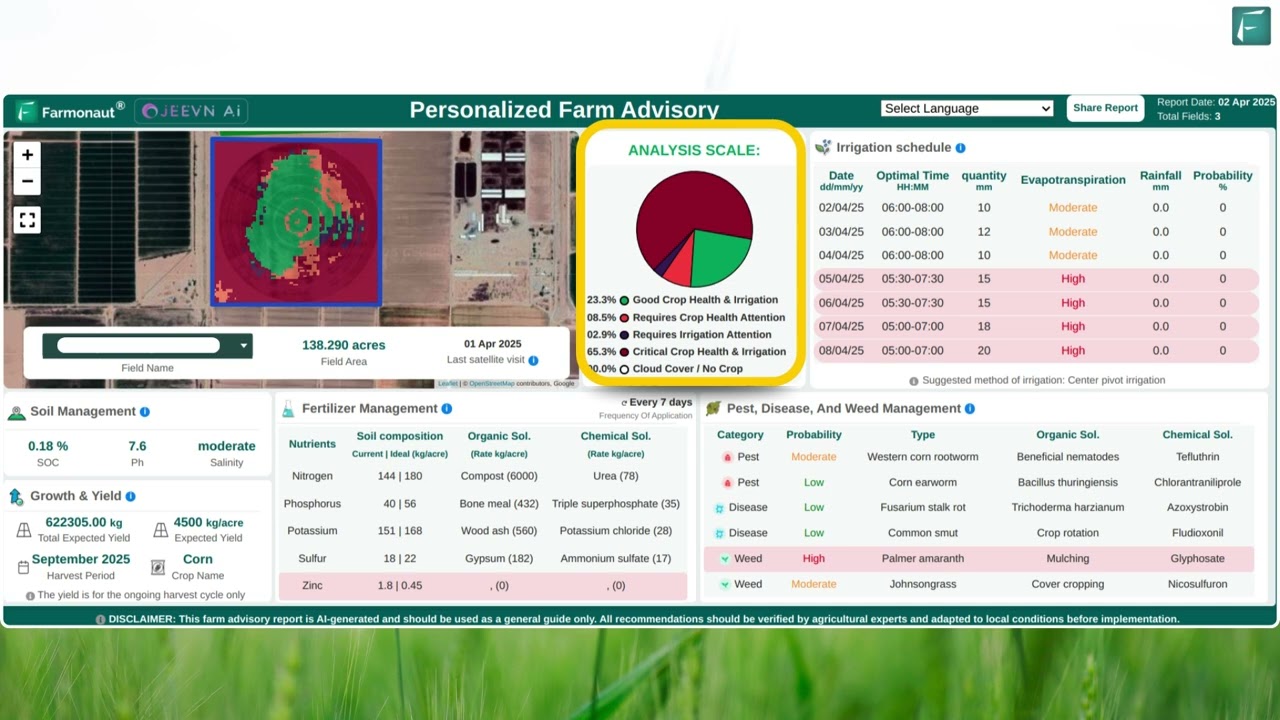
Our Farmonaut satellite-based monitoring tools let farmers document soil conditions and crop stress remotely, and our JEEVN AI Advisory System turns that data into the kind of dated, specific record a grant reviewer wants to see rather than a general claim of "improved practices."
For food safety and export-market applications, blockchain-based product traceability documents provenance from seed to shelf, while carbon footprinting gives Alberta farmers a dated emissions baseline to cite in a sustainability-stream application.

Farmonaut Satellite Tools for Grant-Funded Farms
Whether a project is funded through Sustainable CAP, BFRDP, or a solar-agrivoltaics award, the reporting requirements that follow tend to ask for the same thing: proof the funded practice was implemented and produced a measurable result. Farmonaut's tools are built for exactly that documentation layer:
- Satellite-Based Monitoring: Multi-spectral imagery for crop health, soil moisture, and stress detection — useful evidence for sustainability and efficiency grant reporting.
- JEEVN AI Advisory System: Weather-linked, dated advisory records for Alberta's variable climate.
- Blockchain Traceability: Traceability solutions for value-added and export-market grant streams.
- Fleet & Resource Management: Fleet management tools for equipment-adoption grant documentation.
- Environmental Impact Tracking: Carbon footprint monitoring for emissions-reduction grant reporting.
- Access to Finance: Satellite-based crop loan and insurance tools that can bridge the cash-match gap while a grant disbursement is pending.
- Large-Scale Management: Our farm management platform for corporate and large Alberta operations managing multiple grant-funded projects at once.
- Land Management Integration: Integrated land management tools for operations combining agricultural and adjacent land-use projects.

Access these tools via the web, mobile, or integrate satellite data and AI insights directly through the API and Developer Docs.
Farmonaut Subscription Details & API Access
Farmonaut offers a flexible subscription model for individual producers, businesses, and government users.
- Accessible via Android, iOS, web, and public API
- Modular, scalable pricing to fit small, medium, and large operations
- API documentation: Read our developer docs here
- Direct integrations for third-party ag platforms, finance, insurance, and more
Below is our real-time subscription table. For more information or tailored solutions, visit the Farmonaut website or contact us directly.
Frequently Asked Questions
How much funding is available through Alberta agriculture grants?
Sustainable CAP allocates $508 million to Alberta agriculture for 2023-2028, cost-shared between the federal and provincial governments. Within that, a dedicated $10 million Growing Greenhouses stream runs 2023-2025. Individual project caps and cost-share percentages vary by specific program guide — check alberta.ca/sustainable-cap for the current list of open intakes.
Is "Growing Forward 3" the same as Sustainable CAP?
"Growing Forward 3" is a name some searchers use informally for the current funding framework, which is officially Sustainable CAP — successor to the original Growing Forward and Canadian Agricultural Partnership agreements. Programs under it are listed on Alberta's official Sustainable CAP page rather than under a separate "Growing Forward 3" brand.
Are there farm grants specifically for beginning farmers in Alberta?
Sustainable CAP includes young and beginning farmer support as one of its funding priorities, though this brief did not confirm a standalone dollar figure specific to that stream. Confirm current intake status and amounts directly on alberta.ca/sustainable-cap.
What US grants are available for farmers, including in Virginia?
The confirmed federal option is USDA NIFA's BFRDP, funding $49,999 to $750,000 per award for the 2024-2025 cycle, aimed at training and technical assistance for beginning and established farmers nationwide. This article did not find Virginia-specific state grant programs in its sourcing — Virginia growers should check with Virginia Cooperative Extension or Virginia State University's small farm programs for state-level options, and confirm current BFRDP terms on the USDA NIFA BFRDP page.
Are there government grants for greenhouses?
In Alberta, yes — the $10 million Growing Greenhouses initiative (2023-2025) under Sustainable CAP. In the US, NRCS's EQIP program funds high-tunnel and greenhouse structures, but current per-project payment rates were not confirmed in this article's sourcing; check with your local NRCS service center.
What solar farm grants exist for agricultural operations?
The USDA/DOE LASSO Prize offered $8 million for solar-plus-livestock-grazing (agrivoltaic) systems, with a Phase 1 deadline of March 6, 2025. Check the USDA/DOE solar and farming initiatives page for whether a new phase or successor prize is currently open.
How do I check if a grant program is still accepting applications?
Go to the primary source rather than a summary article: alberta.ca/sustainable-cap for Alberta programs, and the relevant USDA NIFA or USDA/DOE program page for US federal programs. Application windows and funding amounts shift with each fiscal cycle.
Is Farmonaut a grant-issuing body?
No. Farmonaut is not a government agency, regulator, or grant administrator. We provide satellite-driven data, AI-based advisory, traceability, and farm management tools that can support the documentation a grant application or grant report requires.





Conclusion
The reliable numbers behind Alberta and US farm grants are narrower than the search volume around them suggests: $508 million for Alberta's Sustainable CAP framework through 2028, $10 million of that earmarked for greenhouses through 2025, $49,999 to $750,000 per USDA BFRDP award, and $8 million behind the LASSO solar-grazing prize. Everything else — per-project caps, Virginia state programs, EQIP payment schedules, REAP ceilings — has to be pulled from the primary source at the time you apply, because these figures are revised on cycles the funding bodies control, not on a schedule any article can promise to track for you.
The durable move is the checklist in the verification section above: confirm the funding period, re-check the award range against the current fiscal year, and re-pull your farm's financial baseline before committing a cash match. That discipline holds regardless of which program's numbers change next.
For the broader picture of technology, sustainability, and the state of farming across Alberta, see our companion article on agriculture in Alberta.
Discussion
Questions, corrections or field experience? Share them below. First-time comments are reviewed before they appear, and your email is never published.
No comments yet. Be the first to add a question or your experience.

 Indosistim Teknologi
 Suminter India Organics
 Crossprod
 Liquify Digital
 CU Foods
 BeyondTech Global
 Rouge VC
 AgroGreen Dynamics
 AgroRisk
 Oath Inc
 Reddane Farming
 Esri North East Africa
 Cresol
 MDCV UK
 Zerella Group
 Etech Consulting Madagascar
 Vestlandsforsking
 Delicio
 WB Dev
 Exploration consultancy · South Africa · Gold
 Licence holder · Niger · Gold










