

Gemstones · Star gems guide
Star Stone Guide: 7 Gems With Stars and Rays
A star stone shows a moving star of light caused by aligned needle inclusions, usually rutile, in a domed cabochon. Sapphire and ruby show six rays; garnet and diopside often four.
Key takeaways
- Asterism comes from fine needles, usually rutile, reflecting light as crossing bands on a cabochon.
- Sapphire and ruby usually show six rays; diopside four; garnet four or six; star topaz has been recorded with eight.
- The Star of Adam (about 1,404 carats, Sri Lanka) is described as the largest blue star sapphire known.
- Emerald Creek, Idaho allows one permit per person per year and 2 pounds of garnet per day (Recreation.gov).
- USGS put US natural gemstone output at about US$9.4 million in 2025, with 99% net import reliance.
In this article
- What is a star stone?
- 7 star gemstones and how many rays they show
- Record star sapphires
- Where star stones are mined
- Where to find star garnets in Idaho
- Star shaped stones that are fossils
- Natural, treated and synthetic star stones
- How to judge a star stone before you buy
- Star stones for licence owners and investors
- Frequently asked questions
A star stone is a gem that shows a moving star of light on its domed surface, an effect called asterism. The star comes from tiny needle-like inclusions, most often rutile (titanium dioxide), lined up inside the crystal, and it only appears when the stone is cut as a smooth dome called a cabochon, according to the gemology reference on asterism. Star sapphire is the best-known example; star ruby, star garnet, star diopside, star spinel, star topaz and star rose quartz are the others you will meet in the trade.
This guide lists the seven star gems people search for, how many rays each one shows, where each is mined, the record stones, how to tell natural stars from treated or lab-made ones, and what to check before you buy rough or a finished cabochon. It also covers the other meaning of “star stones”: the star-shaped fossil stem pieces collectors pick up on beaches and in limestone quarries.
What is a star stone?
Gemologists call a gem that shows asterism an asteria, or simply a star stone. Light enters the dome, hits thousands of parallel needles and reflects back as a bright band at right angles to each set of needles. One set of needles gives a single band (the cat’s-eye effect, called chatoyancy); two sets crossing give a four-ray star; three sets at 120 degrees give the classic six-ray star of sapphire and ruby.
The needles are often called “silk”. A GIA Gems & Gemology Micro-World note (Spring 2019) photographed needle-like rutile inclusions oriented along the basal plane inside a Burmese star sapphire, which is the same structure that produces the star across the whole stone. In corundum the effect is strong because rutile has a much higher refractive index than the host, which sits between 1.760 and 1.778.
There are two kinds of asterism. Epiasterism is light reflected from inclusions back toward you, as in sapphire. Diasterism is light passing through the stone, as in rose quartz, where you see the star only when a light is placed behind the gem. Rose quartz can show both.
Why the star moves
The rays are reflections, not marks inside the stone, so they glide across the dome as you tilt the gem or move the light. A single small light, such as a penlight or direct sun, gives the sharpest star; diffuse office light often makes it fade. GemSelect’s asterism guide notes that too-dense, uneven or poorly oriented silk gives a fuzzy, broken or off-centre star.
7 star gemstones and how many rays they show
How we chose: these are the species with natural asterism named in standard gemology references and dealer guides, ordered by how often they are sold as star stones. Ray counts are the usual pattern; unusual counts occur in each species.
Chart
Usual number of rays by star gem
Most common star pattern
| Star gem | Mineral | Usual rays | Main cause | Best for |
|---|---|---|---|---|
| Star sapphire | Corundum (blue, black, grey, pink, yellow) | 6, rarely 12 | Rutile silk; hematite in black stars | Classic jewellery and collectors |
| Star ruby | Red corundum | 6 | Rutile silk | High-value rings |
| Star garnet | Almandine garnet | 4 or 6 | Oriented needles | US-sourced collecting (Idaho) |
| Star diopside | Diopside | Usually 4, sometimes 6 | Oriented needles | Lower-cost black stars |
| Star spinel | Spinel | 4 or 6 (rare) | Oriented inclusions | Rare-collector pieces |
| Star topaz | Topaz | 8 reported | Oriented inclusions | Curiosity specimens |
| Star rose quartz | Quartz | 6 | Fine fibres (diasterism) | Spheres and carvings |
Star sapphire
The archetype of the group. Most are greyish-blue to blue and milky, with a six-ray star; black star sapphires owe their star to hematite needles, and some stones from Thailand carry both hematite and rutile needles that make a 12-ray star (asterism reference). Pros: widest choice of colour and size, hard (9 on the Mohs scale) and durable. Cons: many commercial stones are treated or synthetic, so testing matters.
Star ruby
Red corundum with silk. Stellate reflection is rarer in ruby than in sapphire, and star rubies found with star sapphires in Sri Lanka are counted among the most valued “fancy stones”. Pros: strong colour plus star in one stone. Cons: good colour with a sharp, centred star is scarce, and heated stones may have lost their silk.
Star garnet
Almandine garnet from Idaho shows four- or six-ray stars against a deep purple-red body. Idaho named the star garnet its state gem in 1967 (list of US state minerals and gemstones). Pros: a US-mined star stone you can collect yourself. Cons: rarely transparent and softer (6.5-7.5 Mohs) than corundum, per the garnet mineral data.
Star diopside
Almost black stones with a crisp, usually four-ray star (occasionally six), per the International Gem Society diopside guide. Pros: affordable, sharp stars. Cons: softer (5.5-6.5 Mohs) and best kept in pendants or earrings rather than daily-wear rings.
Star spinel
Spinel is one of the minerals the asterism reference lists as able to show a star when a suitable stone is cut as a cabochon; such stones are uncommon. Pros: a true rarity. Cons: hard to source and hard to verify without a lab. See our guide to red spinel prices and mining locations for the wider spinel market.
Star topaz
The asterism reference records star topaz with eight rays. It is a collector’s oddity rather than a jewellery staple, so expect to buy it from specialist dealers.
Star rose quartz
Pink quartz from Brazil and Madagascar, often cut as spheres so the star appears wherever light shines through. It is the most widely available star stone and a good entry point for collectors.
Record star sapphires
The largest named stones show how big asteria can get. The Star of Adam, a blue star sapphire found at Ratnapura in Sri Lanka in August 2015, weighs about 1,404.49 carats and is described as the largest blue star sapphire known (Star of Adam). Before it, the record was held by the 733-carat Black Star of Queensland, found in 1938 by 12-year-old Roy Spencer in Queensland and used as a doorstop for about ten years before a jeweller bought it in 1947 for US$18,000 (Black Star of Queensland). The 330-carat Star of Asia is on show at the Smithsonian’s National Museum of Natural History in Washington, D.C. (Star of Asia).
Chart
Largest named star sapphires
Weight in carats
Where star stones are mined
Most star corundum comes from gem gravels: alluvial deposits where rivers have eroded the host rock and concentrated the heavy, hard gems. Diggers work pits and stream beds by hand or with small pumps, wash the gravel and pick stones by eye. The main sources are:
Chart
US natural gemstone production value
US$ million per year
- Sri Lanka (Ratnapura district): blue star sapphire and star ruby from river gravels; source of the Star of Adam.
- Myanmar (Mogok): star ruby, star sapphire and star spinel.
- Thailand: black star sapphire, including 12-ray stones with both hematite and rutile.
- Australia (central Queensland sapphire fields): black and dark blue star sapphires, including the Black Star of Queensland. Our Australia mining map shows the main fields.
- Madagascar: sapphire, diopside and rose quartz; see our overview of Madagascar’s mining industry.
- East Africa (Tanzania and Kenya): sapphire and garnet from alluvial and primary deposits.
- Brazil: rose quartz in large volumes from pegmatites.
- United States: star garnet in Idaho, and star blue quartz, which Alabama adopted as its state gemstone in 1990 (state gemstone list).
For how primary and placer gem deposits form, see our guide to types of ore deposits.
US gemstone output is small
The US produces only a sliver of the gems it uses. USGS estimates US natural gemstone output at about US$9.4 million in 2025, against imports for consumption of about US$11 billion, and puts net import reliance at 99% (USGS Mineral Commodity Summaries 2026, gemstones). Arizona, Oregon, California, Nevada, Montana and Maine led natural output, and garnet and sapphire are both on the USGS list of US natural gem materials.
Where to find star garnets in Idaho
The Emerald Creek Garnet Area in the Idaho Panhandle National Forests is the best-known place to dig star garnets yourself. The Forest Service describes it as one of only two places in the world where star garnets occur in quantity, and the only one where the public can collect them (Recreation.gov, Emerald Creek Garnet Area). Rules from the same listing:
- Tickets are booked in advance on Recreation.gov for a morning or afternoon slot and are valid only for that date and slot.
- Each person may hold one permit per calendar year.
- Each person may take up to 2 pounds of garnet material per day.
- Cancellations need 24 hours’ notice; a US$1 reservation fee is not refunded.
Collectors wash gravel through screens to find the dark, rounded garnets; whether a stone carries a star is only clear after it is cut as a cabochon. Read our page on the Emerald Creek garnet mine area for more on the site. Dig only where you hold a permit or the owner’s permission.

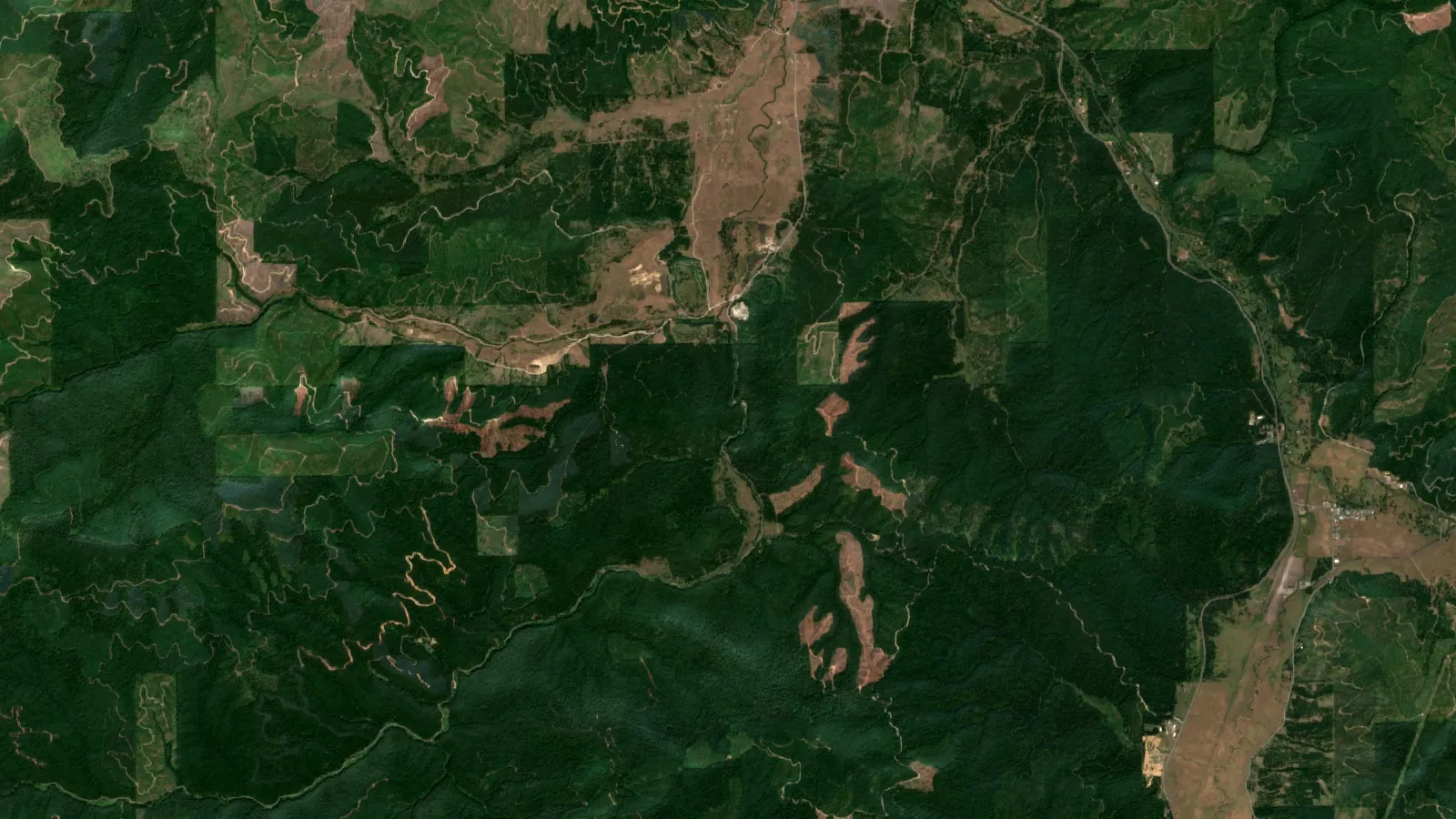
▶ How satellites help find star garnet ground in Idaho. · 15:04
Star shaped stones that are fossils
Many searches for “star shaped stones” or a “stone that looks like stars” are about fossils, not gems. These are pieces of crinoid stems. Crinoids, also called sea lilies, are echinoderms related to starfish, and their stems are stacks of small calcite discs called columnals (crinoid overview). In the Jurassic genus Pentacrinites the stems are pentagonal to star-shaped in cross-section, and these pieces are the parts most often preserved (Pentacrinites). Some limestone beds are made almost entirely of crinoid fragments, so the little five-pointed “star stones” turn up widely in Jurassic rocks of Europe and North America.
A quick test: a fossil star is flat, five-pointed and part of the rock itself; a gem star is a six- or four-ray band of light that moves when you tilt the stone.
Natural, treated and synthetic star stones
Lab-grown star corundum is widely sold, and diffusion treatments can add a surface star to natural corundum. Heating can also remove a star: GemSelect notes that heat treatment may alter or dissolve rutile silk, and that some treatments create or enhance asterism, so a star alone proves nothing about origin.
Signs that a stone needs testing:
- A star that is perfectly sharp, evenly bright and centred on an otherwise clean, very transparent stone.
- Curved colour bands or gas bubbles under a loupe (typical of flame-fusion synthetics).
- A star that sits only at the surface or looks painted on.
- A price far below comparable natural stones.
For any stone over a few hundred US dollars, ask for a report from an independent gem laboratory that states natural or synthetic and any treatment.
How to judge a star stone before you buy
- Star quality. Rays should be straight, of equal length, reach the girdle and meet at the top of the dome.
- Centring. Look straight down under one light; an off-centre star lowers value.
- Body colour. In star sapphire and ruby, stronger colour with a sharp star commands the most; very dark or very milky stones show weaker stars.
- Cut. A balanced dome, not a heavy bottom kept only to save weight.
- Treatment and origin. Get the laboratory report in writing.
- Durability. Match hardness to use: corundum suits rings; diopside and quartz suit pendants.
Prices vary too widely by species, size, colour and star quality for a single table to be useful, so the calculator below lets you build your own budget from dealer quotes.
Calculator
What will a star stone cost me?
Enter the weight and a dealer’s per-carat quote.
- Stone only (US$): $900
- Stone plus report (US$): $1,000
Example values only, not a market price. Prices are inputs: example, use today’s price from your dealer quote. Lab report and setting fees vary by laboratory and jeweller.
Star stones for licence owners and investors
For anyone weighing a gem licence or a parcel of rough, the questions are the same as for any small mine: is the gravel continuous, what share of stones carries usable silk, and can the operation be permitted and run legally? Our step-by-step note on mining analysis and mine evaluation covers the checks investors apply. Satellite imagery can help screen a lease before a visit, for example by mapping old pits, drainage and access roads across alluvial ground; Farmonaut provides that kind of satellite mapping for mining licences.
▶ Remote sensing for mining explained in plain words. · 2:01
Frequently asked questions
What is a star stone called?
A gem with a star of light is called an asteria or a star stone, and the effect is called asterism. Star sapphire is the best-known example.
What causes the star in a star stone?
Fine needle-like inclusions, usually rutile, lined up in two or three directions inside the crystal. Light reflects off each set as a band, and the bands cross to form the star on a domed cabochon.
Which gemstones have a star?
Sapphire, ruby, garnet, diopside, spinel, topaz and rose quartz are the main ones; sapphire and ruby are the most traded.
How many rays can a star stone have?
Usually four or six. Twelve-ray stars occur in some sapphires with two sets of inclusions, and star topaz has been recorded with eight.
What is the largest star sapphire?
The Star of Adam from Sri Lanka, at about 1,404 carats, is described as the largest blue star sapphire known. The 733-carat Black Star of Queensland held the record before it.
Where can you dig star garnets?
At the Emerald Creek Garnet Area in Idaho, with a timed ticket booked on Recreation.gov, one permit per person per year and a limit of 2 pounds per day.
Is a star sapphire natural or lab-made?
It can be either. Synthetic star corundum and diffusion-treated stones are common, so only a laboratory report can confirm a natural, untreated star.
What are the star-shaped stones found on beaches?
Usually fossil crinoid stem pieces, such as those of Pentacrinites, whose columnals are star-shaped in cross-section.
How do you see the star clearly?
Use a single small light source, such as a penlight or sunlight, and look straight down on the dome; diffuse light weakens the star.
What is a star stone with a purple colour?
Purple-red star garnet from Idaho is the usual answer; purple star sapphire and purple-grey star spinel also exist.
More from Farmonaut: agro admin app, carbon footprinting, crop loan and insurance, farmonaut satellite weather api developer docs, fleet management, product traceability.
This page is for information only and is not investment advice. Gem values depend on laboratory testing and dealer quotes. Collect only where you hold a permit or the landowner’s permission.
Farmonaut mining
Screen a gem lease from space
Farmonaut maps old workings, drainage and access across a mining licence with satellite imagery, so owners can plan field checks before committing to a gem parcel or lease.

Mining Pro sample view, synthetic data
Keep reading
Sources
- Asterism (gemology), reference article: en.wikipedia.org
- GIA Gems & Gemology, Micro-World: rutile silk in a Burmese star sapphire (Spring 2019): gia.edu
- GemSelect, Star sapphire: what causes asterism: gemselect.com
- International Gem Society, Diopside value, price and jewelry information: gemsociety.org
- Garnet, mineral data: en.wikipedia.org
- Recreation.gov, Emerald Creek Garnet Area tickets: recreation.gov
- List of US state minerals, rocks, stones and gemstones: en.wikipedia.org
- Star of Adam: en.wikipedia.org
- Black Star of Queensland: en.wikipedia.org
- Star of Asia: en.wikipedia.org
- USGS, Mineral Commodity Summaries 2026: Gemstones: pubs.usgs.gov
- Crinoid, overview: en.wikipedia.org
- Pentacrinites: en.wikipedia.org
Discussion
Questions, corrections or field experience? Share them below. First-time comments are reviewed before they appear, and your email is never published.
No comments yet. Be the first to add a question or your experience.

 GemSprout Metals Limited
 Qader Group
 Ileys General Trading
 SG Gold Mining LLC
 VRV Global Pte Ltd
 Omsri International FZE
 G.I.T.T.
 Jaunita Erss Ltd
 Almosi SARL
 SRK Consulting
 Berks Gold Limited
 Mwerezi Minerals Company Limited
 Mining SARL
 SenGold Invest SAS
 Sean Mining Limited
 NTS Group (Pty) Ltd
 Mine4Africa
 Lithspo Minerals Limited

 Client · Oregon, USA · Gold










