

Reviewed September 2026 against Market Research Future’s mining safety systems MRO forecasts, Natural Resources Canada’s minerals and metals facts, and IBISWorld’s Australia mining industry data.
Try it: Run your own numbers →
Mine-to-Market Solution & Mining Safety Solutions
A mine-to-market solution is the integrated system that tracks a mineral from extraction through processing, transport, and delivery to a buyer — with a data trail attached at every handoff. A mining safety solution is the parallel stack of wearables, sensors, and automated response systems that protects the people running that extraction. They are usually bought and evaluated separately, but they share the same infrastructure: sensor networks, real-time dashboards, and compliance logging. This article covers both, plus where the solution mining market (in-situ extraction of potash, lithium brine, and similar minerals) sits relative to them, and what the mining safety systems MRO services market actually spends on maintenance, repair, and overhaul of that safety equipment.

The Mining Safety Systems MRO Services Market: Actual Size
Mining safety systems MRO — maintenance, repair, and overhaul of gas detectors, biometric wearables, ventilation controls, and emergency response hardware — is a distinct market line item from the safety technology purchase itself. Market Research Future puts the global mining safety systems MRO services market at a forecast $10.5 billion by 2035, growing at a 4.46% compound annual growth rate between 2025 and 2035, with the Asia-Pacific region alone valued at $1.5 billion in 2025 (Market Research Future). That 4.46% CAGR is the figure to track if you are budgeting multi-year MRO contracts — it implies the market roughly doubles every 16 years at a steady compounding rate, not through a single step change.
A related but larger category, the underground mining equipment MRO services market, was valued at $28.47 billion in 2025 and is forecast to reach $40.2 billion by 2035 at a 3.51% CAGR (Market Research Future via OpenPR). The two markets are reported separately because safety-systems MRO (gas monitors, PPE, emergency comms) and equipment MRO (drills, haulage trucks, conveyors) have different replacement cycles and different regulatory drivers — safety systems are typically re-certified on shorter intervals set by mine safety regulators, while heavy equipment MRO follows manufacturer service schedules.
These two figures are re-published on a quarterly cadence. To pull an updated number for either market, visit Market Research Future and search “mining safety systems MRO” — the report page is refreshed each quarter with revised forecasts.

Mine-to-Market Solution: What It Actually Integrates
A mine-to-market solution is not one product — it is four layers stacked on top of each other. Missing any one layer breaks the traceability claim a buyer or regulator will eventually ask you to prove.
The Four Layers of a Working Mine-to-Market Solution
- Extraction data capture: sensor-equipped machinery and environmental monitoring log tonnage, grade, and location at the point of extraction — this is the record everything downstream depends on.
- Processing and yield tracking: algorithms flag equipment settings that waste material or under-recover value, and predictive maintenance schedules reduce unplanned downtime on crushers, mills, and separators.
- Chain-of-custody traceability: blockchain-based traceability records each shipment’s origin and handling — distinct from cryptocurrency, this is a tamper-evident ledger used to satisfy ESG and conflict-mineral disclosure requirements.
- Logistics and delivery: fleet management tools track haulage vehicles from pit to port or processor, cutting idle time and giving a documented delivery record.
The commercial case for building all four layers rather than one or two is straightforward: a buyer who cannot verify origin will not pay a premium for it, and a regulator who cannot see the chain of custody will not grant the social license to expand. Carbon footprinting sits alongside traceability here — both feed the same ESG disclosure a mine now has to produce annually in most US and Australian jurisdictions with reporting requirements.

Solution Mining Market: Where It Fits
“Solution mining” (also called in-situ leaching) is a distinct extraction method — it dissolves the target mineral underground and pumps the resulting brine to the surface, rather than physically excavating ore. Potash is the clearest North American example. Canada produced 25 million tonnes of muriate-of-potash (MOP) in 2024 from 10 active mines in Saskatchewan, several of which use solution mining rather than conventional shaft mining, according to Natural Resources Canada (Natural Resources Canada). That 25-million-tonne figure is the baseline to compare against if you are sizing the solution mining market for potash specifically — Natural Resources Canada updates its potash facts page as annual production data becomes available, typically with a lag of several months after year-end.
Solution mining changes the safety and mine-to-market picture in two ways. First, worker exposure to underground hazards drops sharply because there is no physical excavation crew at depth — the safety solution priority shifts toward well-integrity monitoring, brine containment, and surface processing safety rather than rockfall and gas detection. Second, the mine-to-market chain is shorter: brine processing to finished potash happens largely on one site, so traceability and logistics tracking concentrate on the surface plant and outbound rail or truck shipment rather than a multi-stage underground haulage chain.
If your search brought you here for “solution mining market” specifically: this page treats it as the extraction-method context for mine-to-market and safety solutions, not as a standalone market-sizing report. For potash production volumes and Canada’s national mining data, Natural Resources Canada’s minerals and metals facts page is the primary public source and the one to check for the current annual figure.
Mining Safety Solutions: A Working Checklist
“Mining safety solution,” “mining safety solutions,” and “mine safety solutions” cover the same category from different search habits — wearables, sensor networks, automated hazard detection, emergency response coordination, and remote equipment operation. Here is what each layer does and what it replaces.
Mining Safety Solution Components
- Wearable biometric sensors: continuously monitor heart rate, respiration, temperature, and fatigue indicators, alerting a supervisor before a worker reaches a hazardous exposure threshold rather than after a collapse.
- Environmental sensor networks: fixed and mobile sensors detect carbon monoxide, methane, dust concentration, temperature spikes, and seismic activity in real time, with AI-based risk scoring layered on top to prioritize alerts.
- Automated hazard detection: computer-vision systems flag unsafe worker behavior or structural shifts; drones and ground robots inspect areas unsafe for a human crew.
- Integrated emergency response systems: coordinate rescue teams, push automated evacuation guidance during a collapse, gas leak, or fire, and track worker location in real time for faster extraction.
- Remote and autonomous equipment operation: remote-controlled drilling, loading, and haulage removes operators from the highest-hazard zones entirely — seven specific safety and security innovations are detailed here.
Whether these systems apply equally to open-pit and underground operations matters for procurement: open-pit sites weight toward autonomous haulage and slope-stability monitoring, while underground sites weight toward gas detection and emergency egress systems. A consultant who has fielded both is the fastest way to avoid over-buying one category — a list of modern mine safety consultants and companies is here.

What a Working Safety Program Actually Tracks
Lost-Time Injury Frequency Rate (LTIFR) is the standard benchmark US and Australian operators use to compare safety performance year over year, but a site-specific current LTIFR is not something this article can responsibly publish without a live source — MSHA (Mine Safety and Health Administration) publishes US incident data, and Safe Work Australia plus state regulators publish Australian figures. If you need a current benchmark for your operation type, pull it directly from MSHA’s data retrieval system or your state regulator’s published statistics rather than relying on an industry-wide average, since LTIFR varies enormously between open-pit, underground hard-rock, and solution mining by hazard profile alone.

Comparison Table: Safety & Mine-to-Market Technologies
| Solution Category | Core Technology | Primary Risk or Gap It Addresses | Best Fit |
|---|---|---|---|
| Mine-to-Market Platform | IoT + blockchain traceability + fleet analytics | Unverifiable origin, ESG non-compliance, logistics leakage | Multi-site operators shipping to ESG-conscious buyers |
| Biometric Wearable Safety Devices | IoT + biometric sensors | Undetected fatigue, gas exposure, heat stress | Underground and high-heat surface crews |
| Environmental Sensor Networks | Fixed/mobile gas, dust, seismic sensors | Delayed hazard detection | Underground hard-rock and coal operations |
| Automated Emergency Response | AI + real-time location tracking | Slow evacuation, poor incident coordination | Any underground site with regulator-mandated egress plans |
| Solution Mining (In-Situ Leaching) | Well-field brine extraction, surface processing | Underground excavation-crew exposure | Potash, some lithium and uranium deposits |
| Autonomous Haulage/Drilling | Remote operation + robotics | Operator exposure in hazard-prone zones | Open-pit and large underground fleets |
This is a category-fit comparison, not a pricing table — vendor-specific implementation costs vary by site scale and are not published in aggregate by any of the sources cited here; get a quote scoped to your site rather than a per-unit industry average.
Downtime & Incident Cost Calculator
Use this to estimate what a mining safety systems MRO investment needs to offset in avoided downtime — enter your own site’s production value and downtime hours to see the daily exposure.
Run your own numbers
Assumptions: uses your entered daily production value divided evenly across operating hours; does not account for partial-capacity operation during a fault, regulatory shutdown penalties, or insurance premium changes. Treat this as a first-pass estimate, not a budgeting figure — pair it with a vendor-scoped quote for your site.
Where Farmonaut Fits This Stack
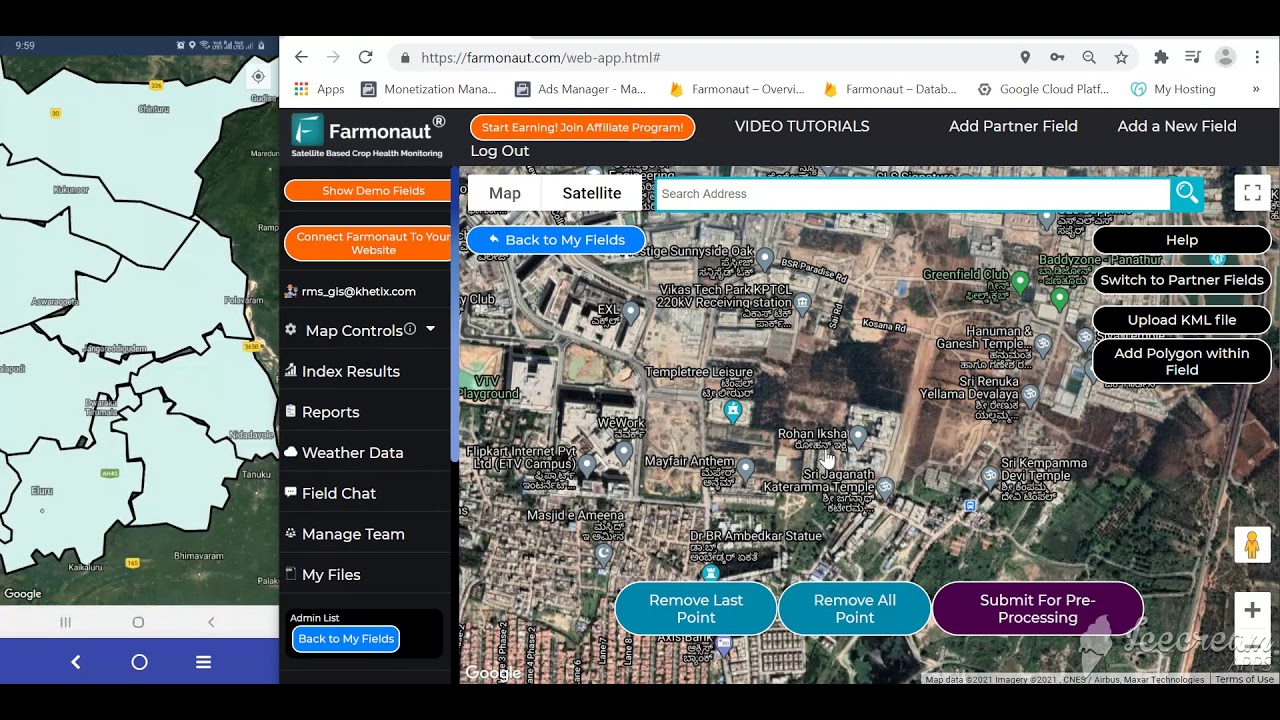
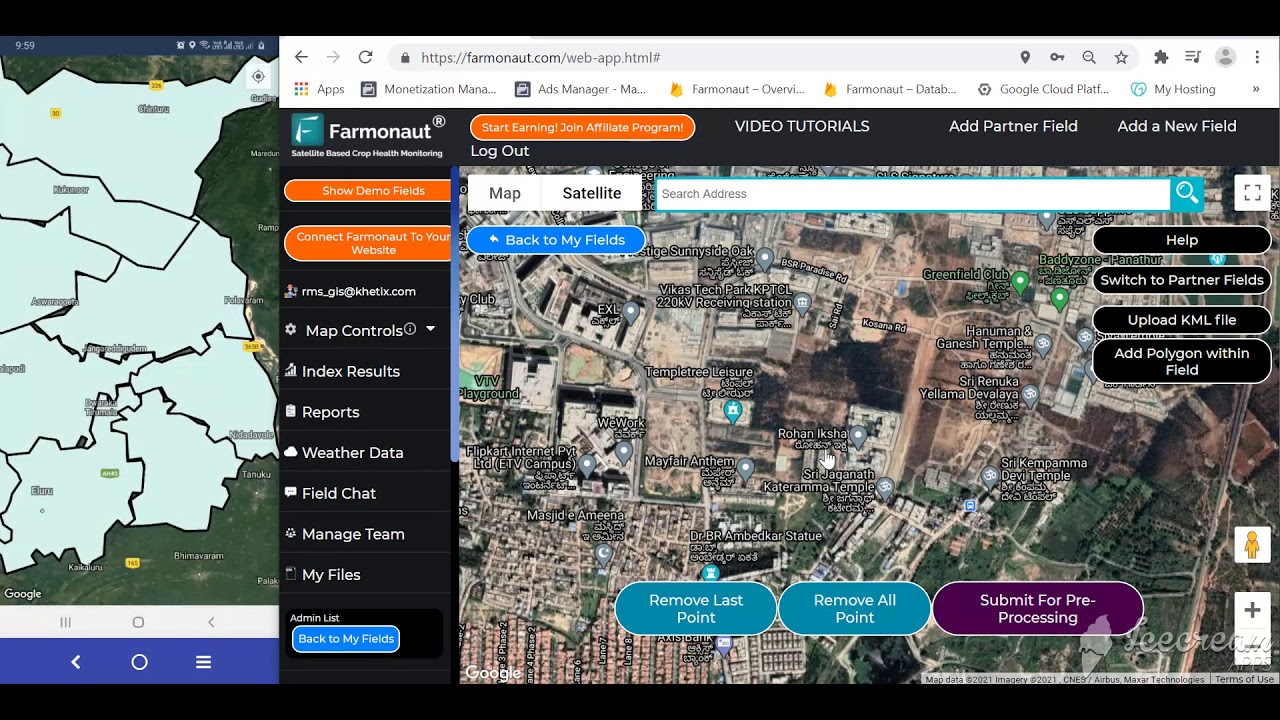
Farmonaut's role is the satellite and remote-monitoring layer underneath mine-to-market and safety platforms, not a replacement for on-site sensor networks or emergency response systems.
- Satellite-based site monitoring: multispectral imagery tracks vegetation health and environmental change around mine perimeters, available via web, Android, iOS, and API.
- Traceability: blockchain-secured origin and journey logs for ESG-compliant reporting on mineral shipments.
- Fleet and resource management: tracking and predictive maintenance analytics for haulage and site vehicles.
- Carbon and environmental tracking: emissions and land-disturbance monitoring for regulatory and ESG disclosure.
Access it from a browser or device:



Developers and system integrators: access Farmonaut's API to feed satellite-powered analytics into your own ERP or fleet dashboard. See the API developer documentation to get started.
Product Links for Each Use Case
- Carbon Footprinting for ESG Compliance: monitor and report mine-site emissions with Farmonaut's carbon footprinting tools.
- Blockchain-Enhanced Traceability: verify mineral authenticity from pit to processor with Farmonaut's traceability solutions.
- Fleet & Equipment Management: optimize vehicle use and predictive maintenance with fleet management tools.
- Remote Large-Scale Asset Monitoring: surveil hundreds of assets with Farmonaut's large-scale site management apps.
- Adjacent Agricultural Verification: satellite-verified credit and insurance for mining-adjacent farmland with Farmonaut's crop loan and insurance systems.
- Extraction Method Context: compare against subsurface mining alternatives, review ethical lithium extraction steps, and see green mining and safety initiatives in practice.

Frequently Asked Questions
What is a mine-to-market solution?
It is the integrated system tracking a mineral from extraction through processing, logistics, and delivery, with traceability records attached at each stage. It combines sensor-based extraction data, yield-tracking analytics, chain-of-custody traceability (often blockchain-based), and fleet logistics into one auditable record.
What is the difference between "mining safety solution" and "mine safety solution"?
They describe the same category — search phrasing varies, but both refer to the combination of wearable biometric sensors, environmental hazard sensors, automated emergency response, and remote/autonomous equipment operation used to reduce worker exposure to underground and surface hazards.
How big is the mining safety systems MRO services market?
Market Research Future forecasts the global mining safety systems MRO services market at $10.5 billion by 2035, growing at a 4.46% CAGR from 2025, with the Asia-Pacific region valued at $1.5 billion in 2025 (source). Check the same report page for the current-quarter revision.
What is the solution mining market?
Solution mining (in-situ leaching) extracts minerals like potash by dissolving them underground and pumping the resulting brine to the surface, avoiding physical excavation. Canada produced 25 million tonnes of potash in 2024 from 10 Saskatchewan mines, several using this method (Natural Resources Canada).
Why does traceability matter for mine-to-market solutions?
Buyers and regulators increasingly require proof of ethical sourcing. Blockchain-based traceability creates a tamper-evident record of origin and handling, which is what a customer or auditor actually checks — not a supplier's word.
How does Farmonaut support mining operations?
Farmonaut provides satellite-based site monitoring, traceability, fleet analytics, and carbon/environmental tracking — the remote-monitoring layer beneath a mine-to-market or safety program, available via web, Android, iOS, and API.
The Durable Checklist
Whichever term brought you here — mine-to-market solution, solution mining market, or mining safety solution — the evaluation questions are the same and do not change with the calendar year:
- Does the mine-to-market platform cover all four layers (extraction data, processing/yield, traceability, logistics), or only one?
- Does the safety program match the extraction method — underground gas/seismic detection for hard-rock, well-integrity and surface-plant monitoring for solution mining, slope stability and autonomous haulage for open-pit?
- Is your MRO budget benchmarked against a current market figure — check Market Research Future's mining safety systems MRO report and the underground equipment MRO report for the latest quarter's numbers — rather than a stale industry rule of thumb?
- Can you produce an auditable chain-of-custody record on demand, or only a narrative description of your sourcing?
- Is your LTIFR benchmarked against MSHA (US) or your state regulator (Australia) data for your specific operation type, not an industry-wide average?
Run that checklist annually — the underlying market figures will change, the checklist itself will not.




Plans
Explore satellite-backed monitoring, traceability, and safety-adjacent tools for mining and resource management with Farmonaut.
Choose the plan that fits your operation below:

 Critica Metals Limited
 Congo Mining Solutions
 Mining SARL
 SenGold Invest SAS
 Sania Corporation
 Sean Mining Limited
 NTS Group (Pty) Ltd
 Mine4Africa
 Lithspo Minerals Limited
 Tintina Mining Group
 Dalgety Minerals Pty Ltd
 Vortex Minerals Pty Ltd
 Faith At Work (Pty) Ltd
 Geotech Mining Solutions plc
 Vulcan International Limited
 Kidepo Associates
 GKY Mining
 Alkimy SARL
 Double A Trading
 GemSprout Metals Limited
 Qader Group
 Ileys General Trading
