

Rare earths · Price guide
Rare Earth Prices: NdPr, Dy and Tb Benchmarks Compared
In October 2026, NdPr oxide was about US$103-106 per kg in China and US$125-140 outside it (Rare Earth Exchanges). Dysprosium and terbium showed far wider gaps. Here is how to read each benchmark.
Key takeaways
- NdPr oxide, October 2026: US$103-106 per kg in China, US$125-140 outside China (Rare Earth Exchanges).
- NdPr means neodymium plus praseodymium only; dysprosium and terbium are priced separately.
- Check tax first: some Chinese quotes include 13% VAT, which alone can move a quote from about US$97 to US$110.
- MP Materials and Lynas contracts carry US$110 per kg NdPr floors; these are contract terms and not market prices.
- NdPr oxide averaged US$55 per kg in 2024 and an estimated US$69 in 2025 (USGS, 2026).
In this article
- Rare earth prices by product: China and outside China
- What is the NdPr oxide price, and why do quotes differ?
- Which rare earth price benchmark is reliable?
- Is there a Western NdPr price separate from Chinese pricing?
- NdPr price history: from the low to the floor
- NdPr metal and alloy prices against oxide
- Why dysprosium and terbium prices have split so far
- What moves rare earth prices
- Rare earth price forecasts: what to check
- How to value a rare earth basket at today's prices
- Frequently asked questions
Rare earth prices in October 2026: NdPr oxide (neodymium-praseodymium oxide, the magnet feedstock) was about US$103 to US$106 per kg in China and US$125 to US$140 per kg outside China, according to the Rare Earth Exchanges monthly price table updated 17 October 2026. Dysprosium oxide was about US$196 to US$201 per kg in China and US$2,500 to US$5,500 outside it. Terbium oxide was about US$896 to US$904 in China and US$10,000 to US$13,000 outside it.
These are not exchange-traded prices. Rare earths have no single global screen price, so each figure comes from a price reporter with its own product grade, delivery point and tax treatment. Two honest quotes on the same day can differ by more than 10% for tax reasons alone. This page sets the main benchmarks side by side, explains which one to use for which job, and gives a calculator that turns any set of prices into a value per kg of mixed rare earth oxide.
A short word on the name. NdPr is two elements only: neodymium (Nd) and praseodymium (Pr). They are sold together as a blend of about 75% Nd and 25% Pr. Dysprosium (Dy) and terbium (Tb) are separate heavy rare earths that are priced separately, even though they go into the same magnets.
Rare earth prices by product: China and outside China
The table shows the reference points for the magnet elements. Prices are US dollars per kg and each row carries its own date. A reporter’s assessment is an estimate of market value, not a price you can trade at.
| Product | China | Outside China | Basis and date |
|---|---|---|---|
| NdPr oxide, 99.5%+ | US$103-106 | US$125-140 | Rare Earth Exchanges, October 2026. China ex-works before VAT; outside China CIF Rotterdam |
| NdPr metal | Not tracked | US$175-250 | Rare Earth Exchanges, October 2026 |
| Pr-Nd alloy | US$133.44 | Not given | SMM series, 30 September 2026, as reported by Critical Minerals News |
| Dysprosium oxide | US$196-201 | US$2,500-5,500 | Rare Earth Exchanges, October 2026 |
| Terbium oxide | US$896-904 | US$10,000-13,000 | Rare Earth Exchanges, October 2026 |
| Gadolinium oxide, 99%+ | US$25.32-28.14 | US$2,500-3,400 | Rare Earth Exchanges, October 2026 |
| Samarium oxide, 99.5%+ | US$22.96-25.77 | US$100-1,000+ | Rare Earth Exchanges, October 2026; few reports, wide range |
| Yttrium oxide, 99.99%+ | US$8.17-8.73 | US$1,100+ | Rare Earth Exchanges, October 2026; lowest reported price outside China |
For a more recent daily signal, Trading Economics showed neodymium at 922,500 yuan per tonne on 5 November 2026, compared with 947,500 yuan on 15 October. That series tracks neodymium alone, not the NdPr blend, and is a contract for difference, so use it for direction rather than for a contract price. If you need neodymium on its own, see our neodymium price per kg guide. For the record of the oxide price over time, there is also a page on neodymium oxide and NdPr price history.
What is the NdPr oxide price, and why do quotes differ?
The NdPr oxide price depends on four things: tax, location, the date of the assessment and the reporter. Tax is the one that catches most readers out.
VAT explains much of the gap between Chinese quotes
Chinese domestic rare earth prices are often quoted with 13% value added tax included. The Shanghai Metals Market (SMM) Pr-Nd alloy page states that its original price includes 13% VAT. A VAT-inclusive quote of about US$110 per kg divided by 1.13 gives about US$97.30, which is the VAT-excluded figure for 30 September 2026 that Critical Minerals News reports from SMM data. Our arithmetic suggests these are the same market level, stated two ways. Before you compare two numbers, check whether both include tax.
Location and delivery terms
China quotes are usually ex-works (collected at the plant) or delivered to works inside China. Outside-China quotes are usually CIF (cost, insurance and freight paid to a named port, such as Rotterdam). Rare Earth Exchanges warns that because terms differ, its gap is a cross-market gap and not an exact origin premium.
The date and the reporter
The China and outside-China order has flipped within months. In a report dated 21 August 2026, Benchmark Minerals assessed NdPr oxide at US$95 per kg CIF Europe and North America and at RMB 721,500 per tonne (US$107.5 per kg) in China, so China was the dearer market. In the Rare Earth Exchanges table for October, outside-China material was the dearer one. The two assessments come from different reporters on different dates, so read them as a sign of a thin, fast-moving market and not as one smooth trend.
Which rare earth price benchmark is reliable?
No benchmark is right for every job. A practical way to choose is to match the benchmark to your decision.
| Your job | Benchmark to look at | Watch for |
|---|---|---|
| Tracking the Chinese market | SMM, China Rare Earth Industry Association index | VAT included or excluded |
| Buying or selling outside China | Benchmark Minerals, Fastmarkets, Argus | CIF port, purity, subscription access |
| Long-run history | USGS annual averages | Annual, published with a lag, FOB basis |
| Quick cross-market check | Rare Earth Exchanges monthly table | Monthly, assessed from a price panel |
| Judging a producer’s revenue | Company reports | Realised price, contract floors, product mix |
| Daily direction | Trading Economics neodymium | Single element, contract for difference |
Treat dealer and small-lot prices as a separate market. Critical Minerals News lists western dealer NdPr at an indicative US$180 to US$240 or more per kg, well above the industrial oxide benchmarks. Small-lot metal is a different product from a container of oxide.
Is there a Western NdPr price separate from Chinese pricing?
Yes. There are now two markets, and government price floors sit between them.
Chart
VAT-excluded NdPr oxide readings against the floor
US$ per kg, SMM series as reported, selected 2026 dates; floor is the MP Materials contract level
The best-known floor belongs to MP Materials. Its annual report for 2025 describes a US$110 per kg floor for NdPr products under an agreement with the US Department of War. If market prices fall below that, the US government pays the shortfall each quarter. Once the company’s 10X magnet plant reaches full capacity, MP passes back 30% of the sales price above US$110 per kg. The Center on Global Energy Policy at Columbia University described the floor as lasting ten years. MP reported US$17.6 million of price protection income in the second quarter of 2026, which shows the floor was paying out in that period.
Lynas Rare Earths has similar terms. Its annual report for the year to June 2026 describes a 12-year agreement with Japan Australia Rare Earths with a US$110 per kg NdPr floor and upside sharing above US$150 per kg, capped at US$10 million a year. It also describes a letter of intent with the US government for about US$96 million of oxides over four years, again with a US$110 floor for NdPr oxide. Rare Earth Exchanges also notes floors of US$575 per kg for dysprosium oxide and US$2,050 per kg for terbium oxide from Serra Verde, under an agreement between USA Rare Earth and the US government.
A floor is a contract term for the named parties and not a market price. A junior project without such a deal earns whatever its buyers will pay. When you read a study that uses US$110 or more per kg, ask whether the project has a contract that supports that number.
NdPr price history: from the low to the floor
Annual averages from the USGS Mineral Commodity Summaries 2026 show how wide the cycle is. NdPr oxide averaged US$124 per kg in 2022, fell to US$55 in 2024 and recovered to an estimated US$69 in 2025. Dysprosium oxide fell every year in the series, from US$410 per kg in 2021 to an estimated US$239 in 2025, according to the USGS heavy rare earths chapter. Terbium oxide went from a US$2,050 average in 2022 to US$812 in 2024 and an estimated US$1,010 in 2025.
Chart
NdPr and dysprosium oxide, annual average
US$ per kg; 2025 is a USGS estimate
The move in 2026 was far sharper than the annual averages show. The Lynas report puts the average China domestic NdPr price, excluding VAT, at US$55.0 per kg in June 2025 and US$100.8 in June 2026. The VAT-excluded SMM series reported by Critical Minerals News read US$90.32 on 1 June, US$110.55 on 2 July, US$97.40 on 4 August, US$96.69 on 5 September and US$97.30 on 30 September 2026.
NdPr metal and alloy prices against oxide
NdPr metal costs more than oxide because oxide must be reduced to metal, usually by electrolysis, and because oxygen is removed: it takes more than 1 kg of oxide to make 1 kg of metal. In the SMM figures reported for 30 September 2026, Pr-Nd alloy was US$133.44 per kg and oxide US$97.30, a gap of about US$36. The gap covers the extra oxide and the conversion cost. Our guide to the praseodymium neodymium alloy price works through that conversion step by step. Before you compare the two, confirm that both quotes are on the same tax basis.
Why dysprosium and terbium prices have split so far
The largest gaps between markets are in the heavy rare earths. Dysprosium and terbium are added in small amounts to neodymium magnets to improve heat resistance, so buyers still need them at high prices, even as use per magnet falls. Fastmarkets reported on 6 October 2026 that, in the week to 1 October, terbium oxide delivered worldwide (CIP, carriage and insurance paid) rose to US$5,000 to US$8,000 per kg, from US$4,200 to US$5,000, and dysprosium oxide rose to US$2,500 to US$3,500, from US$1,910 to US$2,500. Those ranges sit below the Rare Earth Exchanges figures above; reporters, grades, delivery terms and dates all differ.
Chart
Outside-China price as a multiple of the China price
Selected oxides, midpoints of the October 2026 ranges; delivery terms differ
The trigger it named is a US rule. From January 2027 the Pentagon may not buy samarium-cobalt or neodymium-iron-boron magnets containing material mined, refined, separated, melted or produced in China. Market participants told Fastmarkets that US buyers were paying well above European buyers. Fastmarkets also noted that magnet makers keep lowering the amount of these elements per magnet, which limits demand over time.
The NdPr market looked different at the time. Benchmark described ex-China NdPr in August 2026 as well supplied, with producers competing for limited non-Chinese demand, while heavy rare earths faced real scarcity. That contrast matters to an investor reading project studies: a heavy-rich deposit and a light-rich deposit have different price risks.
What moves rare earth prices
- Magnet demand. Natural Resources Canada says permanent magnets were the largest use of rare earths, at 48% of global demand in 2024. Motors in electric vehicles and direct-drive wind turbines are the main end uses followed by the market.
- Chinese supply. The USGS estimates China mined 270,000 of the world’s 390,000 tonnes of rare earth oxide equivalent in 2025, about 69%. Changes in China’s output or policy therefore move the whole market.
- Trade and sourcing rules. The January 2027 Pentagon restriction is pulling demand towards non-Chinese supply.
- New supply outside China. MP reported NdPr sales of 1,006 tonnes in the second quarter of 2026, up 127% year on year, a figure that includes sales to its own magnet segment. Lynas produced 7,260 tonnes of NdPr in its year to June 2026. Benchmark links growing ex-China supply to softer ex-China prices in August.
- Government floors and offtakes. Lynas itself says floor agreements influenced the rise in the China price.
- Recycling and thrifting. Recovery from used magnets adds supply at the margin, and lower heavy rare earth use per magnet trims demand.
Mine output is only part of this. For a view of who produces what, see our list of the largest rare earth companies.
▶ Shows how mining feeds exports, jobs and revenue, and why energy-transition minerals depend on new supply. · 5:03
Rare earth price forecasts: what to check
Treat any single forecast with care. As one example, Trading Economics’ model on 15 October 2026 pointed to about 963,902 yuan per tonne for neodymium by the end of that quarter. By 5 November the series was at 922,500 yuan, lower than on 15 October, and the same model had cut its end-of-quarter figure to about 939,004 yuan. Models of this kind extrapolate; they do not know about a new export licence or a defence contract.
Instead of asking for a number, check these items:
- Is ex-China demand growing as new magnet plants in the US and Europe start? Benchmark names this as the likely way for the ex-China surplus to clear.
- Do outside-China buyers keep paying more after the January 2027 rule takes effect, or was late 2026 a stocking rush?
- Does the China price hold near or above the US$110 per kg floor on a VAT-excluded basis, or do floor payments keep running?
- Do project studies use a price with a contract behind it, or a long-term forecast price?
- How much of the project’s revenue comes from NdPr, and how much from heavies priced in a thin market?
How to value a rare earth basket at today’s prices
Rare earth deposits contain a mix of elements, so a grade alone does not give a value. TREO means total rare earth oxide, and one TREO percentage hides choices about which elements are counted. The value of 1 kg of TREO depends on the share of each element and the price used for it. Much of the mix, such as lanthanum and cerium, is worth little: the USGS lists both at under US$2 per kg as 2025 averages. That is why magnet-element share matters more than total tonnes. See TREO and rare earth basket pricing for more on how grade is reported.
Three practical points for investors and project owners:
- A mixed concentrate does not earn the separated oxide price. A buyer pays only part of the contained value, so payability is an input in the calculator below.
- Choosing the outside-China price for dysprosium or terbium can raise a basket value many times over. Run the numbers at both prices and see how much of the value rests on that choice.
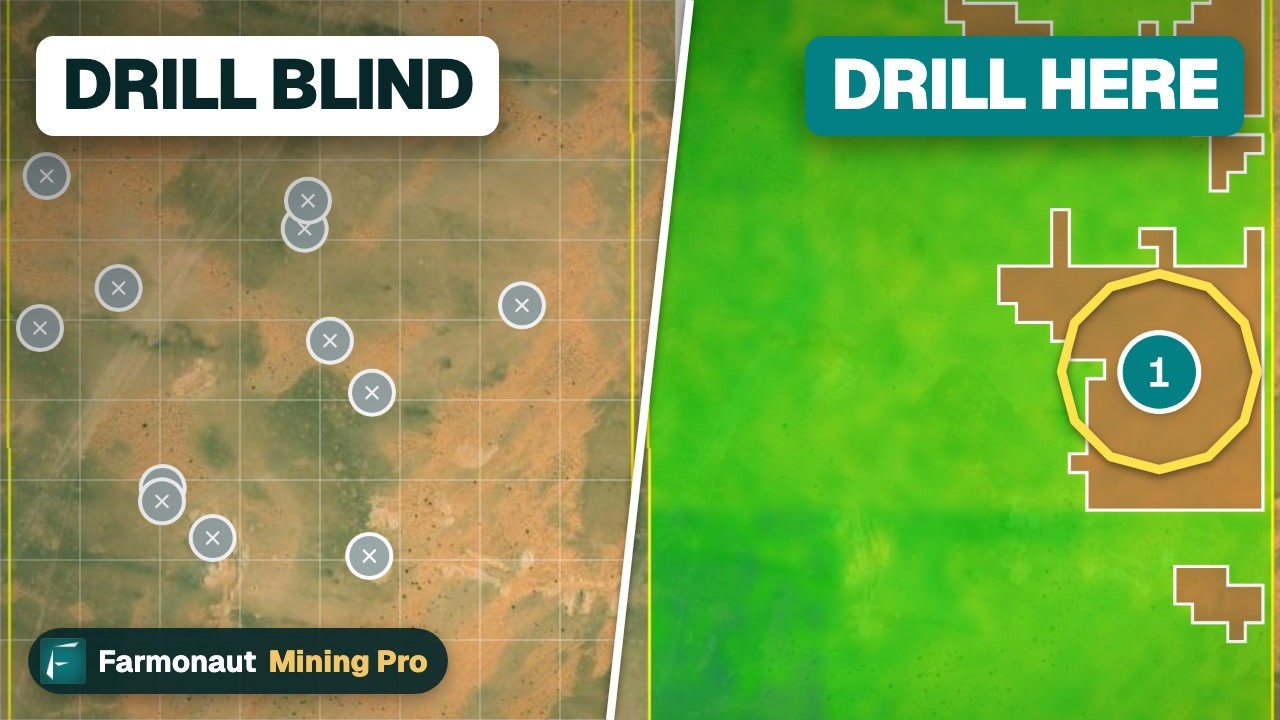
- Satellite screening can help you compare ground before you spend on drilling, but it gives exploration targets only. It does not establish grade, a basket or a resource.
Farmonaut works ahead of that stage, taking a licence boundary and returning satellite-derived exploration targets that sit ahead of any resource estimate.
Calculator
What is your rare earth basket worth per kg?
Enter your own element shares, prices and payability. Other elements count as zero value.
- Payable value per kg TREO (US$): 16.66
- Annual payable value (US$): $16,660,000
- Extra contained value a US$110 NdPr floor would add (US$ per year): $2,000,000
Example values only, not a benchmark or forecast. All prices are inputs: example, use today’s price. Shares are percent of TREO. The floor line uses the US$110 per kg level in the MP Materials annual report for 2025 and applies only to parties with such a contract.

▶ Explains how AI is used in mineral exploration, what it can find and where it fails. · 4:37
Frequently asked questions
What is the NdPr oxide price?
In October 2026, Rare Earth Exchanges put NdPr oxide at US$103 to US$106 per kg in China and US$125 to US$140 per kg outside China. Check a current quote before relying on either figure.
What does NdPr mean in rare earths?
NdPr is the blend of neodymium and praseodymium, usually about 75% Nd and 25% Pr. It does not include dysprosium or terbium, which are priced separately.
What is a reliable rare earth elements price benchmark?
SMM is widely used for China. Benchmark Minerals, Fastmarkets and Argus report outside-China prices. The USGS is useful for annual history. Choose by market and purpose, and check the tax and delivery basis.
Is there a Western NdPr oxide price separate from Chinese domestic pricing?
Yes. Reporters assess CIF prices for Europe and North America separately. Benchmark put them at US$95 per kg in its 21 August 2026 report, below its China price at that time, while the Rare Earth Exchanges October table had them above China.
What is the NdPr metal price?
Rare Earth Exchanges put NdPr metal outside China at US$175 to US$250 per kg in October 2026. SMM’s Pr-Nd alloy was reported at US$133.44 per kg on 30 September 2026.
Why is the US$110 per kg NdPr floor important?
It sets minimum revenue for MP Materials under its US government agreement, and appears in Lynas contracts too. It protects those companies, but it does not set the price for other producers.
Why do rare earth prices differ so much between China and other markets?
Sourcing rules, delivery terms and limited non-Chinese supply all play a part. Among the magnet elements, the gap is largest in dysprosium and terbium.
Why did NdPr prices rise over the past year?
Lynas reported the average China price rising from US$55.0 per kg in June 2025 to US$100.8 in June 2026, and says market demand and government floor agreements influenced the rise.
How much NdPr does the world produce?
Global NdPr figures are mostly private data. The USGS reports all rare earths together: about 390,000 tonnes of rare earth oxide equivalent mined in 2025. Company figures include Lynas at 7,260 tonnes of NdPr in its year to June 2026 and MP at 2,599 tonnes of NdPr oxide in 2025.
Are there rare earth stocks tied to the NdPr price?
Producers’ results depend on it, though floors and contracts change the link. Our page on rare earth mining investment compares companies with facts only. Nothing here is investment advice.
More from Farmonaut: agro admin app, carbon footprinting, farmonaut satellite weather api developer docs, fleet management, product traceability.
This page is for information only. It is not investment advice. Prices change often; confirm any quote with the publisher or your supplier before you buy, sell or sign a contract.
Farmonaut exploration
Screen a rare earth licence area from space
Investors can send a licence boundary as KML, KMZ or a polygon and receive satellite-derived exploration targets, ahead of any resource estimate.

Mining Pro sample view, synthetic data
Keep reading
Sources
- Rare Earth Exchanges, Rare Earth Prices (October 2026): rareearthexchanges.com
- USGS, Mineral Commodity Summaries 2026: Rare Earths: pubs.usgs.gov
- USGS, Mineral Commodity Summaries 2026: Heavy Rare Earths: pubs.usgs.gov
- Benchmark Minerals, Ex-China NdPr prices slip below $110/kg price floor (21 August 2026): source.benchmarkminerals.com
- Fastmarkets, US demand drives sharp increases in CIP global terbium, dysprosium prices (October 2026): fastmarkets.com
- Trading Economics, Neodymium (5 November 2026): tradingeconomics.com
- Critical Minerals News, Rare Earth Price Today (updated 4 October 2026): critical-minerals-news.com
- Lynas Rare Earths, annual results to 30 June 2026 (ASX, 26 August 2026): announcements.asx.com.au
- MP Materials, annual report on Form 10-K for 2025: s25.q4cdn.com
- MP Materials, second quarter 2026 results (6 August 2026): mpmaterials.com
- Shanghai Metals Market, Pr-Nd alloy price page (definition and VAT basis): metal.com
- Natural Resources Canada, Rare earth elements facts: natural-resources.canada.ca
- Center on Global Energy Policy, Columbia University, MP Materials deal: energypolicy.columbia.edu
- Rare Earth Exchanges, What is TREO: rareearthexchanges.com
Discussion
Questions, corrections or field experience? Share them below. First-time comments are reviewed before they appear, and your email is never published.
No comments yet. Be the first to add a question or your experience.

 Denkyira Nkoranza Concession
 Mwerezi Minerals Company Limited
 Congo Mining Solutions
 Mining SARL
 SenGold Invest SAS
 Sania Corporation
 Sean Mining Limited
 NTS Group (Pty) Ltd
 Mine4Africa
 Lithspo Minerals Limited
 Tintina Mining Group
 Dalgety Minerals Pty Ltd
 Vortex Minerals Pty Ltd
 Faith At Work (Pty) Ltd
 Geotech Mining Solutions plc
 Vulcan International Limited
 Kidepo Associates
 GKY Mining
 Alkimy SARL
 Double A Trading

 Licence holder · Nigeria · Gold + lithium










