

Reviewed September 2026 against AgDroneDirectory, Market.US, and the FAA’s Part 137 certification guidance.
An agrispray drone is a UAV built to carry and dispense liquid or granular crop inputs — fertilizer, herbicide, pesticide — over a mapped flight path instead of a tractor boom or manned aircraft pass. In the United States, FAA Part 137 operators treated 16.3 million acres with these aircraft in 2025, up from 10.4 million acres in 2024, according to ResearchAndMarkets’ United States agricultural drone market report. This article covers what agrispray drones and agri spray drones actually cost per acre, how drone fertilizer sprayers and herbicide sprayers compare on payload and coverage, and exactly what FAA certification a farm spraying drone needs before it can legally fly a paid job.
- Market Scale: How Big Is US Drone Spraying in 2026
- How Agrispray Drones Work
- FAA Part 137: The Rule Every Drone Fertilizer Sprayer Must Clear
- Drone Spraying Equipment Cost Comparison
- Payload and Coverage: Sizing a Crop Spraying Drone
- Coverage & Cost Calculator
- How Farmers Access Spray Drones: Buy, Hire, or Co-op
- Pairing Drone Spraying with Satellite Data
- Choosing the Right Agriculture Drone Spray System
- FAQ
- Conclusion
Market Scale: How Big Is US Drone Spraying in 2026
Market.US sizes the US pesticide-spraying drone segment at $0.41 billion in 2024, projecting growth to $2.0 billion by 2034 — a 17.2% compound annual growth rate over that decade, per its pesticide-spraying drone market report. AgDroneDirectory’s broader agricultural drone forecast, covering spraying plus scouting hardware, puts the total US market at $1.76 billion by 2030 in its 2026 agricultural drone spraying statistics guide. These are two different scopes — pesticide-spraying only versus all agricultural drone hardware — so don’t add them together; use whichever matches the claim you’re checking.
Adoption is also visible in the operator count. The FAA had certificated 1,710 Part 137 agricultural drone spray operators as of September 2025, a 58.3% increase year-over-year, according to AgDroneDirectory. Spray drones’ share of all acreage treated by agricultural aircraft (drones plus manned planes and helicopters) rose from 3% in 2023 to 12% in 2025, per Market.US. AgDroneDirectory separately reports drone services generated $215 million in rural economic activity in 2024, and notes that USDA Direct Conservation loan funds directed $300 million toward aerial application platforms in 2025 — check the current loan allocation at your local USDA Farm Service Agency office, since that figure moves with each funding cycle.
How Agrispray Drones Work
Every agrispray drone on the market shares the same core architecture, whether it’s marketed as an agrispray drone, a pesticide drone, or a drone herbicide sprayer:
- Tank and pump system: A liquid or granular hopper feeds a pump-driven nozzle array. Tank size is the single biggest driver of hourly acreage covered — see the payload table below.
- RTK GPS flight planning: Real-time kinematic GPS gives sub-inch positioning so flight lines don’t overlap or gap, which matters directly for chemical label compliance.
- Terrain-following radar or lidar: Keeps nozzle height constant over rolling or terraced ground, which is where boom sprayers struggle most.
- Swappable batteries: Most commercial units run 15-30 minute flights per battery, with operators cycling 4-8 batteries per shift to keep the aircraft in the air.
- Mission-planning software: Field boundaries, no-fly buffers, and application rate are set before takeoff and logged automatically for compliance records.
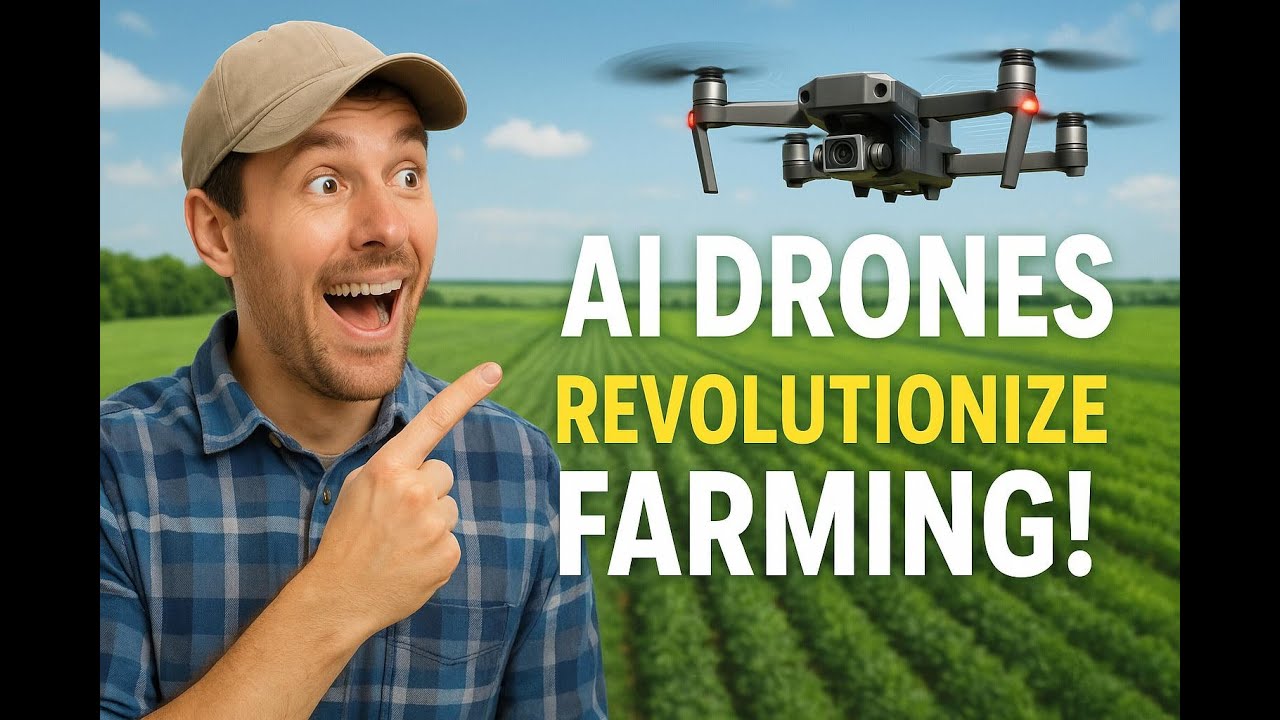
Rotary-wing (multirotor) designs hold 62.2% of agricultural drone market revenue as of 2024, per Market.US, because they hover for precise spot-treatment and handle uneven terrain better than fixed-wing platforms — the tradeoff is shorter range per battery cycle.
FAA Part 137: The Rule Every Drone Fertilizer Sprayer Must Clear
In the US, any drone dispensing an economic-poison (fertilizer, herbicide, pesticide, fungicide) for compensation is legally an “agricultural aircraft operation” and requires an FAA Part 137 certificate — this is separate from, and in addition to, the standard Part 107 remote pilot certificate. Per the Pilot Institute’s Part 137 agricultural spraying guide, processing takes 90 to 180 days as of 2025, so operators planning to sell spraying services for a coming season need to file well before the acreage needs treatment. Requirements include:
- A current Part 107 remote pilot certificate
- An FAA-issued Part 137 agricultural aircraft operator certificate
- Aircraft registration specific to the agricultural operation
- State-level pesticide applicator licensing, which varies by state — check with your state department of agriculture for the exact requirement, since there is no single national list
This certification requirement is precisely why the operator count (1,710 as of September 2025) is a meaningful adoption metric rather than a vanity number: it counts businesses that have cleared a multi-month federal process, not just drone owners.
Drone Spraying Equipment Cost Comparison
The national average cost of drone spraying in the US fell from $21 per acre in 2024 to $13 per acre in 2025 — a 38% reduction in one year, according to AgDroneDirectory’s 2026 statistics guide. That drop reflects more operators competing for the same acreage and larger payload aircraft spreading fixed costs over more acres per flight hour. Actual pricing splits by business model and crop type:
| Cost Model | Price per Acre (USD) | Notes |
|---|---|---|
| US national average, 2025 | $13 | Down from $21/acre in 2024 — AgDroneDirectory |
| Owner-operator, Midwest row-crop scale | $12.27 | Fuel, labor, depreciation on owned equipment — AgDroneDirectory |
| Custom-hire service, typical | $16 | Contracted third-party applicator — AgDroneDirectory |
| Row crops (corn, soy, wheat) | $12–$18 | DroneBundle 2026 cost breakdown |
| Vineyards and orchards | $18–$35 | Higher due to canopy complexity and slower pass speed — DroneBundle |
On the return side, Beck’s Practical Farm Research measured a $27.26-per-acre return on investment from drone-applied fungicide in corn during 2025, cited in AgDroneDirectory’s guide — that’s a trial result for one input and one crop, not a blanket figure for every chemical or crop, so treat it as a directional data point rather than a universal ROI claim.
Payload and Coverage: Sizing a Crop Spraying Drone
Tank size dictates how many acres a crop spraying drone covers before it has to land and refill, which is the practical bottleneck on large operations. For farms treating more than 1,000 acres per season, a 40 to 50 liter payload is the recommended minimum, according to industry equipment guidance compiled by Vastarrive — smaller tanks mean more refill cycles and lower net acres-per-hour once you account for return-to-base time.
| Model | Tank / Payload Capacity | Flow Rate | Source |
|---|---|---|---|
| DJI AGRAS T100 | 100 kg max payload | Not specified | DJI Agriculture |
| UNITED UAV UA80 | 75–80 liters | Not specified | UNITED UAV product page |
| EAVision J150 | 70 liters | 10.5 gallons per minute | EAVision 2026 agricultural drone comparison |
At 40–50 liter payloads, achievable coverage on row crops runs 30–50 acres per hour, per SkyRover Industrial Drones’ guidance on matching payload to farm scale. That coverage figure assumes continuous flight time and doesn’t subtract refill and battery-swap downtime — build that into your own planning using the calculator below rather than taking the raw acres-per-hour number at face value.

Coverage & Cost Calculator
Enter your field size, tank payload, and a per-acre price to estimate flight cycles and total spraying cost for your own operation.
Estimated results:
Assumptions: uses a straight-line acres-per-tank and acres-per-hour estimate; excludes battery-swap downtime, wind holds, turnaround between fields, and refill logistics. Coverage rate defaults to the 30–50 acres/hour range reported by SkyRover Industrial Drones for 40–50 liter payloads; adjust it to your own aircraft’s spec sheet. Price defaults to the 2025 US national average of $13/acre per AgDroneDirectory — replace with your local custom-hire quote or owner-operator cost for an accurate estimate.
How Farmers Access Spray Drones: Buy, Hire, or Co-op
Most US operations don’t own their spray drone outright. Market.US reports that 51% of operations access drones through third-party service providers, and 37% go through a retailer or co-op partnership — ownership is the minority path for now. Separately, 62% of all agricultural drone use (spraying and non-spraying combined) is for monitoring and scouting rather than application, which matters if you’re evaluating a platform: the same aircraft category serves two different jobs, and pure spray drones are usually purpose-built rather than dual-role.

For operations weighing whether to add spraying to existing fleet operations, our Fleet Management suite handles multi-aircraft logistics and scheduling once you’re running more than one drone across a season.
Pairing Drone Spraying with Satellite Data
A spray drone applies a decision; it doesn’t make one. Knowing where to spray and at what rate comes from field-level crop health data collected separately — typically satellite multispectral imagery flagging stressed zones before a drone mission is planned. This is the gap between owning a sprayer and running a precision-application program.
- Field monitoring before the flight: Multispectral vegetation index maps identify which zones of a field actually need treatment, so the drone mission is targeted rather than a blanket pass.
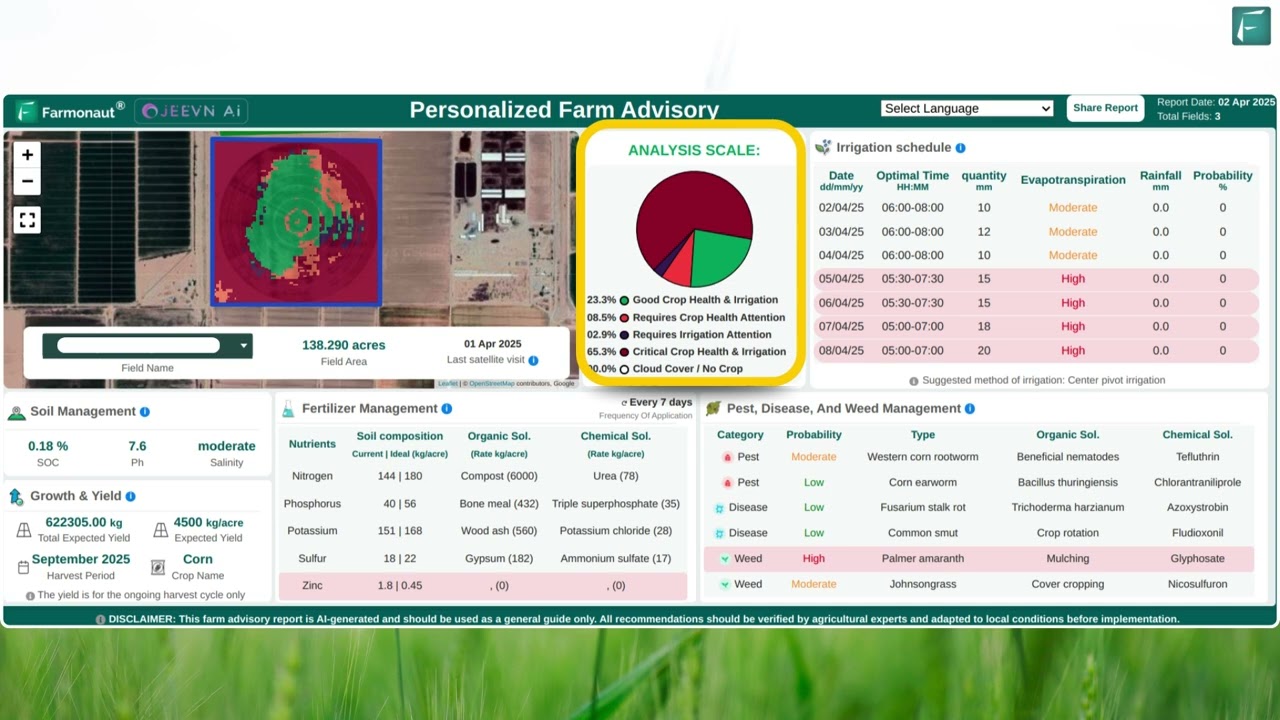
- Advisory integration: Our platform’s Jeevn AI advisory engine issues field-specific spray timing and risk flags that feed directly into drone mission planning.

Looking to integrate real-time crop and drone data analytics into your management system? Access the Farmonaut API and tap into satellite, weather, and crop insight feeds. Developer resources, including endpoint references and sample calls, are documented in our API Developer Docs.
For larger operations coordinating spray missions across multiple fields, Learn more about our Large Scale Farm Management Suite for centralized crop health monitoring and mission planning.

Application records — what was sprayed, where, and at what rate — also matter for compliance and for downstream supply-chain claims. Our Farmonaut Product Traceability tools log that chain of custody, and Carbon Footprinting and Sustainability Tracking tools quantify the input-reduction side of a targeted spray program instead of a blanket one.

Choosing the Right Agriculture Drone Spray System
Match the aircraft to the operation rather than to the spec sheet with the biggest tank:
- Acreage under management: Under 1,000 acres, a 20–35 liter unit with faster refill turnaround often beats a large-tank aircraft on real acres-per-day. Above 1,000 acres, the 40–50 liter class recommended by Vastarrive reduces refill cycles enough to matter.
- Crop and canopy type: Row crops tolerate faster pass speeds and lower per-acre cost ($12–$18/acre per DroneBundle); orchards and vineyards need slower, more careful passes and cost more ($18–$35/acre).
- Certification path: Confirm your own or your contractor’s FAA Part 137 status and state pesticide applicator license before booking a season — the 90–180 day processing window means this isn’t a same-week fix.
- Buy vs. hire: With 51% of operations using service providers and 37% using retailer/co-op channels per Market.US, ownership only pencils out once acreage and season length justify the equipment and certification overhead.
- Data integration: A sprayer with no upstream field data applies chemical uniformly; pairing it with satellite or scouting data is what turns “spraying” into “precision application.”
For those scaling operations, integrating satellite analytics with drone spray missions through our Farmonaut Platform connects monitoring data directly to mission planning.
Financing a Spray Program
Need satellite-based verification to support agro-financing or crop insurance while you’re investing in spray equipment or certification? See satellite-driven crop loan & insurance verification for how field data supports risk assessment and underwriting.
Accessibility: Web, Android, iOS, and APIs
Developers can integrate satellite, weather, and crop data directly via our open API.
FAQ
-
Q: What does an agrispray drone cost to operate per acre?
A: The US national average was $13 per acre in 2025, down from $21 per acre in 2024, per AgDroneDirectory. Row crops run $12–$18/acre and orchards/vineyards run $18–$35/acre per DroneBundle’s 2026 cost breakdown. Get a current local quote from a Part 137-certificated operator, since price shifts with regional competition and season. -
Q: Do I need a license to fly a pesticide drone spraying operation?
A: Yes. Any paid agricultural spray operation needs an FAA Part 137 agricultural aircraft operator certificate plus a standard Part 107 remote pilot certificate and state pesticide applicator licensing. Processing for Part 137 runs 90–180 days per the Pilot Institute’s guide, so apply before the season you plan to fly. -
Q: What size tank do I need for a drone fertilizer sprayer?
A: For operations under 1,000 acres, 20–35 liters is usually enough. Above 1,000 acres, a 40–50 liter payload is the recommended minimum per Vastarrive’s equipment guidance, since it cuts refill cycles that otherwise eat into acres-per-hour. -
Q: How many acres can a crop spraying drone cover in a day?
A: At 30–50 acres per hour (the range SkyRover Industrial Drones reports for 40–50 liter payloads on row crops), a full working day can realistically cover several hundred acres once refill and battery-swap time is subtracted. Use the calculator above with your own aircraft’s spec sheet for a farm-specific estimate. -
Q: Should I buy a drone herbicide sprayer or hire a service?
A: Market.US reports 51% of US operations use a third-party service provider and 37% use a retailer/co-op channel as of 2025 — outright ownership is the minority approach. Ownership tends to pencil out only once acreage and season length justify the equipment cost plus the Part 137 certification overhead. -
Q: Can drone spray data integrate with satellite crop monitoring?
A: Yes — platforms like Farmonaut combine multispectral field monitoring with mission planning, so drone flights target zones flagged by the imagery instead of spraying a field uniformly.
Conclusion
Agrispray drones moved from novelty to documented infrastructure in the US between 2024 and 2025: treated acreage grew from 10.4 million to 16.3 million acres, certificated operators grew 58.3% to 1,710, and per-acre cost fell 38% to $13. None of that growth changes the two gates every buyer or hirer has to clear — FAA Part 137 certification with its 90–180 day timeline, and matching tank payload to actual acreage rather than to the biggest spec sheet available. The market figures here will move again by next season; the certification requirement and the payload-to-acreage math will not. Check AgDroneDirectory’s and Market.US’s next annual updates for the current acreage and cost figures before budgeting a season around numbers in this article.

 Misteo
 Tres Valles
 LACOS Geoinformation
 Pulsar Supernova
 Magrifly
 LatConnect 60
 WebsEdge
 Blickwinkel
 Agricultural Credit Policy Council
 MCSOD
MCSOD Marei Nursery
 eKGIS
eKGIS Mostas Tech
 Andex
Andex FCF India
 Unifrutti Gulf
 Deluxe Conseil
