

Smart Irrigation Systems: Benefits, Costs & How They Work
Reviewed September 2026 against USDA NASS’s 2023 Irrigation and Water Management Survey and US EPA WaterSense soil-moisture controller data.
Try it: Enter your numbers above to see estimated savings. →
A smart irrigation system is a controller-plus-sensor setup that decides when and how much to water based on measured soil moisture, weather forecasts, and crop data, instead of a fixed clock. The US EPA’s WaterSense program has documented roughly 20% water reductions from soil-moisture-based irrigation controllers (SMS systems) compared with clock-timer controllers, without a yield penalty when set up correctly. Below is exactly what these systems are, what they cost in scale terms across US irrigated agriculture, and how the pieces fit together.
Table of Contents
- What Are Smart Irrigation Systems?
- US Irrigation at Scale: The Numbers Behind the Problem
- How a Smart Irrigation System Actually Works
- Comparison Table: Conventional vs. Smart Irrigation
- Smart Irrigation in Agriculture: The Core Benefits
- Advantages of Smart Irrigation Systems, Ranked by Impact
- Smart Irrigation Monitoring: What You Actually See
- The Smart Irrigation Market: Size and Growth
- Water Savings Calculator
- Where Farmonaut Fits: Satellite Data for Irrigation Decisions
- Challenges & What to Check Before You Buy
- FAQ: Smart Irrigation Systems
- Conclusion
- Try it: Enter your numbers above to see estimated savings.
What Are Smart Irrigation Systems?
A smart irrigation system replaces a fixed watering schedule with a decision loop: a sensor or model measures how much water the soil and crop actually need, and a controller opens or closes valves accordingly. The three components that make a system “smart” rather than merely automated are:
- Soil moisture sensors placed at root depth, reporting volumetric water content in real time.
- Weather integration — evapotranspiration (ET) data and rainfall forecasts that adjust the schedule before a storm or heat spike.
- An automated controller that translates sensor and weather inputs into valve run-times, without a person manually calculating them.
The University of Florida IFAS Extension’s technical publication on smart irrigation controllers describes soil-moisture-sensor (SMS) systems as either bypass controllers, which override a pre-set schedule when the soil is already wet enough, or fully sensor-driven systems that calculate run-time directly from measured moisture. Both approaches are what the EPA WaterSense program tested when it documented the roughly 20% water savings figure. This is the working definition behind every “what are smart irrigation systems” question: sensors plus weather data plus automated control, replacing a calendar-based schedule.
US Irrigation at Scale: The Numbers Behind the Problem
The scale of US irrigated agriculture is what makes even modest per-acre water savings add up. Per USDA NASS’s 2023 Irrigation and Water Management Survey, 212,714 US farms irrigated a combined 53.1 million acres, applying a total of 81 million acre-feet of water — an average of 1.5 acre-feet per acre for the year. An acre-foot is roughly 326,000 gallons, so the national total works out to about 26.4 trillion gallons applied across irrigated cropland in 2023.
That average of 1.5 acre-feet per acre is the baseline any smart-irrigation savings claim should be measured against. If EPA WaterSense’s 20% reduction figure for soil-moisture-controller systems applied uniformly across that acreage, it would represent roughly 16.2 million acre-feet — but that figure is illustrative of the scale, not a claim about actual national adoption, since NASS’s survey does not yet break out irrigation method by technology type (sensor-based versus clock-timer versus flood). If you need current-year totals for your own state or crop, USDA NASS republishes irrigation and water-management data annually each October, and state-level detail is available through the NASS Quick Stats database.
How a Smart Irrigation System Actually Works
The working of a smart irrigation system follows a repeating loop, not a one-time setup. Here is the sequence:
- Sensing: Soil moisture probes at root depth (typically installed at multiple depths for row crops) report volumetric water content to the controller, usually every 15–60 minutes.
- Weather input: The controller pulls evapotranspiration estimates and short-range rainfall forecasts, either from an on-site weather station or a networked service.
- Decision: The controller compares current soil moisture against a crop-specific threshold (a “management allowed depletion” level) and calculates whether irrigation is needed and for how long.
- Actuation: Valves or pivot systems run only for the calculated duration — this is where the water saving actually happens, since a clock-timer system would run for a fixed duration regardless of soil state.
- Logging and remote access: Each cycle’s data is logged, and the farm operator can review or override the schedule from a phone or desktop app.
That loop is the durable part of this article: sensor thresholds, ET-based scheduling, and bypass logic don’t change even as specific product prices and market sizes do. If you’re evaluating a system, the question to ask a vendor is which step in this loop their hardware actually automates — many “smart” controllers only automate step 4 and still rely on you to set the schedule manually, which is not the same as a full sensor-driven system.
Comparison Table: Conventional vs. Smart Irrigation Systems
The table below separates what is independently documented (EPA WaterSense’s water-savings figure, USDA NASS’s national baseline) from what is a directional estimate pending better public data, per the gaps identified below.
| Feature/Parameter | Conventional (clock-timer) Irrigation | Smart (sensor-based) Irrigation | Source / Status |
|---|---|---|---|
| Water applied, US average | 1.5 acre-feet/acre (national average, all methods, 2023) | Up to ~20% less on systems using soil-moisture sensor controllers | USDA NASS 2023; EPA WaterSense |
| Scheduling basis | Fixed calendar/timer, manually set | Real-time soil moisture + ET + forecast data | UF/IFAS Extension AE437 |
| Remote monitoring | Rarely available | Standard on sensor-controller and satellite-linked systems | Product-category standard |
| Cost per acre to install | N/A | Not published by USDA/academic sources — vendor quotes only | Gap — request itemized vendor quotes for your acreage |
| US market size | N/A | $304.4 million (2025) projected to $460.4 million (2030) | Markets and Markets, US smart irrigation market |
Smart Irrigation in Agriculture: The Core Benefits
Smart irrigation in agriculture delivers benefits that fall into four categories: water use, labor, input costs, and resilience. Each is worth separating because they compound differently depending on your operation’s constraints.
Water Conservation
EPA WaterSense’s documented ~20% reduction from soil-moisture-based controllers is the most defensible water-savings figure available for the US market — it comes from a federal program that certifies controller performance, not a vendor claim. Applied against the NASS 2023 baseline of 1.5 acre-feet/acre, that is roughly 0.3 acre-feet/acre saved on fields where a sensor-based controller replaces a clock-timer, before accounting for crop type, soil texture, or climate zone, all of which shift the real number for a given field.
Improved and More Uniform Yields
Because sensor-driven scheduling avoids both over- and under-watering, yield uniformity across a field tends to improve — plants at the edges of a pivot’s reach or in sandier soil patches get water matched to their actual need rather than the same run-time as the rest of the field. USDA NASS does not publish a national yield-lift figure specific to smart-irrigation adoption (see gaps below), so treat any yield percentage from a vendor as their internal test data, not an independent benchmark, until you can verify it against your own season’s records.
Cost and Labor Efficiency
Remote scheduling and automated alerts cut the labor hours a crew spends walking pivots and adjusting valves by hand. The size of that saving depends on farm layout and current staffing model, and isn’t independently published at a national level — track your own hours before and after installation for the number that matters for your operation.
Climate Resilience
Forecast-integrated scheduling lets a system pre-empt a heat spike (running an extra cycle before predicted high ET days) or skip a cycle ahead of forecast rain — a capability a fixed-timer system structurally cannot have, regardless of how well the timer was originally set.
Advantages of Smart Irrigation Systems, Ranked by Impact
Ranked by how directly each advantage is documented in independent data, rather than by marketing emphasis:
- Water reduction: ~20% documented by EPA WaterSense for soil-moisture-controller systems — the strongest independently verified figure in this category.
- Reduced runoff and deep percolation: targeting water to the root zone rather than a fixed area cuts water lost past the root zone or off the field edge — a documented mechanism (per UF/IFAS Extension AE437), though the volume saved is field-specific.
- Remote, centralized control: a standard feature of sensor-controller systems and satellite-linked platforms — the labor-time value depends on your current staffing model.
- Forecast-adjusted scheduling: a structural capability of any weather-integrated system, unavailable to fixed-timer irrigation regardless of how it’s configured.
- Automated leak and dry-spot alerts: catches equipment failures and coverage gaps between scheduled field visits — the earlier a leak is caught, the smaller the water and crop-stress loss, though this isn’t independently quantified at a national level.
This overview of smart irrigation in advanced agriculture covers the sensor and automation side of this same list in more technical depth, and this piece on smart irrigation and farm productivity looks at how these systems interact with broader precision-agriculture equipment.
For crop-specific guidance on tuning irrigation to soil health outcomes rather than just water volume, see 10 ways to boost irrigation efficiency and soil health, and for how automated watering hardware has evolved, see automatic plant watering system innovations.
Smart Irrigation Monitoring: What You Actually See
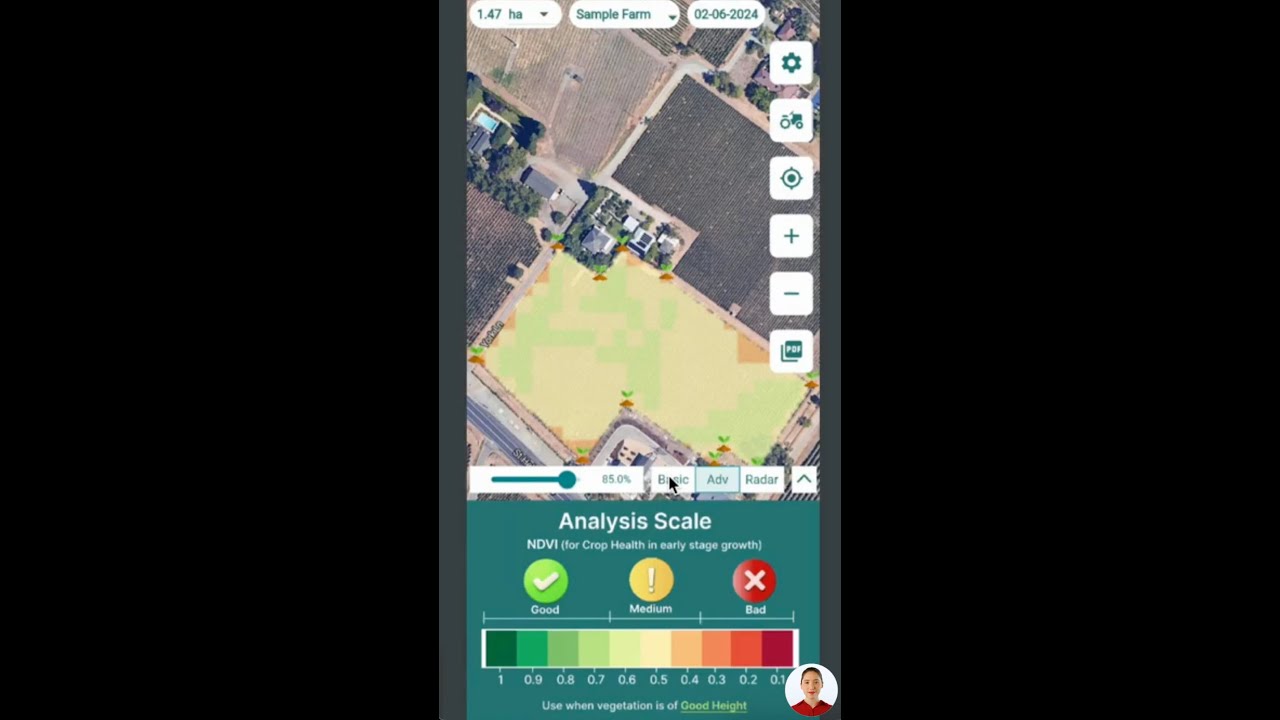
Smart irrigation monitoring is the dashboard side of the system — the interface that turns raw sensor and weather data into something a farm operator checks each morning. A functional monitoring setup shows, at minimum: current soil moisture by zone or field, the controller’s next scheduled run-time and duration, cumulative water applied over the season against a target, and any active alerts (sensor offline, unexpected moisture drop indicating a leak, or a valve that failed to close).
The value of monitoring is largely in catching failures early: a pivot that stops mid-field, a valve stuck open, or a sensor reporting stale data are all failures that a clock-timer system gives you no way to detect remotely. Farmonaut’s Agro Admin App is built for exactly this — centralized monitoring across multiple fields or clients from one interface, which matters more as acreage under management grows, since a single field can be walked but a hundred-field portfolio cannot.
The Smart Irrigation Market: Size and Growth
The US smart irrigation market was sized at $304.4 million in 2025, with market research projecting growth to $460.4 million by 2030 — a compound annual growth rate of 8.6% over that period, per Markets and Markets’ geographic market report. Within the broader agricultural irrigation machinery category, pivot irrigation systems account for an estimated 43.35% of the US irrigation equipment market as of 2025, per Market Research Future’s agricultural irrigation machinery report — context for how much of the installed base a smart retrofit or new-build system is competing against.
Market-size projections vary by 1–3% between research firms depending on methodology, so treat the $460.4 million 2030 figure as one credible projection rather than a fixed number — check Markets and Markets or Mordor Intelligence directly for the most recent published update if you need current figures for a business case.
Water Savings Calculator
Run your own acreage and current water use through EPA WaterSense’s documented savings rate below to estimate what a soil-moisture-controller retrofit could save on your farm.
Enter your numbers above to see estimated savings.
Assumptions: uses your entered acreage and current application rate rather than a fixed default; the 20% option reflects EPA WaterSense's documented average for soil-moisture-based controllers versus clock-timer controllers and is not a guarantee for any specific field, soil type, or crop. Excludes installation, sensor, and maintenance costs, and excludes any yield-related revenue effect. Water cost defaults to $0 (unmetered); enter your local metered or pumping cost to see a dollar estimate.
Where Farmonaut Fits: Satellite Data for Irrigation Decisions
Ground sensors measure a single point; satellite imagery shows how moisture and crop stress vary across an entire field, which is where precision agriculture technology adds a layer sensors alone cannot. Farmonaut combines satellite-based crop and soil monitoring with weather data and an AI advisory (Jeevn AI) to flag zones within a field that need attention before a walk-through would catch it.
- API access for developers building irrigation logic into an existing platform: Farmonaut API and the API developer docs.
- Fleet-level management for operations running irrigation and equipment across multiple fields: Fleet Management.
- Carbon and resource tracking tied to water-use reductions, relevant for sustainability reporting: Carbon Footprinting.
- Traceability linking irrigation and input records to verified produce history: Product Traceability.
- Digital agronomy context for how irrigation data fits a broader farm-management stack: what is digital agronomy.
Reliable, third-party-verifiable irrigation and monitoring data also matters beyond the field: Farmonaut's Crop Loan and Insurance Verification Services use the same data streams to reduce fraud risk in lending and insurance underwriting. For a look at where irrigation automation fits among other farm equipment innovations, see top agricultural equipment innovations.
Challenges & What to Check Before You Buy
Four things to verify before committing to a system, since the public data gaps mean vendor claims need independent checking:
- Installed cost per acre: not published by USDA or academic sources — get itemized quotes from at least two vendors covering hardware, installation, and any subscription/data fees, and compare against your current pumping and labor cost.
- Payback period: limited independent US studies exist; most payback claims come from vendor white papers. Ask the vendor for the assumptions behind their payback number (water price, labor rate, yield assumption) and re-run it with your own figures.
- What "smart" actually automates: confirm whether the system does sensor-driven scheduling (step 3 in the loop above) or only remote control of a manually-set schedule — the water savings documented by EPA WaterSense apply to the former.
- Maintenance: soil sensors drift and need periodic calibration; a system with unmaintained sensors can silently revert to worse-than-timer performance.
FAQ: Smart Irrigation Systems
-
Q: What are smart irrigation systems, in one sentence?
A: Systems that use soil moisture sensors, weather data, and automated controllers to water based on measured need rather than a fixed schedule. -
Q: How much water do smart irrigation systems actually save?
A: The US EPA WaterSense program documents roughly 20% water reduction from soil-moisture-based controllers versus clock-timer controllers. Field-specific results depend on soil type, crop, and climate. -
Q: How big is the US irrigated farm sector these systems serve?
A: 212,714 farms irrigated 53.1 million acres and applied 81 million acre-feet of water in 2023, per USDA NASS's Irrigation and Water Management Survey — the most recent published survey as of this review. -
Q: How big is the smart irrigation market in the US?
A: $304.4 million in 2025, projected to reach $460.4 million by 2030 (8.6% CAGR), per Markets and Markets — treat this as one research firm's projection, since estimates vary 1–3% between firms. -
Q: What does smart irrigation monitoring show day to day?
A: Current soil moisture by zone, the next scheduled run and duration, cumulative seasonal water use, and alerts for sensor failures or unexpected moisture drops that indicate leaks. -
Q: How does a smart irrigation system work, step by step?
A: Sensors measure soil moisture, the controller pulls weather/ET data, compares both against a crop threshold, calculates run-time, actuates the valves, and logs the result — repeating on a set interval, typically every 15–60 minutes for sensor readings. -
Q: Is there a published cost per acre to install one?
A: No independent government or academic source publishes this; it is available only from equipment vendors and resellers, so get itemized quotes for your specific acreage and crop.
Conclusion
The case for smart irrigation rests on one federally documented number — a roughly 20% water reduction from soil-moisture-based controllers, per EPA WaterSense — set against the scale of US irrigated agriculture: 212,714 farms, 53.1 million acres, and 81 million acre-feet applied in 2023, per USDA NASS. The market backing that shift is real but modest by agtech standards: $304.4 million in 2025, growing at 8.6% annually through 2030 per Markets and Markets. What isn't yet independently published — installed cost per acre, payback period, adoption rate by farm size — is exactly what you should be pushing vendors to substantiate with your own field's numbers rather than accepting a national average.
Use the calculator above with your own acreage and water cost as a starting estimate, then verify any vendor's savings and payback claims against EPA WaterSense's documented controller performance and your own season's pumping records before committing capital.
Interested in managing crop cycles, plantations, and forest agri-projects end-to-end? Discover how Farmonaut integrates crop advisory, remote sensing, and resource management in every agro-ecosystem.
Build the future of farming with Farmonaut – for smarter irrigation, precise data, and sustainable agriculture.
Discussion
Questions, corrections or field experience? Share them below. First-time comments are reviewed before they appear, and your email is never published.
No comments yet. Be the first to add a question or your experience.

 AgroStar
 Native Seeds
 Andex
Andex FCF India
 Unifrutti Gulf
 Deluxe Conseil
 TVS Electronics
 BW Pipelines
 WICO
WICO Gen Chayat
 Chimera Innovation
 SkyHarvest
 Polaris Digitech
 Teledarbas
 Wild Oak Farm
