

Irrigation tools · Buyer guide
Best Soil Moisture Meters for Farms: 7 Compared by Price
Wireless probes from Farm21, Sensoterra, Sentek, CropX and Arable, plus low-cost tensiometers, compared by what they measure and cost. Among the sensors the University of Arizona Extension priced in November 2023, packages listed from US$109 to US$1,317.
Key takeaways
- Single-depth farm sensors listed at about US$100-700 and multi-depth probes at US$600-1,750 in November 2023, plus gateways (US$399-2,250) and data plans (US$150-350 a year), per University of Arizona Extension.
- Only 27,831 of 212,714 US irrigating farms (about 13%) used a soil moisture sensing device to decide when to irrigate in 2023 (USDA NASS).
- Trigger points depend on soil: about 25-27% volumetric water for silty clay loam but 6-8% for sand, for well-calibrated sensors (University of Nebraska).
- UC ANR cites 9-10% yield gains in celery and strawberries and 10-16% water savings in deficit irrigation trials guided by sensors.
- Tensiometers need no soil calibration; capacitance probes should be calibrated for soil type and salinity.
In this article
- Best soil moisture meters at a glance
- How we chose these meters
- The seven soil moisture meters compared
- What soil moisture meters cost
- How soil moisture meters work
- How US farmers decide when to irrigate
- Irrigation trigger points by soil type
- Does a soil moisture meter pay for itself?
- How to choose and install a soil moisture meter
- Sensors plus satellite maps for whole-field coverage
- FAQ
The best soil moisture meters for farms are wireless probes that log readings every hour and send them to an app, such as the Farm21 FS21, Sensoterra, Sentek, CropX and Arable systems, plus low-cost tensiometers and Watermark sensors for growers on a tight budget. Among the sensors priced in November 2023 by a University of Arizona Extension market review, packages listed from about US$109 to US$1,317. Yet only 13% of US irrigating farms used a soil moisture sensing device to decide when to water in 2023.
This guide compares seven options, what each one measures, and what it costs. It also shows which soil readings should trigger irrigation, how US farmers decide when to water, and gives a calculator to test whether a sensor system could pay for itself on your field. For houseplants and garden beds, see our separate guide to moisture meters for plants.
Best soil moisture meters at a glance
The table sums up the seven picks. Prices are list prices or published fees with their date; several makers sell only through dealers, so you need a quote.
| Meter | How it measures | Depths | Price shown | Best for |
|---|---|---|---|---|
| Farm21 FS21 | Capacitance, plus air temperature and humidity | 3 depths in the top 30 cm | About EUR 320 hardware (FAO listing) | Arable farms that want a dashboard with alerts |
| Sensoterra | Impedance (resistivity and capacitance) | Single depth or 6 depths to 40 in | US$252-294 single, US$950 multi (Nov 2023) | Orchards, vines and platforms that need an API |
| Sentek probes | Capacitance, with salinity and temperature | Multi-depth profile | Dealer quote | Deep-rooted and high-value crops |
| CropX | Soil sensors plus satellite and weather data | Multi-depth | Dealer quote | Row crops and dairies that want one app |
| Arable | In-field weather and crop station | Not a soil probe | Dealer quote | Measuring crop water use and weather per field |
| Irrometer | Tensiometer or Watermark (soil water tension) | One sensor per depth | Dealer price | Low-cost scheduling and salty soils |
| Dragino LSE01 | FDR, with temperature and salinity | Single depth | US$109 (Nov 2023) | Tinkerers with their own LoRaWAN network |
How we chose these meters
We started with the products in the original version of this page and checked each one against the maker’s current website. We added two lower-cost options from the University of Arizona review, because price is the main barrier for many farms. We then compared what each system measures, how many depths it reads, how data reach you and what a published price or fee shows. We did not field-test the devices. Any accuracy figures are the makers’ own, not independent tests.
Extension specialists stress that the right choice depends on crop, soil and how often you will look at the data. The UC Agriculture and Natural Resources sensor guide notes that a poor first purchase can put growers off sensors for good, and suggests talking to local farm advisors before buying.
The seven soil moisture meters compared
1. Farm21 FS21
Best for: arable and vegetable farms that want soil and weather data in one dashboard.
The FS21 is an in-field sensor unit. According to the FAO Agritech Observatory profile of Farm21, it reads soil moisture at three depths in the top 30 cm, soil temperature at 10 and 20 cm, and air temperature and humidity. Data travel over a cellular link to Farm21’s cloud platform. There, the readings are combined with satellite images, local weather and scouting notes to produce irrigation alerts, graphs and dashboard widgets. The same profile lists a one-time hardware price of around EUR 320, with extra services such as high-resolution satellite imagery sold as paid add-ons.
The dashboard is the main reason people search for Farm21. In short: you see live readings per depth, trend graphs, automatic warnings when soil dries past your set level, and dashboard views that combine the readings with satellite data. Check the current subscription terms with the company, since fees can change.
2. Sensoterra
Best for: orchards, vineyards and anyone who wants to plug sensor data into another platform.
Sensoterra makes wireless probes in different lengths, so you can read the active root zone or deeper layers. The company says its probes take hourly readings, install in about a minute, need no maintenance and work in clay, sand and peat soils. It also describes an “API first” approach, so the data can feed other farm software. The Arizona review classes Sensoterra as an impedance sensor (soil resistivity plus capacitance) and lists US$252-294 for a single-depth probe and US$950 for the multi-depth version, which reads six depths to 40 inches (prices as of November 2023).
3. Sentek soil data probes
Best for: deep-rooted, high-value crops and research plots.
Sentek, founded in 1991, makes multi-depth capacitance probes that track soil water, salinity and temperature down the profile. Its telemetry units send readings to irrigation software, and the company says its products are used in more than 80 countries. The older version of this page said one Sentek probe reads from 0.5 mm to 40 m deep; that is not a depth range the company states, so treat multi-depth probes as covering the root zone, typically a few feet. Sentek sells through dealers, so ask a local dealer for a price.
4. CropX
Best for: row crops, pasture and dairy farms that want soil, satellite and weather data in one app.
CropX pairs its soil sensors with a farm management platform. The platform imports data from soil probes, satellites and farm machinery, and offers irrigation planning, actual evapotranspiration estimates, salinity and nitrogen-leaching monitoring, effluent irrigation planning and sustainability reports. It is a good fit when many fields and many users share one account.
5. Arable
Best for: measuring crop water use and weather at the field level.
Arable is best known for its in-field station that tracks rainfall, weather and crop signals; the original Mark 2 device was listed in our older version of this page. Arable now markets the system around irrigation advice, weather risk and measured water savings. Choose it when you want to know how much water the crop used, not only how wet the soil is.
6. Irrometer tensiometers and Watermark sensors
Best for: low-cost irrigation scheduling, berries, vegetables and salty soils.
Irrometer has made tensiometers since 1951. A tensiometer reads soil water tension in centibars, which tells you how hard roots must pull to get water. Irrometer says tensiometers are unaffected by salinity and need no site calibration. Its Watermark granular matrix sensor reads the same tension electronically. In Nebraska, extension staff install Watermark sensors at 1, 2, 3 and sometimes 4 feet in representative parts of a field, as the Nebraska CropWatch guide to the Watermark sensor explains. In a University of Georgia irrigation budget, tension sensors are described as cheaper than capacitance sensors and more widely adopted by farmers.
7. Dragino LSE01
Best for: growers or advisors who already run a LoRaWAN network.
The LSE01 is an FDR sensor that reads soil moisture, temperature and salinity at one depth, with a lithium battery and a LoRaWAN radio. At US$109 it was the cheapest package in the Arizona review (November 2023). You need your own gateway and software to see the data, so it suits people who are comfortable setting up their own system.
What soil moisture meters cost
Single-depth sensors ranged from about US$100 to US$700 and multi-depth probes from US$600 to US$1,750 in the University of Arizona review. A wireless gateway cost US$399 to US$2,250, repeaters about US$150 to US$200, and data plans US$150 to US$350 a year (or US$2 to US$550 per sensor per year). Some sellers bundle the gateway into the data plan. Most warranties were one year.
Chart
Listed prices of selected farm soil moisture sensors
US$ per sensor package, lowest listed price, November 2023, selected products
Add the pieces up before you buy. Using the Arizona ranges, one multi-depth probe at US$800, a gateway at US$399 and a US$150 data plan come to about US$1,350 in the first year, before any installation help. A second station on the same farm usually shares the gateway, so the cost per station falls as you add more. Ask each seller whether the data plan covers the gateway, software updates and agronomy support, and what happens to your data if you stop paying.
The cheapest option is not always the best. A single-depth probe in the main root zone can be enough to time the next irrigation, the Arizona authors note, while a multi-depth probe shows whether water reaches deeper roots or drains past them.
How soil moisture meters work
There are two ways to express soil water. Volumetric water content (% by volume) tells you how much water is in the soil. Soil matric potential, or tension (kPa or centibars), tells you how tightly the soil holds that water and how easy it is for roots to take up. Nebraska research on irrigation trigger values explains why both matter.
Capacitance and FDR sensors
These measure the soil’s dielectric constant, which rises with water content. They respond fast and suit continuous logging. Calibrate them for your soil: the Arizona review advises calibration for sandy, loamy and clay soils and warns that salinity can skew readings.
TDR and TDT sensors
Time domain reflectometry sends an electromagnetic pulse along the probe and times its return. Penn State Extension calls TDR quick and fairly accurate if the probe is calibrated for the soil type.
Tensiometers and granular matrix sensors
These read water tension directly. UC ANR notes that tensiometers suit crops sensitive to water stress, such as berries and vegetables, and do not need soil calibration. Penn State adds that in heavy clay the ceramic tip can clog and need cleaning.
Neutron probes and gravimetric sampling
Neutron gauges estimate water from hydrogen in the soil. They are accurate but use a radioactive source, so they need a licensed operator and are mainly used in research. Gravimetric sampling (weighing soil before and after drying) is the reference method used to calibrate other sensors.
▶ How soil and water together shape crop growth, and why soil water status matters for yield. · 9:40
How US farmers decide when to irrigate
US farms irrigated 53.1 million acres and applied 81 million acre-feet of water in 2023, according to the USDA 2023 Irrigation and Water Management Survey. The same survey asked how farms decide when to water. Most still look at the crop or feel the soil. Of 212,714 irrigating farms, 27,831 used a soil moisture sensing device, about 13%. In California the share was about 25% (9,429 of 38,033 farms).
Chart
How US farms decide when to irrigate
Share of 212,714 irrigating farms using each method, 2023; farms could report more than one
Sensors do not replace walking the field. A Nebraska review of farmer Watermark data from 2017 to 2021 found that about two thirds of the irrigators could have saved water without lowering yield, while 15-20% of fields may have been under-watered late in the very dry years of 2020 and 2021, as Nebraska CropWatch reported.
Irrigation trigger points by soil type
A meter is only useful if you know which reading means “irrigate now”. Nebraska research suggests volumetric trigger points by soil type, based on about 35-40% depletion of the soil water per foot, for well-calibrated sensors. Sandy soils hold far less water, so they reach the trigger sooner and at lower readings. The same work found that keeping 25% more water than needed in the corn root zone cut yields by as much as 15 bu/acre in a multi-year study near Clay Center, so over-watering has a cost too.
Chart
Suggested irrigation trigger points by soil type
Volumetric soil water content (% by volume) for well-calibrated water content sensors
For tension sensors, an Arkansas fact sheet gives a conservative threshold of about 60 centibars averaged across the profile for silt loams and clays and 20-35 cb for sandy soils. Check the trigger against the crop’s look in the first season you use it.
Does a soil moisture meter pay for itself?
Research shows gains in some crops. UC ANR cites yield gains of 9% for celery and 10% for strawberries with sensor-guided irrigation compared with grower practice, and 10-16% water savings at full yield in strawberry and almond trials of deficit irrigation. Results on your farm depend on crop, soil, water price and how well you act on the data. Use the calculator below with your own numbers.
Try the numbers for your own farm below.
Calculator
Could a sensor system pay for itself on your field?
Enter your own field, water use, pumping cost and system costs.
- Yearly pumping savings: $540
- Yearly system cost: $600
- Water saving needed to break even: 3.3 %
Example values only, not a benchmark or a forecast; every number is your input. The default 18 inches applied is close to the US average of 1.5 acre-feet per acre (USDA NASS 2023 survey). The water saving is your own estimate. Hardware cost is spread evenly over the years of use, with no interest.
How to choose and install a soil moisture meter
- Map your soils first. Penn State suggests starting with the USDA Web Soil Survey to find soil types and water holding capacity in each field.
- Pick tension or water content. Tensiometers and Watermark sensors suit variable or salty soils without calibration; capacitance probes suit continuous logging and automation.
- Choose depths. Common installation depths run from 6 inches to 60 inches, the Arizona review notes. Cover the main root zone and one layer below it.
- Place sensors in representative spots. Avoid low spots, field edges and wheel tracks. Install in the row after emergence.
- Install with good soil contact. Avoid air gaps; some probes need a soil slurry in the hole. Do not install in wet soil, and keep footprints few to avoid compaction.
- Set and test your trigger. Use the soil-type triggers above as a start, then adjust from what you see in the crop.
Electrical and radio equipment should be installed to the maker’s instructions and local rules. For bigger irrigation investments, get advice from your extension office or an irrigation professional.

▶ A walk-through of the Farmonaut web app for monitoring fields with satellite imagery. · 8:43
Sensors plus satellite maps for whole-field coverage
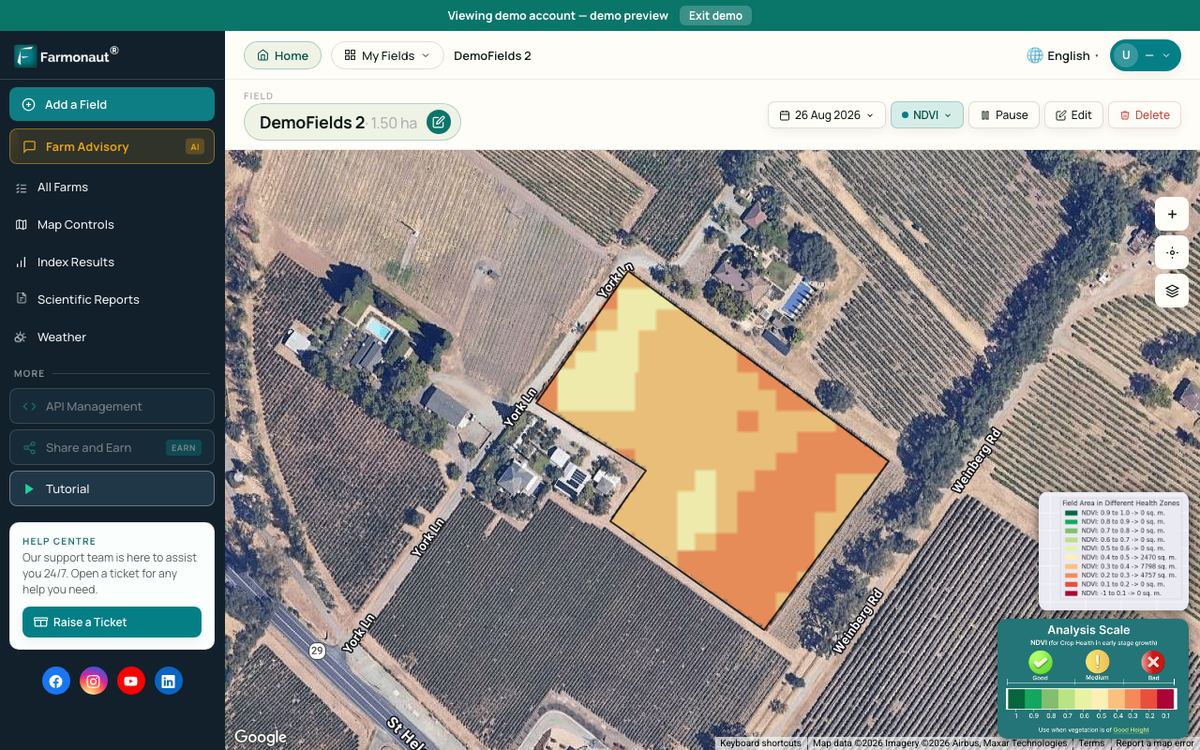
A probe reads one point. On large or uneven fields, it helps to see which zones dry out first, so you know where to put probes and which ones represent the field. Satellite vegetation maps show crop vigor and water stress patterns across the whole field, and Farm21 and CropX both combine their sensors with satellite data for this reason. The Farmonaut Satellite + AI Farm Monitoring System shows satellite crop health and soil moisture index maps for each field you draw, on web, Android and iOS, and its satellite and weather API (see also the API console) can feed those layers into your own tools. Satellite maps show where crops differ, not the cause; confirm with a probe or a soil check.
For wider water planning, see our guides on agriculture and water management and sustainable water management, and our deeper look at soil moisture sensors in agriculture.
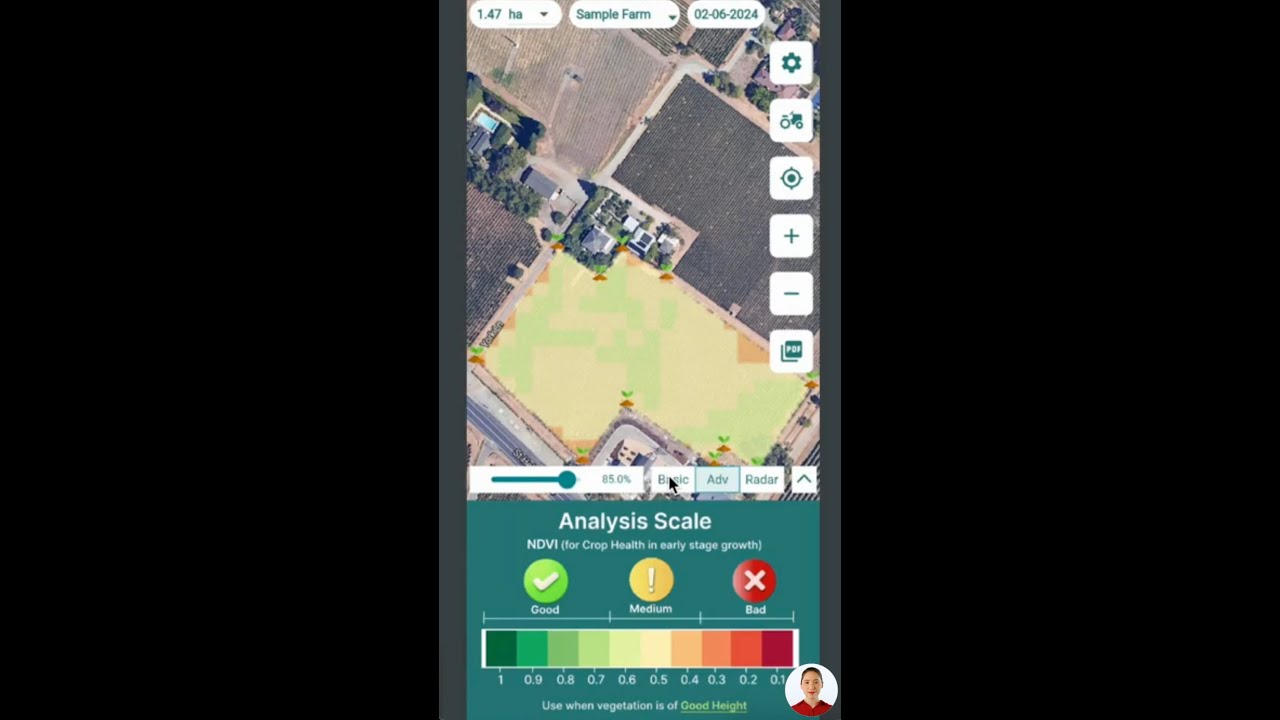
▶ How to read satellite crop maps in the Farmonaut mobile app. · 4:01
FAQ
Do soil moisture meters really work?
Yes, when installed well and calibrated. UC ANR cites yield gains of 9-10% in celery and strawberries and 10-16% water savings in deficit irrigation trials. Poor soil contact, wrong depth or uncalibrated readings are the usual reasons they disappoint.
What is the most accurate type of soil moisture sensor?
Neutron probes and well-calibrated TDR sensors are among the most accurate, but neutron probes need a licensed operator. For farm use, calibrated capacitance probes and tensiometers both give reliable readings for irrigation timing. Makers’ accuracy figures are often 0.5-3% volumetric water content, per the Arizona review.
How much does a farm soil moisture sensor cost?
About US$100-700 for a single-depth sensor and US$600-1,750 for a multi-depth probe, plus a gateway (US$399-2,250) and a data plan of US$150-350 a year, based on November 2023 list prices in the University of Arizona review.
How many sensors do I need per field?
Many advisors start with one station per field or per center pivot, with sensors at two or more depths. The Georgia irrigation budget assumes one sensor per pivot and one base station per farm. Add stations where soils differ.
How deep should I install a soil moisture sensor?
Cover the main root zone and one layer below it. Nebraska extension staff place Watermark sensors at 1, 2 and 3 feet, and sometimes 4 feet, in corn and soybeans. UC ANR notes that shallow-rooted, drip-irrigated crops such as strawberries use wetter triggers, while deep-rooted crops under overhead irrigation use drier triggers.
Can satellites replace soil moisture probes?
Not fully. Satellite data show patterns across the whole field, while a probe measures water at set depths in one spot. Used together, maps help you place probes and probes confirm what the maps suggest.
Related pages on our site: soil testers, farm planning steps, carbon footprinting, fleet management, crop loan and insurance checks, product traceability, large-farm management, home page, web app.
Farmonaut crop monitoring
See where your fields dry out first
Draw your fields once and Farmonaut shows satellite crop health and soil moisture maps for them through the season, on web, Android or iOS.



Sources
- University of Arizona Cooperative Extension, Guidance for Soil Moisture Sensor Selection: Market Analysis and Decision-Making Strategies (az2082, March 2024): extension.arizona.edu
- USDA NASS, 2023 Irrigation and Water Management Survey (2024): nass.usda.gov
- UC Agriculture and Natural Resources, Soil Moisture Sensors: ucanr.edu
- University of Nebraska-Lincoln CropWatch, Soil water content- and matric potential-based irrigation trigger values (2019): cropwatch.unl.edu
- University of Nebraska-Lincoln CropWatch, Study reviews farmer irrigation scheduling tendencies in central Nebraska (2022): cropwatch.unl.edu
- University of Nebraska-Lincoln CropWatch, Using the Watermark sensor: cropwatch.unl.edu
- Penn State Extension, Monitoring Soil Moisture (updated April 2024): extension.psu.edu
- University of Georgia Extension, Circular 1235: Cost of Irrigation Ownership and Operating Costs (June 2021): fieldreport.caes.uga.edu
- University of Arkansas Cooperative Extension, FSA58 Watermark soil moisture sensors fact sheet: uaex.uada.edu
- FAO Agritech Observatory, Farm21 profile: agritechobservatory.review.fao.org
- Sensoterra, company website: sensoterra.com
- Sentek Technologies, company website: sentektechnologies.com
- CropX, farm management system: cropx.com
- Arable, company website: arable.com
- Irrometer, soil moisture sensors: irrometer.com
Discussion
Questions, corrections or field experience? Share them below. First-time comments are reviewed before they appear, and your email is never published.
No comments yet. Be the first to add a question or your experience.

 Prochecker
 Misteo
 Tres Valles
 LACOS Geoinformation
 Pulsar Supernova
 Magrifly
 LatConnect 60
 WebsEdge
 Blickwinkel
 Agricultural Credit Policy Council
 MCSOD
 Marei Nursery
 eKGIS
 Mostas Tech
 Andex
 FCF India
 Unifrutti Gulf
 Deluxe Conseil

 Licence holder · Niger · Gold
 Licence holder · Nigeria · Gold + lithium
 Client · Tanzania · Gold
 Client · Somalia · Gold
 Client & affiliate partner · Ghana · Gold










