

Soil · Planting guide
Soil Temperature Map: 7 Sources and Crop Planting Temps
State mesonets and National Weather Service pages publish soil temperature maps, mostly at 2 or 4 inches. Corn needs about 10°C (50°F) at seeding depth and wheat about 4°C (39°F), according to Alberta Agriculture.
Key takeaways
- Seven public sources: NWS NCRFC, Iowa Environmental Mesonet, Oklahoma Mesonet, Nebraska CropWatch, MSU Enviroweather, LSU AgCenter and NOAA’s USCRN.
- Minimum germination temperatures: wheat 4°C, oats 5°C, corn 10°C (Alberta Agriculture); pepper and cucumber 60°F (OSU Extension).
- LSU AgCenter advises cotton planting after 3 days with a 65°F mean at 4 inches, measured at 8 a.m.
- Corn took 22 days to emerge at 50°F and 7 days at 68°F in the OSU table.
- Match the map depth to your seeding depth and use daily or multi-day averages.
In this article
- Soil temperature map sources at a glance
- How we chose these sources
- Seven places to find a soil temperature map
- Planting thresholds by crop
- Why warmer soil means faster emergence
- How to read a soil temperature map
- How to measure soil temperature in your own field
- Soil moisture: the other half of the planting call
- Greenhouses and high tunnels
- Common mistakes with soil temperature data
- FAQ
A soil temperature map shows how warm the ground is at a set depth, usually 2 or 4 inches, across a state or region. In the US, the quickest free-to-view sources are state mesonets and National Weather Service pages; the NWS North Central River Forecast Center publishes maps by depth for the Midwest. Most field crops need the soil at seeding depth to reach a set minimum before planting: about 10°C (50°F) for corn and 4°C (39°F) for wheat, according to Alberta Agriculture’s germination guide.
This guide lists seven places to find these maps, explains what each one measures, and gives planting thresholds by crop with charts. It also has a small calculator that checks your own morning and afternoon readings against a crop minimum.
Soil temperature map sources at a glance
The table compares the seven sources in this guide. Depth matters: a 2-inch reading warms and cools faster than a 4-inch one, so compare like with like.
| Source | Area covered | Depths shown | Best for |
|---|---|---|---|
| NWS NCRFC | Upper Midwest | Several depths | Regional overview and frost depth |
| Iowa Mesonet | Iowa, by county | 4 inches | County maps plus a forecast |
| Oklahoma Mesonet | Oklahoma | 2, 4, 10, 24 inches | Bare-soil map, 1- and 3-day averages |
| Nebraska CropWatch | Nebraska | 4 inches, bare soil | 1-day and 7-day averages |
| MSU Enviroweather | Michigan | Station network | Crop and pest tools |
| LSU AgCenter | Louisiana | 4 inches, hourly | Cotton and Southern crops |
| NOAA USCRN | Lower 48, Alaska, Hawaii | Station soil probes | Long, quality-checked records |
How we chose these sources
We picked sources that are run by a government agency or a university, that publish soil readings rather than air temperature only, and that state the depth they measure. We opened each page in October 2026. Some state pages change address or go offline for a while, so check the page date before you rely on it. We left out sites that only model soil warmth from air temperature without saying so.
Seven places to find a soil temperature map
1. National Weather Service river forecast center maps
The NWS North Central River Forecast Center has a page of soil temperature maps by depth, next to its frost depth and spring flood outlook pages. It covers the upper Midwest, the region that drains to the Mississippi and the Great Lakes. Best for: a quick regional view in early spring, when frost is leaving the ground.
2. Iowa Environmental Mesonet county maps
Iowa State University’s Iowa Environmental Mesonet shows a daily map of 4-inch soil temperature for every county. It blends ISU Soil Moisture Network readings with a bias-corrected NWS model, and adds a second map from the GFS forecast model. Best for: Iowa growers who want county detail and a look at the next few days.
3. Oklahoma Mesonet
The Oklahoma Mesonet soil temperature pages offer current maps at 2, 4, 10 and 24 inches, plus a 4-inch bare-soil map. They also show 1-day and 3-day averages, which smooth out one warm afternoon. Best for: Oklahoma wheat, cotton and pasture managers who want several depths in one place.
4. Nebraska CropWatch and Nebraska Mesonet
The University of Nebraska’s CropWatch soil temperature page reports 4-inch readings under bare soil, with 1-day and 7-day averages, using data from the Nebraska State Climate Office. In October 2026 the page said its data feed was down for a while and pointed readers to the Nebraska Mesonet for current bare-soil readings. Best for: Nebraska corn and soybean planting decisions.
5. Michigan State University Enviroweather
MSU Enviroweather offers weather and crop tools for Michigan growers, built on a network of weather stations around the state. Best for: Michigan field crop, fruit and vegetable growers.
6. LSU AgCenter weather stations
The LSU AgCenter publishes hourly soil temperatures at the 4-inch planting depth for its Louisiana stations. Its cotton advice uses those readings directly (see the cotton threshold below). Best for: cotton, rice and vegetable growers in Louisiana and nearby states.
7. NOAA U.S. Climate Reference Network
NOAA’s U.S. Climate Reference Network is a set of high-quality stations across the lower 48 states, Alaska and Hawaii. The stations measure temperature, rain, wind and soil conditions at long-term sites protected from land-use change. Best for: national comparisons and long records, not field-level detail, because stations are far apart.
Outside the US, check your provincial or national weather service. In Canada, Alberta’s guide notes that soil warmth differs a lot between sites in the same province (see the chart in the measuring section below).

▶ How satellite remote sensing maps soil moisture across fields. · 4:50
Planting thresholds by crop
A soil temperature map is only useful next to a number. The minimums below are germination guides, not guarantees. Alberta’s guide says values should be regarded as approximate because germination depends on several factors, including moisture and seed quality.
Chart
Minimum soil temperature for germination
°F, selected crops
Oregon State University Extension publishes a table of soil temperatures for vegetable seed germination, based on work by J. F. Harrington of UC Davis (published 2013, reviewed 2024). The chart shows the minimum it lists for common crops.
| Crop | Minimum | Preferred range | Source |
|---|---|---|---|
| Wheat | 4°C (39°F) | 20°C | Alberta Agriculture |
| Barley | 3-5°C | 20°C | Alberta Agriculture |
| Oats | 5°C | 20-24°C | Alberta Agriculture |
| Canola | 5°C (Argentine type) | 15-20°C | Alberta Agriculture |
| Alfalfa | 1°C | 25°C | Alberta Agriculture |
| Corn | 10°C (50°F) | 16-32°C | Alberta; OSU |
| Dry beans | 15°C ideal | 18-23°C growth | OMAFRA |
| Cotton | 65°F at 4 in. | 3 days in a row | LSU AgCenter |
| Tomato | 50°F | 60-85°F | OSU Extension |
| Pepper | 60°F | 65-95°F | OSU Extension |
Two crops need extra care. For cotton, the LSU AgCenter advises a mean daily temperature of 65°F or more at a 4-inch depth, measured at 8 a.m., for at least three days in a row, and a check of the five-day forecast. For dry edible beans, the Ontario agronomy guide for field crops gives 15°C or above as the ideal germination temperature and warns that cold soil raises the risk of slow emergence, crusting damage and root rot.
Seed labels and seed company guides may give their own numbers for a variety. When they differ from the tables here, follow the seed supplier and your local extension office.
Why warmer soil means faster emergence
Below the minimum, germination is delayed, which can damage seed and leave an uneven stand. Above it, emergence speeds up quickly. The OSU table counts the days until seedlings appear from seed planted half an inch deep. Corn took 22 days at 50°F, 12 days at 59°F and 7 days at 68°F. Tomato took 43 days at 50°F and 8 days at 68°F.
Chart
Days to seedling emergence by soil temperature
Days, seed planted half an inch deep
The OSU figures come from seed held at a steady temperature, so field results vary. Still, they show why waiting can pay: if a week of warming took your soil from 50°F to 59°F, corn planted then would need about 12 days instead of 22. The same table shows lettuce and onion sprouting even at 41°F, which is why cool-season crops go in first.
How to read a soil temperature map
Use these steps before you trust any color on a map.
- Check the depth. A 2-inch map runs warmer in the afternoon and colder at dawn than a 4-inch map. Match the depth to your seeding depth.
- Check the cover. Bare soil warms faster than soil under sod or heavy residue. Oklahoma and Nebraska both publish bare-soil readings for this reason.
- Check the time. Is it a single reading, a daily mean or a 3-day or 7-day average? Averages are better for planting calls.
- Check the date. Some maps show the last reading the station sent. If a feed is down, the map may be days old.
- Check the forecast. A cold front after planting can undo a warm week. LSU links its cotton advice to the five-day outlook.
- Check your own field. A station a few miles away may sit on different soil, slope or cover.
How to measure soil temperature in your own field
Alberta Agriculture’s guide explains a simple method. Any thermometer that reads at a set depth will do. Push a rod in first to make a pilot hole, put the bulb at your planting depth, wait a minute or two, and shade the thermometer in bright sun. Take readings in the morning and the afternoon; the guide says the daily average usually lies between the two.
Pick spots that look like the land you will seed. The guide notes that bare soil warms fastest, south-facing slopes warm before north-facing ones and level land, and dry soils warm faster than wet ones. Shallow depths warm first, so a shallow seeding gives the earliest germination if moisture is there.
The chart shows how much soil warmth varies between sites in one province. It uses Alberta’s long-term average 5 cm readings under grass for May, morning versus afternoon.
Use the calculator to check your own readings against a crop minimum from the table above.
Chart
May soil temperature at 5 cm, Alberta sites
°C, long-term monthly averages under grass
Try the numbers for your own farm below.
Calculator
Is your soil warm enough to plant?
Enter your own morning and afternoon readings at seeding depth and the crop minimum.
- Estimated daily average: 51.0 °F
- Estimated daily average in °C: 10.6 °C
- Crop minimum in °C: 10.0 °C
Example values only, not a benchmark or a forecast. The daily average is taken as the midpoint of your two readings, a simplification of Alberta Agriculture’s note that the daily average usually lies between them. Crop minimums come from the table above (Alberta Agriculture; OSU Extension); check your seed supplier’s guide too.
Soil moisture: the other half of the planting call
Warm soil is not enough if the seedbed is too dry or too wet. Wet soil also warms more slowly, as the Alberta guide points out. Many mesonet sites that publish soil temperature also publish soil moisture, so check both on the same page. For a wider look at soil data layers, see our guide to USGS and global soil maps.
Satellite images do not measure soil temperature at seeding depth. They can, however, show how crops emerge and grow across a field after planting. Farmonaut Satellite + AI Farm Monitoring System gives vegetation and moisture-index maps for fields you draw, so you can see which parts of a field came up late. For developers, our satellite data API and the satellite weather API developer docs explain the data feeds.
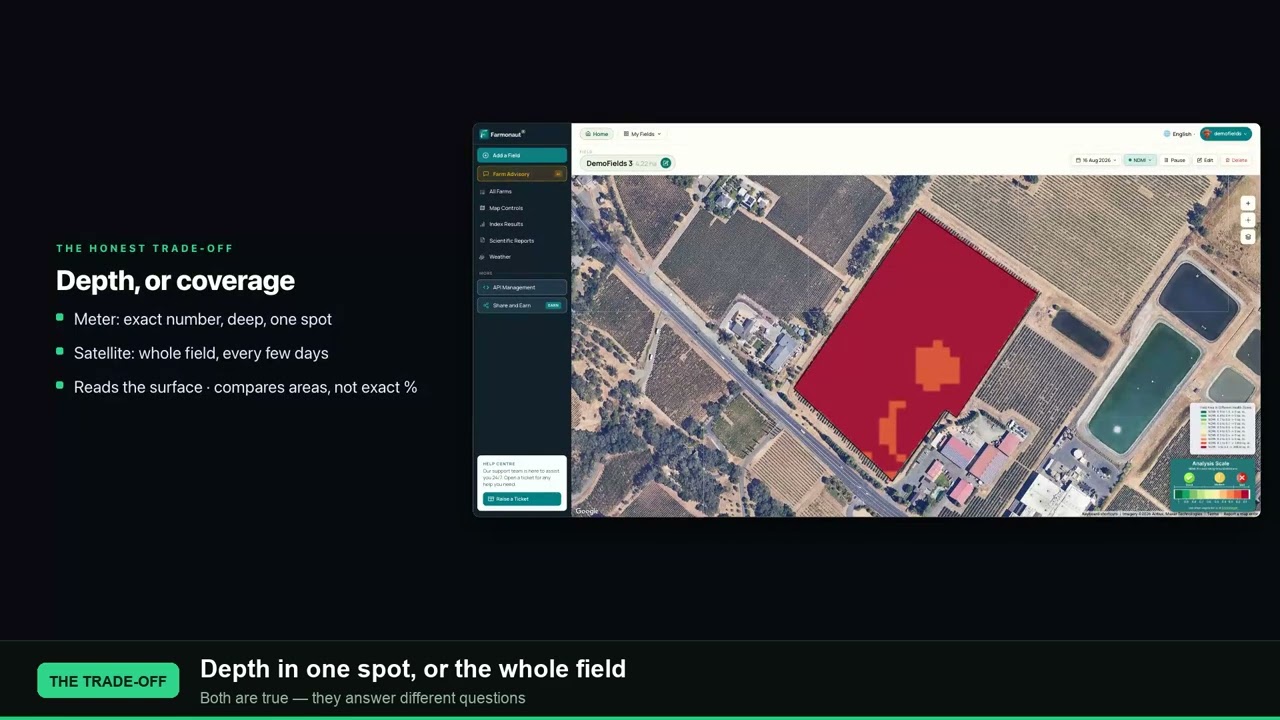
▶ When a soil moisture probe helps and when satellite moisture maps are enough. · 2:11
Greenhouses and high tunnels
Under cover, the soil warms earlier than in the open field, so outdoor maps say little about it. Use a probe thermometer in the beds or a wired sensor. Warm-season vegetables such as pepper, eggplant and cucumber have a 60°F minimum in the OSU table, so they gain most from protected soil in early spring.
Common mistakes with soil temperature data
- Planting on one warm afternoon. Use a daily or multi-day average.
- Reading the wrong depth. A 2-inch map can be several degrees off a 4-inch reading at the same hour.
- Using air temperature. Soil lags air by days in spring.
- Ignoring residue. Alberta’s guide notes that bare soil warms fastest, so fields under heavy residue may lag nearby tilled ones.
- Trusting an old map. Check the time stamp on every map.
Related pages on our site: farm monitoring app, agribusiness admin app, farm fleet management, product traceability, crop loan and insurance verification, carbon footprinting.

▶ Six plain steps to start precision farming, from field maps to satellite monitoring. · 4:18
FAQ
Where can I find a soil temperature map for my state?
Start with your state mesonet or state climate office, then your land-grant university’s extension site. Oklahoma, Iowa, Nebraska, Michigan and Louisiana all publish soil readings. The NWS North Central River Forecast Center covers the upper Midwest.
What soil temperature is needed to plant corn?
Alberta Agriculture and Oregon State University Extension both list 10°C (50°F) as the minimum for corn germination. At that temperature emergence is slow; the OSU table shows 22 days at 50°F against 7 days at 68°F.
At what depth should I measure soil temperature?
Measure at the depth you plan to seed. Many US planting guides and maps use 4 inches; Alberta’s guide uses seeding depth and shows 5 cm (2 inch) averages.
When should I check soil temperature during the day?
Alberta’s guide suggests a morning and an afternoon reading, since the daily average usually lies between them. LSU’s cotton advice uses an 8 a.m. reading over three days.
Can satellites measure soil temperature for planting?
Satellites measure the surface, not the soil at seeding depth, so use ground stations or a probe for planting calls. Satellite crop maps are more useful after planting, to see emergence and crop growth across a field.
Farmonaut crop monitoring
See how your fields emerge from space
Draw your fields once and Farmonaut shows satellite vegetation maps for them through the season, on web, Android or iOS.



Keep reading
Sources
- Alberta Agriculture and Forestry, Soil Temperature for Germination (Agdex 120/3, published 2000): www1.agriculture.alberta.ca
- Oregon State University Extension, Soil temperature conditions for vegetable seed germination (J. F. Harrington; published 2013, reviewed 2024): extension.oregonstate.edu
- LSU AgCenter, Soil temperature important for cotton planting (April 2020): lsuagcenter.com
- Ontario Ministry of Agriculture, Food and Rural Affairs, Agronomy Guide for Field Crops, Chapter 5: Dry Edible Beans (2022): ontario.ca
- National Weather Service, North Central River Forecast Center, Soil Temperature Maps by Depth (accessed October 2026): weather.gov
- Iowa State University, Iowa Environmental Mesonet, County 4 inch Soil Temperature Maps (accessed October 2026): mesonet.agron.iastate.edu
- Oklahoma Mesonet, Soil Temperature maps (accessed October 2026): mesonet.org
- University of Nebraska-Lincoln, CropWatch Soil Temperature Update (accessed October 2026): cropwatch.unl.edu
- Michigan State University, Enviroweather (accessed October 2026): enviroweather.msu.edu
- NOAA National Centers for Environmental Information, U.S. Climate Reference Network (accessed October 2026): ncei.noaa.gov
Discussion
Questions, corrections or field experience? Share them below. First-time comments are reviewed before they appear, and your email is never published.
No comments yet. Be the first to add a question or your experience.

 YelloSkye
 GalaxEye Space
 Sun Palm Australia
 Grandstream Algérie
 XOS Realty
 Geospatial Lab Africa
 Agro La Gándara
 HIPSAC
 ZOL Zimbabwe
 Juligerm
 AdBio
AdBio MISE Maroc
 NWNS
NWNS Red August Group
 Farm Inc
 WeMe Global
 Agrotoken
 Blue BearX
 Insignito
 Licence holder · Niger · Gold
 Licence holder · Nigeria · Gold + lithium










