

IoT for Smart Farming: 7 Game-Changing Systems for 2026
Table of Contents
- Introduction: Smart Farming IoT – The Agricultural Revolution
- The Core of Smart Farming: What is IoT for Smart Farming?
- Key Benefits of Smart Farming Systems
- 7 Game-Changing IoT Systems for Smart Farming in 2026
- Comparison Table: 7 Leading IoT Systems in Agriculture
- Vertical Farming Using IoT: The Future Indoors
- Smart Supply Chain & Walmart Farming Approach
- How Farmonaut Empowers Smart Agriculture in 2026
- Future Trends: Predictive Analytics, AI Integration, and Beyond
- FAQ – IoT for Smart Farming in 2026



Introduction: Smart Farming IoT – The Agricultural Revolution
The global landscape of agriculture is shifting dramatically. Over the past years, the emergence of IoT for smart farming has revolutionized the sector, leading us toward a future where smart farming systems are not just innovative, but indispensable. As we move into 2025 and beyond, technology stands at the forefront – enabling farmers, businesses, and governments to monitor, analyze and automate food production with precision never seen before.
Smart farming IoT solutions, such as sensors, drones, and integrated satellite technologies, promise increased crop efficiency, optimal usage of resources, and sustained environmental impact reduction. This blog explores seven game-changing smart farming IoT systems for 2026 – providing insights into their applications, benefits, and the future of agriculture.
The Core of Smart Farming: What is IoT for Smart Farming?
In agricultural terms, IoT for smart farming refers to the integration of digitally connected devices that monitor, collect, and transmit data across the farming landscape. These systems utilize an array of sensors (measuring soil moisture, temperature, humidity, nutrient levels, and pest presence), satellite imagery, drones, and machine-to-machine (M2M) communications to create a continuous stream of information.
How Does This Technology Work?
- Deploys intelligent sensors directly in the soil and crop canopy to monitor real-time moisture, temperature, and nutrient levels.
- Uses drones and satellite imagery for rapid crop health monitoring and pest detection.
- Enables automated irrigation and fertilization by linking sensor data with control systems.
- Feeds data into cloud-based analytics platforms for predictive management of yields, growth patterns, and input needs.
- Integrates with AI-driven carbon footprint monitoring and advisory systems for truly smart, sustainable agriculture.

How many US farms use IoT and precision tools
Connected farm technology is common on big crop farms and rare on small ones. USDA survey data for 2023 show the gap clearly.
| Technology (2023) | Small farms | Midsize farms | Large-scale crop farms |
|---|---|---|---|
| Guidance autosteering | 9% | 52% | 70% |
| Variable rate technology | 5% | 32% | 45% |
| Yield monitors, yield maps or soil maps | 13% | – | 68% |
Source: USDA ERS, America’s Farms and Ranches at a Glance 2024. Drone use levelled off at 12% of large-scale crop-producing family farms, and robotic milking was used on 19% of large-scale farms that produced milk.
Across all farms, the picture is thinner. USDA’s farm technology survey found that 27% of US farms used any precision agriculture practice in 2023 and 22% in 2025. Connectivity is the base layer: 85% of farms had internet access in 2025, 74% had a cellular data plan and 55% used a broadband connection (USDA NASS, Technology Use, August 2025).
Key Benefits of Smart Farming Systems & IoT Integration
- 📊 Enhanced Efficiency: Automated systems reduce manual labor, and increase productivity by focusing precisely on what each crop needs.
- 📊 Improved Crop Yields: Close monitoring of soil and plant health leads to higher yields and quality produce.
- 📊 Sustainability: Efficient resource usage (especially water via smart irrigation) lowers environmental impact and waste.
- 📊 Predictive Insights: Historical + real-time data powers predictive analytics—forecasting weather, pests, and market movements.
- 📊 Transparent Traceability: With innovations like blockchain-enabled product traceability consumers have increased trust in food authenticity.

7 Game-Changing IoT Systems for Smart Farming in 2026
As digital transformation accelerates in agriculture, seven leading smart farming systems stand out for 2026. Each brings a unique mix of sensors, analytics, automation, and control—redefining efficiency, crop growth, and sustainability for farmers and the entire supply chain.
- Satellite-Based Crop Monitoring Systems
- Main Application: Field health and vegetation analysis via satellites
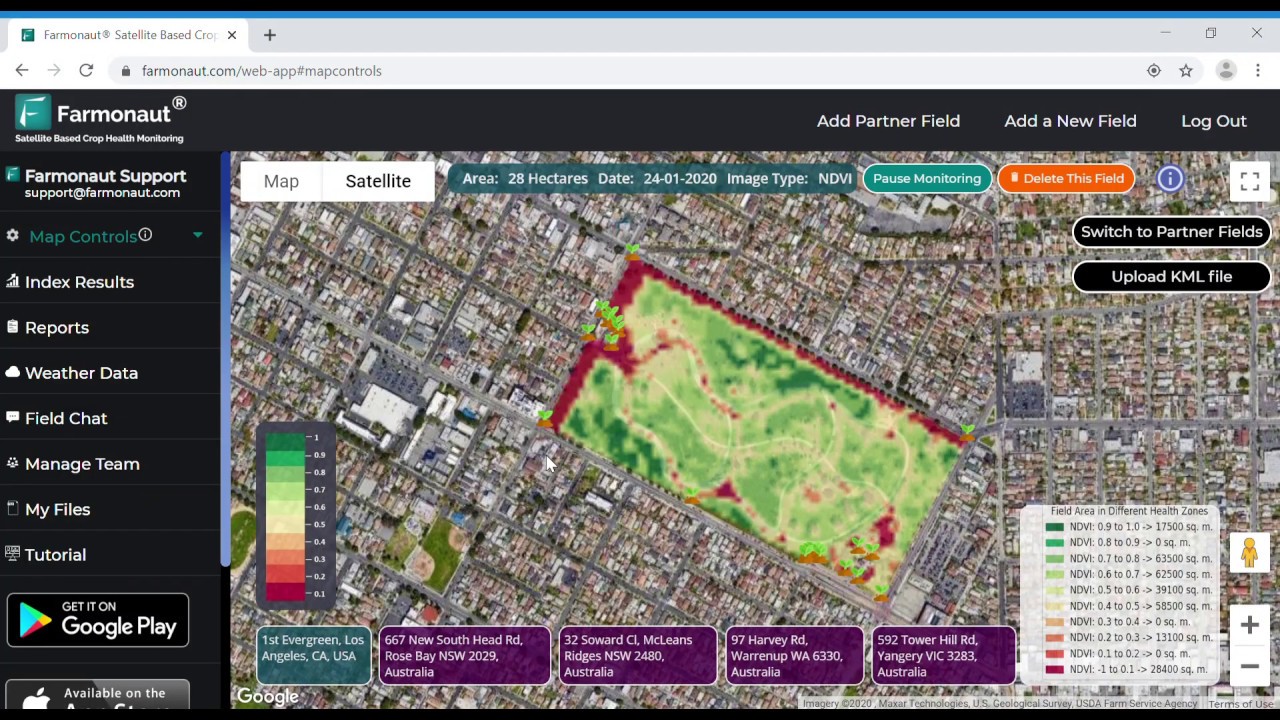
- Key Features: Real-time NDVI mapping, pest/disease hotspot tracking, automated alerts, large-scale crop management
- Farmonaut Services: Our system monitors soil moisture, crop health, and environmental impact, providing actionable intelligence for farmers and governments across millions of hectares.
- Smart Irrigation Controllers
- Main Application: Automated water usage management
- Key Features: Soil moisture sensors, rain sensors, remote control via app, AI-driven scheduling, integration with satellite-guided irrigation planning
- Livestock Health Monitoring Solutions
- Main Application: Real-time animal health and location tracking
- Key Features: Wearable IoT devices, continuous behavior/logging, early disease detection, AI-based alerts, environmental impact monitoring
- Vertical Farming IoT Ecosystems
- Main Application: Indoor, vertical crop growing with closed-loop environmental control
- Key Features: Sensors for CO2, light, temperature, humidity; automated nutrient/fertigation systems; growth analytics; blockchain-based traceability
- Agro-Machinery & Equipment Telematics
- Main Application: Fleet/resource management for tractors, combine harvesters, and logistics
- Key Features: GPS tracking, predictive maintenance, fuel efficiency analytics, AI-based route optimization, satellite-integrated fleet management
- Pest & Disease Predictive Analytics Platforms
- Main Application: Early identification of pest/disease outbreaks
- Key Features: Multi-modal sensor data, climate pattern recognition, AI/ML, satellite alerts, automated recommendations for intervention
- Farmonaut Jeevn AI: This leverages real-time and historical satellite data to predict pest risks and recommend field-level actions for farmers, reducing pesticide waste and environmental impact.
Common Mistake: Ignoring pest alerts is costly. FAO estimates that up to 40% of global crop production is lost to pests each year (FAO, 2021). Act on system alerts promptly.
- Blockchain-Based Agri Traceability Solutions
- Main Application: Ensuring authenticity across the agri-food supply chain
- Key Features: Seamless integration with sensor and IoT data, harvest-to-market product tracking, tamper-proof blockchain records, compliance-ready reporting, access to credit/insurance validation for crops

Comparison Table: 7 Leading IoT Systems in Agriculture
Use this table for a quick glance at the top smart farming systems and their projected value in 2026:

Vertical Farming Using IoT: The Future Indoors
Vertical farming using IoT is rapidly becoming a transformative system for high-density crop production, especially in urban areas. This smart agriculture technique involves growing crops in vertically stacked layers, often in controlled, indoor conditions. Here’s how IoT propels vertical farming into the future:
- IoT sensors precisely regulate temperature, humidity, light intensity, and CO2 levels—optimizing photosynthesis for every plant.
- Automated irrigation and nutrient-fertigation deliver minimal water and fertilizer for maximum yield.
- Advanced analytics predict crop performance, growth cycles, and harvest timings in real-time.
- Blockchain integration ensures complete traceability from seed to food.
- Enables urban farming and year-round production, even with limited land and resources.

Pros & Icons Visual List: Vertical Farming with IoT
- 🌇 Year-Round Crop Production: Independent of weather—continuous food supply.
- ♻ Water Savings: Closed-loop systems recirculate water, so far less is lost to runoff and evaporation than in open fields.
- 🔒 Enhanced Food Safety: Closed system prevents pest intrusion and contamination.
- 💡 Data-Driven Optimization: Every growth parameter is measured and controlled for maximum efficiency and quality.
- 🏙 Urban Integration: Make use of non-arable urban rooftops and warehouses.

Smart Supply Chain & Walmart Farming Approach
Walmart, for example, required its leafy-green suppliers to trace products back to the farm on the IBM Food Trust blockchain by September 2019, cutting trace-back time from days to seconds (Walmart, 2018).
- Track produce through every stage—from field/growth to harvest to transportation—with sensors, cameras, and digital records.
- Ensure timely harvest, optimal storage conditions, and minimized loss in transit.
- Enable rapid, transparent recalls or certifications, supporting regulatory and consumer demands.
- Integrate blockchain for trusted traceability—proving origin, quality, and fair trade practices.
- Leverage satellite data to cross-validate crop claims for insurance or credit applications: Check satellite-based farm loan & insurance verification.

How Farmonaut Empowers Smart Agriculture in 2026
At Farmonaut, we are committed to making satellite-driven insights affordable and accessible for all stakeholders in agriculture. Our platform blends advanced satellite imagery (multispectral NDVI, crop stress mapping), AI-powered analytics, and blockchain traceability, supporting decision-makers in farm management, supply chains, and regulatory environments.
- Real-time monitoring of crop health, soil moisture, temperature, and environmental impact from anywhere, on any device.
- Jeevn AI Advisory System: Delivers actionable, personalized strategies based on real-time and historical satellite data. See AI in action for predictive pest, irrigation, and weather guidance.
- Robust fleet and resource management tools to optimize machinery usage, operational costs, and reduce environmental footprint. Learn more about our fleet management tools.
- Blockchain-based traceability strengthening supply chain authenticity, supporting market and regulatory demands.
- Environmental impact monitoring with accurate, actionable carbon footprinting for sustainable growth and compliance.
Our business model is designed for everyone—from smallholder farmers using mobile apps, to large agricultural enterprises, governments, and corporate supply chain managers. Farmonaut’s SaaS approach makes advanced technology attainable while scaling with operational growth.
Discover our developer resources for satellite weather API here or visit our direct API endpoint.
Future Trends: Predictive Analytics, AI, and Beyond – Smart Farming in 2026
The integration of IoT and AI promises an even smarter tomorrow. The combination unlocks true predictive insights for:
- 📊 Weather Pattern Forecasting: Sensors and satellites blend with AI to predict seasonal anomalies, droughts, or excessive rainfall with higher precision.
- 📊 Pest/Disease Outbreaks: Combines ground, aerial and space-borne data for early warnings—crucial for reducing waste and chemical use.
- 📊 Crop Yield Projections: Automated models analyze every growth stage, optimizing market timing and logistics.
- 📊 Resource Planning: Smart algorithms prescribe fertilization, irrigation, and harvest plans to maximize both yield and sustainability.
- 📊 Market Dynamics: Satellite-backed supply chain analytics reduce risk, giving farmers & investors better pricing power and harvest-to-market efficiency.
5 Bullet Points on the Future of Smart Farming IoT
- ✔ Edge Computing: Decentralizes analysis, speeding up alerts and reducing cloud costs in 2026’s sensor-heavy fields.
- ✔ More Accessible Financing: Satellite-based verification revolutionizes crop loans and insurance.
- ✔ Expansion of Connected Devices: More sensors, tags and connected machines in fields, supporting precision management at all scales.
- ✔ AI-Powered Swarm Drones: Automating pest control, crop scouting, and seeding across complex or remote terrain.
- ✔ Ultra-Sustainable Practices: Detailed carbon, water, and input monitoring support regenerative and climate-resilient agriculture.
What holds back IoT on farms
A 2024 review by the US Government Accountability Office named three main barriers to wider use of precision agriculture tools (GAO-24-105962):
- Upfront cost. New sensors, controllers and connected machinery need capital that many farms do not have.
- Data ownership. Farmers are unsure who owns field data and how technology companies will use it.
- No common standards. Devices and software from different makers often do not work together.
Reasons for buying differ by tool. In USDA’s 2023 survey, 64% of farms using autosteer cited less operator fatigue and 50% cited saved labor time. Farms using yield monitors or soil maps most often cited higher yields (55%) and lower input costs (41%) (USDA ERS). Before buying, check whether your fields have the cellular or broadband coverage the device needs to send data.
FAQ – IoT for Smart Farming in 2026
1. What is IoT for smart farming, and how does it work?
IoT for smart farming refers to the deployment of internet-connected devices—like sensors, cameras, GPS units, and automated machinery—that collect data about conditions such as soil moisture, crop growth, livestock health, and equipment performance. This data is transmitted to cloud-based platforms, where it’s analyzed (often with AI/machine learning) to trigger automated responses (irrigation, fertilization) or to guide informed decisions, increasing efficiency and sustainability.
2. How do smart farming IoT systems improve efficiency and sustainability?
They allow for real-time, data-driven resource management—so water, fertilizer, and energy are used only when and where they’re needed. This minimizes waste and environmental impact, while often boosting crop yields and reducing operational costs.
3. What crops and farm sizes benefit most from these systems?
Smart farming systems benefit all scales, from smallholders to large enterprises. Crops with high value, tight quality standards, or complexity (like tomatoes, leafy greens, berries) see the greatest gains. Vertical farming using IoT particularly suits urban farming and areas with limited land and water.
4. How does Farmonaut help different types of agricultural users?
Farmonaut’s platform provides scalable solutions, from small farmers accessing real-time crop and soil insights via mobile app, to agribusinesses and governments managing entire regions. Our tech integrates satellite data, AI-based advisory, and blockchain traceability, empowering data-driven, transparent farming for all users.
5. Are IoT systems hard to integrate with existing operations?
It depends. Satellite-driven and cloud-based options need little in-field hardware, but sensors and machinery from different makers often lack common standards and may not work together, and upfront cost is a real barrier (GAO, 2024). Check compatibility and field connectivity before buying.
Conclusion
As the global demand for sustainable and productive agriculture continues to rise, IoT for smart farming stands poised at the forefront of agricultural transformation. From vertical farming using IoT to Walmart farming scale supply chain optimization, today’s smart farming systems empower farmers to monitor, analyze, and automate every aspect of their operations. Integration with AI, satellite imagery, and blockchain multiplies the efficiency, resilience, and sustainability of food production as we move toward 2026.
Whether you are an individual grower, a commercial agribusiness, or a forward-thinking investor, there has never been a better time to adopt cutting-edge smart farming IoT technology. The future of agriculture is intelligent, connected, and transformative.
Learn more about Farmonaut’s Carbon Footprinting tools for sustainable agriculture here.
Explore product traceability for your smart supply chain with Farmonaut.
Enhance operational efficiency with fleet/resource management tools by Farmonaut.
Discover agro admin tools for comprehensive, large-scale farm management with Farmonaut.

 Sama Premium
 Mahaswami
 Prochecker
 Tres Valles
 LACOS Geoinformation
 Pulsar Supernova
 Magrifly
 LatConnect 60
 WebsEdge
 Blickwinkel
 Agricultural Credit Policy Council
 MCSOD
MCSOD Marei Nursery
 eKGIS
eKGIS Mostas Tech
 Andex
Andex FCF India
 Unifrutti Gulf
 Deluxe Conseil
