

Technology in Sustainable Agriculture: 7 Key Innovations 2025
Meta Description: Discover how technology in sustainable agriculture is transforming farming in 2025. Explore 7 innovations, including precision agriculture and biotechnology, that enhance productivity, resilience, and ecological balance.
In Fraunhofer ISE’s Heggelbach trial, growing crops under solar panels raised land use efficiency to 186% in the hot summer of 2018 (Fraunhofer ISE).
Introduction: The Critical Role of Technology in Sustainable Agriculture
Technology in sustainable agriculture is not simply a buzz phrase—it is a transformative force, redefining how we grow, manage, monitor, and transport our food. As global food security, climate change, and population growth interconnect, agricultural stakeholders increasingly realize the necessity to harness innovative tools, data-driven decisions, and ecological balance. By 2025, the integration of technology in sustainable farming is not just desirable; it’s indispensable for optimizing productivity, enhancing resilience, and promoting environmental stewardship.
The Imperative for Sustainable Agriculture
Sustainable agriculture seeks to meet current and future food needs without compromising natural resources or the environment. It is a paradigm that emphasizes the preservation of soil health, biodiversity, water, carbon sequestration, and socio-economic viability for farming communities. As the world faces increasing pressures from climate degradation, natural resource scarcity, and environmental impacts, traditional farming methods—which, although foundational, cannot scale sustainably—demand technology-led interventions.
Sustainable agriculture technology innovations directly address these challenges. These innovations span digital data platforms, next-generation sensors, artificial intelligence, advanced machinery, remote sensing, and biotechnology, providing new solutions to age-old problems and laying the foundation for a more resilient food system.
Modelled hydroponic lettuce in Arizona used about 12 times less water per kilogram than field lettuce, but about 82 times more energy (Barbosa et al., 2015).
Technology in Sustainable Farming: Reshaping the Global Landscape
The integration of technology in sustainable agriculture is rapidly reshaping the global landscape of food production, enabling us to optimize input use, reduce environmental impacts, and improve productivity. Let us explore the primary technological trends driving this transformation in 2025:
- Precision Farming leverages data, IoT, and automation to deliver resources in the most efficient, targeted manner.
- Biotechnology in Sustainable Agriculture brings crop resilience and reduced dependence on chemicals.
- AI-driven Decision Support & Real-Time Monitoring ensure fast responses to crop and weather conditions.
- Digital Platforms & Supply Chain Traceability foster transparency, reduce waste, and support sustainability claims.
- Renewable Energy & Mechanization curb emissions, promoting climate mitigation and sustainable intensification.
- Agroforestry & Forestry Technologies preserve biodiversity, enhance carbon sequestration, and enable stable food production in challenging environments.
7 Key Sustainable Agriculture Technology Innovations for 2025
In exploring technology in sustainable agriculture, these seven innovations are fundamentally reshaping how farming, management, and conservation coexist:
- Precision Agriculture & Data-Driven Farming
- Artificial Intelligence, Remote Sensing & IoT Integration
- Biotechnology in Sustainable Agriculture
- Advanced Water & Nutrient Management Technologies
- Digital Farm Management Platforms & Blockchain Traceability
- Renewable Energy & Climate-Smart Mechanization
- Forestry & Agroforestry Innovations
1. Precision Agriculture & Data-Driven Farming
Precision agriculture is at the heart of modern sustainable agriculture technology innovations. By employing GPS-guided machinery, drone-based remote sensing, satellite imagery, IoT-enabled sensors, and big data analytics, we now enable site-specific management of crops, soils, and resources, rather than blanket application. The result: increased efficiency, higher yields, and significant reductions in inputs, waste, and environmental impact.
Key Features & Benefits:
- Site-Specific Crop Management: Field variability is precisely mapped; water, fertilizer, and pesticide are only applied where and when needed.
- Real-Time Data Collection: Sensors in fields provide continuous monitoring of soil moisture, nutrient levels, pest presence, and crop health.
- Variable Rate Technology (VRT): Advanced machinery adjusts the rate of input application dynamically, reducing runoff and maximizing output.
- AI and Predictive Analytics: Farmers now leverage AI-powered weather models, disease prediction, and crop modeling for optimum decision making in a highly variable climate.
- Resource Optimization: Each drop of water and granule of fertilizer is accounted for—accentuating resource conservation while enhancing productivity.
Precision agriculture can raise yields and cut input waste, but the size of the gain varies widely with the crop, the field and the farm’s starting practices. Such technology is now indispensable for scaling sustainable food production.




2. Artificial Intelligence, Remote Sensing & IoT Integration
The integration of AI, remote sensing, and the Internet of Things (IoT) is leading to a new era of smart, connected farms. Drones, satellites, and sensors collect data not just on weather and soil conditions, but also on plant health, growth stages, and pest outbreaks. Cloud-connected IoT devices feed this data to AI-powered platforms, automating complex analyses and delivering actionable recommendations to farmers directly on mobile devices.
- Drones and Satellite Monitoring: High-resolution aerial imagery provides accurate plant vigor analysis and helps in early detection of stress, pests, and diseases.
- Automated Alerts: Advanced platforms use machine learning to trigger real-time alerts for irrigation, fertilization, and crop threats—reducing manual labor and guesswork.
- Climate and Weather Prediction: Local sensors and remote data are aggregated for granular, plot-level forecasting, supporting climate-resilient management.
- Integrated Systems: Cloud-based management tools combine device data, weather, and market analytics for full-spectrum farm oversight, reducing losses and enhancing returns.
Such digital innovations are at the core of efficient resource use, supporting millions of farmers in monitoring and optimizing production—especially in climate-vulnerable regions.

3. Biotechnology in Sustainable Agriculture
Biotechnology in sustainable agriculture unlocks powerful new approaches for combating climate variability, pest pressures, and soil degradation. Precision techniques—like CRISPR-Cas9 and gene editing—allow for the development of crop and forest species that thrive amid changing conditions, resist pests and diseases, and use resources more efficiently.
Cutting-edge research is now producing:
- Drought, Salinity, and Pest-Resistant Varieties: These advanced crops sustain high productivity even on marginal land and under unpredictable weather.
- Enhanced Nutrient Use Efficiency: Engineered plants require less fertilizer, reducing runoff and supporting ecological balance.
- Improved Carbon Sequestration: Plant varieties bred for deep root systems and high biomass soak up more atmospheric carbon, aiding climate mitigation.
- Forest Restoration: Biotech applications in forestry build resilience against disease and reforest degraded landscapes, enabling the return of biodiversity.

4. Advanced Water & Nutrient Management Technologies
Water and nutrient management remain two of the most critical challenges in sustainable agriculture. With water scarcity intensifying in many regions, smart irrigation systems and targeted nutrient delivery are now central to sustainable production.
- Drip Irrigation & Moisture Sensors: Automated, sensor-triggered drip lines provide water directly to root zones, drastically improving water use efficiency.
- Smart Irrigation Scheduling: Machine learning and weather forecasting optimize irrigation timing for maximum crop uptake and minimum loss.
- Biofertilizers & Slow-Release Formulations: Custom formulations and beneficial microbes supply nutrients gradually and sustainably, supporting soil health and reducing contamination risks.
- Nutrient Sensors: On-field devices ensure that nutrient application matches plant demand, boosting yields while minimizing environmental runoff.
The traceability of inputs and field practices—enabled by digital tools—also supports global compliance and certification efforts.

5. Digital Farm Management Platforms & Blockchain Traceability
Integrated digital platforms and farm management systems have become game-changers in agriculture in technology. They consolidate data from sensors, drones, weather stations, markets, and supply chain partners—delivering holistic, real-time insights and simplified workflow management.
- End-to-End Monitoring: Crop growth, resource use, finance, and logistics—all tracked and managed digitally from anywhere, at any time.
- Blockchain Traceability: Blockchain-based product traceability records the origin and handling of sustainably produced food from farm to fork. This increases transparency, helps deter fraud, and can support premium pricing for certified products.
- Resource & Fleet Management: Logistics, machinery use, and input allocation are optimized for sustainability through platforms like Fleet Management by Farmonaut, delivering cost and time savings while reducing environmental footprint.
- Carbon Footprint Tracking: Platforms such as Farmonaut’s Carbon Footprinting solution provide live data on emissions, allowing farmers and agribusinesses to identify and mitigate sustainability risks as they arise.
These platforms underpin the scaling of sustainable practices, enhance compliance capabilities, facilitate lending through satellite-based crop loan and insurance verification, and open new markets to responsible producers.

6. Renewable Energy & Climate-Smart Mechanization
Sustainable agriculture includes an environmental imperative to reduce greenhouse emissions and dependency on fossil fuels. Renewable energy and climate-smart, conservation-oriented mechanization are increasingly mainstream by 2025.
- Solar-Powered Irrigation Pumps: Farmers deploy solar panels to power wells and drip irrigation, cutting or replacing diesel fuel use.
- Biogas Digesters: Organic byproducts—manure and crop residue—are transformed into clean energy, supporting farm operations sustainably.
- Eco-Friendly Mechanization: Electric and hybrid tractors, low-till seeders, and robotic harvesters reduce fuel use, soil compaction, and emissions.
- On-Farm Renewable Integration: Energy-efficient systems lower operational costs and contribute directly to carbon neutrality goals.
Combining energy innovation with strategic farm management accelerates progress toward global environmental and sustainability targets.
Agrivoltaics: solar panels and crops on the same field
Agrivoltaics mounts solar panels high enough above a field for crops to grow and machines to work underneath. The best-documented trial is Fraunhofer ISE’s system at the Heggelbach farm community near Lake Constance in Germany, where panels stand about five metres above winter wheat, potatoes, celery and clover.
In the first year, the combined output of crops and electricity raised land use efficiency to 160% compared with growing crops and generating solar power on separate plots (Fraunhofer ISE, 2017). In the hot, dry summer of 2018 the shade helped the crops, and land use efficiency rose to 186% (Fraunhofer ISE, 2019).
The trade-offs are cost and fit. Elevated steel frames cost more than ground-mounted solar, and shade-tolerant crops respond better than sun-hungry ones. It suits farms that already pay for pumping or cold storage and can use the power on site.
7. Forestry & Agroforestry Innovations
Agroforestry—which integrates trees into crop and livestock systems—enhances landscape productivity, improves biodiversity, and increases ecosystem resilience. Modern forestry also benefits immensely from advanced technology, especially in remote sensing and resource mapping.
- Remote Sensing for Forest Monitoring: Drones, satellites, and spectral imaging deliver real-time, vast coverage for inventory, health assessment, illegal logging detection, and carbon sequestration tracking.
- Agroforestry Planning: Digital mapping tools optimize tree-crop-livestock arrangements for maximum ecological and economic return, building resilience against weather extremes.
- Restoring Ecosystem Services: These innovations bolster pollinator habitat, improve soil retention, and support climate adaptation at the farm and landscape levels.
- Precision Forest Management: Integration of forest data into Farmonaut’s large-scale forest and plantation management platform enables evidence-based decisions, reduced deforestation, and improved conservation outcomes.
Such approaches secure the long-term sustainability and productivity of both agricultural and forested lands.

Hydroponics and vertical farming: the water and energy trade-off
Soilless systems grow plants in nutrient solution indoors or in greenhouses, often stacked in layers. A peer-reviewed comparison of lettuce grown in Yuma, Arizona, put hard numbers on the trade-off (Barbosa et al., International Journal of Environmental Research and Public Health, 2015):
| Per kilogram of lettuce, per year | Hydroponic (modelled) | Conventional field |
|---|---|---|
| Yield (kg per m²) | 41 ± 6.1 | 3.9 ± 0.21 |
| Water (litres per kg) | 20 ± 3.8 | 250 ± 25 |
| Energy (kJ per kg) | 90,000 ± 11,000 | 1,100 ± 75 |
Hydroponics produced about 11 times more lettuce per square metre and used about 12 times less water, but needed about 82 times more energy, mostly for lighting and climate control. It makes most sense where water or land is scarce and electricity is cheap or renewable.
Comparative Impact Table: Sustainable Agriculture Innovations
Published adoption rates and yield gains for these technologies vary too widely by country and crop to summarise in one global figure; the sections above describe what each one does.
Farmonaut: Democratizing Precision Agriculture Worldwide
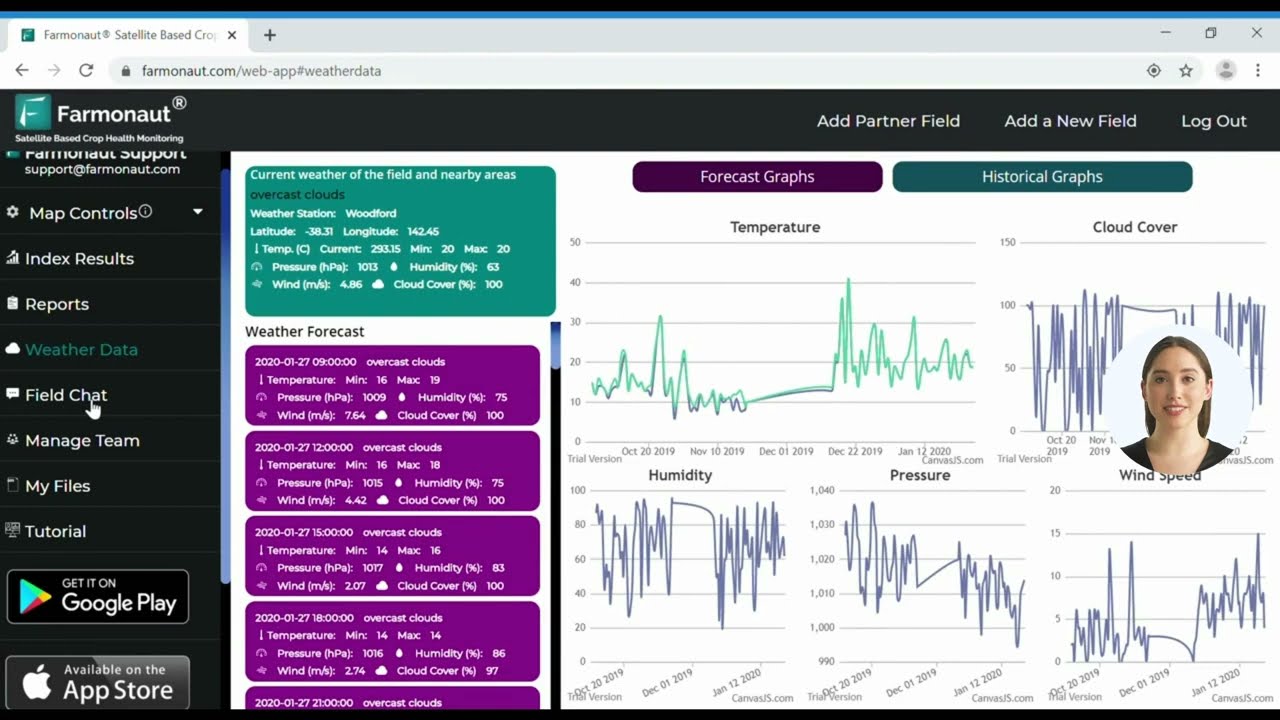
At Farmonaut, we are at the forefront of making technology in sustainable farming accessible and affordable across the globe. Our advanced, satellite-based farm management solutions are available as mobile apps, web platforms, and APIs, serving diverse users—from smallholder farmers to large agribusinesses and governmental bodies.
- Satellite-Based Crop Health Monitoring: We provide real-time, multispectral analyses (NDVI, soil moisture, etc.), helping farmers detect and resolve crop stress issues, optimize irrigation schedules, and apply fertilizers and pesticides efficiently.
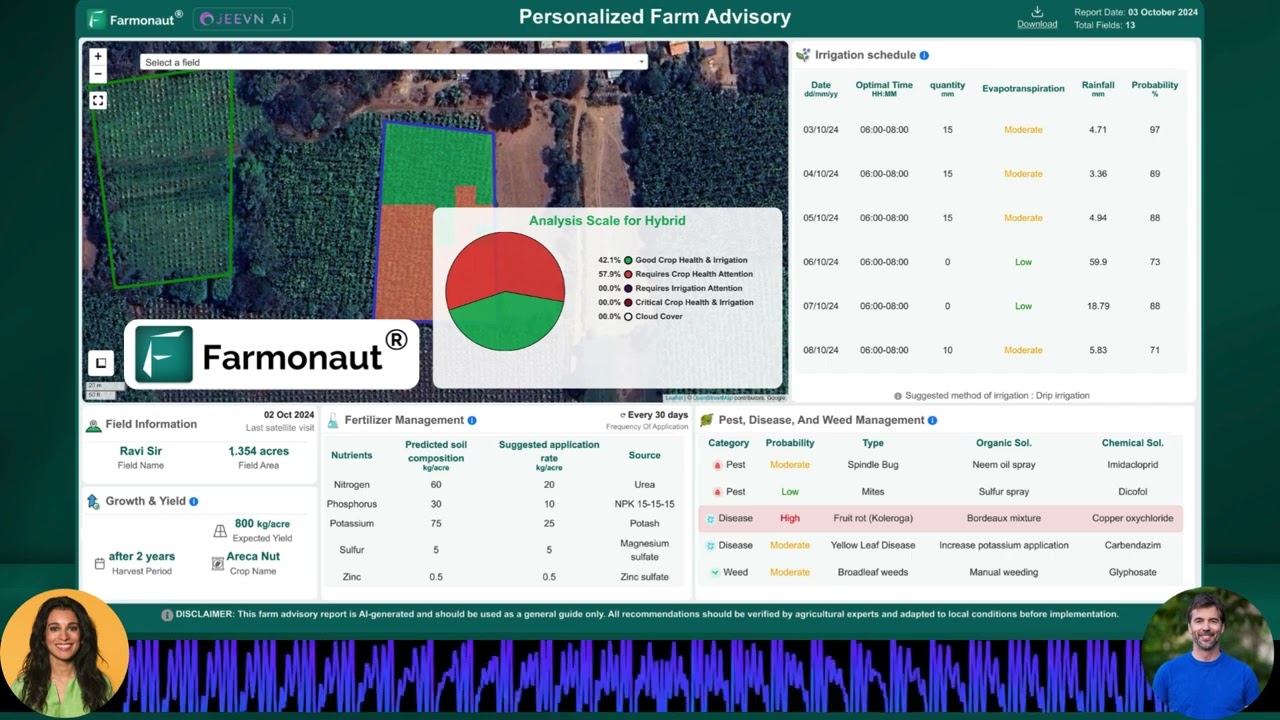
- Jeevn AI Advisory: Our AI-driven platform delivers personalized, actionable advice, integrating satellite data, weather, and farm history to enhance decision making—and thus farm productivity.
- Blockchain-Based Product Traceability: Our technology ensures transparent, tamper-proof food supply chains—critical in today’s highly accountable food system.
Explore Farmonaut’s Product Traceability Solutions - Resource & Fleet Management Tools: Our digital platforms streamline logistics, optimize machinery usage, and minimize operational costs.
- Carbon Footprinting Capabilities: We help track agri-emissions in real time, supporting climate and environmental compliance for farms and supply chains.
- Subscription and API Access: Whether you manage a single hectare or thousands, our platform is easy to scale and accessible through our web/Android/iOS apps or via direct developer API integration: Farmonaut API | API Docs
- Farm Financing Support: Our services make crop loan and insurance application verification fast and reliable—mitigating fraud, reducing risks, and increasing farmer access to finance.
Learn about Satellite-based Crop Loan and Insurance Verification - Agroforestry and Plantation Advisory: We support large-scale forest and plantation management, leveraging mapping and monitoring tools for maximal impact on carbon sequestration and sustainable land use.
Want to see how our pricing works? Explore below:
Challenges & The Future Outlook of Technology in Sustainable Agriculture
Despite the accelerating innovation in technology in sustainable agriculture, there remain significant challenges to achieving full potential and equity. These include:
- Access and Affordability: High initial investment, patchy infrastructure, and connectivity gaps continue to hinder technology adoption for smallholder farmers, especially in developing regions.
- Digital Literacy: Effective use requires education and ongoing support—essential to turning ‘data’ into actionable field practices.
- Data Security & Ownership: Managing sensitive farm data brings new privacy and security concerns across global supply chains.
- Scaling Sustainable Practices: Transitioning from pilot to large-scale implementation demands alignment across finance, extension, and policy frameworks, ensuring that technology uplifts all communities, not only a privileged few.
The Outlook: The convergence of AI, IoT, blockchain, and biotechnology promises a truly transformed agricultural landscape by 2025 and beyond. Emerging fields such as vertical farming, controlled-environment agriculture, cultured proteins, and advanced soil microbiome management will further complement open-field advances.
Every farming stakeholder—growers, agribusinesses, policy makers, and technology companies—must work together to accelerate the responsible, inclusive, and beneficial adoption of sustainable agriculture technology innovations.
Frequently Asked Questions (FAQ)
- What is technology in sustainable agriculture?
- It refers to digital, biological, and mechanical innovations—such as sensors, remote sensing, AI, biotechnology, and blockchain—that boost agricultural productivity and resilience while minimizing environmental and social impacts.
- How is biotechnology used in sustainable farming?
- Biotechnology develops crop and forest varieties that better withstand pests, diseases, drought, and poor soils, while reducing the need for agrochemical inputs and supporting higher biodiversity and ecosystem health.
- What are digital farm management platforms?
- They are cloud-based tools (including apps and APIs like Farmonaut) that integrate data from sensors, weather, markets, and logistics to support decision-making, traceability, and resource optimization.
- Why is precision agriculture essential for sustainable food production?
- By focusing resources exactly where needed, precision farming maximizes yield, reduces waste, and minimizes environmental impact—all critical for feeding a growing global population sustainably.
- How does blockchain traceability support sustainable agriculture?
- Blockchain ensures that each step of the food journey is recorded and tamper-proof, providing transparency for consumers and reward for producers who follow sustainable practices.
Conclusion: Technology’s Indispensable Role in Sustainable Agriculture’s Future
As we move into 2025 and beyond, technology in sustainable agriculture is not just a support tool but the very backbone of resilient, productive, and ecologically sound food systems. With precision farming, biotechnology, digital management platforms, renewable energy, and advanced conservation systems—all underpinned by actionable data and accessible insights—the world moves closer toward achieving sustainable food security, ecological equilibrium, and climate mitigation.
We, at Farmonaut, remain committed to making these advanced technologies affordable and accessible, empowering farmers and agribusinesses of all scales to lead the way in this global transformation.
The future of farming is data-driven, digitally enabled, and environmentally attuned—let us harness these innovations for a better Earth and a brighter tomorrow.
Discussion
Questions, corrections or field experience? Share them below. First-time comments are reviewed before they appear, and your email is never published.
No comments yet. Be the first to add a question or your experience.

 Atur Kuliner
 GlobalQuant
 MDCV UK
 Zerella Group
 Etech Consulting Madagascar
 Vestlandsforsking
 Agritein
 Delicio
 WB Dev
 Sama Premium
 Prochecker
 Tres Valles
 LACOS Geoinformation
 Magrifly
 LatConnect 60
 Blickwinkel
 Agricultural Credit Policy Council
 Marei Nursery
 eKGIS
eKGIS Mostas Tech
