

Farm ATV Weather Protection & Quad Bike Trailer Guide
Reviewed September 2026 against USDA Economic Research Service, American Farm Bureau Federation, and Mordor Intelligence data.
Try it: Run your own numbers →
“The innovative quad bike trailer weighs less than 100 kg, making it 50% lighter than traditional farm equipment.”
Farm ATVs and quad bikes need three things most operations get wrong: a way to move them between fields without burning diesel in a full-size truck, weather protection that survives a season of dust and rain, and a trailer light enough that towing it doesn’t defeat the fuel savings. This guide covers all three, with US market figures on ATV adoption, weather-related crop losses that justify the investment, and a lightweight quad bike trailer built specifically to solve the transport problem.
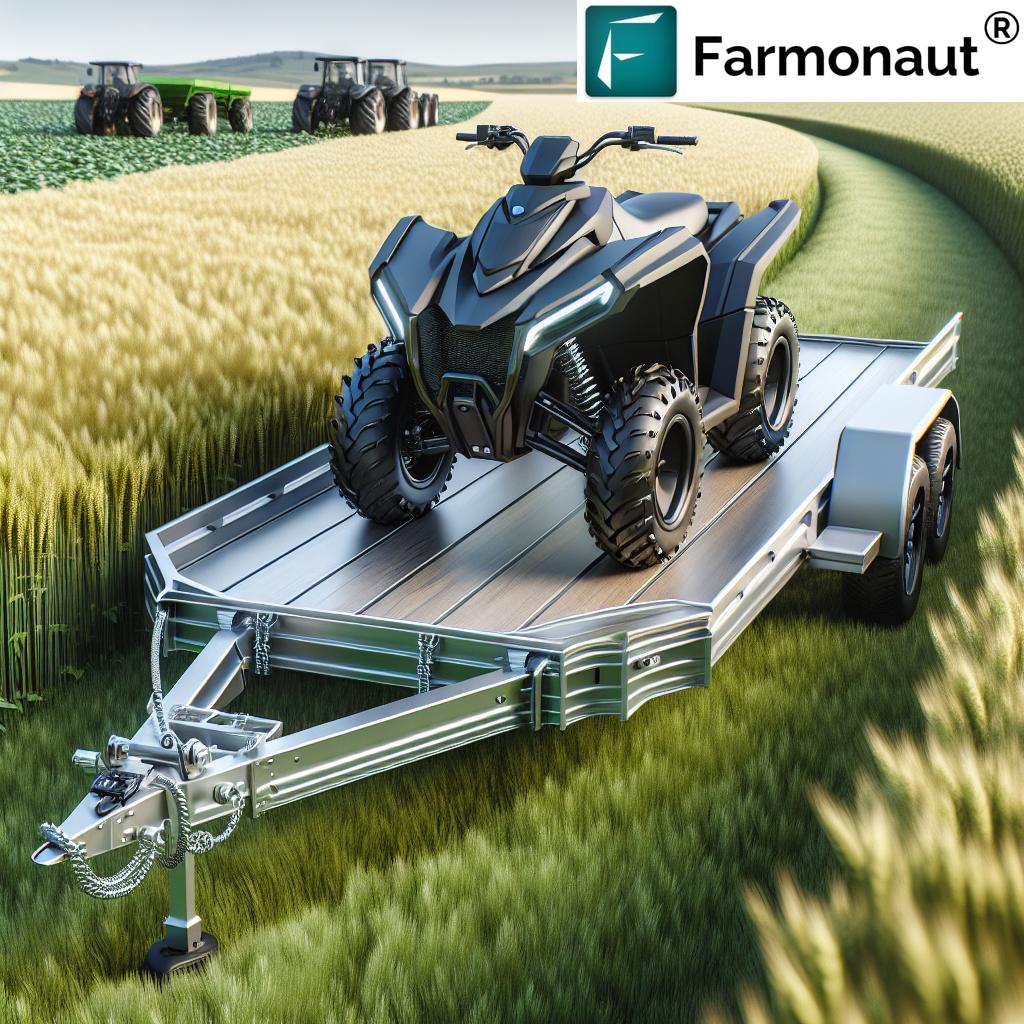
Table of Contents
- The US Agricultural ATV Market: Size and Growth
- The Quad Bike Trailer: Specs and Features
- ATV Weather Protection: Why It Matters
- Farm Weather Stations and Precision Ag Adoption
- Comparison: Trailer vs. Traditional Transport
- Trailer Towing & Fuel Savings Calculator
- Safety and Equipment Standards
- What Comes Next for Farm ATV Equipment
- FAQ
- Try it: Run your own numbers
The US Agricultural ATV Market: Size and Growth
The North America ATV and UTV market was valued at $10.90 billion in 2025, according to market research compiled by Mordor Intelligence. Unit volume across the region reached roughly 395,000 machines in 2025. Utility ATVs — the class farmers actually buy for chores, not recreation — accounted for 56% of that market in 2025, and the agricultural application segment specifically is projected to grow at a 10.2% compound annual growth rate from 2025 through 2033.
That growth is not evenly split by fuel type. Gasoline-powered ATVs held 92% of the North America market in 2025, meaning most of the fleet still needs fuel-efficient handling and transport rather than charging infrastructure. If you’re comparing an agricultural quad bike against a standard utility ATV for farm use, the honest answer is that both fall in the same utility category most manufacturers report under — the market data doesn’t break out “quad bike” as a separate segment from “ATV,” so treat the terms as interchangeable when you’re shopping.
None of this data isolates farm-specific ATV adoption rates the way, say, USDA’s Census of Agriculture isolates tractor ownership. If you need a number specific to your county or state, USDA’s National Agricultural Statistics Service runs a Quick Stats query tool that lets you pull custom equipment tables — search by state and commodity at the NASS portal directly, since no pre-built query currently isolates ATV or quad bike counts the way it does for tractors and combines.
The Quad Bike Trailer: Specs and Features
The transport problem is straightforward: moving an ATV or quad bike between fields, or to a different part of a large farm, traditionally meant using a larger fuel-hungry truck and a heavy trailer, or driving the ATV itself over public roads where that’s even legal. The lightweight quad bike trailer addresses this directly. At under 100 kg, it’s roughly half the weight of a conventional equipment trailer, which matters for two reasons: less tongue weight on the tow vehicle, and lower fuel consumption per trip.
- Lightweight Design: Weighing less than 100 kg, it’s significantly lighter than conventional trailers.
- Fuel Efficiency: Its design allows for easy towing, reducing fuel consumption.
- User-Friendly: Prioritizes safety and accessibility with a unique securing mechanism.
- Low-Profile Construction: Ensures stability and ease of loading/unloading.
- Versatility: Currently suited for off-road use, with potential for future road-legal adaptations.
This is a case where a physical invention and a digital layer solve adjacent problems. The trailer gets the ATV to the field faster and cheaper; once it’s there, knowing where to send it — which block needs a spot-check, which irrigation line needs a look — is a data problem, not a hardware one. That’s where satellite crop monitoring and AI-based advisory tools fit into the same operation, whether you’re running arable acreage or managing livestock, as covered in Farmonaut’s arable farming examples guide.
The Impact on Farm Efficiency
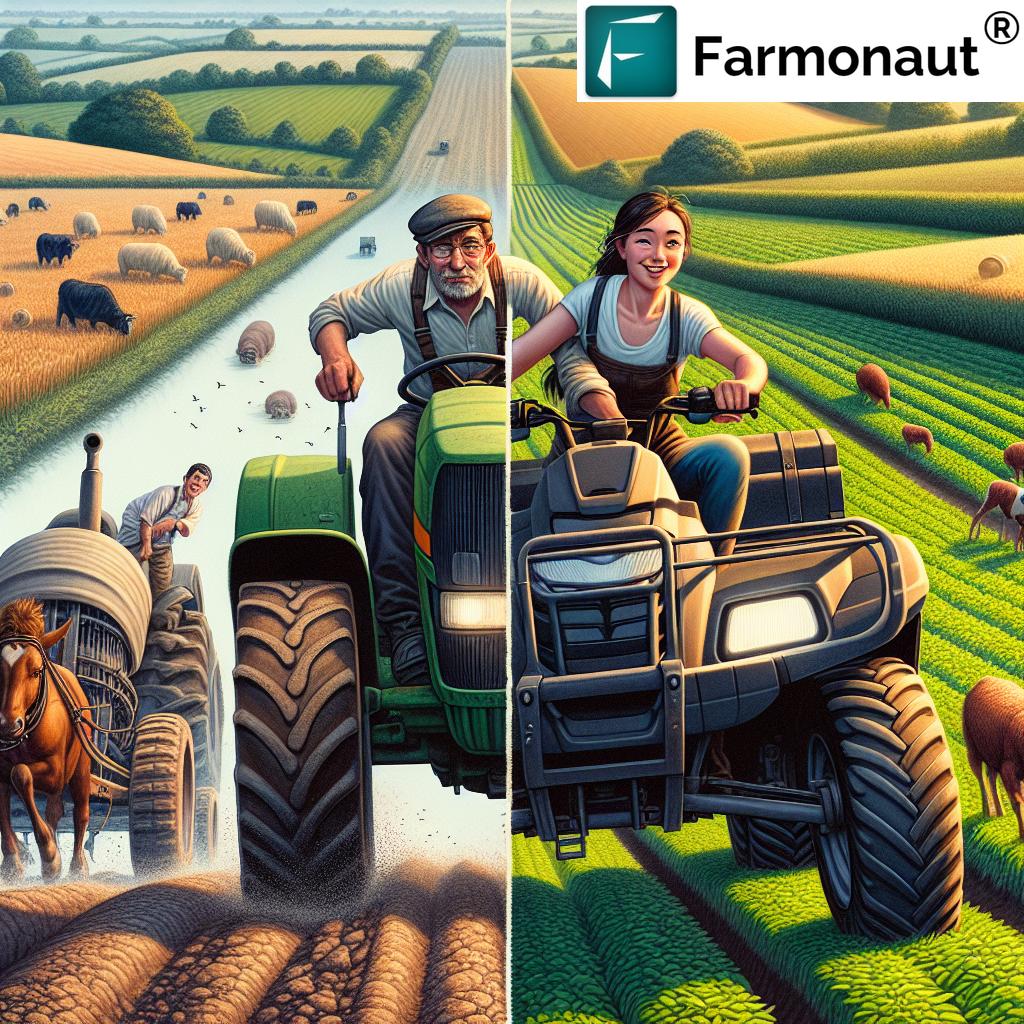
- Time Savings: Quicker transportation of ATVs between fields means more time for actual farm work.
- Cost Reduction: Lower fuel consumption and maintenance costs compared to larger vehicles.
- Increased Productivity: Easier mobility allows for more frequent use of ATVs in various farm tasks.
- Environmental Benefits: Reduced fuel usage aligns with sustainable farming practices.
For farmers looking to optimize their operations, tools like Farmonaut’s satellite-based farm management solutions can complement these efficiency gains. Our platform offers real-time crop health monitoring and AI-based advisory systems, further enhancing farm productivity.


ATV Weather Protection: Why It Matters
Weather protection for farm ATVs isn’t cosmetic — it’s a direct extension of the same risk that drives crop insurance enrollment. The American Farm Bureau Federation reported $21.9 billion in weather-related crop and rangeland losses across the US in 2023, with drought responsible for 43% of that total and floods or excess precipitation accounting for 31%. An ATV that sits exposed through those same conditions — mud, standing water, dust storms between rain events — takes the same weather load the crops do, minus any insurance backstop.
That’s the case for ATV weather protection as a category: cab enclosures, canopy covers, and weather-resistant seals that keep an operator dry and keep electrical components from corroding. Federal crop insurance enrollment for the eight major US field crops reached 89% in 2024, per USDA’s Risk Management Agency — growers have effectively standardized on protecting the crop. Equipment protection hasn’t caught up at the same rate, and the market data doesn’t currently publish adoption figures for ATV weather covers specifically; that’s a genuine gap, not a number we’re going to guess at.
What you can act on directly: match the enclosure or cover to your actual exposure. A cab enclosure with a hard top and doors suits operations in high-precipitation regions or anywhere freezing rain is a factor; a ventilated mesh cover suits dust and sun exposure in drier regions without adding heat buildup. Either way, check the manufacturer’s specified operating temperature range and UV rating before buying — those specs vary by product line and are listed on the manufacturer’s own spec sheet, not in any government dataset.
Farm Weather Stations and Precision Ag Adoption
A farm weather station is the instrumented half of the same weather-risk picture. USDA’s Economic Research Service found that 27% of US farms and ranches had adopted some form of precision agriculture technology as of 2023, a category that includes on-farm weather monitoring alongside guidance and mapping tools. Adoption is far higher for specific technologies on larger operations: autosteering systems were in use on 70% of large-scale crop farms and 52% of midsize farms in 2023, per the same ERS dataset.
Soil moisture sensors — the closest analog to a dedicated weather station in ERS’s own reporting — delivered annual net returns of $400 to $1,700 per 130-acre field in a Nebraska-based ERS study, primarily through avoided over-irrigation. That’s the clearest dollar figure available for weather-adjacent monitoring hardware, and it’s a real return range, not a marketing estimate.
There’s no isolated “weather station adoption rate” published separately from the broader precision-ag figure — ERS folds it into the 27% headline number rather than breaking out weather hardware on its own. If you want a number specific to your operation type or region, ERS republishes this data alongside each five-year Census of Agriculture and updates it annually through the ARMS survey; check USDA ERS’s precision agriculture research page for the current edition before budgeting a purchase.
Comparison: Trailer vs. Traditional Transport
| Feature | Innovative Quad Bike Trailer | Traditional ATVs | Standard Farm Vehicles |
|---|---|---|---|
| Weight Capacity | Moderate (suitable for ATVs) | Low | High |
| Fuel Efficiency | High | Moderate | Low |
| Maneuverability | Excellent | Good | Limited |
| Cost-effectiveness | High | Moderate | Low |
| Safety Features | Advanced (specific to ATV transport) | Basic | Standard |
| Versatility (on/off-road use) | High (primarily off-road) | High | Limited |
| Maintenance Requirements | Low | Moderate | High |

Trailer Towing & Fuel Savings Calculator
Use your own tow vehicle’s fuel figures and trip pattern below to estimate the annual fuel savings from switching to a lightweight trailer versus a standard equipment trailer.
Run your own numbers
Assumptions: figures are estimates based on the numbers you enter, not a measured test of any specific trailer model. The calculator excludes maintenance cost differences, trailer purchase price, tongue-weight effects on braking, and any road-legal towing restrictions in your state. Confirm your tow vehicle's actual loaded fuel economy under real conditions before budgeting savings.
Safety and Equipment Standards
Safety features on the quad bike trailer are built around the transport moment specifically — the point where an ATV is most likely to shift, tip, or roll off during loading:
- Secure Locking Mechanism: Ensures the ATV stays in place during transport.
- Low Center of Gravity: Improves stability, reducing the risk of tipping.
- Easy Loading Design: Minimizes the risk of accidents during loading and unloading.
- Durable Construction: Built to withstand the rigors of farm use.
These sit alongside the broader set of precautions that apply to any powered farm equipment during the highest-risk stretch of the calendar. Farmonaut's farm equipment safety tips for planting season guide covers pre-operation checks, PPE, and load securement that apply directly to ATV and trailer use, not just tractors and planters.
Evolution of Agricultural Trailers
- Traditional Heavy-Duty Trailers: Robust but often oversized for smaller tasks.
- General-Purpose Farm Trailers: Versatile but not optimized for specific equipment like ATVs.
- Specialized Equipment Trailers: Designed for specific machinery but often expensive.
- Lightweight Agricultural Trailers: The current generation, balancing efficiency and functionality.

What Comes Next for Farm ATV Equipment
Three trends are converging on this equipment category at once. First, the agricultural ATV/UTV application segment is growing faster (10.2% CAGR, 2025–2033) than the North America market overall, which means more manufacturers are building farm-specific attachments — trailers, weather cabs, sprayer mounts — rather than treating ATVs as a recreational product farmers happen to buy. Second, gasoline still dominates at 92% of the 2025 market, so fuel efficiency gains from lighter trailers and better route planning will matter more than any near-term shift to electric drivetrains. Third, the precision-ag adoption curve (27% of farms overall, rising toward 70% on large operations for specific technologies like autosteering) suggests that weather stations and soil sensors will keep spreading down from large operations to midsize ones, the same pattern ERS already documented for autosteering between 2023 and now.
Digital tools are the natural complement to all three trends. Farmonaut's satellite-based platform doesn't replace a weather station or a trailer, but it does tell you where to send the ATV: which field block shows stress, where irrigation is under- or over-applying, and how conditions are trending across a season. That's the layer that sits on top of the physical equipment covered in this guide, and it's covered in more detail in Farmonaut's piece on agricultural innovation trends, our history of farming innovations, and our look at eco-friendly farming methods.
For developers and larger operations building weather data into their own systems, Farmonaut offers a direct satellite and weather API with full developer documentation, which can feed weather station-equivalent data into whatever farm management software you already run.


Checklist: Choosing ATV Weather Protection and a Trailer for Your Farm
This method stays valid regardless of which model year or product line you're comparing:
- Match protection to your climate risk, not the showroom default. If your region's losses skew toward flood/excess precipitation (31% of the 2023 national total per the Farm Bureau), prioritize sealed electrics and a hard-top cab over a light mesh cover.
- Weigh the trailer, not just the ATV. A sub-100 kg trailer adds meaningfully less tongue weight than a conventional unit — ask for the trailer's unloaded weight in writing, not just its capacity rating.
- Check road-legal status in your state. Off-road-only trailers and ATVs have different registration and lighting requirements state to state; this is a legal question for your state DMV, not a spec the manufacturer controls.
- Confirm the operating temperature and UV rating on any weather cover. These are on the manufacturer's spec sheet and differ by product line, not by farm.
- Re-check adoption and market data every year or two. USDA ERS republishes precision-ag figures with each Census of Agriculture (every five years) and annually via ARMS; the Farm Bureau publishes its crop-loss summary most years by spring for the prior calendar year.
For more information on how Farmonaut can support your farming operations alongside this equipment, explore our vertical farming lighting trends guide as well.
FAQ Section
Q: How does the quad bike trailer improve farm efficiency?
A: The trailer improves efficiency by providing a lightweight, sub-100 kg solution for transporting ATVs and quad bikes across farms, reducing the time and fuel cost of using a full-size truck for short hauls.
Q: What's the difference between an ATV and an agricultural quad bike?
A: Market research treats them as the same equipment category. Mordor Intelligence's North America ATV/UTV report groups utility-class machines together regardless of whether a buyer calls theirs a "quad bike" or an "ATV" — the 56% utility-segment share and 10.2% agricultural CAGR both apply to the same machines.
Q: Do I need a farm weather station, or is a soil moisture sensor enough?
A: They measure different things — a weather station reports ambient conditions, a soil moisture sensor reports what's happening below the surface. USDA ERS's Nebraska study found soil moisture sensors alone returned $400–$1,700 per year per 130-acre field, so that's the better-documented starting point if you're choosing one first.
Q: Is the quad bike trailer suitable for all types of farms?
A: It's built for off-road use, so it suits large or diverse-terrain operations where ATVs are used frequently between fields, more than small operations with a single paved yard.
Q: How much do weather-related losses actually cost US farms?
A: $21.9 billion in 2023 across crops and rangeland, per the American Farm Bureau Federation — 43% from drought, 31% from floods and excess precipitation. That figure is reported annually most years by spring for the prior year; check the Farm Bureau's Market Intel page directly for the current release before citing it elsewhere.
Q: Can Farmonaut's technology be used alongside this quad bike trailer?
A: Yes. Farmonaut doesn't manufacture the trailer or ATV hardware, but our satellite-based monitoring and API can tell you which field the ATV needs to reach next, based on real-time crop stress and weather data.
Farmonaut Subscriptions
Pair the right physical equipment — a lightweight trailer, properly matched weather protection, a farm weather station — with Farmonaut's satellite-based crop monitoring and AI advisory tools to get the full picture: where conditions are changing, and how fast you can get equipment there to respond.
Discussion
Questions, corrections or field experience? Share them below. First-time comments are reviewed before they appear, and your email is never published.
No comments yet. Be the first to add a question or your experience.

 Patrick America
 Red Dog Management
 Liquify Digital
 Ascentya
 CU Foods
 BeyondTech Global
 Rouge VC
 AgroGreen Dynamics
 AgroRisk
 Oath Inc
 Reddane Farming
 Esri North East Africa
 Cresol
 MDCV UK
 Zerella Group
 Etech Consulting Madagascar
 Vestlandsforsking
 Delicio
 WB Dev
 Sama Premium
 Prochecker
 Tres Valles
 Exploration consultancy · South Africa · Gold
 Licence holder · Niger · Gold










