

Brazil Agriculture Market: AI, Biotech & Machinery Data
Reviewed August 2026 against IMARC Group, Verified Market Research, and USDA Foreign Agricultural Service reporting.
Try it: Run your own numbers →
Brazil’s agriculture market was valued at USD 380 billion in 2024, and the country harvested 322.3 million tonnes of grain in the 2024/25 crop year, according to USDA’s Grain and Feed Annual report. Within that broader base, the AI-in-agriculture segment is still small — USD 60.0 million in 2025 — but IMARC Group projects it will reach USD 260.0 million by 2034, an 18.53% compound annual growth rate. This article breaks down what’s actually happening across AI, seed treatment, biostimulants, machinery, and irrigation equipment in Brazilian agriculture, with sourced figures for each.
Table of Contents
- Brazil Agriculture Market: Size and Structure
- Brazil AI in Agriculture Market: Size, Growth, and Drivers
- Brazil Seed Treatment Market: Conventional and Biological
- Brazil Agricultural Biotechnology Market
- Brazil Biostimulants Market: Seaweed Extracts Lead
- Brazil Agricultural Machinery Market: Tractors and Irrigation Equipment
- 5G Smart Farming and Agriculture Analytics in Brazil
- Precision Agriculture Input Savings Calculator
- How Farmonaut Fits Into Brazil’s Agtech Stack
- Comparative Table: Market Segments at a Glance
- Frequently Asked Questions
- Where This Market Goes Next
- Farmonaut Subscriptions
- Try it: Run your own numbers
Brazil Agriculture Market: Size and Structure
Brazil’s agriculture sector was valued at USD 380 billion in 2024, per Verified Market Research and IMARC Group estimates, anchored by climate conditions that support two to three harvests a year across much of the Cerrado and southern grain belt. USDA’s Grain and Feed Annual report put the 2024/25 grain harvest at 322.3 million tonnes, covering soybeans, corn, and wheat.
The country’s natural resource base — arable land, water availability, and soil types across multiple agro-climatic zones — underpins production of soybeans, corn, coffee, sugarcane, and beef. That scale is exactly why AI, biotech, and machinery vendors treat Brazil as a priority market: even a small percentage shift in technology adoption across a $380 billion base moves absolute dollars that dwarf equivalent shifts in most other countries.
What’s changed since earlier market write-ups isn’t the scale of Brazilian agriculture — it’s the granularity now available on specific technology segments within it. Below, each segment gets its own sourced figures rather than a single blended growth number.
Brazil AI in Agriculture Market: Size, Growth, and Drivers
The Brazil AI in agriculture market was valued at USD 60.0 million in 2025, according to IMARC Group. IMARC projects this reaching USD 260.0 million by 2034, implying an 18.53% CAGR across 2026–2034. That’s a roughly 4.3x increase in market size within nine years, from a base that’s still tiny relative to the $380 billion agriculture market it sits inside.
This gap between a large agriculture economy and a comparatively small dedicated “AI in agriculture” market figure is common internationally — most farm AI spending gets bundled into machinery, seed, or crop protection budgets rather than tracked as a standalone software or hardware line item. Read the AI segment figure as a proxy for dedicated AI platforms and services, not total technology-influenced production value.
Key demand drivers behind that projected growth include:
- Predictive analytics for drought, pest, and disease risk, letting farmers act before losses compound.
- AI-powered monitoring tools that flag nutrient deficiencies, irrigation gaps, or pest pressure from imagery and sensor feeds.
- Drone-based multispectral mapping across large-area soybean and corn operations where walking fields isn’t practical.
One adoption data point worth naming precisely: TechSci Research and Ken Research project that 80% of Brazil’s exported crops will use precision agriculture or traceability tools by 2025 forecast — but that figure covers export-destined crops specifically, not all farmland or all farmers. There’s no published overall farmer-adoption percentage for AI or precision tools across Brazil’s full grain and livestock base; if you need that number for a specific region or crop, the closest proxy is checking machinery dealer and cooperative adoption surveys for that state, since no national census tracks it consistently year over year.

Farmers can access satellite-driven crop and soil monitoring via the  Farmonaut Web App for field-level analytics accessible from a phone, tablet, or desktop.


Brazil Seed Treatment Market: Conventional and Biological
The Brazil seed treatment market was valued at USD 206.5 million in 2025, per IMARC Group, with a projected rise to USD 422.1 million by 2034 — roughly doubling over that span. Within this total, the biological seed treatment segment specifically was valued at USD 142.9 million in 2024, per IMARC Group and Mordor Intelligence figures, meaning biologicals already account for a substantial share of Brazil’s total seed treatment spend rather than being a fringe category.
Seed treatment covers both chemical coatings (fungicides, insecticides applied pre-planting) and biological alternatives (beneficial microbes, biofertilizer inoculants) applied to soybean, corn, and cotton seed before it goes in the ground. Brazil’s large-scale soybean rotation — the crop most associated with the country’s export economy — is the primary demand driver, since seed-applied inoculants for nitrogen fixation are now standard practice on most commercial soybean acreage.
Brazil Agricultural Biotechnology Market
Biotechnology functions as a companion technology to both AI platforms and seed treatment — genetically improved seed lines are what AI-driven variable-rate and predictive systems are optimizing around. Brazil’s biotech pipeline centers on drought-tolerant and pest-resistant soybean and corn varieties, along with disease-resistant coffee and sugarcane cultivars suited to the country’s tropical and subtropical growing zones.
There is no separately published Brazil-specific “agricultural biotechnology market” dollar figure in the research gathered for this article distinct from the seed treatment and AI figures above — biotech seed value is typically bundled into overall seed market reporting rather than broken out as its own line. If you need a standalone biotech-market number for Brazil, the most reliable path is checking IMARC Group’s seed treatment market report directly, since biotech seed treatment interacts closely with that segment’s methodology.
What biotech adoption does for growers, directionally, based on the seed treatment and biological segment sizing above: reduced reliance on synthetic chemical inputs, better resilience against Brazil’s variable rainfall pattern, and improved match between seed genetics and specific soil/climate zones — from Cerrado savanna soils to the more humid tropical crop zones further north.
Brazil Biostimulants Market: Seaweed Extracts Lead
The Brazil biostimulants market was valued at USD 252.4 million in 2024, according to Verified Market Research. Within that market, seaweed extracts hold a 59% product share as of 2024, per Verified Market Research and IMARC Group data — making them the dominant biostimulant category by a wide margin over amino acid-based and other formulations.
Biostimulants differ from fertilizers and pesticides: they don’t supply nutrients directly or kill pests, but instead trigger physiological responses in the plant — improved root development, stress tolerance, or nutrient uptake efficiency. Brazilian growers use them alongside, not instead of, conventional fertility programs, particularly on soybean and sugarcane acreage where input cost management is a constant pressure against commodity price cycles.
On refresh timing: IMARC Group and Mordor Intelligence track this market annually, with the next report update carrying 2026 actuals typically expected in Q1 2027. If you’re reading this after that point, check Verified Market Research’s biostimulants page directly for the current-year figure rather than relying on the 2024 baseline above.
Brazil Agricultural Machinery Market: Tractors and Irrigation Equipment
The Brazil agricultural machinery market was valued at USD 3.2 billion in 2025, per IMARC Group, with a projected climb to USD 4.6 billion by 2034. Tractors make up the largest single equipment category, holding a 45.32% share of the machinery market in 2025, according to Mordor Intelligence — meaning tractors alone account for close to half of all machinery spending tracked in this market.
Within machinery, irrigation equipment is its own demand driver, particularly across drier Cerrado zones and second-crop (safrinha) corn planting windows where soil moisture timing determines yield outcomes as much as genetics does. There is no separately published Brazil-specific irrigation-machinery-only dollar figure distinct from the total USD 3.2 billion machinery market figure in the sources gathered for this piece; Mordor Intelligence’s machinery market report is the source to check for equipment-category breakdowns as they’re published.
For machinery investment planning purposes, the practical takeaway is that tractors and general field equipment dominate spend, and irrigation-specific hardware sits as a smaller but growing subset tied directly to the safrinha planting calendar and drought risk management on non-irrigated acreage.

5G Smart Farming and Agriculture Analytics in Brazil
5G-enabled smart farming and agriculture analytics are two of the fastest-cited emerging categories in Brazilian agtech coverage, but neither has a standalone Brazil-specific market-size figure in the sources gathered for this article. What is documented: 80% of Brazil’s exported crops are forecast to use precision agriculture or traceability tools by 2025, per TechSci Research and Ken Research — and that adoption depends on connectivity infrastructure (cellular and satellite backhaul in rural zones) reaching the fields where those tools run.
5G rollout in rural Brazil lags urban coverage, which is the practical bottleneck behind the “smart agriculture” and “5G smart farming” search interest — buyers are trying to gauge whether connectivity will support real-time sensor and drone data transmission on their specific farm before investing in hardware that depends on it. If a standalone dollar figure for Brazil’s 5G-in-agriculture or agriculture-analytics market becomes available, check IMARC Group’s Brazil market report index directly, since these categories are adjacent to the AI-in-agriculture segment IMARC already tracks at USD 60.0 million (2025).
For traceability and supply-chain analytics specifically — the component of “agriculture analytics” with the clearest current use case in Brazil — see Farmonaut’s Traceability Solution, which supports blockchain-based tracking from field to export buyer, a requirement increasingly demanded by international soybean and coffee purchasers auditing supply chains.

Developers and agribusinesses building custom AI-powered solutions for Brazilian farms can access the Farmonaut API and API Developer Docs directly, pulling satellite and weather data into custom dashboards or advisory platforms.
Precision Agriculture Input Savings Calculator
Estimate potential input-cost savings from adopting satellite-guided variable-rate application on your own acreage, using your current spend and farm size as inputs below.
Run your own numbers
Assumptions: uses your own entered spend-per-hectare and reduction percentage — it does not assume a fixed national input cost. It excludes equipment purchase or subscription costs, financing terms, and yield-side revenue changes; it estimates input-cost savings only, not net ROI.
How Farmonaut Fits Into Brazil’s Agtech Stack
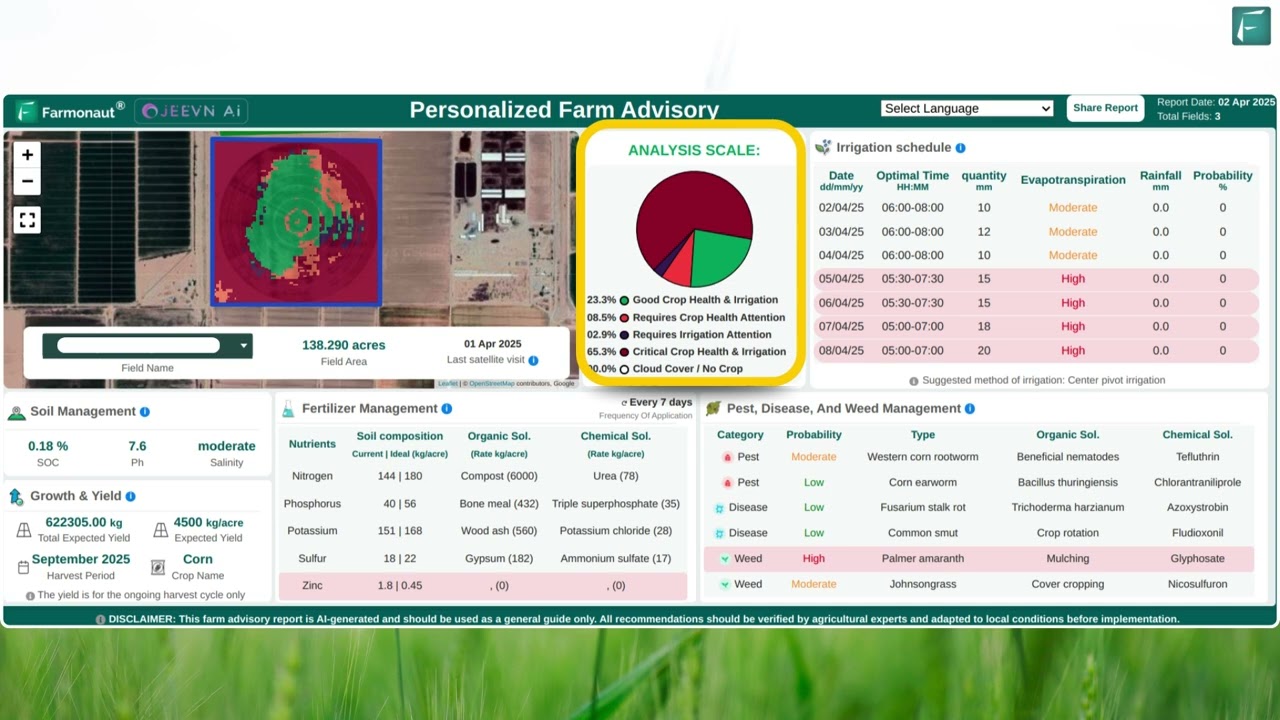
Farmonaut’s platform uses satellite imagery, AI, and blockchain to monitor crop health (NDVI), soil conditions, and environmental impact through web, Android, iOS, and API interfaces. For operations tracking the same input-optimization goals covered above, the platform supports:
- Real-time monitoring and AI-based advisory for field-to-market traceability, feeding into the export-compliance and traceability demand described in the analytics section above.
- Satellite-verified data for financing, via crop loan and insurance verification, reducing friction for rural borrowers and risk exposure for lenders.
- Fleet Management for machinery and logistics coordination (Farmonaut’s Fleet Management), relevant given the USD 3.2 billion machinery market’s tractor-heavy composition described above.
- Carbon footprint tracking for operations managing sustainability compliance and buyer requirements (Carbon Footprinting product).
For agronomists and administrators managing multiple farms, Farmonaut’s Large Scale Farm Management App provides plot-level analytics on vegetation, climate, and soil across thousands of fields.

Comparative Table: Market Segments at a Glance
| Segment | Market Size | Vintage | Projected / Related Figure | Source |
|---|---|---|---|---|
| Total agriculture market | $380.0 billion | 2024 | 322.3 million tonnes grain harvest (2024/25) | Verified Market Research / IMARC; USDA |
| AI in agriculture | $60.0 million | 2025 | $260.0 million by 2034 (18.53% CAGR) | IMARC Group |
| Seed treatment (total) | $206.5 million | 2025 | $422.1 million by 2034 | IMARC Group |
| Seed treatment (biological) | $142.9 million | 2024 | Subset of total seed treatment market | IMARC Group / Mordor Intelligence |
| Biostimulants | $252.4 million | 2024 | Seaweed extracts hold 59% product share | Verified Market Research |
| Agricultural machinery | $3.2 billion | 2025 | $4.6 billion by 2034; tractors 45.32% share | IMARC Group / Mordor Intelligence |
Figures as published by the cited sources at the time noted; check each source link directly for updates beyond the vintage listed.

Frequently Asked Questions
-
How big is the Brazil AI in agriculture market?
IMARC Group values it at USD 60.0 million in 2025, projected to reach USD 260.0 million by 2034 at an 18.53% CAGR (2026–2034). This is a distinct, much smaller figure than Brazil’s total $380 billion agriculture market — it measures dedicated AI platforms and services, not all technology-influenced production value.
-
What is the size of Brazil’s seed treatment market?
USD 206.5 million in 2025, projected to USD 422.1 million by 2034 per IMARC Group. Biological seed treatment specifically was valued at USD 142.9 million in 2024.
-
How large is the Brazil biostimulants market, and what dominates it?
USD 252.4 million in 2024, per Verified Market Research. Seaweed extracts hold a 59% product share within that total, ahead of amino acid-based and other biostimulant categories.
-
What share of the Brazil agricultural machinery market do tractors hold?
45.32% as of 2025, according to Mordor Intelligence, within a total machinery market valued at USD 3.2 billion in 2025 and projected to reach USD 4.6 billion by 2034.
-
Is there a published adoption rate for AI or precision agriculture among Brazilian farmers overall?
Not as a single national percentage. The closest published figure is that 80% of Brazil’s exported crops are forecast to use precision agriculture or traceability tools by 2025, per TechSci Research and Ken Research — but that covers export-destined crops, not all farmland. For farm-level or state-level adoption data, check machinery dealer or cooperative surveys for that specific region, since no consistent national census tracks overall adoption.
-
How does biotechnology support sustainability in Brazilian agriculture?
Gene-edited and biotech seed varieties reduce reliance on synthetic pesticide and fertilizer inputs, improve resilience to drought and disease, and are increasingly paired with biological seed treatments — a USD 142.9 million segment in 2024 — rather than chemical treatments alone.
-
What are the main obstacles to digital transformation in Brazil’s rural agriculture?
Rural 5G and cellular connectivity gaps, upfront equipment and software costs relative to smallholder budgets, and the absence of a single national adoption benchmark that would let individual farms compare their technology uptake against a verified baseline.
-
How can Brazilian farmers access affordable crop and soil monitoring?
Through Farmonaut’s satellite-driven platforms, farmers can monitor crop health, soil data, and weather patterns via web and mobile apps (Farmonaut Web App), without needing dense on-the-ground sensor networks.

Where This Market Goes Next
Brazil’s $380 billion agriculture base (2024) is fragmenting into distinct, individually trackable technology markets: AI platforms at $60.0 million (2025) headed toward $260.0 million by 2034, seed treatment at $206.5 million (2025) headed toward $422.1 million, biostimulants at $252.4 million (2024) dominated by seaweed extracts, and machinery at $3.2 billion (2025) headed toward $4.6 billion, with tractors holding 45.32% of that share.
None of these figures are static, and the durable approach is to check each cited source directly on the cadence it publishes — IMARC Group and Mordor Intelligence typically refresh their Brazil agriculture reports annually, with biostimulants specifically expected to carry 2026 actuals around Q1 2027. Where a figure isn’t published at all — overall farmer AI-adoption rate, EMBRAPA’s technology R&D budget, irrigation-equipment-specific spend — treat that as a genuine gap to research directly from the relevant agency or trade body, not a number to estimate.
Whichever segment you’re evaluating, the practical checklist is the same: confirm the vintage of any figure you’re citing, check whether it’s a total-market or sub-segment number, and verify the projection horizon (CAGR periods differ by report) before comparing it against a different source’s figure for the same-sounding category.




Further reading:
Subscribe to Farmonaut: Satellite-Driven Agriculture Monitoring
Ready to add satellite and AI-based crop and resource monitoring to your operation? Choose a Farmonaut subscription below:
For individual advisory, sustainable farming practices, or scaled industrial monitoring, contact us to learn how our platform can serve your needs.
Discussion
Questions, corrections or field experience? Share them below. First-time comments are reviewed before they appear, and your email is never published.
No comments yet. Be the first to add a question or your experience.

 Concept Global
 Kubota
 FFBS
FFBS Jontra
 Kalustyan
 Tucor
Tucor Geno
Geno Hayleys Agriculture
 Linx Agritech
 Adinet
 Save Your Soils
 Grandstream Algérie
 XOS Realty
 Geospatial Lab Africa
 Agro La Gándara
 HIPSAC
 ZOL Zimbabwe
 Licence holder · Niger · Gold










