

Agricultural Land Classification Map UK: Top 2025 Trends
Agricultural land classification map UK—these words are becoming increasingly vital for farmers, foresters, planners, and policymakers. In 2025, these maps are essential tools for understanding, evaluating, and managing British farmland and forestry resources. Leveraging advances in GIS and remote sensing, the agricultural land classification maps are crucial for making informed decisions regarding land use, investment, and conservation.
This blog explores the top 2025 trends in the world of agricultural land classification in the UK, highlighting cutting-edge technologies, the pivotal role of remote sensing, how these maps inform sustainable management, and what it means for agriculture, forestry, and food security.
“Over 90% of UK agricultural land classification maps in 2025 will integrate advanced GIS and remote sensing technologies.”
What is Agricultural Land Classification?
Agricultural land classification (ALC) is a systematic assessment method used to evaluate, categorize, and grade land based on its agricultural potential. In the UK, this system divides land into five main grades determined by soil quality, climate, topography, drainage, and other physical characteristics that influence agricultural productivity.
What separates the middle grades is explained in a closer look at Grade 2, 3 and 4 land and what each allows.
- Grade 1 (Excellent): High quality agricultural land with very few limitations, suitable for a wide range of crops and intensive farming.
- Grade 2 (Very Good): Slightly more limitations but still considered very good for most agricultural uses.
- Grade 3 (Good to Moderate): Subdivided into 3a (good quality) and 3b (moderate quality). Offers flexibility for cropping but with some restrictions.
- 3a: Good quality, often protected as ‘Best and Most Versatile Land’.
- 3b: Moderate quality with more noticeable limitations.
- Grade 4 (Poor): Land with significant limitations, generally used for grazing or forestry.
- Grade 5 (Very Poor): Essentially unsuitable for cropping, mostly used for rough grazing, wildlife habitat, or conservation projects.
These grades play a vital role in determining the best use of land, balancing agricultural productivity with conservation and sustainable land management. They provide an informed basis for key planning decisions regarding development and environmental stewardship.
Agricultural Land Classification Map UK: Grades, History & Modern Role
An agricultural land classification map UK provides a visual representation of the various grades of land across regions. These maps are typically created through a combination of scientific surveys, soil analysis, climatic data, and now, advanced remote sensing and GIS technologies.
Historically, land classification in the UK was led by the Ministry of Agriculture, with significant contributions from the Department for Environment, Food & Rural Affairs (DEFRA). These organizations standardized the classification system and pioneered nationwide surveys.
Today in 2025, agricultural land classification maps are digital, precise, and widely accessible, thanks to modern data integration. Local authorities, foresters, planners, and farmers regularly use these tools to guide decisions regarding land utilization and protection.
- DEFRA’s interactive mapping portals and datasets now help planners, developers, and environmental agencies to identify high-value, ‘best and most versatile’ farmland, guiding planning permissions and development controls.
- With GIS and remote sensing advances, updated ALC maps reflect changes in soil quality, land use, and climate impact almost in real-time, keeping stakeholders informed of the current land status.
- Farmonaut helps further this revolution by providing precise remote sensing and satellite imagery data to users, enabling more accurate real-time assessments.

ALC Systems and Assessment Processes: How are Maps Created?
Agricultural land classification maps rely on systematic assessment processes:
-
Desk-Based Data Gathering:
Integrates existing soil surveys, topographical maps, climate records, and historical land use data. This step sets a foundation for targeted field work. -
Fieldwork and Soil Sampling:
On-site soil pits, structure assessments, drainage evaluations, and crop potential estimates. This primary data is geocoded for precise mapping. -
Geospatial and Remote Sensing Integration:
- Utilize high-resolution satellite imagery (Sentinel, Landsat, etc.).
- Apply LiDAR for elevation and slope mapping.
- Leverage AI-driven analysis for vegetation, soil quality, and flood risk mapping.
-
Digital Map Generation:
Using GIS software, the spatial data is combined to create a multi-layered agricultural land classification map. Modern maps allow users to query specific areas and even run land use or climate change simulations.
This evolving workflow ensures that the agricultural land classification map UK is always informed by the latest data and best scientific practices.
Agricultural Land Classification Map UK: Role & Relevance in UK Farming and Forestry (2025)
In the dynamic farming and forestry landscape of the UK, agricultural land classification uk maps have never been more critical.
Key reasons why they’re indispensable in 2025:
-
Sustainable Land Management:
ALC maps guide sustainable use of resources and foster conservation by identifying land best suited for food production, forestry, or environmental restoration. -
Supporting UK Food Security:
By protecting the best and most versatile farmland (Grades 1, 2, 3a), these maps underpin domestic food production, helping the UK meet self-sufficiency goals amidst global challenges. -
Forestry & Conservation Decisions:
Combining agricultural land classification map uk with biodiversity mapping allows foresters and planners to identify poor-grade land ideal for woodland creation or rewilding, supporting government tree-planting initiatives and net-zero targets. -
Directing Policy & Subsidies:
Policymakers use agricultural land classification report data to allocate environmental land management payments and intervene where climate or management pressures affect land quality.
As climate urgency grows, the importance of precise ALC data only increases.

2025: Top Trends in GIS & Remote Sensing for Agricultural Land Classification Map UK
Modern ALC maps in the UK are shaped by rapid advances in digital technology:
-
AI and Machine Learning Integration:
Automated feature recognition, multi-temporal change analysis, and prediction of climate impact on land grades. -
High-Resolution Satellite Data:
Datasets from Sentinel-2, Landsat 8/9, and private constellations deliver crop health, soil moisture, and topographical insights at field-level accuracy.
Learn more about satellite soil moisture monitoring advantages for agriculture:

-
Open-Data GIS Portals:
DEFRA’s and other public portals provide interactive mapping of land grades, enabling quicker, more responsive planning decisions. -
Blockchain for Data Traceability:
New traceability solutions ensure land classification reports and subsidy claims are verifiable and auditable across the entire agricultural supply chain.
Read more about traceability and how it empowers transparency:
Farmonaut Traceability Solutions
-
API and Automation:
Seamless data integration into local authority systems and agribusiness management platforms via modern Farmonaut API.
(Developer Docs) -
Dynamic, Real-Time Land Status Monitoring:
Regular updates allow for the early detection of degradation or positive land use change, supporting rapid responses by authorities and farmers.
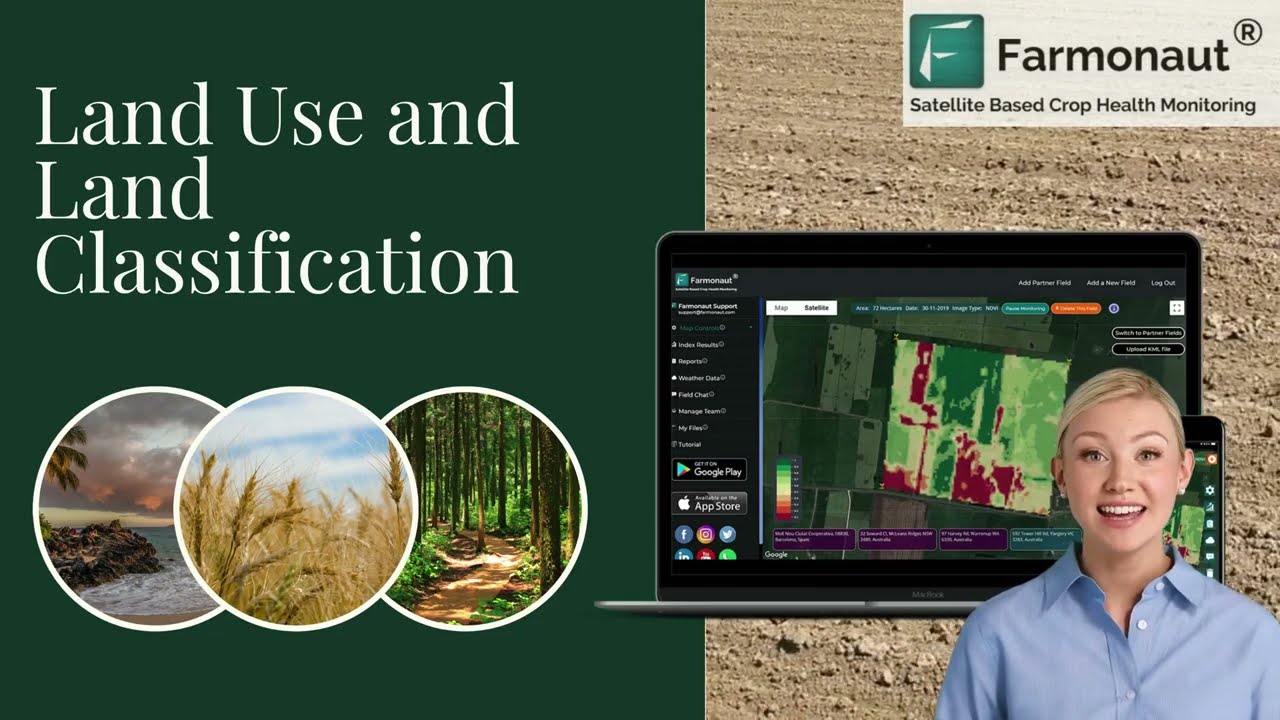
Farmonaut and the Future of Agricultural Land Classification Map UK
At Farmonaut, we believe that democratized access to precision agriculture is fundamental for the next generation of land management tools. Our mission is to make cutting-edge, satellite-based farm management solutions affordable and accessible to farmers, agribusinesses, and policymakers worldwide.
- Satellite-Based Crop Health Monitoring: We use multi-spectral imaging to deliver precise, field-level vegetation health, soil moisture, and crop development data—helping stakeholders optimize yields and resource allocation.
- Jeevn AI Advisory System: This innovative AI platform analyzes satellite and ground data to provide tailored, real-time crop management advice, empowering farmers with actionable insights.
-
Fleet & Resource Management: Our digital management tools track farming machinery and optimize logistics for larger-scale operations.
Explore benefits at:
Farmonaut Fleet Management
- Blockchain-Based Product Traceability: We offer supply chain transparency using blockchain technology, ensuring that agricultural land classification report data and products are traceable and verifiable.
-
Carbon Footprinting: Our real-time emission tracking helps users measure and reduce their environmental impact easily.
Read more:
Farmonaut Carbon Footprinting
-
API and App Platforms:
-
-
Large-Scale Farm Management: For authorities and agribusinesses seeking scalable monitoring, we provide advanced management tools.
Discover more: Large Scale Farm Management




Our commitment supports the ongoing evolution of agricultural land classification maps UK by integrating real-time data and making climate-smart farming tools widely available.
Comparison Table: Agricultural Land Classification Systems and Remote Sensing Advancements in the UK (2025 Estimate)
| Land Classification Type | Estimated Coverage in UK (%) for 2025 | Key GIS/Remote Sensing Technologies Used | Primary Uses / Planning Applications |
|---|---|---|---|
| Grade 1 – Excellent Quality | 2% | Sentinel-2, LiDAR, AI-based soil classification, geospatial analytics | High-value crop zoning, food security, protected against development |
| Grade 2 – Very Good Quality | 9% | DEM data, multispectral imagery, climate impact modelling | Versatile crop production, local food supply, managed development control |
| Grade 3a – Good Quality | 15% | Remote sensing for vegetation index, soil moisture maps, ground surveys | Protected as ‘Best and Most Versatile’, investment incentives |
| Grade 3b – Moderate Quality | 22% | Satellite time-series, AI yield prediction, hydro-climatic risk mapping | General food production, targeted improvement schemes |
| Grade 4 – Poor Quality | 31% | Drone imagery, slope and erosion mapping, forestry suitability models | Forestry, pasture, environmental restoration planning |
| Grade 5 – Very Poor Quality | 21% | LiDAR for wetland detection, biodiversity and rewilding suitability maps | Wildlife habitat, carbon sequestration projects, rarely cropped |
Note: Percentage estimates are based on DEFRA and sector forecasts for 2025. Technology usage shows contemporary best practices for each grade.
“UK land planners analyze more than 1.5 million hectares annually using high-resolution satellite data for classification accuracy.”
Agricultural Land Classification Map UK: In-depth Uses for 2025 and Beyond
Agricultural land classification maps UK underpin countless decisions, investments, and planning projects. Their practical value for land managers, farmers, and public authorities is immense.
1. Planning and Development Control
- Local authorities rely on up-to-date classification maps when reviewing planning applications for housing, infrastructure, or industrial projects.
- Best and Most Versatile Land (Grades 1, 2, 3a) is given primary protection against development, securing the national food base.
- Updated ALC data ensures incoming climate challenges or land degradation events are considered in new projects.
2. Agricultural Management & Investment
- Farmers use ALC reports to determine what crops to plant, where to invest in drainage/irrigation, and how to maximize profitability while maintaining sustainability.
- New precision farming tools integrate classification data for better daily decision-making.
- For investors, land classification underpins valuation, project financing, and loan approvals.
- Farmonaut Crop Loan and Insurance platforms securely leverage remote classification data to support responsible farm financing.
3. Forestry, Conservation & Environmental Services
-
Poor grade and very poor grade land often have greater suitability for
woodland, agroforestry, and rewilding projects—and are key to government carbon offset and biodiversity goals. - Knowing which land is less suitable for crops, planners can efficiently allocate incentives for environmental conversion.
-
Read about carbon sequestration on farmland:
Farmonaut Carbon Footprinting for Agriculture
4. Policy, Schemes, and Subsidy Allocation
-
DEFRA and devolved governments
use agricultural land classification maps uk to target Environmental Land Management schemes (ELMs), supporting the recovery of nature and the sustainable intensification of high-quality farmland. - Subsidies and payments are increasingly tied to real, measured improvements or risks to land grades (e.g., flood reduction, improved soil structure).

Agricultural Land Classification Report: Detailed Analysis and Modern Applications
An agricultural land classification report is a comprehensive document based on ALC map data, physical site surveys, and the latest remote sensing inputs.
-
Structure and Contents:
- Preliminary desk-based soil and topography analysis
- Summary of historical cropping, climate, and management practices
- Field survey logs, including soil pit data, drainage status, and limitations such as slope or wetness
- Integration of satellite-derived indices (vegetation index, yield risk)
- Assessment of long-term sustainability and quality changes
- Policy and planning recommendations for stakeholders
-
Purpose:
- Support in statutory planning, land sale transactions, and land conversion cases
- Basis for environmental impact assessments
- Required for most major development applications involving agricultural land
-
Modern Evolution (2025):
- Reports can now deliver dynamic, scenario-driven analytics (e.g., how will a hectare’s grade shift under more rainfall or warming climate?)
- Machine learning models offer predictive power to pre-empt degradation risks
- API accessibility improves third-party verification and integration with government or insurer systems
The agricultural land classification report forms an essential proof-point, whether for future-proofing investments or ensuring legal compliance under changing environmental and land use frameworks.

Agricultural Land Classification UK: 2025 Trends and the Road Ahead
The coming years will see ALC maps UK and associated reports evolve rapidly. Here’s what to expect:
-
Climate Resilience Built-In:
Next-generation ALC tools will more deeply integrate climate forecasts, soil carbon storage, and flood or drought risk for proactive, adaptive land management. -
Greater Transparency & Access:
Digital, open-access GIS platforms (public and industry-specific) will allow instant querying and modelling of land grades at any location, supporting collaboration across the value chain. -
AI-Driven Advisory for All Stakeholders:
AI systems will provide not just classification but ongoing management advice and suggestions personalized to changing farm or woodland conditions. -
Integration with Carbon & Nature Markets:
More ALC maps will be paired with biodiversity and carbon sequestration data, enabling farmers to claim environmental incentives for land enhancement, not just food production. -
Dynamic Soil & Crop Health Monitoring:
Annual (or even seasonal) map and report updates will become standard, offering more agile responses to land degradation and conservation needs.
The evolution of agricultural land classification maps and reports UK will underpin national resilience to climate, food security, and environmental policy shifts.
Farmonaut: Essential Solutions for Modern Agriculture (2025)
- Satellite-Based Decision Making:
- Integrate with your business: Access Farmonaut’s API for seamless data connectivity. Find detailed developer docs here.
- Drive transparency & compliance: Use product traceability solutions to verify classifications for supply chains.
- Carbon & environment: Start tracking with carbon footprinting tools for environmentally responsible management.
- Financing & insurance made easy: Secure crop loans or insurance using satellite-based verification via Farmonaut Crop Loan & Insurance.
- Fleet and large-scale farm management: Streamline agri-business with Farmonaut Fleet Management and large-scale management solutions.
Frequently Asked Questions (FAQ): Agricultural Land Classification Map UK
- Q: What is an Agricultural Land Classification Map UK used for?
A: It visually represents the quality, capability, and best use of land across the UK. It assists in planning, farm management, policy, subsidy, environmental conservation, and forestry decisions by showing which areas are best for cropping, livestock, or conservation. - Q: What technologies are shaping ALC maps in 2025?
A: GIS, high-resolution satellite data (Sentinel, Landsat), AI-driven analytics, remote sensing, and blockchain-based traceability now power real-time, accurate classification and monitoring. - Q: How often are ALC maps updated?
A: Traditionally every few years, but with new cloud GIS and satellite monitoring, updates are now annual or even more frequent. - Q: Why are Grades 1, 2, and 3a called “Best and Most Versatile Land”?
A: Because they are most suitable for a wide range of crops and intensive farming, so they’re strongly protected from non-agricultural development. - Q: Can farmers access modern ALC data directly?
A: Yes, platforms like Farmonaut make satellite-driven classification and advisory tools directly available via apps and web dashboards. - Q: What’s the benefit of integrating ALC data with resource management?
A: It helps optimize decision-making, enables targeted investments, ensures regulatory compliance, and increases sustainability and productivity for agriculture and forestry.
Conclusion: The Ongoing Evolution of Agricultural Land Classification Map UK
Agricultural land classification map UK and the supporting reports are more than regulatory obligations—they’re essential to the future of UK agriculture, food security, and sustainable environmental management.
As we move through 2025 and beyond, the integration of advanced GIS, AI, and satellite technologies means these maps are no longer static—they’re dynamic, interactive decision-support systems. They will support climate resilience, precision farming, supply chain transparency, improved subsidy targeting, and ecological restoration at never-before-seen scales.
Farmonaut is at the forefront, delivering these capabilities to users across the agricultural spectrum, and ensuring that the power of data-driven land assessment is accessible to all.
Whether you’re a farmer, planner, policymaker, or forester, make the most of up-to-date agricultural land classification maps UK and robust reporting for every land use and investment decision.
Together, let’s ensure UK farmland is productive, resilient, and managed for generations to come.

 Kalustyan
 Tucor
Tucor Saraswati Agro
 Geno
Geno Hayleys Agriculture
 Linx Agritech
 Adinet
 Save Your Soils
 Grandstream Algérie
 XOS Realty
 Geospatial Lab Africa
 Agro La Gándara
 HIPSAC
 ZOL Zimbabwe
 Juligerm
 MISE Maroc
 NWNS
NWNS
