

Ag retail · Buyer guide
Nutrien Ag Solutions Locations: Services and How to Choose
Nutrien Ag Solutions, the retail arm of Nutrien Ltd., says it has more than 1,700 locations worldwide. Find a branch with its online locator, then compare services and dated price quotes. This independent guide covers what it sells and recent US retail fertilizer prices.
Key takeaways
- Nutrien Ag Solutions says it has more than 1,700 locations worldwide; Nutrien’s 2025 results place its retail network in North America, South America and Australia.
- Crop nutrients ($7.29 billion) and crop protection ($6.11 billion) made up most of Nutrien’s 2025 Retail sales.
- In late September 2026, DTN’s US retail survey put urea at $683 per ton and anhydrous at $979 per ton.
- Compare any retailer on price basis, application timing, agronomy, soil testing and credit terms, in writing.
- Farmonaut is independent of Nutrien; this page implies no partnership.
In this article
- Where Nutrien Ag Solutions locations are
- What the retail business sells: sales by product line
- Fertilizer prices at US retail
- How to choose an ag retailer: a buyer guide
- Services beyond inputs: grain storage and sustainable practice
- Digital tools that work alongside a retailer
- Large chain, co-op or independent dealer
- How we checked the numbers
- FAQ
Nutrien Ag Solutions is the retail arm of Nutrien Ltd. Its own website says it has more than 1,700 global locations, and Nutrien’s 2025 results place its retail network in North America, South America and Australia. To find Nutrien Ag Solutions locations near you, use the branch finder on the company’s website, then call the branch to confirm which products and services it offers.
This guide is an independent overview. Farmonaut is not connected to Nutrien. We explain what the branches sell, how the retail business splits its sales, what fertilizer cost at US retail in late September 2026, and how to compare any ag retailer. A calculator lets you work out your own nitrogen cost per acre before you call a branch.
Where Nutrien Ag Solutions locations are
Nutrien says its Retail segment sells to farmers through a network of retail locations in North America, South America and Australia (Nutrien full-year 2025 results, February 2026). The company’s US site describes more than 1,700 global locations. It does not publish a simple count by country on that page, so treat any country split you see elsewhere with care unless it is dated and comes from Nutrien’s own filings.
The US network has a long history. Before 2018 it traded in the US as Crop Production Services, the retail arm of Agrium. Nutrien was formed when PotashCorp and Agrium merged, and the retail brand was renamed in 2018. Crop Production Services itself came from four companies, and Nutrien’s history page says it had more than 900 retail locations and 7,500 employees before the rebrand.
How to find the nearest branch
- Open the location finder on the Nutrien Ag Solutions website for your country.
- Search by town, ZIP code or postcode.
- Check the branch type. Some sites are full agronomy centers with storage and spreaders; others are smaller sales or seed points.
- Call ahead. Ask about stock, application equipment, opening hours in your busy season and the name of the local crop consultant.
What a typical branch offers
Services differ by site, so confirm locally. Across the network, Nutrien lists these product lines in its results:
- Crop nutrients: nitrogen, phosphate and potash products.
- Crop protection: herbicides, fungicides and insecticides, including its own Loveland Products brand.
- Seed: national brands plus its own Proven Seed and Dyna-Gro Seed.
- Services: custom application, soil sampling and agronomy advice.
- Merchandise: a merchandise line that Nutrien reports as a separate sales category; ask your branch what it stocks.
- Nutrien Financial: credit for input purchases.
What the retail business sells: sales by product line
Nutrien reported Retail sales by product line for the full year 2025. Crop nutrients brought in $7.29 billion and crop protection products $6.11 billion. Seed added $2.13 billion. Services and other came to $944 million, merchandise to $875 million and Nutrien Financial to $376 million. These are company-reported sales in US dollars, before an internal elimination line.
Chart
Nutrien Retail sales by product line
US$ million, full year 2025, company-reported
The split tells a farmer something useful. Fertilizer and crop protection are the core of the business. Services are a small part of sales, but their gross margin rose from $716 million in 2024 to $750 million in 2025. That fits a business that wants to sell application and advice, not only product.
Nutrien also said that a weather-shortened fall application window in the US cut crop nutrient volumes in the fourth quarter of 2025. Dry conditions in Australia reduced crop protection sales. Branch stock and service capacity can be tight in those windows, which is one reason to book early.
Chart
Retail gross margin by product line
US$ million, full year, company-reported
Fertilizer prices at US retail
Retail fertilizer prices change week by week. In the last week of September 2026, the DTN survey of US retail dealers showed these average prices per ton: anhydrous $979, MAP $974, DAP $934, 10-34-0 $702, urea $683, potash $499, UAN32 $483 and UAN28 $430. These are national average retail prices from dealer surveys, not contract or delivered prices at any single branch.
Chart
US average retail fertilizer prices
US$ per ton, last week of September 2026, national dealer survey averages
On a nitrogen basis, DTN put urea at $0.74 per pound of N and anhydrous at $0.60 per pound of N. Compared with a year earlier, anhydrous was 20% higher and urea 12% higher (DTN, October 2026).
Earlier in 2026, the conflict near the Strait of Hormuz pushed nitrogen prices up fast. A farmdoc daily analysis from the University of Illinois found that urea rose 41.1% between mid-February and mid-April 2026. The same piece estimated the increase added roughly $30 to $55 per acre in nitrogen costs for corn. The World Bank also reported that fertilizer prices surged as Hormuz disruptions tightened supplies. Prices at your local branch will differ from these national figures, so ask for a written quote.
Your nitrogen cost per acre
The calculator below converts a price per ton into a cost per pound of N and per acre. Enter the quote you get from any retailer, Nutrien or another.
Try the numbers for your own farm below.
Calculator
What will nitrogen cost you per acre?
Enter a quote from any retailer and your own rate and acres.
- Cost per pound of N: 0.74 $/lb N
- Product needed per acre: 348 lb
- Total nitrogen cost: $59,391
- Corn needed to pay for it: 29.7 bu/acre
Example values only, not a benchmark or a quote. The default price ($683 per ton, urea at 46% N) is DTN’s US average retail price for the last week of September 2026; your local price will differ. The corn price is your own input. 2,000 lb per short ton is fixed in the formula.
How to choose an ag retailer: a buyer guide
Most areas have more than one input supplier: a Nutrien branch, a farmer co-op, an independent dealer or a regional chain. Compare them on the same points.
| Question | Why it matters | What to ask for |
|---|---|---|
| Price basis | Prices can be list, booked or delivered | Written quote per ton, with delivery and application |
| Application | Spreader and sprayer time is scarce in spring and fall | Booking window and per-acre fee |
| Agronomy | Advice quality varies by person | Name and certification of the agronomist |
| Soil testing | Rates should follow current soil tests | Sampling grid, lab used and turnaround |
| Credit terms | Input finance has a real cost | Interest rate, due dates and fees in writing |
| Storage and pickup | Distance adds fuel and labor | Hours, loading speed and minimum orders |
Questions to ask before you book
- Is the price a booked price, a cash price or a list price, and on what date was it set?
- Does the rate follow your soil test? The USDA NRCS nutrient management standard (Code 590) says current soil tests are no older than three years, or the interval your land-grant university recommends.
- Will the plan follow the 4R idea of right source, rate, time and place? The EPA notes that applying nutrients in the right amount, at the right time, with the right method and placement reduces losses to water.
- Who pays if application is delayed by weather?
Fertilizer and crop protection advice is general. Always check the product label, follow local rules and get professional advice for your own fields.

▶ Six plain steps to start precision farming, from field maps to satellite monitoring. · 4:18
Services beyond inputs: grain storage and sustainable practice
Many growers who visit an input branch also ask about storing grain and about conservation practices. These are not Nutrien products in most cases, but they shape what you buy.
Grain storage basics
Stored grain spoils faster when it is wet and warm. Oklahoma State University Extension warns that stored wheat at moistures above 12.5 percent may be at risk, and that aeration is the main tool to cool grain and hold quality. Sensor cables and fans help, but they only work if someone checks the readings. For bin types and layouts, see our guide to grain storage bins and advanced storage systems.
Sustainable farming practices
Common practices that cut input waste include no-till, cover crops, integrated pest management and nutrient recycling with manure or compost. The EPA lists nutrient management and conservation tillage among the main ways farms reduce nutrient runoff. Ask your retailer whether it offers cover crop seed, variable-rate application or help with cost-share paperwork.

▶ Seven simple sustainable farming practices that protect soil and water, explained with humor. · 4:34
Digital tools that work alongside a retailer
Many retailers now offer field mapping, soil sampling plans and variable-rate prescriptions. Independent tools can add a second view. Satellite imagery shows how crop vigor changes across a field during the season, which helps you decide where to walk and sample. It shows a change in plant cover, not its cause, so an agronomist still needs to check the field.
Farmonaut, a US-based company, offers satellite crop monitoring through web, Android and iOS apps. You draw your fields once and get vegetation maps through the season, which you can share with whichever agronomist you use.
Related pages on our site: web and mobile apps, large-scale farm management, product traceability, carbon footprinting, fleet management, crop loan and insurance verification, satellite data API and API developer docs.
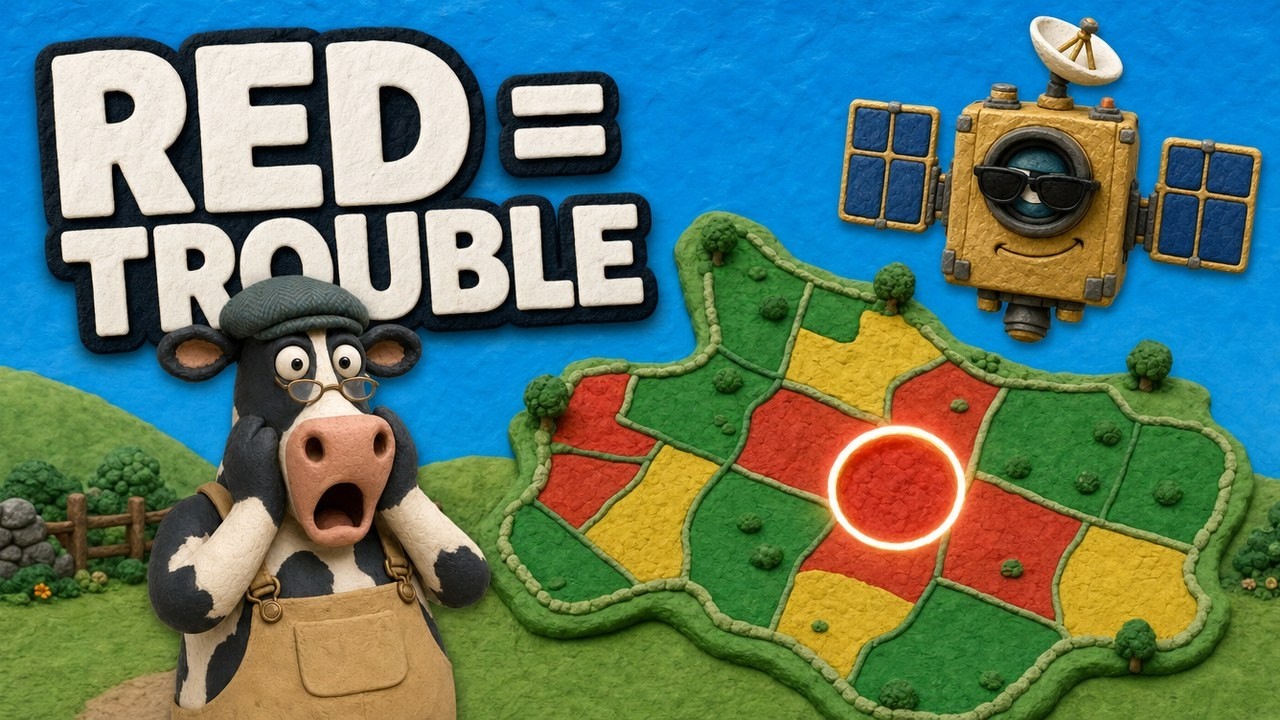
▶ How satellite NDVI maps show crop stress across a large farm before it is easy to see. · 4:09
Large chain, co-op or independent dealer
A national chain, a farmer-owned co-op and a local independent dealer can all supply the same fertilizer. The differences lie in scale, ownership and service, and each suits a different kind of farm.
- Large chain (such as Nutrien): a wide product range, its own seed and chemical brands, and in-house credit. Staff may move between branches, so ask who will be your agronomist next season.
- Farmer co-op: owned by members, and profits may come back as patronage. Check the membership terms and how patronage is paid.
- Independent dealer: often a smaller product list but flexible service. Check how much application equipment they own and how they cope with a short spring window.
None of these is better for every farm. The right choice depends on your crops, your distance to each site, the advice you need and the price you are quoted on the same date for the same product.
Timing your orders
Booking inputs early can lock a price and secure application time, but it also ties up cash. The farmdoc daily analysis noted that pre-booking softened the 2026 price rise for some Midwest farmers, but did not remove it. Before you book, compare the booked price with your expected crop price, check the payment date, and ask what happens if your plan changes. Keep every quote with its date so you can compare like with like.
Keep good records
Write down what you applied, where, when and at what rate. Records help you check whether the rate matched the soil test, support cost-share or compliance paperwork, and make next year’s quotes easier to compare. A simple field map with dates is enough for most farms.
How we checked the numbers
We used Nutrien’s full-year 2025 results release for sales and margin by product line, and the Nutrien Ag Solutions website for the location count and history. Fertilizer prices come from DTN’s weekly US retail survey for the last week of September 2026, and price drivers from farmdoc daily and the World Bank. Practice advice comes from USDA NRCS, the EPA and university extension services. We did not contact Nutrien, and nothing here is an endorsement or a partnership.
FAQ
How many Nutrien Ag Solutions locations are there?
The company’s website says it has more than 1,700 global locations. Nutrien’s 2025 results place its retail network in North America, South America and Australia. Counts change as branches open, close or merge, so check the location finder for your area.
What services do the branches offer?
Nutrien reports sales of crop nutrients, crop protection products, seed, services such as application and agronomy, merchandise and credit through Nutrien Financial. Not every branch offers every service, so call your local site.
Who owns Nutrien Ag Solutions?
It is the retail business of Nutrien Ltd., a Canadian crop inputs company formed in 2018 from the merger of PotashCorp and Agrium. In the US it was earlier known as Crop Production Services.
Are fertilizer prices the same at every branch?
No. National averages such as DTN’s survey are a guide only. Local prices depend on freight, booking date, volume and service. Ask for a dated written quote and compare it with other suppliers.
Should I book fertilizer early?
Early booking can fix a price and secure application time, but it ties up cash and does not always beat later prices. Compare a dated booked price with your crop price and payment terms, and get professional advice if the sums are large.
Is Farmonaut part of Nutrien?
No. Farmonaut is an independent US-based satellite crop monitoring company. This page is a neutral guide and does not imply any partnership.
Farmonaut crop monitoring
See your own fields from space
Draw your fields once and Farmonaut shows satellite vegetation maps for them through the season, on web, Android or iOS.




Keep reading
Sources
- Nutrien, Nutrien Reports Full-Year 2025 Results and Provides 2026 Guidance (February 2026): placera.se
- Nutrien Ag Solutions, About us (accessed October 2026): nutrienagsolutions.com
- DTN, UAN32 Leads Fertilizer Prices Higher (7 October 2026): dtnpf.com
- farmdoc daily, University of Illinois, Middle East Ceasefire Fails to Ease U.S. Fertilizer Price Pressure on Farmers (April 2026): farmdocdaily.illinois.edu
- World Bank Blogs, Fertilizer prices surge as Strait of Hormuz disruptions tighten supplies (2026): blogs.worldbank.org
- USDA NRCS, Conservation Practice Standard 590 Nutrient Management (hosted by Utah State University Extension): extension.usu.edu
- US EPA, Sources and Solutions: Agriculture: epa.gov
- Oklahoma State University Extension, CR-1741 stored grain fact sheet: pods.okstate.edu
- Nutrien Ag Solutions, Find Location branch locator (accessed October 2026): nutrienagsolutions.com
- Nutrien Financial, financing overview (accessed October 2026): nutrienfinancial.com
Discussion
Questions, corrections or field experience? Share them below. First-time comments are reviewed before they appear, and your email is never published.
No comments yet. Be the first to add a question or your experience.

 SP Farms
 Indosistim Teknologi
 Suminter India Organics
 Liquify Digital
 CU Foods
 BeyondTech Global
 Rouge VC
 AgroGreen Dynamics
 AgroRisk
 Oath Inc
 Reddane Farming
 Esri North East Africa
 Cresol
 MDCV UK
 Zerella Group
 Etech Consulting Madagascar
 Vestlandsforsking
 Delicio

 Exploration consultancy · South Africa · Gold
 Licence holder · Niger · Gold










