
Grazing software · Buyer guide
Pasture Grazing Apps Compared: 7 MaiaGrazing Alternatives
Pasture grazing apps map paddocks, count rest days and record herd moves. MaiaGrazing is now closed to new accounts, so new buyers must look elsewhere. Here are seven options compared from makers’ own pages, with USDA data on herd size and farm signal.
Key takeaways
- MaiaGrazing is a legacy platform closed to new accounts; its maker, Atlas Ag, points users to Atlas Grazing (checked 5 November 2026).
- About 79% of US farms with beef cows kept fewer than 50 cows (our sum, 2022 Census of Agriculture), so small plans matter: PastureMap listed US$10 a month for 50 animals on 5 November 2026.
- In one three-year Georgia trial, rotation carried a 38% higher stocking rate and 31% less winter hay, with no change in individual calf weaning weight (Hoveland et al., 1997).
- 55% of US farms used broadband and 74% had a cellular plan in 2025 (USDA NASS), so test offline use in your furthest paddock before you subscribe.
In this article
- The seven pasture grazing apps at a glance
- How we chose these grazing management apps
- What each grazing app offers
- What a cattle pasture app should actually do
- Why rotational grazing software can pay
- How to map pastures in grazing software
- Is your phone signal good enough for a rotational grazing app?
- GPS tags and virtual fencing with pasture management software
- Satellite pasture monitoring alongside a grazing app
- How to choose the right pasture management software
- Pasture planning calculator: paddocks, rest and app break-even
- FAQ
- Bottom line on grazing apps
Pasture grazing apps map your paddocks, count grazing and rest days, and record herd moves so you can move cattle before grass is overgrazed. About 40% of US cow-calf operations reported some form of rotational grazing in 2018, according to the USDA Economic Research Service, and every one of them has rest periods to track. This guide compares seven apps, names the MaiaGrazing replacement, and gives you a calculator to test paddock numbers and an app’s break-even.
Start with one fact if you came here looking for a MaiaGrazing alternative: its developer now describes MaiaGrazing as a legacy platform closed to new accounts and points new users to Atlas Grazing. So a new buyer has to choose something else anyway. The right pick depends on herd size, phone signal and whether you want to estimate grass from satellite images or walk it yourself.
The seven pasture grazing apps at a glance
The table below uses what each maker says on its own website, checked on 5 November 2026. We did not test the apps on a working ranch, so treat this as a shortlist to trial. Features and prices change often. Where a maker does not show one fixed price on the page we read, the table says where to look or ask.
| App | Best for | Grazing tools | Maps and pasture data | Devices and signal | List price seen |
|---|---|---|---|---|---|
| Atlas Grazing | Current MaiaGrazing users planning a move | Livestock, paddocks and daily work in one system | Paddock records | Mobile access stressed by the maker | Ask for a quote |
| PastureMap | Small US herds that want a low entry price | Moves, grazing periods, rest days, stocking and carrying capacity, animal days per acre | Paddocks, gates and water | Browser and app; maker says it works with no reception | US$10 a month for 50 animals and one member |
| Pasture.io | Grass-focused farms that want feed budgets | Feed wedge, grazing planner, suggested next moves | Daily satellite-based pasture cover and growth rates, plate meter readings optional | No hardware required | Ask for a quote |
| Herdwatch | Herds that want cattle records and grazing in one app | Herd moves, rest, grazing days, stocking rate | Draw pastures on a satellite map; grass covers | Phone, tablet, PC; records offline and syncs later | Priced by herd type and size; 30-day trial listed |
| fieldmargin | Mixed farms that also map crops and jobs | Herd moves, automatic rest days, grazing history | Farm map, notes and field jobs | Phone and computer; maker says it works offline | See the maker’s plans page |
| Pasture Pro | US ranches with several workers and leases | Grazing reports and livestock records | Boundaries, livestock location, parcels; GPS ear tags offered | App; works offline, unlimited users | Check in the app |
| AgriWebb | Larger herds that need audit-ready records | Drag-and-drop mob moves and grazing insights | Interactive farm map | Works offline | Calculator priced by head count |
If you only need a rotation calendar and rest-day counts, PastureMap, fieldmargin and Herdwatch cover that job. If you want pasture cover estimated from images instead of a plate meter walk, start with Pasture.io or add a separate satellite tool. If compliance records drive the purchase, look at AgriWebb and Herdwatch first.
How we chose these grazing management apps
We started from the products the earlier version of this page covered, added AgriWebb, and looked at the searches that bring readers here: rotational grazing app, cattle pasture app, pasture mapping software and MaiaGrazing replacement. We kept products that have a working maker website in English and name grazing, paddock or pasture tools on it. We then read each maker’s own product page on 5 November 2026.
This is not a ranking. We found no independent like-for-like test of these products, and no USDA survey we read reports what share of ranches use grazing software as distinct from rotational grazing itself. Any time-saving percentage on a vendor page deserves one question: which study measured that?
What each grazing app offers
1. Atlas Grazing (the MaiaGrazing successor)
Best for: current MaiaGrazing customers, and producers who want livestock, paddocks and daily work in one system.
Atlas Ag says MaiaGrazing ran for about 10 years before it shut the door to new accounts. The company describes Atlas Grazing as a wider system where livestock, paddocks and daily work sit together, with stronger mobile access. Current MaiaGrazing Pro customers are invited to request a move and plan it on their own schedule.
Before you move, ask three things in writing. Will all paddock history come across? Will your forage budgets and reports come across? Which outside systems connect, and at what cost? Ask about integrations and cost directly, because the legacy page we read does not set out either one. Ask for a demo using your own farm map, not a sample farm.
2. PastureMap
Best for: small and mid-sized US cattle herds that want a low-cost way in.
PastureMap, now listed under Grassroots Carbon, tracks cattle moves, grazing periods and rest days. It also calculates stocking and carrying capacity and reports animal days per acre. The maker adds to-do lists, herd notes, season scenarios, and reports for NRCS and GAP certification. On 5 November 2026 its page showed US$10 a month for 50 animals and one team member, a list price that rises with animals and members. Ask whether calves count toward the animal total.
3. Pasture.io
Best for: intensive grass farms that plan around pasture cover and growth rate.
Pasture.io builds a whole-farm feed position from satellite images, weather and your records. It shows pasture cover and growth rates by paddock, a feed wedge and a grazing planner, and its assistant Pio suggests next grazing moves. No hardware is needed, and you can add your own plate meter or farm walk readings. The customer stories on its site come from Australia and New Zealand, among others, so check how well its cover estimates fit your grass species and climate.
4. Herdwatch
Best for: farms that want herd records and pasture records in one account.
Herdwatch lets you tap the corners of a pasture on a satellite map and get acres and perimeter. It records herd moves and grass covers, works out stocking rate and average farm cover, and produces grazing and pasture reports. The maker says records can be made offline and synced later. It runs separate sites for different countries, so make sure you read the page for yours.
5. fieldmargin
Best for: mixed farms that want one map for livestock, fields and jobs.
fieldmargin records animal numbers and location on a farm map. You move a herd by picking its new location. The app then calculates field rest days and keeps a history of who grazed where and for how long. Notes and field jobs can hold treatments, broken fences, fertilizer and hay yields. It suits sheep, cattle and horses, according to the maker, which makes it a fair pick for a paddock management app on a smaller mixed farm.
6. Pasture Pro
Best for: US ranches with several workers, leases and remote sites.
Pasture Pro, from a company that says it ranches in Snyder, Texas, is wider than grazing alone. It lists pasture boundaries, parcel data, task lists, inventory, lease records, water wells, livestock risk protection quotes and solar GPS ear tags. It says it works offline and allows unlimited users. Reports include grazing. Choose it if ranch administration is your main problem and a detailed forage budget is not.
7. AgriWebb
Best for: larger livestock businesses where records must satisfy auditors or buyers.
AgriWebb offers management by mob or by individual animal, plus an interactive farm map, livestock reconciliation, team tasks and drag-and-drop mob moves. Plans are named Essentials, Compliance and Performance, and a calculator prices them by cattle and sheep numbers. On 5 November 2026 the page showed a first-year discount on annual plans until 30 November, so check the regular renewal price as well. If you farm in Britain, our guide to livestock farm software in the UK covers local record rules.
What a cattle pasture app should actually do
Every product above bundles a different mix of seven jobs. Compare products job by job and you will avoid paying for features you will never open.
- Plan the rotation. Set grazing periods and rest for each paddock, then change them when growth slows.
- Locate the livestock. Record the herd by hand, or feed in GPS tags and virtual fence collars if the app accepts them.
- Watch soil and pasture condition. Log grass covers and soil tests, or view vegetation indices from satellite images.
- Keep the records. Replace notebooks with logs you can search and export for a lender, a certifier or a conservation program.
- Assign the work. Pin fence repairs and water checks to a place on the map and give them to a person.
- Map the land. Hold boundaries, gates, water and lanes, then calculate areas.
- Raise alerts and suggestions. Prompt a move when a paddock reaches its limit, or suggest the next grazing.
The table shows who needs each job. It reports function and fit only. We could not find any independent study that gives labor hours saved per feature, so we do not print such a number.
| Tool | What it does | Who needs it most | Works with poor signal? |
|---|---|---|---|
| Grazing planner | Schedules moves, grazing days and rest | Anyone running more than a few paddocks | Often, if the app stores data on the phone |
| Livestock tracking | Shows animal location by GPS tag or collar | Large ranches with scattered herds | Depends on the network; ask the seller |
| Pasture monitoring | Reads covers, soil tests and vegetation indices | Farms timing fertilizer or feed decisions | Images need a connection to load |
| Records and reports | Stores logs and exports reports | Farms with buyer or program requirements | Capture offline, then sync |
| Task manager | Assigns fence and water jobs | Teams of two or more | Check before buying |
| Pasture maps | Draws paddocks and works out areas | Everyone, as the first step | Saved maps may work; check before buying |
| Alerts and advice | Prompts moves and suggests plans | Busy managers who want reminders | Usually needs a sync first |

▶ How our admin app handles task management across large farms. · 7:27
Why rotational grazing software can pay
An app does not grow grass. It makes a rotation easier to keep, and the rotation may pay on the right site. One useful US number comes from a three-year trial in central Georgia. Hoveland and colleagues (Journal of Production Agriculture, 1997) split mixed tall fescue and bermudagrass pastures into 12 paddocks, with 2 days of grazing and 22 days of rest, and compared them with continuous stocking.
Chart
Georgia trial: rotation against continuous stocking
Percent difference under rotation, three years, one site, tall fescue and bermudagrass
Rotation carried a 38% higher stocking rate and 37% more calf weaning weight per acre, and winter hay use was 31% lower. Three limits matter. Cow weight change, pregnancy rate and individual calf weaning weight did not differ, so the gain came from carrying more animals per acre. The trial used one fescue type on one site, and the gains came because rotation helped that grass survive. And the authors point out extra costs for electric fence and waterers.
Soil and water results point the same way, with conditions. A 12-year study of 15 small watersheds, summarized by USDA’s Agricultural Research Service, found higher erosion under continuous grazing. Fenced stream buffers kept erosion low in the rotationally grazed pastures. The NC State Extension literature review suggests a limit of 3 days of grazing near streams, followed by 3 weeks of recovery. An app with a rest-day counter makes such a limit simple to follow. Your local rules, program terms and adviser come first.
Adoption leaves room to grow. The ERS chart shows 54% of retained-stocker operations used some form of rotation in 2018, ahead of 38% of strictly cow-calf operations. Only 16% of all cow-calf producers used intensive systems, defined as an average grazing period of 14 days or fewer per paddock, and 24% used basic rotation. Short grazing periods create far more moves to record, so intensive systems are where an app may help the most.
Scale changes the decision too. The USDA reported 27.6 million US beef cows on 1 January 2026, and the 2022 Census of Agriculture counted 622,162 farms with beef cows. By our sum of the census table, about 79% of those farms kept fewer than 50 cows. That group should compare per-animal pricing and small plans before anything else. A simple map and a rest-day counter may be all they need.
Chart
US cow-calf operations using rotational grazing
Percent of operations by group, 2018 survey
How to map pastures in grazing software
Pasture mapping software is only as useful as the first map you draw. A good base map is worth the time. The steps below are general, so check the menus and import options in the app you trial.
- Import a boundary. Start from an existing file if your app accepts one, such as an NRCS conservation plan map, a Google Earth KML or a shapefile. Otherwise trace on the satellite layer.
- Draw every paddock as its own shape. The software calculates the area, which drives stocking rate and animal days per acre. Wrong areas give wrong rest periods.
- Mark water, gates and lanes. A paddock without reliable water is not really available, and gate positions decide how fast you can move a herd.
- Add temporary fences as separate cells. Draw polywire strips and breaks as their own cells so rest days are counted for each one.
- Record the first grazing event. Log the herd, the date and the pasture condition. From then on the app can count grazing days and rest days.
For pasture design work, such as splitting a large paddock, sketch the new fence lines in the app first. Check the paddock sizes and walking distance to water before you buy a single post. Fence costs show why. New Mexico State University’s cost comparison B-133 (March 2025) uses US$15,000 per mile for a custom-built four-wire fence, a figure it says varies with terrain and boundary shape.
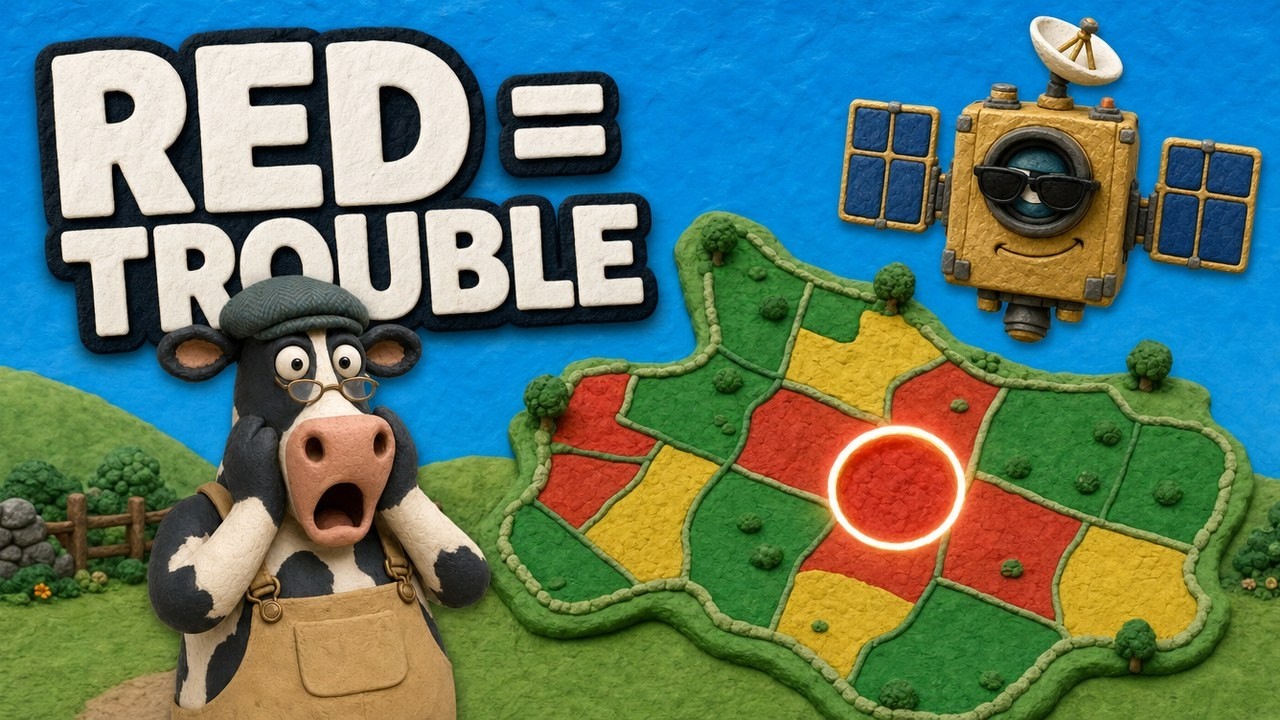
▶ A short, light explainer on how NDVI maps show plant stress before you can see it. · 4:09
Is your phone signal good enough for a rotational grazing app?
Signal may decide your choice before any feature does. The USDA’s Technology Use report (August 2025) says 85% of US farms had internet access and 82% had a smartphone, while 74% had access through a cellular data plan and 55% through a broadband connection. Those are farm-level figures. They say nothing about coverage in your far paddock.
The gap between the two connection types varies among the states in the chart, from 6 points in South Dakota to 28 in Oklahoma. Test this yourself during a trial. Switch your phone to airplane mode, record a herd move in your furthest paddock, then reconnect at home and check that the move has synced without a duplicate. Do it with a satellite map layer too, because some features may need a connection even where record keeping does not.
Chart
How farms connect in cattle states
Percent of farms by method of internet access, selected states and US, 2025; farms can report both
GPS tags and virtual fencing with pasture management software
Trackers and virtual fence collars are the expensive end of this category. They replace labor and fence rather than a notebook, so judge them separately from your app subscription. Pasture Pro lists GPS ear tags. For others, ask which tags and collars connect before you buy either one.
The research is young but useful. In a 110-day trial on shortgrass rangeland, published in Frontiers in Veterinary Science (2025), virtual fencing kept steers in their target areas 94–99% of the time, although five of the 60 regularly stepped out briefly each day. That was one season on a research site.
For costs, NMSU’s B-133 models a 360-cow New Mexico ranch with 75 miles of fence. Its tables give US$188 per cow a year for a physical fence, including maintenance, against US$92.71 per head for a virtual system with towers, collars, batteries and labor. These are modeled costs from one assumed ranch, using a US$200 collar price, and the paper’s own comparison shows the gap changes with fence length. The bulletin also adds that cost alone does not explain ranchers’ choices.
Satellite pasture monitoring alongside a grazing app
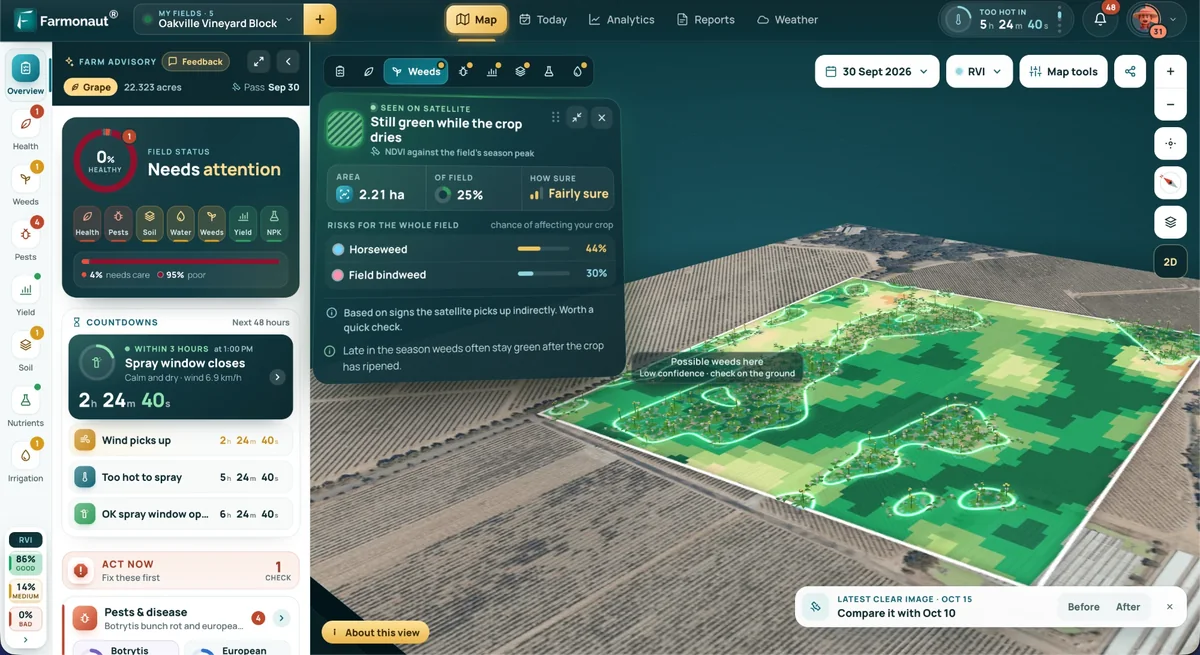
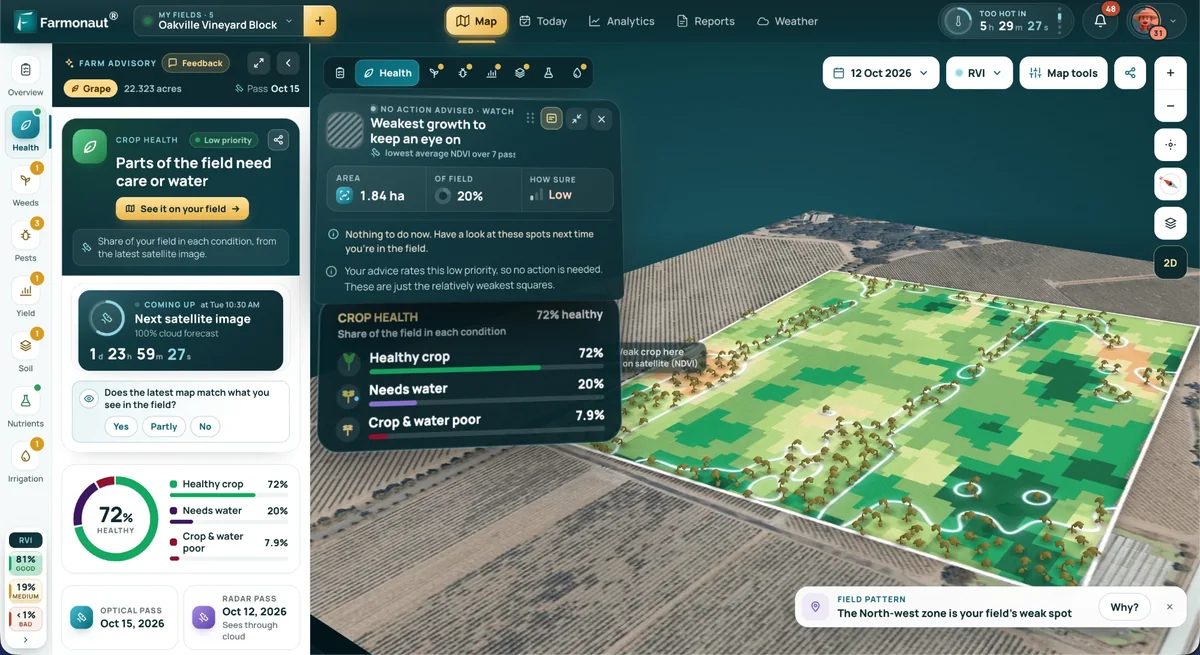
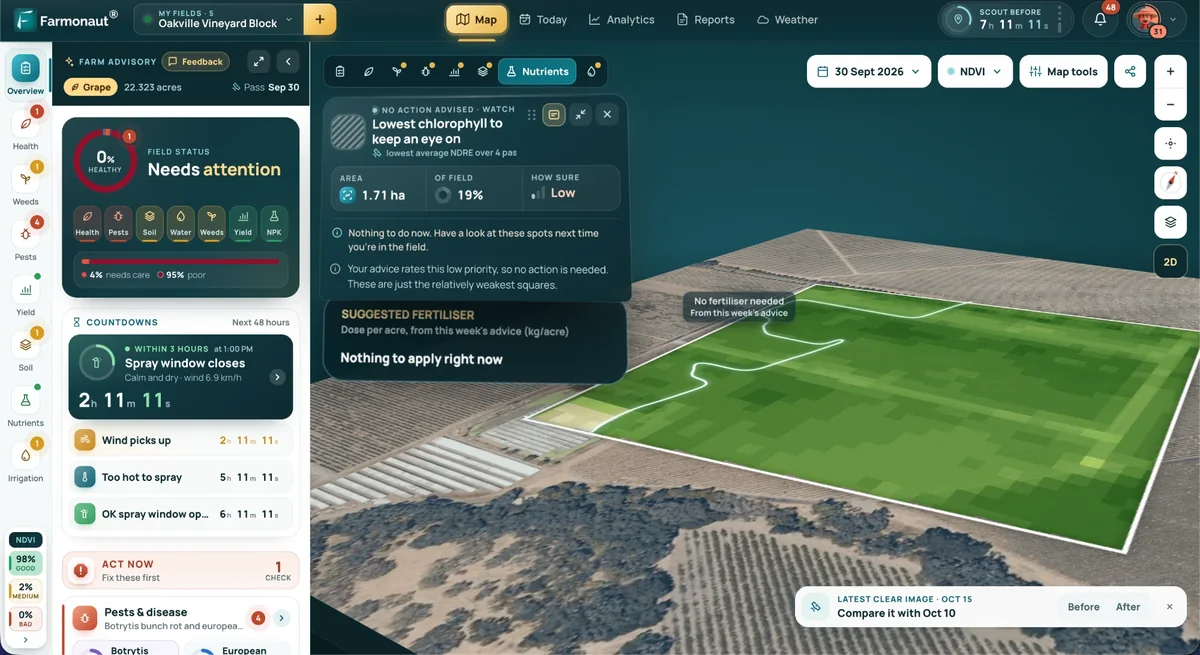
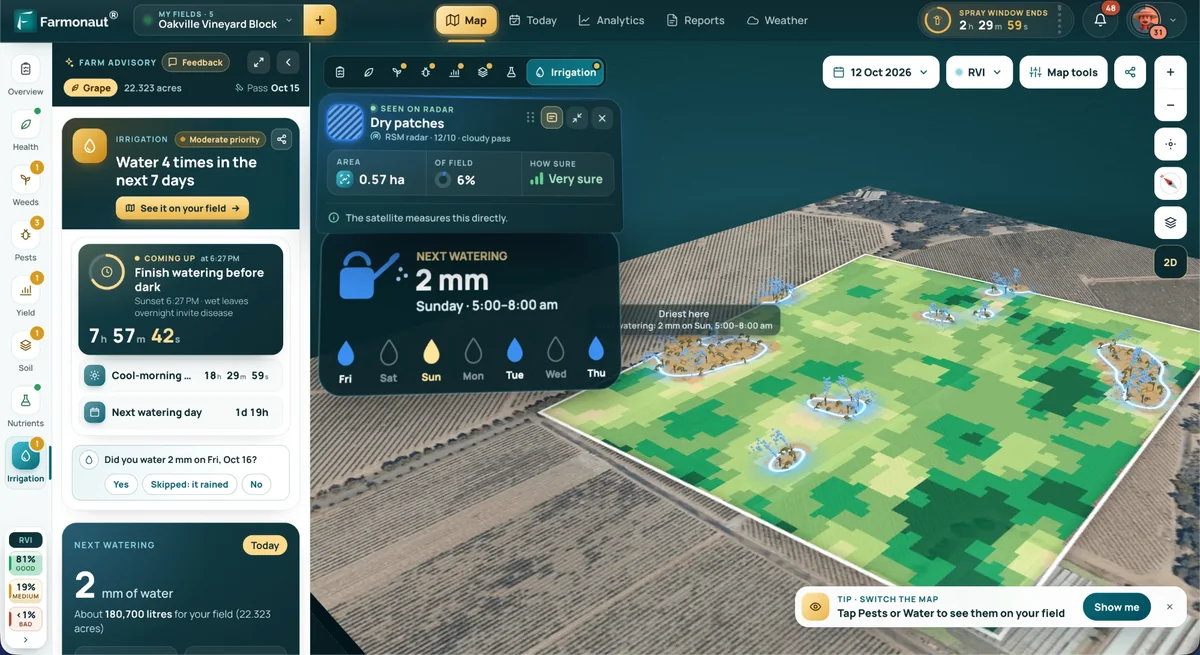
A grazing app tells you where the herd has been. A satellite view can show which paddocks are greening up or falling behind, without walking each one and without field sensors. It shows vegetation change, though. It does not tell you the cause, so a poor patch still needs a visit.
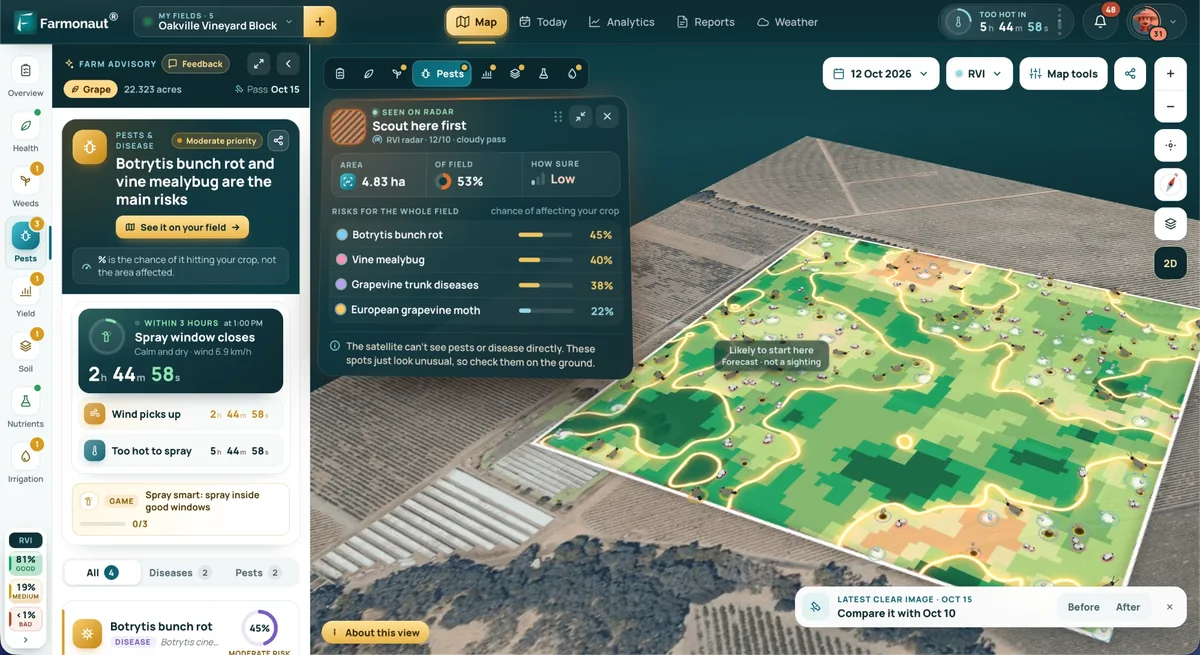
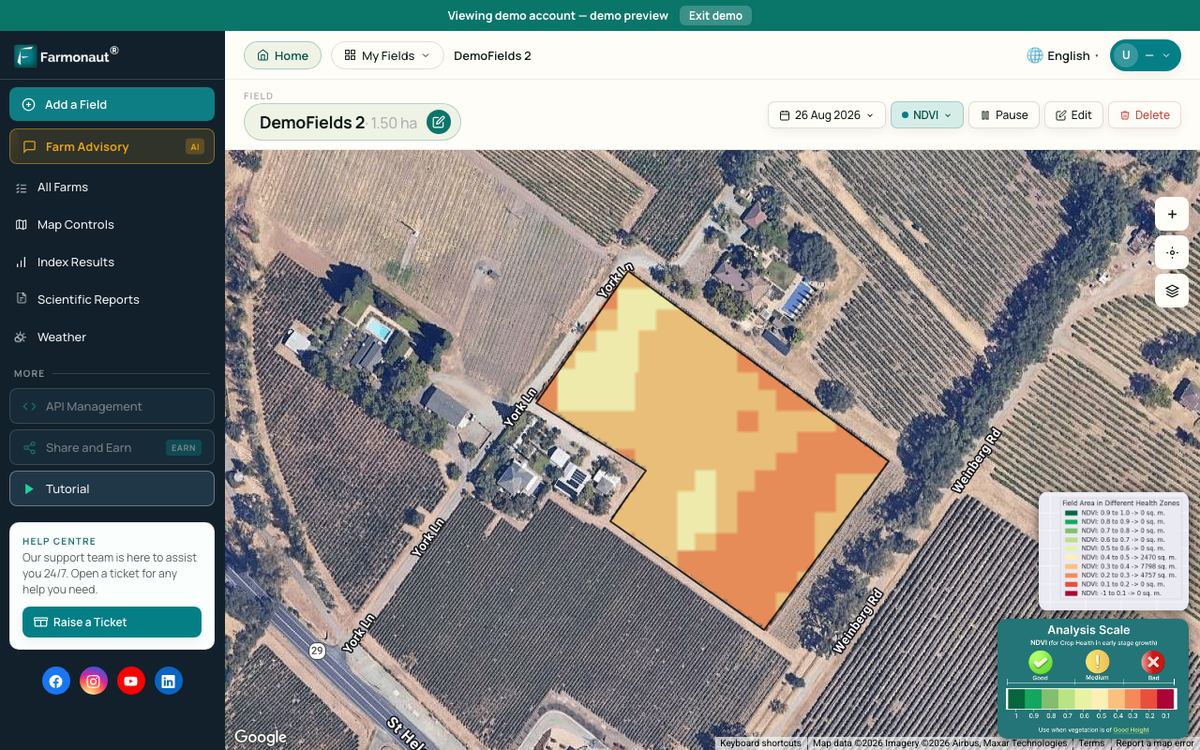
Farmonaut is one tool of this type. You draw your land once, then view vegetation maps through the season on web, Android or iOS, alongside whichever grazing app keeps your herd records. It does not replace a rest-day counter or herd book. Clouds can also delay a clear image, so plan your moves around your own eyes and records as well.

▶ Our tutorial on drawing a field and reading satellite vegetation maps in the web app. · 8:43
How to choose the right pasture management software
Work down this list with your own numbers, and shortlist two apps at most.
Chart
US farms with beef cows by herd size
Number of farms, 31 December 2022 inventory
- Herd and paddock count. Check the price at your herd size and at the size you plan in three years. Per-animal and per-acre plans can diverge fast.
- Grazing period. Moves every 14 days can live in a simple calendar. Daily moves need few taps and quick paddock selection.
- Signal. Run the airplane mode test above in your worst paddock.
- Who enters the data. A two-minute job for your hired hand decides whether records are kept. Have that person try the trial.
- Grass measurement. Choose between walking with a plate meter, photo records and satellite estimates, and be honest about how often you will walk.
- Reports. List what your lender, certifier or conservation program needs, then export one of each during the trial.
- Data exit. Ask how to export maps and grazing history. MaiaGrazing’s closure to new accounts is a good reminder that products can close to new accounts.
- Support hours. Check that help is available in your time zone during the grazing season.
Farmonaut suits the satellite question in that list, not the herd-records one, so assess it beside an app rather than instead of one. For stocking rate context, use local guides rather than a national figure. Alabama Extension lists from 1.5 to 2.5 acres per cow-calf pair across the forages and regions in its table, and your region’s service will have its own numbers. Your local adviser can help you set these for your pasture type.
Pasture planning calculator: paddocks, rest and app break-even
Enter your own numbers below. The calculator shows how long each paddock can feed your herd, the rest period that gives, and the number of bought-feed days an app must save to cover its yearly cost. It does not forecast any gain from rotation. The Georgia trial’s 38% belongs to that trial.
Try the numbers for your own farm below.
Calculator
How long will each paddock last, and what must an app save?
Enter your own acres, herd, forage and costs.
- Paddock size: 15.0 acres
- Rest before the herd returns: 42.0 days
- Stocking rate: 2.40 acres/cow
- Fed days an app must save to break even: 5.0 days
Example values only, not a benchmark or a forecast; every number is your input. The example is set so the app needs 5 fed days saved to cover its cost. Forage on offer and daily intake vary by pasture, season and animal, so ask your local extension service. Grazing days ignore regrowth during the grazing period. Real results depend on weather, water and management.
FAQ
What is the best MaiaGrazing alternative?
For current customers, the maker’s route is Atlas Grazing, since MaiaGrazing is closed to new accounts. New buyers should compare by need: PastureMap for a low entry price, Pasture.io for pasture cover and feed planning, Herdwatch or AgriWebb when herd records matter, fieldmargin for mixed farms and Pasture Pro for ranch administration.
Is there a good app for rotational grazing on a small farm?
PastureMap’s plan for 50 animals was listed at US$10 a month on 5 November 2026, and fieldmargin and Herdwatch also track rest days. By our sum of the 2022 Census table, about 79% of US beef cow farms had fewer than 50 cows, so start with the smallest plan that counts rest days and exports records.
Do pasture grazing apps work without phone signal?
Several makers say so, including PastureMap, Herdwatch, Pasture Pro and AgriWebb. “Works offline” can mean different things, so test a herd move in your furthest paddock during a trial and check that it syncs correctly later.
Can satellite images replace a plate meter?
They can reduce walking, but check them first. Pasture.io lets you add plate meter or farm walk readings alongside its satellite-based estimates. Compare the two on a few paddocks of your own before you rely on the images for a feed budget.
How much do pasture grazing apps cost?
Few of these makers showed one fixed price on the pages we read. PastureMap listed US$10 a month for 50 animals on 5 November 2026, while AgriWebb prices by head count and Herdwatch by herd type and size. Ask for the renewal price, not only the first-year offer. Take financial advice for bigger ranch investments such as collars or fencing.
Bottom line on grazing apps
Pick by the job you are missing. If rest days live in your head, any of the simple trackers will help. If feed budgeting is the gap, trial a pasture-cover tool. If a certifier or buyer is asking for records, trial a records-led app. Whichever you choose, map the farm first, run the airplane mode test, and use the calculator to see what the app must save to pay for itself.
Related pages on our site: farm management systems, large-scale farm administration, fleet management, product traceability, carbon footprinting, crop loan and insurance checks, satellite data API, API developer docs, mobile and web apps.
Farmonaut pasture monitoring
See your own paddocks from space
Draw your pasture once and Farmonaut shows satellite vegetation maps for it through the season, on web, Android or iOS.



Keep reading

Sources
- USDA ERS, About 40 percent of all cow-calf operations reported using rotational grazing in 2018 (2022): ers.usda.gov
- USDA NASS, 2022 Census of Agriculture, Volume 1, US data: nass.usda.gov
- USDA NASS, United States cattle inventory down slightly (30 January 2026): nass.usda.gov
- USDA NASS, Technology Use report (August 2025): esmis.nal.usda.gov
- Hoveland et al., Journal of Production Agriculture (1997): acsess.onlinelibrary.wiley.com
- USDA ARS, Pilon et al., Long-term effects of grazing management and buffer strips on soil erosion (2017): ars.usda.gov
- NC State Extension, Grazing Practices: A Review of the Literature: content.ces.ncsu.edu
- New Mexico State University, B-133 Virtual Fencing vs. Physical Fencing Cost Comparison: pubs.nmsu.edu
- Frontiers in Veterinary Science, virtual fencing of yearling steers on rangelands (2025): frontiersin.org
- Alabama Cooperative Extension, Stocking Rates for Cow-Calf Operations: aces.edu
- Atlas Ag, MaiaGrazing legacy platform page: atlasag.com
- Grassroots Carbon, PastureMap: grassrootscarbon.com
- Pasture.io: pasture.io
- Herdwatch, pasture management software: herdwatch.com
- fieldmargin, livestock: fieldmargin.com
- MyAgInnovations, Pasture Pro: myaginnovations.com
- AgriWebb, pricing: agriwebb.com
Discussion
Questions, corrections or field experience? Share them below. First-time comments are reviewed before they appear, and your email is never published.
No comments yet. Be the first to add a question or your experience.

 Blue BearX
 Insignito
 Croptimum
 Dalmia Bharat Sugar
 DnCubed
 Pistachio ST
 Field Capacity
 Indosistim Teknologi
 Liquify Digital
 CU Foods
 BeyondTech Global
 Rouge VC
 AgroGreen Dynamics
 AgroRisk
 Oath Inc
 Reddane Farming
 Esri North East Africa
 Cresol
 MDCV UK

 Licence holder · Niger · Gold