

Farming basics · Step-by-step guide
Steps of Agriculture: 10 Stages From Plan to Sale
Farming follows ten steps: plan, prepare land, choose seed, sow, water, feed, protect, harvest, store and sell. This guide explains each one with dated numbers from USDA, FAO and extension services, and a calculator to test whether storing grain pays.
Key takeaways
- The ten steps of agriculture run from planning and soil testing to harvest, storage and sale; each step depends on the one before it.
- Corn seedlings took 22 days to appear at 50°F soil and 7 days at 68°F in Oregon State University Extension’s tests.
- FAO gives indicative field application efficiencies of 60% for surface irrigation, 75% for sprinkler and 90% for drip.
- FAO estimates 13.3% of food was lost after harvest worldwide in 2023; Northern America and Europe had the lowest regional loss at 10.0%.
- US corn averaged US$4.64 a bushel in May 2025 and US$3.93 in October 2025 (USDA NASS prices received), so storage decisions matter.
In this article
- The steps of agriculture in order
- What is step agriculture?
- Why the order matters
- 1. Planning and preparation
- 2. Land preparation
- 3. Seed selection
- 4. Sowing and planting
- 5. Irrigation management
- 6. Crop nutrition and fertilization
- 7. Pest and disease management
- 8. Harvesting
- 9. Post-harvest handling and storage
- 10. Marketing and distribution
- Modern tools at each step
The steps of agriculture are the jobs a farmer does in order to turn a bare field into a crop that is sold: plan, prepare the land, choose seed, sow, water, feed, protect, harvest, store and sell. Each step depends on the one before it. A late or rushed step costs yield or money later in the season, so it helps to see the whole process at once before you start.
This guide walks through the ten steps with numbers from public sources: how soil temperature changes how fast seed comes up, how much irrigation water reaches the crop with each method, how much food is lost after harvest, and how farm prices moved through a recent season. A calculator at step 10 lets you test whether storing grain after harvest pays at your own prices and costs.
The steps of agriculture in order
Most field crops follow the same order, whether you grow wheat in Saskatchewan, maize in France or soybeans in Iowa. The names change from one textbook to another. Some lists stop at harvest; others, like this one, carry on to storage and sale, because that is where the money is made or lost. The table sums up each step and the main decision it involves.
Infographic
The 10 steps in order
- 1PlanningCrops, rotation, soil test, budget.
- 2Land preparationSeedbed, residue, drainage, lime.
- 3Seed selectionVariety and tagged seed.
- 4SowingRight depth, rate and soil temperature.
- 5IrrigationWater when the crop needs it.
- 6NutritionSoil test first, then the 4Rs.
- 7Crop protectionScout, threshold, then control.
- 8HarvestRight timing, low combine losses.
- 9StorageDry, cool, clean, checked.
- 10MarketingSell with a plan and a break-even price.
| Step | Main job | Key decision | When |
|---|---|---|---|
| 1. Planning | Choose crops, check soil and budget | What to grow and where | Months before sowing |
| 2. Land preparation | Till or prepare a seedbed, manage residue | How much tillage | Weeks before sowing |
| 3. Seed selection | Pick variety and seed lot | Maturity, disease resistance | Before the season |
| 4. Sowing | Plant at the right depth, rate and date | When soil is warm enough | Start of the season |
| 5. Irrigation | Supply water when rain falls short | Method and timing | Through the season |
| 6. Nutrition | Add the nutrients the soil lacks | Rate and timing | Before and during growth |
| 7. Crop protection | Scout and control weeds, pests, disease | When to act | Through the season |
| 8. Harvest | Cut or pick at maturity | Timing and machine settings | End of the season |
| 9. Storage | Dry, clean and keep the crop safe | Moisture and pest control | After harvest |
| 10. Marketing | Sell the crop | Sell now or store and sell later | Harvest and after |
What is step agriculture?
“Step agriculture” is a short way of saying that farming is a sequence. Every season runs from a plan to a sale, and each step has a window. Sow too early in cold soil and seed sits in the ground. Spray too late and the pest has done its damage. Harvest too late and grain shatters or lodges.
Seeing the process as steps also helps with records. If you write down what you did at each step, and what it cost, you can compare fields and years. That record is what lenders and crop insurers ask for, and it is the base for any change you make next year.
The steps are not a strict line. Scouting for pests overlaps with irrigation. Planning for next year starts while this year’s crop is still in the bin. Still, the order holds: you cannot harvest well from a field that was planted badly.
Why the order matters
Three reasons stand out. First, inputs are expensive and most of them are spent early. Seed, fertilizer and land costs are paid before the crop is up, so mistakes in the first four steps are hard to recover. Second, timing affects yield. Many crops have a narrow planting window and a narrow harvest window. Third, the crop is only worth what you get for it. A good harvest sold at the yearly low, or partly lost in storage, can still lose money.
Labor matters too. USDA’s ERS farm labor overview notes that self-employed and family farmworkers in the US fell from 7.60 million in 1950 to 2.06 million in 2000, a 73% drop, while hired workers fell from 2.33 million to 1.13 million. With fewer people on farms, each step has to be planned and, where it pays, done by machine.
1. Planning and preparation
The first of the steps of agriculture is the plan. Decide which crops to grow, on which fields, and how they fit a rotation. A rotation that alternates grain with a legume or a cover crop can break pest cycles and add organic matter. SARE’s guide to cover crops for sustainable crop rotations lists the main uses: slowing erosion, improving soil health, holding water, smothering weeds and helping control pests and disease.
Planning also means a budget. List the costs you expect for each field: seed, fertilizer, chemicals, fuel, repairs, interest and land. USDA’s Economic Research Service publishes commodity costs and returns estimates for corn, soybeans, wheat, cotton and other crops, last updated on 1 October 2026. These give a national and regional benchmark you can compare with your own numbers.
Finally, check your risk tools before the season starts. Crop insurance sign-up dates, operating loans and contracts with buyers all have deadlines. Our page on satellite data for crop loans and insurance explains how field records can support those applications. Rules and products differ by country and state, so get professional advice on finance and insurance.
Soil testing
A soil test tells you pH and nutrient levels, and it is the base for steps 6 and 2. Purdue Extension’s soil sampling guidelines (AY-368) say to sample 0 to 8 inches deep for fertility analysis in conventional tillage. In conservation tillage they advise separate samples: 0 to 4 inches for pH and lime, and 0 to 8 inches for fertility. The guide stresses consistency: sample the same way, at the same time of year, and use the same lab, so that changes in results reflect real changes in the soil.

▶ Six plain steps to start precision farming without buying a robot. · 4:18
2. Land preparation
Land preparation gets the field ready for seed. On a conventional farm this means plowing or disking to bury residue, loosen soil and kill weeds, then a lighter pass to make a firm, level seedbed. On a no-till or strip-till farm, preparation is lighter: residue stays on the surface and the planter cuts through it.
The choice depends on soil, climate and equipment. Tillage dries and warms soil faster in spring, which can help in cool, wet regions. Leaving residue protects soil from wind and water erosion and holds moisture. Many farms use a mix, for example strip-till on heavy soils and no-till on slopes.
Other jobs at this step include fixing drainage, levelling land for surface irrigation, and applying lime if the soil test shows low pH. Lime works slowly, so it is best applied months ahead. Field maps help here: a satellite view shows wet spots, bare patches and old field boundaries you may want to fix before planting.
3. Seed selection
Seed is one of the largest single costs. Choose a variety that matches your season length, soil and the diseases common in your area. In the US, Canada, the UK and Australia, state, provincial or national variety trials compare yields on local plots; these are a better guide than a brochure.
Check the seed tag. It lists germination percentage, purity and any seed treatment. Buy certified seed where it is available. If you save your own seed, test germination before sowing, and check whether the variety is protected: many modern varieties may not be saved or replanted under the purchase agreement. When in doubt, check the label and local rules.
Seed treatments protect seedlings from soil-borne disease and early insects. They add cost, so they pay most where those problems are common, or where cold, wet soil slows emergence.
4. Sowing and planting
Sowing puts the seed at the right depth, spacing and rate, at the right time. Soil temperature is the main timing signal for many crops. Seed sown into cold soil absorbs water but grows slowly, and it is exposed to rot and insects for longer.
Oregon State University Extension’s table on soil temperature for seed germination shows the effect clearly for corn. At 50°F, seedlings took 22 days to appear; at 68°F, they took 7 days; and at 77°F to 86°F, 4 days. At 41°F and below, there was little or no germination. The chart shows the full range from the same table.
Seeding rate depends on the crop, row width and seed size. Extension agronomy guides publish recommended rates by crop and region; use them as a starting point and adjust for seed germination and field conditions. Check depth and spacing in the field after the planter has run a short distance, and again on each new soil type.
Chart
Days for corn seedlings to appear by soil temperature
Days from sowing at half an inch deep to seedling emergence, by soil temperature (°F)
5. Irrigation management
Where rain does not meet the crop’s needs, irrigation fills the gap. The method decides how much of the water you pump reaches the root zone. Water is lost to runoff, deep percolation below the roots and evaporation.
Chart
Share of irrigation water that reaches the crop
Indicative field application efficiency by irrigation method, %
The FAO irrigation water management manual gives indicative field application efficiencies of 60% for surface irrigation (border, furrow and basin), 75% for sprinkler and 90% for drip. The manual notes that poor management can push these values lower. In practice, a sprinkler system that is well maintained and run at night may beat a drip system with blocked emitters.
Timing matters as much as the method. Many crops are most sensitive to drought at flowering and grain fill. Soil moisture probes, weather data and crop water-use estimates help decide when to irrigate. Satellite water indices such as NDWI show which parts of a field are drier than others, which helps you spot a blocked line or an uneven pivot. Weather data from a service like the satellite and weather API can feed farm software that plans irrigation.
Some growers skip soil altogether. Systems such as aeroponics grow plants with roots in mist, using very little water, though they suit high-value crops in controlled spaces rather than field grain.
▶ How the NDWI satellite water index shows which parts of a field are dry. · 7:57
6. Crop nutrition and fertilization
Fertilizer replaces what the soil cannot supply. The soil test from step 1 shows which nutrients are low. Nitrogen, phosphorus and potassium are the main ones, with sulfur, zinc and others on some soils.
A simple rule is the “4R” approach: the right source, at the right rate, at the right time and in the right place. Splitting nitrogen into two or three applications, rather than one large dose at planting, can match supply to crop demand and cut losses to leaching. Banding phosphorus near the seed can help on cold, low-phosphorus soils.
Variable-rate application uses maps of yield, soil or crop vigor to put more fertilizer where it pays and less where it does not. Satellite vegetation maps taken a few weeks after emergence show zones of weak and strong growth that can guide the rate. Always follow the product label and local nutrient rules, which in parts of Europe, Canada and the US limit when and how much you may apply.
7. Pest and disease management
Weeds, insects and diseases cut yield and quality. Integrated pest management (IPM) combines prevention, scouting and control. The US EPA’s IPM principles describe four steps: set action thresholds, monitor and identify pests, prevent, and control. A threshold is the level at which pests or conditions call for action; the EPA notes that seeing a single pest does not always mean control is needed.
Prevention comes first: rotation, clean seed, resistant varieties and good timing. Scouting tells you when a problem crosses the threshold. Control then uses the most targeted method that works, whether mechanical, biological or chemical. The FAO’s IPM guidance takes the same approach and stresses keeping natural enemies of pests alive.
Satellite crop-health maps help with the “monitor” step. A patch of low vegetation index in a green field is a reason to walk that spot. It may be pests, disease, waterlogging or a planter skip; only a field check tells you which. Before you spray, check the label, the pre-harvest interval and local rules, and get advice from an agronomist if you are unsure.
8. Harvesting
Harvest at the right time and with the right settings. Harvest too early and grain is wet and must be dried at cost. Harvest too late and losses rise from shattering, lodging, birds and weather.
Each crop has its own signals. For canola, the Canola Council of Canada’s harvest guide says the crop reaches its best seed yield and quality when swathed at 60% seed colour change or later. For grain corn, growers watch kernel moisture; for wheat, grain hardness and moisture.
Check combine losses. Count seeds on the ground behind the machine, in a small frame, and compare with the crop’s guide for loss per area. Adjusting reel speed, fan speed or concave settings can cut losses quickly. Keep equipment maintained and plan routes; tools for farm fleet management help larger farms track machines and trucks at harvest.
9. Post-harvest handling and storage
A crop is not safe once it is in the truck. It must be cleaned, dried to a safe moisture level and kept cool and protected from insects, moulds and rodents. Moisture is the main risk: damp grain heats and spoils.
Losses after harvest are large on a world scale. FAO’s SDG 12.3.1 food loss data estimate that 13.3% of food was lost after harvest in 2023, on farms and in transport, storage, wholesale and processing, up slightly from 13.0% in 2015. Northern America and Europe had the lowest regional loss at 10.0%, up from 9.4%. Sub-Saharan Africa had the highest at 23.0%.
Good storage practice is simple but needs discipline. Clean bins before filling. Dry grain to the safe level for the crop and the length of storage. Run aeration fans to keep the grain cool and even. Check temperature and look for insects every couple of weeks. FAO’s notes on harvesting and grain storage point out that a crop left standing too long in the field to dry is exposed to moulds, insects, birds and rodents, so field drying is a trade-off too.
Buyers want to know where food comes from. Records from each step, from seed lot to bin, support product traceability and can help meet buyer or export rules.
Chart
Food lost after harvest, 2015 vs 2023
% of food lost from harvest up to (not including) retail, FAO Food Loss Index regional estimates
10. Marketing and distribution
The last of the steps of agriculture is the sale. You can sell at harvest, store and sell later, sign a contract before harvest, or use futures and options through a broker. Each choice trades price risk against cost.
Prices change through the year. USDA NASS’s Agricultural Prices report of 29 September 2026 gives the average price farmers received each month. In 2025, corn averaged US$4.64 a bushel in May and US$3.93 in October; all wheat fell from US$5.71 in March to US$4.73 in October. These are average prices received by farmers, not futures or local cash bids. The chart shows each month of 2025.
Harvest-time prices are often lower than spring prices, but not every year, and storage has costs: bin costs or commercial storage fees, shrink, and the interest you give up by not selling. The calculator below tests the sums for your own grain. Prices are not forecasts; marketing decisions carry risk, so get professional advice where you need it.
Some farms also sell direct, through farm shops, markets or online. Direct sales need more time and labor but keep more of the retail price. Reporting tools such as the agro admin app help co-ops and agribusinesses manage many growers and their deliveries.
Chart
US prices received for corn and wheat by month, 2025
US$ per bushel, monthly average price received by farmers
Try the numbers for your own farm below.
Calculator
Store grain or sell at harvest?
Enter your own bushels, prices and storage costs.
- Price gain per bushel: 0.27
- Storage cost per bushel: 0.15
- Interest cost per bushel: 0.10
- Break-even later price: 4.18
All values are examples near break-even, not forecasts or advice: use today’s price and your own costs. Storage cost should include bin or elevator fees, drying, aeration and shrink. Interest is the cost of waiting for your money. A positive result means storing would have paid at these inputs.
Modern tools at each step
Technology does not change the order of the steps, but it changes how each is done. GPS guidance cuts overlap in tillage, planting and spraying. Variable-rate planters and spreaders change rates across a field. Soil moisture probes and weather stations guide irrigation. Yield monitors record results at harvest, which feed back into next year’s plan.
Satellite monitoring links the steps. Sentinel-2 and other satellites revisit fields every few days and record how green and dense the crop is. That helps you see uneven emergence after sowing, stress during the season and maturity before harvest. Farmonaut Satellite + AI Farm Monitoring System shows these maps for fields you draw, on web, Android or iOS. Field data can also support estimates of farm emissions; see our page on carbon footprinting.
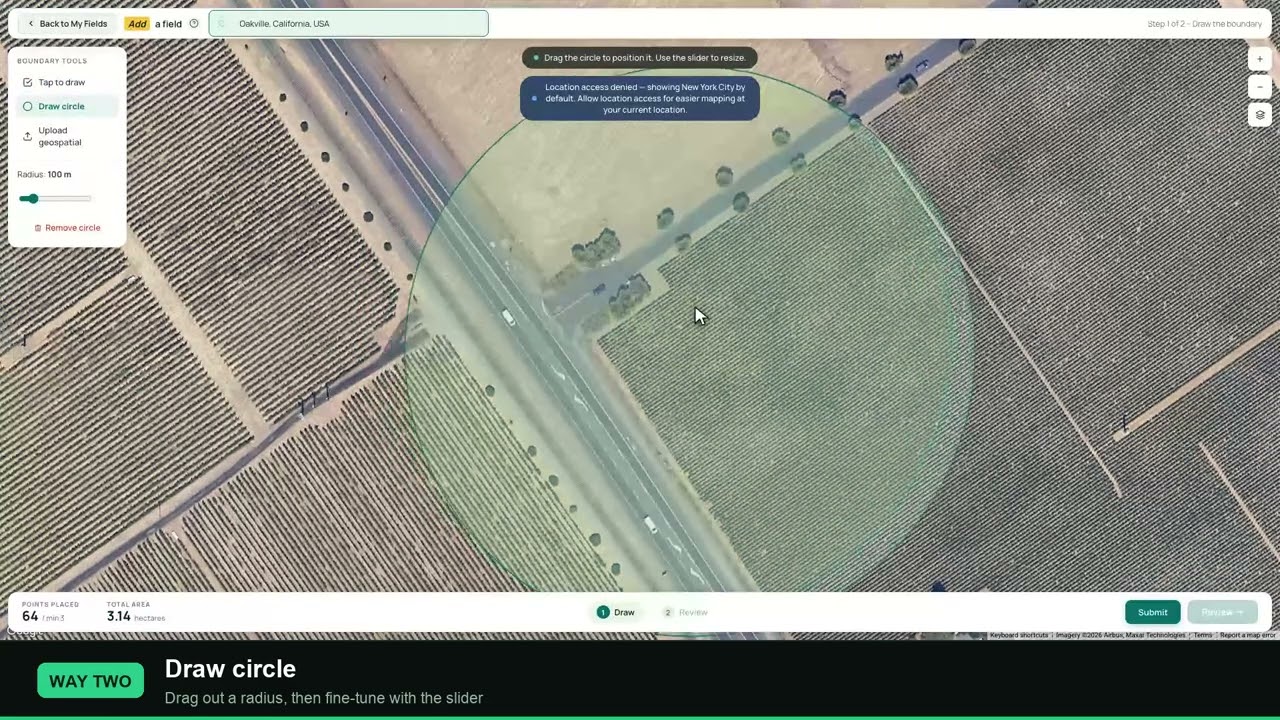
▶ How to add a field boundary for satellite monitoring, all three ways. · 3:50
Common mistakes at each step
- Planning: no written budget or break-even price, so you cannot judge a sale.
- Land preparation: working wet soil, which causes compaction that lasts for years.
- Seed: picking a variety on brochure yield rather than local trial results.
- Sowing: planting into cold soil to save a few days, then replanting.
- Irrigation: watering on a fixed calendar rather than crop need.
- Nutrition: fertilizing without a recent soil test.
- Protection: spraying on sight rather than on a threshold.
- Harvest: never checking combine losses.
- Storage: filling bins with grain above safe moisture.
- Marketing: selling everything on one day without a plan.
How we checked the numbers
Germination times come from Oregon State University Extension’s published table. Irrigation efficiencies are FAO’s indicative values, not measured results for any one farm. Food loss shares are FAO’s modelled regional estimates for 2015 and 2023. Prices are USDA NASS monthly averages received by farmers, as published on 29 September 2026. Soil sampling, IPM and harvest guidance come from Purdue Extension, the US EPA, FAO and the Canola Council of Canada. Each source is listed at the end of the article.
Related pages on our site: steps of farming with pictures and costs · satellite crop monitoring · monitoring app
FAQ
What are the main steps of agriculture?
The main steps are planning, land preparation, seed selection, sowing, irrigation, crop nutrition, pest and disease management, harvesting, storage and marketing. Shorter lists group these into soil preparation, sowing, manuring, irrigation, weeding, harvesting and storage.
What is the final process in agriculture?
Selling the crop is the final step. In shorter school lists, which stop at the farm gate, storage is the last step after harvesting.
What is the first step in agriculture?
Planning, including a soil test. In practice the first field job is land preparation: tilling or preparing the seedbed and fixing pH and drainage.
When should seed be sown?
When the soil is warm and moist enough for the crop. Corn seedlings took 22 days to appear at 50°F and 7 days at 68°F in Oregon State University’s tests, and the same table lists 50°F as the minimum soil temperature for corn germination.
Does it pay to store grain after harvest?
Only if the later price exceeds the harvest price by more than storage, shrink and interest costs. In 2025, US corn received US$3.93 a bushel in October and US$4.64 in May (USDA NASS), but the gap differs from year to year.
How can satellites help with the steps of agriculture?
They show crop vigor and water stress across a whole field every few days. This helps you check emergence, find problem spots to scout and judge maturity. A field visit is still needed to confirm the cause.
Farmonaut crop monitoring
See your own fields from space
Draw your fields once and Farmonaut shows satellite vegetation and water maps for them through the season, on web, Android or iOS.




Keep reading

Sources
- USDA NASS, Agricultural Prices (released 29 September 2026): esmis.nal.usda.gov
- FAO, SDG indicator 12.3.1 Global food losses: fao.org
- FAO, Irrigation water management training manual, Annex I: Irrigation efficiencies: fao.org
- Oregon State University Extension, Soil temperature conditions for vegetable seed germination: extension.oregonstate.edu
- USDA ERS, Commodity Costs and Returns (updated 1 Oct 2026): ers.usda.gov
- USDA ERS, Farm Labor: ers.usda.gov
- Purdue Extension, AY-368 Soil Sampling Guidelines: extension.purdue.edu
- SARE, Cover Crops for Sustainable Crop Rotations: sare.org
- US EPA, Integrated Pest Management principles: epa.gov
- FAO, Integrated Pest Management: fao.org
- Canola Council of Canada, Canola Encyclopedia: Harvest management: canolacouncil.org
- FAO, Grain storage techniques: harvesting, threshing and cleaning: fao.org
Discussion
Questions, corrections or field experience? Share them below. First-time comments are reviewed before they appear, and your email is never published.
No comments yet. Be the first to add a question or your experience.

 Reddane Farming
 Esri North East Africa
 Farmer Amigo
 Cresol
 Atur Kuliner
 MDCV UK
 Zerella Group
 Etech Consulting Madagascar
 Vestlandsforsking
 Agritein
 Delicio
 WB Dev
 Sama Premium
 Prochecker
 Tres Valles
 LACOS Geoinformation
 Magrifly
 LatConnect 60
 Blickwinkel
 Agricultural Credit Policy Council

 Exploration consultancy · South Africa · Gold
 Licence holder · Niger · Gold
 Licence holder · Nigeria · Gold + lithium
 Client · Tanzania · Gold
 Client · Somalia · Gold
 Client & affiliate partner · Ghana · Gold










