

Peppers · Diagnosis guide
Curling Leaves on Pepper Plants: Diagnose by Direction
Downward curl on new leaves with a bronze sheen points to broad mites; cupped, puckered leaves near a field edge point to herbicide drift; ring spots point to tomato spotted wilt. Use the direction table and a scouting routine to find your cause.
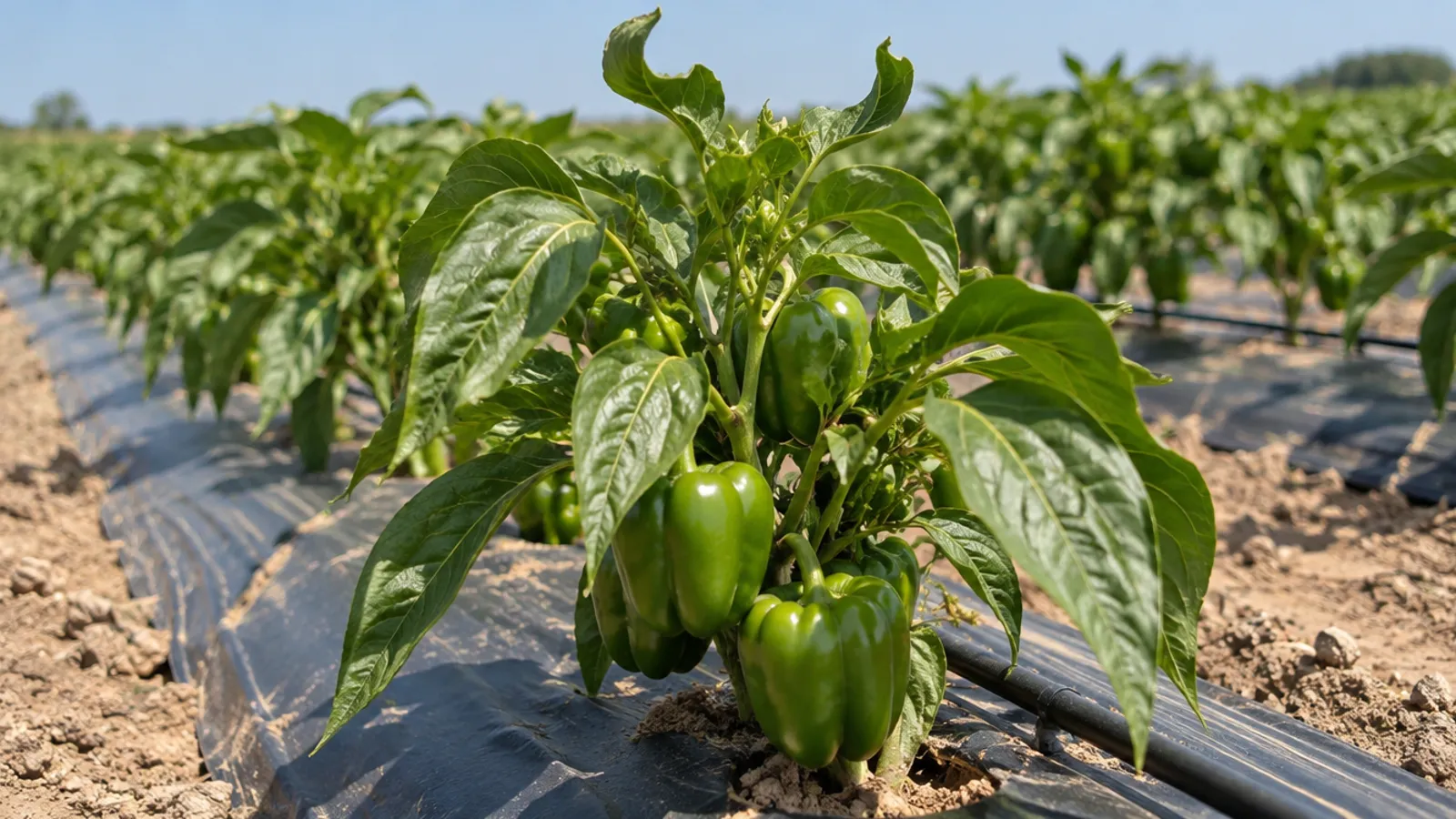
Key takeaways
- Rule out heat and water stress first: Clemson gives 70 to 85°F days and 60 to 70°F nights as the best range for peppers (HGIC 1316, 2023).
- Downward curl on the newest leaves with bronzing and malformed tips points to broad mites, which are about 0.2 mm long (UF/IFAS, 2025).
- Ring spots with curl point to tomato spotted wilt virus, which has no cure; imidacloprid on transplants can cut it by up to 50% (NC State, 2024).
- Peppers were among the most dicamba-sensitive vegetables in a Rutgers greenhouse study; affected bell pepper leaves curled upward with a bubbly top surface (2020).
- Scout both leaf surfaces and the field pattern before you spray, and follow the label and local rules.
In this article
- Quick Diagnosis: What the Curl Direction Tells You
- A 10-Minute Scouting Routine
- Step 1: Rule Out Heat and Water Stress
- Where Peppers Grow Best: Temperature Ranges
- Step 2: Look for Pests on Both Leaf Surfaces
- Why a Hand Lens Matters: Pest Sizes
- Step 3: Check for Virus
- Step 4: Check for Herbicide Drift
- Greenhouse and High-Tunnel Peppers
- Fruit Problems That Look Related
- Common Mistakes When Pepper Leaves Curl
- Fixes by Cause
- Tracking Curl Across a Whole Field
- Why It Matters: Pepper Acreage and Value
Curling leaves on pepper plants usually trace back to one of a few causes, and the direction of the curl narrows the list fast. A downward curl on the newest leaves with a bronze sheen points to broad mites (UF/IFAS, 2025). Cupped leaves with a puckered, bubbly top surface point to herbicide drift (Rutgers, 2020), especially if the worst plants are along a field edge. Curl with ring spots points to tomato spotted wilt virus, though other viruses can look similar.
Capsicum is the botanical genus, and “capsicum” is the usual name for bell pepper in Australia, New Zealand and the UK. Hot peppers sit in the same genus, so one checklist covers all three, although the sources below mostly describe bell pepper and general pepper crops. This guide gives the checklist in order, with a direction table, three charts from extension and USDA data, and a calculator that tests whether a thrips-control step pays for itself on your planting. Read the product label and follow local rules before you spray anything.
Quick Diagnosis: What the Curl Direction Tells You
Before you read further, note three things: which way the leaf curls, which leaves are affected (new or old), and whether the problem is patchy, uniform or confined to one field edge. The table matches those clues to the source that describes each cause.
| What you see | Other clues | Likely cause | Source |
|---|---|---|---|
| Down, newest leaves | Bronze sheen, malformed tips, soil moisture fine | Broad mites | UF/IFAS; UC IPM |
| Up, cupped | Puckered top surface, crinkling, worst near a field edge | Dicamba drift | Rutgers |
| Crinkled, elongated | Brittle, thickened stems | 2,4-D type herbicides | Mississippi State (tomato) |
| Curl and pucker | Distorted foliage, thrips in flowers | Thrips feeding | UC IPM |
| Curl with spots | Brown or ring spots, seedlings bent like a hook | Tomato spotted wilt virus | NC State |
| Curl and stunting | Patchy across the field, whiteflies present | Possible whitefly-borne virus | NC State; UC IPM |
| Mild cupping | Plants otherwise healthy | Example: light sap-sucker feeding (one expert’s view) | Ask Extension |
| Curls by afternoon | Flat again by morning, hot dry spell | Heat or water stress | Rule out first |
Work the list in this order: weather and soil moisture, pests on both leaf surfaces, virus signs, then herbicide. The order matters because heat and water cost nothing to rule out, and whiteflies and other small pests sit mostly on the underside of the leaf, where you have to look for them. Treat the table as a shortlist, not a lab result. If the problem spreads or you are unsure, send a sample to your state plant clinic.
A 10-Minute Scouting Routine
A short, repeatable walk finds the cause faster than guessing from a photo. Do it at the same time of day, because heat curl changes with the hour.
- Walk the field edge, the middle and any low spot. Note where the curled plants are, and mark the first and last affected plant in a row.
- Pick 10 plants in the affected area and 10 in a normal area. Compare new leaves with older leaves.
- Turn over three leaves per plant. Use a hand lens on the underside and at the growing tip.
- Open a few flowers and tap them over a white card to look for thrips.
- Dig around two plants. Check that roots are white and firm and that the soil is neither dust-dry nor soggy.
- Ask neighbors, and check your own spray log, for any herbicide use in the last two weeks.
- Write the date, weather and your findings in a notebook. If the pattern changes, you will know when.
This routine works for a backyard bed and for a 40-acre block. Only the number of sample points changes.
Step 1: Rule Out Heat and Water Stress
Start here because it costs nothing. Peppers grow best when days are 70 to 85°F and nights are 60 to 70°F, according to Clemson Cooperative Extension (factsheet HGIC 1316, updated January 2023). Leaves that curl on the hottest afternoons and lie flat again after a cool night are probably reacting to the weather, not to a pest or disease. NC State notes that tomato leaves can curl in high heat or drought when the water supply is disrupted.
Two quick checks settle the question. First, look at the same plants at dawn. If the leaves are flat, the curl is a daytime stress response. Second, dig into the root zone and check moisture. Clemson advises watering enough to wet the soil to at least 6 inches and keeping moisture uniform, especially during fruit set, so check at that depth, not only at the surface. Fix the water pattern first, then look again after two or three days. Mulch helps hold moisture steady (Clemson).
Water stress works in both directions. A plant in dry soil closes its leaves to save water. A plant in waterlogged soil has roots that cannot take up water or air, so the leaves can look stressed even though the soil is wet. This is why the finger test and a look at the roots are better than a fixed watering schedule. Clemson says mulch helps retain consistent soil moisture, and UF/IFAS shows drip irrigation and mulch in use. It describes young pepper crops grown on black-plastic mulched beds with drip irrigation in North Florida (UF/IFAS EDIS SS497).
New transplants can also curl for a few days while roots settle, and wind or hail can cause a similar short-term curl. If the new growth comes through flat and green, there is nothing to treat.
If the curl stays after cooler weather and steady moisture, move on. Do not add calcium or other nutrients as a first guess. A Maryland gardener who suspected calcium and overwatering was told by University of Maryland Extension in June 2024 that minor feeding by insects with sucking mouthparts may have caused the cupping, and that no control was needed, according to Ask Extension question 871668.
Where Peppers Grow Best: Temperature Ranges
The chart below shows the daytime and night-time ranges Clemson gives for healthy growth. Afternoons above the daytime range are when heat stress is most likely, but Clemson gives no leaf-curl threshold. Treat the figures as a guide for the crop in general, since varieties differ.
Chart
Best temperature ranges for pepper growth
Degrees Fahrenheit; general range for Capsicum annuum, varieties differ
Step 2: Look for Pests on Both Leaf Surfaces
Many pepper pests are small, and they hide on the underside of the leaf. Use a 10x hand lens and check the newest leaves, the growing tip and the flowers.
Aphids, thrips and other sap-suckers
Thrips feeding distorts foliage and can make leaves curl and pucker, according to the UC IPM pepper guidelines (text dated 2016). Aphids can curl leaves too, and UC IPM notes that once leaves have curled they hide aphids from contact sprays (UC IPM aphid pest note). That is why scouting early matters more than spraying late. A mild case, as in the Maryland example above, may need no treatment at all.
Not every thrips on a pepper plant is a problem. UF/IFAS (EDIS IN401) reports that native flower thrips in Florida cause little or no damage even at 20 to 25 per flower, and that at least 6 western flower thrips or melon thrips adults per flower can be tolerated without damage. On fruit, an average of two thrips per fruit is tolerable. The numbers come from Florida work on pepper and eggplant, so use them as a guide to scouting rather than a spray trigger for every region.
The virus is the bigger risk. UF/IFAS adds that spraying adult thrips in flowers does not stop them passing the virus to the plant, so prevention such as ultraviolet-reflective mulch has to come earlier. Minute pirate bugs help in the meantime: UF/IFAS states that about one predator to 180 thrips is enough to suppress a population, and about one to 40 brings it under control. Broad-spectrum sprays kill these predators, which is another reason to scout before you spray.
Broad mites: the cause people miss
If the newest leaves at the top curl downward and take on a bronze sheen while soil moisture is fine, suspect broad mites. UF/IFAS Extension St. Lucie County describes the damage as downward curling, bronzing and malformed terminals, and says fruit may be unsellable for fresh markets (UF/IFAS, July 2025). UC IPM adds that feeding causes leaf elongation and a wrinkled surface, and advises a hand lens to look for the mite.
The adult female is about 0.2 mm long, so the pest itself is nearly invisible. The same UF/IFAS note says broad mites are hard to control with pesticides because they feed in hidden places, and that damage can appear after the mites are gone. It suggests clean planting stock, predatory mites such as Amblyseius and Neoseiulus, and delaying sprays until new growth appears. Follow the product label and local rules for any miticide.

▶ A claymation test of whether AI can spot crop pests before they damage a harvest. · 6:32
Why a Hand Lens Matters: Pest Sizes
The chart compares the adult length of the pests above. The smallest are far below what the eye can pick out.
Western flower thrips adults are 0.06 inch (1.5 mm) long, onion thrips 0.05 inch (1.3 mm) and silverleaf whitefly adults about 0.06 inch (1.5 mm), according to UC IPM. A broad mite female is about 0.2 mm and the male about 0.11 mm (UF/IFAS). UC IPM says thrips are best seen with a hand lens, and a stronger lens helps with mites at about 0.2 mm.
Chart
Adult length of the pests behind leaf curl
Millimetres; thrips and whitefly values are the figures given for adults
Step 3: Check for Virus
A virus is the cause when curl comes with spots, stunting or a patchy pattern across the field. Two groups matter for peppers in North America.
Tomato spotted wilt virus and thrips
NC State Extension (factsheet published 1 July 2024) says infected peppers form small brown necrotic spots or chlorotic ring spots. If a leaf is covered in spots, the whole leaf may brown, roll and wilt. Infected seedlings form a shepherd’s crook shape and die, and fruit show yellow ringspots and sunken brown patches. Once a plant is infected there is no cure, and symptoms may take days or weeks to show after the thrips feed.
UF/IFAS notes that western flower thrips is the most efficient vector of the virus, and that aphids and whiteflies are not vectors (UF/IFAS EDIS IN401). UC IPM states that the main damage thrips cause to peppers is carrying the virus. A pepper plant with ring spots therefore calls for thrips control, not a fertilizer. NC State advises confirming the diagnosis through a plant clinic, because some symptoms overlap with other viruses.
The NC State factsheet lists these steps:
- Treat transplants with imidacloprid just before planting. Research suggests this can cut spotted wilt by up to 50%. It is only partly effective, and the label sets the rules.
- Use reflective mulch. NC State reports it disorients thrips on tomatoes, and costs more than black or white plastic, so it suits fields with a history of high thrips numbers.
- Use thrips-proof screening with holes under 169 microns in greenhouses.
- Choose pepper hybrids carrying the Tsw resistance gene. Resistance-breaking variants were found in North Carolina tomato in 2022, so watch for symptoms even on resistant plants.
Timing helps you plan. In North Carolina, NC State says tobacco thrips is common in April and May and drives the first spread of the virus from weeds to newly planted fields. Western flower thrips is most common from May or June through July, can persist into October, and spreads the virus from plant to plant. Weeds such as dandelion, sow thistle, chickweed, buttercup and plantain give thrips a place to build up, so NC State recommends controlling them. The virus infects more than 1,000 plant species, which is why weeds and ornamentals often carry it between crops.
NC State also advises keeping newly bought plants apart until you are sure they are free of insects and disease, and discarding transplants that show symptoms. UC IPM adds that peppers should not be planted next to onions, garlic or cereals, where thrips build up in large numbers.
The calculator at the end of this section shows whether the transplant step pays back on your own numbers.
Whitefly-borne leaf curl viruses
Most of the evidence on spotted wilt and yellow leaf curl in this guide comes from tomato work, and pepper-specific curl is less documented. Tomato yellow leaf curl virus is carried by the silverleaf whitefly. NC State says the virus mainly affects tomato and lists pepper among its other hosts, and notes that infected hosts without symptoms can serve as a reservoir. The same factsheet, which is written for tomato, gives a useful diagnostic: nutrient problems tend to look the same across the whole crop, while plants with the virus are patchy. UC IPM recommends planting peppers at least half a mile upwind from key whitefly hosts such as melons, cole crops and cotton, and says reflective mulch can delay whitefly build-up by 4 to 6 weeks. That mulch loses its effect once foliage covers more than 60% of the surface.
Whiteflies are hard to spot early. UC IPM advises checking field margins first, because they are infested first, and checking pepper fields twice a week when nearby host crops are in decline. Yellow sticky traps help to detect the first flights. NC State notes that adult whiteflies can travel at least 10 miles and that symptoms can take up to three weeks to appear after infection, so a plant that looks healthy today may already carry the virus. It also advises buying transplants from regions where whiteflies do not survive the winter. No treatment cures an infected plant, so the aim is to protect young plants early.
Try the numbers for your own farm below.
Calculator
Does treating transplants pay for itself?
Enter your own planting size, expected virus rate, treatment effect, plant value and treatment cost.
- Infected plants, no treatment: 1,000
- Plants saved by treatment: 200
- Value of plants saved: $600
- Treatment cost: $500
- Break-even infection rate: 8.3 %
All starting values are round examples, near break-even, not benchmarks or forecasts. NC State Extension (2024) says treating transplants with imidacloprid can cut tomato spotted wilt by up to 50%, so use a lower figure unless you have local data. Costs are inputs: use today’s price quote and follow the product label.
Step 4: Check for Herbicide Drift
Drift is easy to miss because the source is often a neighbor’s field. Rutgers Cooperative Extension ran a 2019 to 2020 greenhouse study with tiny simulated drift doses of dicamba. Peppers, tomatoes and eggplant were among the most sensitive crops, and bell pepper leaves curled upward at the edges with a bubble-like texture on the top surface and crinkling (Rutgers Plant & Pest Advisory, 30 May 2020). The highest dose was about one drop of product per quart of water.
Mississippi State University Extension adds that 2,4-D and similar growth-regulator herbicides cause leaf crinkling, curling or elongation, with brittle, thickened petioles and stems. Glyphosate more often shows first as yellowing at the base of leaflets on growing tips. That publication describes tomato, and peppers are a related crop, so treat it as a close guide rather than a pepper-specific trial. It also warns that 2,4-D damage can be mistaken for virus symptoms.
The practical consequence is that a leaf-curl virus and an auxin herbicide can look alike. The Mississippi State publication gives one way to separate them: if a virus carried by insects is the cause, the insect vectors are likely present and easy to observe in the planting. A field with curl and no insects, but a spray event next door, points to drift.
Three clues often point to drift (these are field rules of thumb, not tested in the sources above): symptoms start soon after a nearby spray, they are strongest on the side of the field facing the source, and they fade toward the middle. Insect and mite damage builds over days and the pests can be found on the leaves. NC State says nutrient problems tend to look the same across a whole crop, while a virus is patchy.
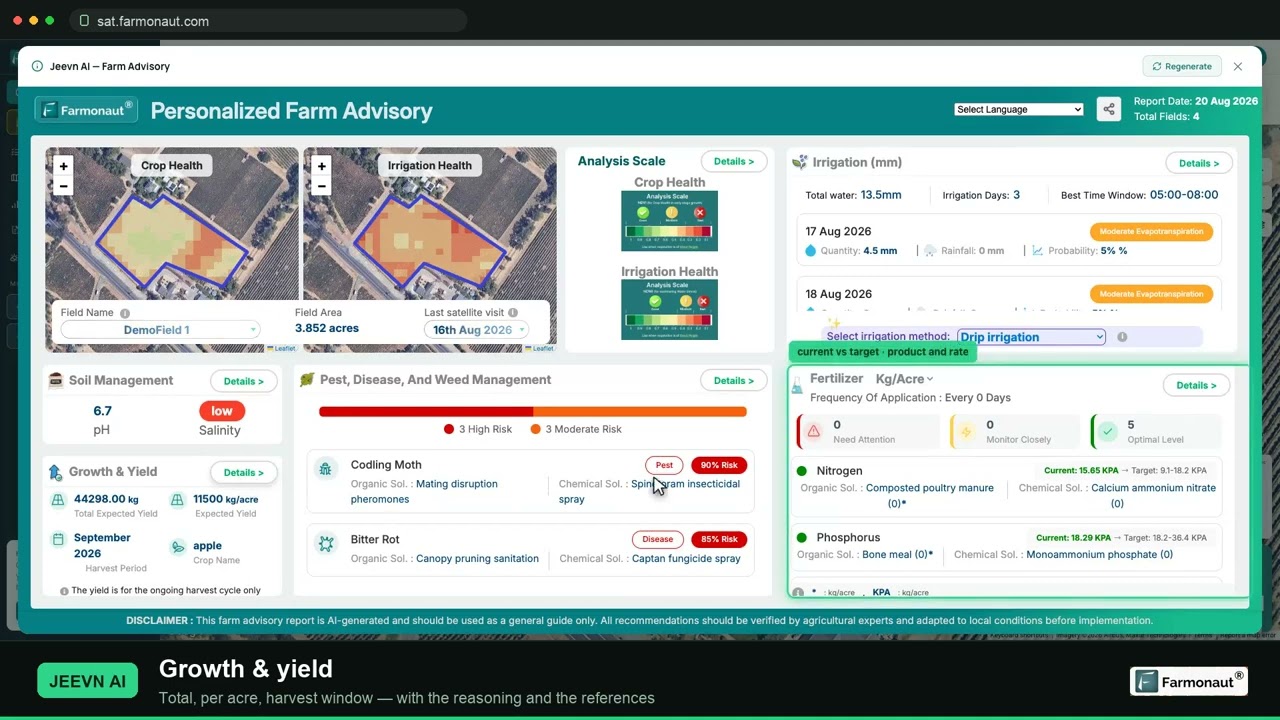
▶ A walkthrough of reading NDVI maps and running an AI farm advisory on your own field. · 19:36
Greenhouse and High-Tunnel Peppers
Protected crops add one rule: keep thrips out. NC State advises thrips-proof screening on air intakes and vents, with holes under 169 microns, and notes that absolute control inside a greenhouse is not possible. A double-door entry adds a second barrier. Screen incoming plants too, because they can bring thrips in. Do not grow ornamentals and vegetable transplants in the same house, since many ornamentals host the virus and can carry it without symptoms. Yellow sticky cards let you track thrips and other insects, and NC State advises acting when numbers begin to grow.
Fruit Problems That Look Related
Blossom-end rot is a fruit disorder, not a cause of curled leaves. It starts as a light green or yellow sunken spot at the tip of the pepper and turns black as fungi colonize it. UF/IFAS explains that calcium moves with the water stream to fast-growing leaves ahead of fruit, so steady moisture matters more than a calcium spray (UF/IFAS EDIS SS497). If you see sunken fruit spots, handle them as a separate problem.
Common Mistakes When Pepper Leaves Curl
- Spraying at the first sign. A mild cupping with no insects may need no treatment, as Maryland extension advised in the example above.
- Adding calcium or fertilizer first. Calcium problems show up on the fruit as blossom-end rot, and that is tied to water movement.
- Treating for several causes at once. You then cannot tell which step worked.
- Ignoring the field pattern. Patchy, edge-only and uniform curl each point to a different cause.
- Pulling only the worst plant. If a virus is the cause, check weeds and nearby plants that may host the insect and the virus.
Fixes by Cause
Match the fix to the cause you found. Do not treat for several things at once.
- Heat or water stress. Keep soil moisture steady with drip irrigation and regular checks of the soil, and mulch to retain moisture (Clemson, 2023).
- Aphids and thrips. Scout twice a week on young plants. Use yellow sticky cards to see when insects arrive. Treat only if numbers are rising, and check the label first.
- Broad mites. Start with clean transplants, protect predatory mites, and time any miticide to new growth.
- Tomato spotted wilt. Confirm the virus through a plant clinic, discard symptomatic transplants, control weeds that host thrips and the virus, and consider treated transplants, reflective mulch or resistant varieties.
- Whitefly-borne virus. Keep peppers away from other whitefly hosts, destroy crop residue, and use reflective mulch in the early weeks.
- Herbicide drift. Keep a written record of the date, wind and nearby spraying, and tell your extension office. Use drift-reducing nozzles and buffers on your own sprayers, and keep sprayers used for growth-regulator herbicides separate from the ones used near vegetables.
- Unknown cause. Send a leaf sample with a note on pattern and timing to your state plant diagnostic clinic.
Pesticide, fertilizer and legal rules differ by state, province and country. Follow the product label, check your local rules and ask a licensed adviser before you spray.
For home gardens and for commercial fields
Home gardeners can often fix the problem with watering, shade and hand removal of pests and plants. Aphids can be knocked off sturdy plants with a strong stream of water, according to the UC IPM aphid note. Commercial growers have more tools, such as treated transplants and reflective mulch, but also more risk, because a virus or drift event can affect a whole block. In both cases the first step is the same: find the cause before you buy a product.
Tracking Curl Across a Whole Field
On a large planting, the pattern tells you as much as the leaf. Patchy curl suggests a virus or a pest hot spot, curl along one edge suggests drift, and curl in low spots suggests water. Satellite vegetation maps, for example in the Farmonaut Satellite + AI Farm Monitoring System, can show where plant vigor drops after an event. A satellite shows a change in the crop, not its cause, so walk the weak patch with a hand lens to confirm it.
▶ How satellite NDVI maps show crop stress across a large farm before you can see it from the field edge. · 4:09
Why It Matters: Pepper Acreage and Value
The three biggest bell pepper states are California, Florida and Georgia. They produced 82.7% of the conventional bell pepper volume in 2022 (USDA-NASS 2023, as reported in UF/IFAS EDIS FE1146). Over 2010 to 2022 California averaged 15,976 harvested acres a year, Florida 12,258 and Georgia 3,425, excluding 2020, per the same review.
Chart
Average bell pepper acres harvested per year
Conventional bell pepper, top three states, averages for 2010 to 2022 excluding 2020
Related Pages on Our Site
For related reading see our guides on crop monitoring, the farm management app, farm record tools, farm planning tools, machinery tools, farm finance tools, the weather API documentation and the satellite API.
How We Checked the Numbers
The symptom descriptions and figures above that carry a source come from university extension or government pages that we opened and read, including UF/IFAS, NC State, Rutgers, Mississippi State, Clemson and the University of California IPM program. Temperature ranges are from Clemson, pest sizes from UC IPM and UF/IFAS, and acreage and value figures from UF/IFAS reporting of USDA-NASS data for 2010 to 2022. The imidacloprid figure is NC State’s summary of research and is an upper bound, not a promise. The scouting routine, the finger test and the field-pattern clues are general field practice, not findings from one study. The calculator uses your own inputs. Sources are listed at the end of the page.
FAQ
Why are my bell pepper leaves curling down?
Check the newest leaves first. Bronzed, downward-curled new growth with malformed tips points to broad mites (UF/IFAS, 2025). If the whole plant droops with the curl, check soil moisture 2 inches down, since dry soil and waterlogged roots can both cause it. Then look at both sides of the leaf with a hand lens.
Why are my pepper leaves curling up or inward?
Upward or inward curl has more possible causes: heat and water stress on hot afternoons, thrips or aphid feeding, whitefly-borne or spotted wilt virus, and herbicide drift. Work through the order above. Puckered, bubbly leaf tops point to dicamba drift (Rutgers, 2020), especially along a field edge.
Are capsicum leaves curling for a different reason than bell pepper?
No. Capsicum is the botanical genus, and many gardeners in Australia, New Zealand and the UK use the word for sweet peppers. Bell pepper is Capsicum annuum (Clemson, 2023), and hot peppers belong to the same genus, so the same checklist applies.
Is pepper leaf curl always caused by a virus?
No. Weather, light insect feeding, mites and herbicide drift all curl leaves. Mississippi State Extension warns that herbicide damage is often mistaken for disease. A virus is likely when you also see ring spots, stunting or a patchy pattern, and the NC State and UC IPM pages above describe those signs.
How do I tell herbicide drift from a pest problem?
Look at timing and location. Drift symptoms appear soon after a nearby spray and are strongest on the side facing the source, with a puckered or bubbly top surface. Pest damage builds over days, and you can usually find insects or mites under a hand lens. A virus or a pest hot spot can be patchy.
What is the fastest fix for curling leaves on pepper plants?
Rule out heat and water first, since that is quick and costs nothing. If the curl remains, inspect both leaf surfaces for insects and mites, then check for ring spots and field-edge patterns before you apply any product. Read the label and local rules for any spray.
Farmonaut crop monitoring
See your own fields from space
Draw your fields once and Farmonaut shows satellite vegetation maps for them, on web, Android or iOS.




Keep reading


Sources
- UF/IFAS EDIS FE1146, A Review of Bell Pepper Production and Price Trends from 2010 to 2022: ask.ifas.ufl.edu
- UF/IFAS EDIS SS497, Blossom-End Rot in Bell Pepper: Causes and Prevention: ask.ifas.ufl.edu
- University of Maryland Extension via Ask Extension, Curling pepper leaves #871668 (June 2024): ask.extension.org
- UF/IFAS Extension St. Lucie County, Pepper Problem: Broad Mite (July 2025): blogs.ifas.ufl.edu
- NC State Extension, Tomato Spotted Wilt Virus on Tomato and Pepper (July 2024): content.ces.ncsu.edu
- NC State Extension, Tomato Yellow Leaf Curl Virus: content.ces.ncsu.edu
- Rutgers Plant and Pest Advisory, Specialty Crops Injury Caused by Dicamba Herbicide Drift (May 2020): plant-pest-advisory.rutgers.edu
- Mississippi State University Extension, Herbicide Damage in Tomatoes (P3679): extension.msstate.edu
- UC IPM, Peppers: General Pests, Seedling Through Bloom: ipm.ucanr.edu
- UC IPM, Peppers: Whiteflies: ipm.ucanr.edu
- UC IPM, Peppers: Thrips: ipm.ucanr.edu
- UC IPM, Aphids (Home and Landscape pest note): ipm.ucanr.edu
- UF/IFAS EDIS IN401, Managing Thrips in Pepper and Eggplant: edis.ifas.ufl.edu
- Clemson Cooperative Extension HGIC, Pepper factsheet HGIC 1316 (updated January 2023): hgic.clemson.edu
Discussion
Questions, corrections or field experience? Share them below. First-time comments are reviewed before they appear, and your email is never published.
No comments yet. Be the first to add a question or your experience.

 Bharat Krushi Seva
 Geno
 Hayleys Agriculture
 Linx Agritech
 Adinet
 Save Your Soils
 Grandstream Algérie
 XOS Realty
 Geospatial Lab Africa
 Agro La Gándara
 HIPSAC
 ZOL Zimbabwe
 Juligerm
 AdBio
 MISE Maroc
 NWNS

 Licence holder · Niger · Gold










