

Farming history · Evidence guide
Ancient Chinese Farming Techniques: 8 Methods, Evidence
Ancient Chinese farmers grew millet in the dry north and rice in the wet south, then built terraces, gravity irrigation, rice-fish fields, intercrops and variety mixtures. Modern trials show what several of these methods still deliver, such as 68% less pesticide in rice-fish fields (PNAS, 2011).
Key takeaways
- Common millet was domesticated in northern China about 10,000 years ago (PNAS, 2009); a genome study traced the first cultivated rice to the Pearl River area (Nature, 2012), though archaeology points to the Lower Yangtze.
- The Hani terraces of Yunnan cover about 70,000 ha and have been farmed for over 1,300 years (FAO).
- Rice-fish fields kept the same rice yield as rice alone with 68% less pesticide and 24% less fertilizer (Xie et al., PNAS, 2011).
- Maize intercropped with faba bean overyielded by 43%, and mixed rice varieties cut blast severity by 94% in Yunnan trials.
- China’s cereal yield rose from 1,193 kg/ha in 1961 to 6,424 kg/ha in 2023 (World Bank).
In this article
- A short history of ancient Chinese agriculture
- 8 ancient Chinese farming techniques and what they did
- What the evidence says about traditional Chinese farming practices
- How Chinese farming changed in modern times
- Comparison table: ancient techniques and modern uses
- How to test intercropping on your own farm
- Mistakes to avoid when copying old methods
- Using these ideas in small gardens and city plots
- Where modern tools fit in
- How we checked the facts
- FAQ
Ancient Chinese farming techniques include millet dry farming, paddy rice, hillside terraces, river-diversion irrigation, rice-fish fields, intercropping, mixed varieties and the careful return of manure and crop waste to the soil. Several are still in use: the Hani people have farmed the rice terraces of Yunnan for over 1,300 years (FAO GIAHS), and a field study found that traditional rice-fish fields used 68% less pesticide than rice grown alone.
This guide explains eight traditional Chinese farming practices, what modern research has measured about each, and how growers in North America, Europe and Australia use the same ideas today. It also has three charts, a comparison table and a land equivalent ratio calculator you can use on your own intercropping trial.
A short history of ancient Chinese agriculture
Farming in China began in two places with two different crops. In the dry north, along the Yellow River, people grew millet. In the wet south, along the Yangtze and Pearl rivers, they grew rice. Wheat, soybeans, hemp and many vegetables came later, and the two systems slowly mixed.
Millet is the oldest. Researchers who studied storage pits at the Cishan site in Hebei found common millet grains and concluded that the crop was domesticated about 10,000 years ago (Lu et al., PNAS, 2009). That makes it one of the oldest known grain crops in East Asia.
Rice has a long story too. A genome study of more than 1,000 rice lines placed the first cultivated rice in the middle area of the Pearl River in Guangxi, southern China (Huang et al., Nature, 2012). Archaeological finds point instead to the Lower Yangtze, so the exact birthplace is still debated. Rice later spread across East and Southeast Asia.
Over thousands of years, Chinese farmers built a set of methods to grow more food on limited land. Space was tight, rain came in hard bursts, and soils had to stay fertile without bought fertilizer. The answers they found still make sense on a modern farm. The same pressures shaped ancient farming methods in other parts of the world.
The two farming zones also shaped daily life. Northern villages stored millet in pits dug into dry loess, which kept grain safe for long periods. Southern villages built their lives around water: canals, ponds and paddies were managed together, and fish, ducks and rice often shared the same fields. Over many centuries, farmers moved south and brought northern crops with them, while rice spread north wherever water allowed.
Three ideas run through almost every traditional system. First, use every scrap of land, even steep hills. Second, move water with gravity and keep it in the soil. Third, keep the soil fed by returning what the farm produces. The techniques below are practical forms of those three ideas.
8 ancient Chinese farming techniques and what they did
Each technique below has a short “Best for” line that says where the idea fits on a farm or garden today.
1. Millet dry farming in the north
Northern farmers grew foxtail and common millet on loess soils with little rain. Millet needs less water than wheat or rice and ripens fast, so it fit short, dry summers. Farmers sowed in rows, hoed weeds by hand and kept stubble on fields to hold soil.
Best for: dryland growers who want a short-season, low-water grain in a rotation.
2. Paddy rice in flooded fields
In the south, farmers built level fields with low earth walls (bunds) and kept them flooded. Standing water controls many weeds, holds warmth and keeps nutrients in place. Seedlings were raised in nursery beds and moved by hand into the paddy, which saved seed and gave young plants a head start.
Best for: rice growers and anyone who raises transplants in a nursery before field planting.
3. Terraces on steep hills
Where flat land ran out, farmers cut steps into hillsides. Terraces slow water, stop soil from washing away and make a flat bed for crops. The Hani terraces in Yunnan cover about 70,000 hectares across four counties (FAO). Forests above the villages store water, which flows down through channels to each terrace in turn.
FAO also lists the risks: steep slopes and heavy rain can cause collapses, dry years bring water shortages, and fewer young people want to keep the work going.
Best for: sloping land, vineyards, orchards and stepped raised beds in gardens.
4. River-diversion irrigation
The Dujiangyan system in Sichuan is the best-known example. Built in the 3rd century BC, it splits the Min River without a dam and sends water onto the Chengdu Plain. UNESCO’s World Heritage listing for Dujiangyan said it irrigated 668,700 hectares of farmland when the site was listed in 2000. The design uses the shape of the river and gravity, not pumps.
Best for: farms that can use gravity-fed ditches, ponds or tanks to cut pumping costs.
5. Rice-fish fields
Farmers stocked fish in flooded rice fields. FAO notes that a Han Dynasty clay plate from about 2,000 years ago shows a fish swimming from a pond into a rice field, and the Qingtian rice-fish system has been a Globally Important Agricultural Heritage System since 2005. Fish eat insects and weeds, stir the water and add manure. Rice shades the water and keeps it cool for fish.
A study in Zhejiang compared rice-fish fields with rice grown alone over six years. Rice yield was the same, yet the rice-fish fields used 68% less pesticide and 24% less chemical fertilizer (Xie et al., PNAS, 2011). The farmer also harvests fish from the same land.
Best for: rice farms and small aquaponics setups that link fish waste to plant growth.
6. Intercropping and crop rotation
Chinese farmers often grew two crops side by side, such as maize with faba bean or wheat with soybean, and changed crops from season to season. The old farming manual Qi Min Yao Shu, written by Jia Sixie, describes crop sequences and the use of legumes to keep land productive.
Modern trials in Gansu tested this. When maize was intercropped with faba bean, maize grain overyielded by 43% and faba bean by 26% compared with the crops grown alone (Li et al., PNAS, 2007). The authors linked part of the gain to faba bean roots making soil phosphorus easier for maize to take up.
Best for: mixed vegetable plots, cereal-legume strips and cover-crop mixes.
7. Mixed rice varieties against disease
Farmers in Yunnan traditionally grew more than one rice variety in the same area. A large trial in 1998 and 1999 tested this: susceptible sticky rice planted in mixtures with resistant hybrid rice had 89% greater yield and 94% less severe blast than when grown alone (Zhu et al., Nature, 2000). By the end of the two-year programme, farmers had stopped spraying fungicide for blast.
Best for: growers who want to slow disease without extra sprays, for example with variety blends in wheat or barley.
8. Returning manure and crop waste to the soil
Traditional farms in China recycled almost everything: animal manure, human waste, crop stalks, pond mud and ash all went back to the fields. Legumes and green manure crops were grown and turned in. This kept soils fertile for centuries without bought fertilizer.
The modern version is compost and cover crops. The US SARE programme explains how cover crops add organic matter, protect soil and supply nitrogen when legumes are used. Follow local rules on manure storage and spreading, and test soil before you add nutrients.
Best for: every farm and garden, from a balcony worm bin to a 1,000-acre rotation.
Chart
Rice-fish fields: inputs and yield versus rice alone
Rice monoculture = 100; farmer-field survey in Zhejiang, 2005-2010
What the evidence says about traditional Chinese farming practices
Old methods are not automatically better. But for several of them, modern field trials have measured clear results. The chart below brings together the gains reported in the trials cited above. They come from different crops, places and years, so compare them with care.
Chart
Gains measured in trials of traditional practices
Percent change versus the single crop or monoculture, selected field trials
The rice-fish study shows another pattern: the same rice yield with far fewer inputs. That matters for farms where input costs, not yield, decide profit.
Diversity is the common thread. Fish and rice, maize and bean, or two rice varieties together each create a system where one part helps the other. Pests and disease find it harder to spread, and nutrients are used more fully.
▶ Seven simple sustainable farming practices that protect soil and water, explained with humour. · 4:34
How Chinese farming changed in modern times
From the 1960s, China added irrigation, chemical fertilizer and new high-yield varieties to these old systems. Cereal yields rose fast. World Bank data show China’s cereal yield went from 1,193 kg per hectare in 1961 to 6,424 kg per hectare in 2023, while the US went from 2,522 to 8,330 kg per hectare over the same period (World Bank, cereal yield).
Chart
Cereal yield, China and United States
kg per hectare, 1961-2023
The gains came with a cost: heavy nitrogen use and pollution. A national programme then tried to fix this with better advice for small farms. From 2005 to 2015, about 20.9 million farmers in 452 counties adopted improved practices. Average maize, rice and wheat yields rose by 10.8–11.5% while nitrogen use fell by 14.7–18.1% (Cui et al., Nature, 2018).
So modern Chinese farming is a blend. Traditional ideas such as rotation and recycling sit next to precise fertilizer advice and new seed. FAO’s heritage programme now lists 104 systems in 29 countries, and China has several of them, including the Hani terraces and the Qingtian rice-fish fields.
Comparison table: ancient techniques and modern uses
| Technique | Original purpose | Modern use | Measured result |
|---|---|---|---|
| Millet dry farming | Grain with low rainfall | Short-season grain in dry rotations | Domesticated about 10,000 years ago (PNAS, 2009) |
| Paddy rice | Weed and water control | Rice paddies, nursery transplants | Genome study points to the Pearl River area (Nature, 2012) |
| Terraces | Farm steep slopes, stop erosion | Hillside orchards, stepped raised beds | Hani terraces cover about 70,000 ha, over 1,300 years (FAO) |
| River diversion | Gravity irrigation, flood control | Gravity ditches, ponds, tanks | Dujiangyan irrigated 668,700 ha (UNESCO, 2000) |
| Rice-fish | Fish and rice from one field | Rice-fish farms, aquaponics | 68% less pesticide, 24% less fertilizer (PNAS, 2011) |
| Intercropping | More food per field | Strip crops, vegetable mixes | Maize +43%, faba bean +26% (PNAS, 2007) |
| Variety mixtures | Spread risk from disease | Cereal variety blends | Blast 94% less severe (Nature, 2000) |
| Manure and compost | Keep soil fertile | Compost, cover crops | Adds organic matter and nitrogen (SARE) |
For the hand tools and inventions behind these methods, such as the iron plough and the seed drill, see our separate guide to ancient Chinese farming tools.

▶ Why soil carbon matters for farmers, and how returning organic matter builds it. · 12:15
How to test intercropping on your own farm
The simplest way to judge an intercrop is the land equivalent ratio (LER). You divide each crop’s intercrop yield by its yield when grown alone, then add the two numbers. An LER above 1.0 means the mix produced more than the same land split between two single crops. An LER below 1.0 means growing them apart was better.
- Pick two crops that differ in height, root depth or nutrient needs, such as a cereal and a legume.
- Grow a strip of each crop alone next to the intercrop, on similar soil.
- Harvest and weigh each crop from each plot, using the same units per acre or hectare.
- Enter the four yields in the calculator below.
- Repeat for two or three seasons before you change the whole farm, because weather changes the result.
The calculator starts with example numbers that give an LER of exactly 1.0, the break-even point. Replace them with your own yields.
Try the numbers for your own farm below.
Calculator
Did your intercrop beat single crops?
Enter yields from your own intercrop and single-crop strips, in the same unit.
- Partial LER, crop A: 0.60
- Partial LER, crop B: 0.40
- Land gain or loss versus single crops: 0.0 %
Example values only, chosen to give the break-even LER of 1.0; they are not benchmarks. LER = intercrop yield / sole yield for each crop, summed (standard formula, no fixed constants).
Mistakes to avoid when copying old methods
Old methods worked inside a whole system of labour, climate and local knowledge. Copying one part without the rest can fail. These are common traps.
- Ignoring labour: traditional terraces, transplanting and hand weeding took many hours per acre. Plan how you will do the work with your own crew and machines before you change a field.
- Picking the wrong partner crop: an intercrop works when the two crops use light, water or nutrients in different ways. Two tall, hungry crops side by side will compete, not help.
- Judging after one season: a wet or dry year can hide or exaggerate a result. Compare at least two or three seasons.
- Skipping the control strip: without a plot of each crop grown alone, you cannot tell whether the mix helped. Keep a small control strip every year.
- Raw manure near food crops: follow food safety rules on how long before harvest manure can be applied, and compost it well.
- Fish without a plan: fish in fields or tanks need clean water, the right stocking rate and protection from birds. Check local rules before stocking fish.
The aim is not to farm as people did 2,000 years ago. It is to borrow the ideas that fit: diversity, gravity water, soil cover and recycling, and test them with your own numbers.
Using these ideas in small gardens and city plots
The same principles work at small scale. A stepped set of raised beds on a slope acts like a mini terrace: water drains from the top tier to the lower ones, and you can put thirsty crops at the bottom. A rain barrel feeding a drip line by gravity copies the idea behind river diversion. A bed with beans, a brassica and herbs is a small intercrop.
- Rooftops and balconies: check the weight limit first and use light growing mix. Add drainage layers and catch trays so water can be reused.
- Water: mulch beds to cut evaporation, and water early in the day.
- Soil: compost kitchen waste or use a worm bin, then add the compost to beds each season.
- Diversity: mix families in each bed and rotate them each year to slow pests and disease.
- Fish and plants: small aquaponics units copy the rice-fish loop. Keep fish stocking low and filter the water.
Community gardens can share tools, seed and soil tests. A shared rotation calendar across plots also slows the spread of pests.
Start small. Pick one idea, such as a bean and maize strip or a gravity drip line from a rain barrel, and run it for a full season. Write down what you planted, when you watered, and what you harvested. A simple notebook is enough. After two or three seasons you will know which old methods suit your soil, climate and time.
Some ideas need care in cool climates. Rice-fish systems need warm water and a long season, so they suit the US South, parts of Australia and southern Europe better than Canada or the UK. Terraces need regular repair after storms. Intercrops need more planning at sowing and harvest, especially if you use machines built for one crop.

▶ How raised beds improve soil control, drainage and plant growth in a garden. · 9:38
Where modern tools fit in
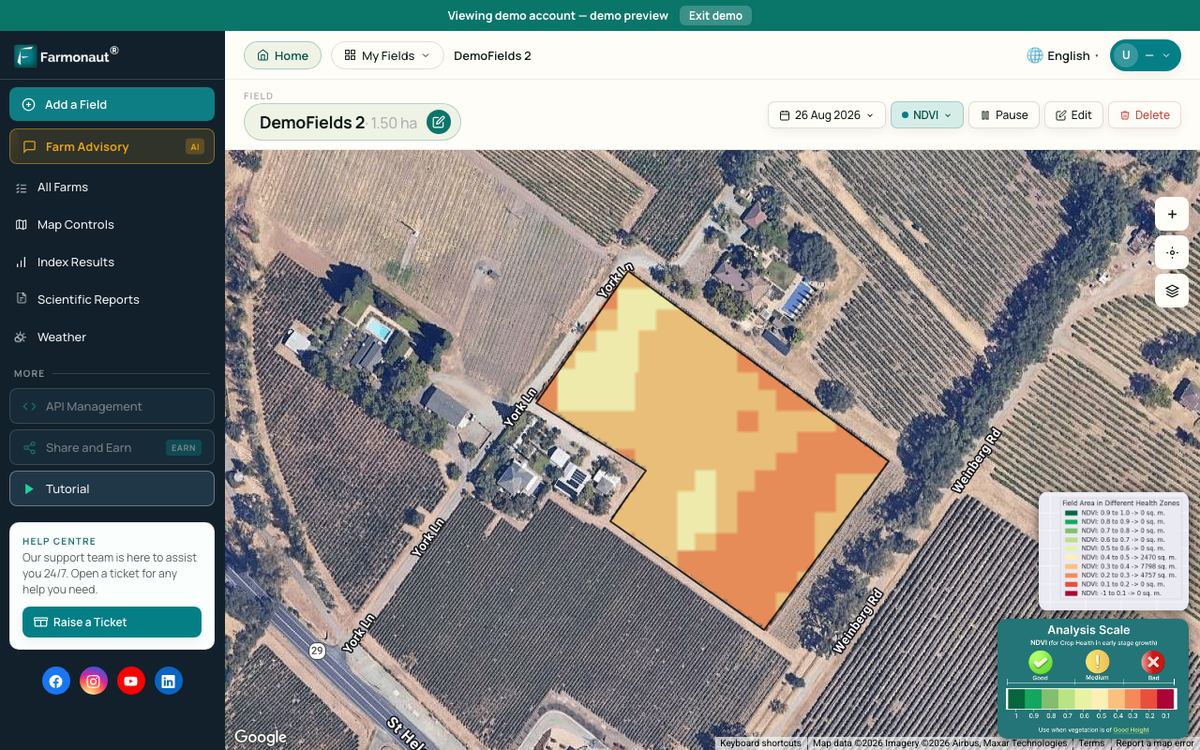
Traditional farmers watched their fields every day. On a large farm that is hard to do. Satellite images now show crop vigour across every field each few days, so a manager can see which strip of an intercrop or which terrace is falling behind and then walk there to check. Satellites show a change in plant growth, not its cause, so a field visit is still needed.
The Farmonaut Satellite + AI Farm Monitoring System is one example of this kind of tool; it maps crop health indices from satellite data for each field.
Related pages on our site: farm fleet management, managing many farms in one dashboard, farm carbon footprint tracking, satellite data for crop loans and insurance, satellite and weather API documentation, food product traceability and the crop monitoring app.
How we checked the facts
Ancient history is full of round numbers and repeated claims. For this guide we used three kinds of sources. For dates and places, we used peer-reviewed studies on crop origins and the official FAO and UNESCO heritage pages. For results, we used field trials published in PNAS and Nature that compared a traditional practice with a modern single crop on real farms. For modern yields, we used World Bank data, which draw on FAO crop statistics.
Each number on this page names its source and year. Trial results apply to the crop, place and years studied. A gain measured on rice in Yunnan or maize in Gansu will not repeat exactly on your farm, which is why the calculator above asks for your own yields.
FAQ
What were the main ancient Chinese farming techniques?
The main ones were millet dry farming, flooded paddy rice, hillside terraces, river-diversion irrigation such as Dujiangyan, rice-fish fields, intercropping and rotation, mixed crop varieties, and recycling manure and crop waste into the soil.
What crops did farmers in ancient China grow?
Millet in the north and rice in the south came first. Common millet was domesticated about 10,000 years ago (PNAS, 2009). Wheat, soybeans, hemp, vegetables and fruit trees were added over time.
How was water managed for farming in ancient China?
Farmers used terraces to slow water on slopes, channels to move it from forests to fields, and large gravity systems such as Dujiangyan, which splits the Min River without a dam. UNESCO’s 2000 listing put the area it irrigates at 668,700 hectares.
Are traditional Chinese farming practices still used today?
Yes. The Hani rice terraces and the Qingtian rice-fish fields are FAO heritage systems that are still farmed. Intercropping and variety mixtures are also studied and used in modern Chinese farming.
Can I use these methods on a small farm or garden?
Yes. Stepped raised beds, gravity-fed drip lines, mixed plantings, crop rotation and compost all scale down well. Test one change at a time and record yields so you know what worked.
Farmonaut crop monitoring
See your own fields from space
Check crop vigour across every field and strip from satellite images, then walk to the spots that need a look.



Keep reading
Sources
- Lu et al., Earliest domestication of common millet in East Asia, PNAS (2009): pmc.ncbi.nlm.nih.gov
- Huang et al., A map of rice genome variation reveals the origin of cultivated rice, Nature (2012): nature.com
- FAO GIAHS, Hani Rice Terraces, China: fao.org
- UNESCO World Heritage, Mount Qingcheng and the Dujiangyan Irrigation System: whc.unesco.org
- FAO GIAHS, Rice Fish Culture, China: fao.org
- Xie et al., Ecological mechanisms underlying the sustainability of the rice-fish system, PNAS (2011): pmc.ncbi.nlm.nih.gov
- Li et al., Diversity enhances agricultural productivity via rhizosphere phosphorus facilitation, PNAS (2007): pmc.ncbi.nlm.nih.gov
- Zhu et al., Genetic diversity and disease control in rice, Nature (2000): nature.com
- SARE, Building Soils for Better Crops, Ch. 10 Cover Crops: sare.org
- World Bank, Cereal yield (kg per hectare), World Development Indicators: data.worldbank.org
- Cui et al., Pursuing sustainable productivity with millions of smallholder farmers, Nature (2018): nature.com
- FAO, Globally Important Agricultural Heritage Systems programme: fao.org
Discussion
Questions, corrections or field experience? Share them below. First-time comments are reviewed before they appear, and your email is never published.
No comments yet. Be the first to add a question or your experience.

 AgroRangers
 FCF India
 Unifrutti Gulf
 Deluxe Conseil
 TVS Electronics
 BW Pipelines
 WICO
 Gen Chayat
 Chimera Innovation
 SkyHarvest
 Polaris Digitech
 Teledarbas
 Wild Oak Farm
 SFX

 Licence holder · Niger · Gold
 Client · Tanzania · Gold
 Client · Somalia · Gold
 Client & affiliate partner · Ghana · Gold










