

Rare earths · Radiation explained
Is Neodymium Radioactive? Element, Ore and Magnets
No in practice: two of neodymium’s seven natural isotopes decay, but with half-lives above 10¹⁵ years. The radiation in rare earth mining comes from thorium and uranium in the ore, such as monazite at 5-12% thorium (World Nuclear Association).
Key takeaways
- Neodymium-144 (23.8% of natural Nd) has a half-life of about 2.29 × 10¹⁵ years; neodymium-150 about 9.3 × 10¹⁸ years (RSC; NUBASE).
- Pure neodymium gives roughly 0.01 Bq per gram, about 100 times below the 1 Bq/g NORM level used by EPA Western Australia.
- Promethium is the only rare earth with no stable isotope; thorium and uranium are actinides, not rare earths.
- Monazite holds 5-12% thorium; the Mt Weld rare earth concentrate carries about 1,630 ppm Th and 6.3 Bq/g (EPA WA).
- US rules treat ore with 0.05% or more uranium plus thorium as source material (10 CFR 40.4).
In this article
- Is neodymium radioactive? The short answer with numbers
- Is neodymium a rare earth element?
- Neodymium radioactive vs non-radioactive rare earth elements
- Are neodymium magnets radioactive?
- Which rare earth ores are radioactive, and how much
- Why rare earth mining produces radioactive waste
- Where neodymium is mined
- Neodymium prices and what drives them
- What a consultant should check on a rare earth project
- Frequently asked questions
Is neodymium radioactive? Not in any practical sense. Neodymium (Nd, element 60) is a rare earth metal, and most of its natural atoms are stable. Two of its seven natural isotopes, neodymium-144 and neodymium-150, do decay, but so slowly that they are treated as stable: neodymium-144 has a half-life of about 2 × 10¹⁵ years (isotope data, NUBASE values). The radiation question in rare earth work comes from somewhere else: the ores that carry neodymium usually also hold thorium and some uranium, and those are what mine operators, regulators and consultants have to manage (US EPA). This guide separates the element from the ore, lists which rare earths are actually radioactive, and gives a quick screening calculator for the uranium and thorium content of a sample or concentrate.
Is neodymium radioactive? The short answer with numbers
Natural neodymium is a mix of seven isotopes (atoms of the same element with different numbers of neutrons). The Royal Society of Chemistry lists their natural shares as neodymium-142 at 27.2%, neodymium-143 at 12.2%, neodymium-144 at 23.8%, neodymium-145 at 8.3%, neodymium-146 at 17.2%, neodymium-148 at 5.8% and neodymium-150 at 5.6% (RSC periodic table, neodymium). Five of those never decay.
Chart
Natural neodymium isotopes by abundance
Share of natural neodymium, %; Nd-144 and Nd-150 are the two very long-lived ones
Neodymium-144 gives off an alpha particle, but its half-life of about 2.29 × 10¹⁵ years means almost none of it decays in a human lifetime. Neodymium-150 undergoes double beta decay with a half-life of about 9.3 × 10¹⁸ years. Reference tables say that, for practical purposes, both can be considered stable. Different tables give slightly different half-lives (the RSC lists 2.1 × 10¹⁵ years for neodymium-144), but every source puts them in the thousands of trillions of years.
What does that mean in becquerels, the unit for one decay per second? Working from the half-life and the 23.8% share of neodymium-144, a gram of pure neodymium metal produces roughly 0.01 decays per second (our calculation from the published half-life and abundance). Western Australia’s environmental regulator uses one becquerel per gram as the level above which a rare earth concentrate counts as naturally occurring radioactive material (EPA Western Australia, Mt Weld assessment). Pure neodymium sits about a hundred times below that level.
Why the question comes up at all
People ask because rare earth mining has a real radiation story, and neodymium is the best-known rare earth. The two get blended in news coverage. The element is not the problem. The minerals it is mined from are, because they hold thorium and uranium in their crystal structure. Once a processor separates neodymium from those minerals, the neodymium oxide or metal that leaves the plant carries none of that thorium.
Is neodymium a rare earth element?
Yes. Neodymium is one of the 15 lanthanides, the row of elements from lanthanum (57) to lutetium (71). The US EPA defines the rare earth elements as those 15 plus yttrium (39) and scandium (21), because the last two behave chemically in the same way (US EPA, TENORM: rare earths mining wastes). Geologists split the group into light rare earths, lanthanum to gadolinium, and heavy rare earths, terbium to lutetium, with yttrium usually counted with the heavy group (USGS Fact Sheet 2014-3078). Neodymium is a light rare earth.
Chart
Light rare earths in the Earth’s crust
Average crustal abundance, parts per million (lead is 14 ppm)
The name is misleading. The USGS lists the average crustal abundance of neodymium as 41.5 parts per million (ppm, or grams per tonne of rock), more than lead at 14 ppm, and it says every rare earth except promethium is more common in the crust than silver, gold or platinum. What is rare is a deposit where these elements are concentrated enough to mine at a profit.
Carl Auer von Welsbach first separated neodymium in 1885. The name comes from the Greek for “new twin”, because it was split out of a substance once thought to be a single element (RSC).
Neodymium radioactive vs non-radioactive rare earth elements
The clean way to sort the group is by isotope, not by reputation. There are three classes.
- Radioactive with no stable form: promethium (61). Every isotope of promethium is radioactive. The longest-lived, promethium-145, has a half-life of 17.7 years, and promethium is one of only two elements below bismuth with no stable isotope at all, the other being technetium (RSC periodic table, promethium). It occurs in nature only in tiny traces made when uranium-238 splits, so it is never mined.
- Stable elements with a very long-lived natural isotope: lanthanum, neodymium, samarium and lutetium, among others. Lanthanum-138, samarium-147 and lutetium-176 decay slowly enough that geologists use them as clocks to date rocks (rare earth element overview). Their activity is far too low to matter for handling, shipping or magnets.
- Fully stable: the rest, including cerium, praseodymium, terbium and dysprosium in their natural form.
Thorium and uranium are not rare earth elements. They are actinides, the row below the lanthanides. The older version of this page listed thorium as a radioactive rare earth; that was wrong. Thorium matters to rare earth projects because it sits inside the same minerals, not because it belongs to the same group.
| Element | Group | Radioactive? | Why it matters to a mine |
|---|---|---|---|
| Neodymium (Nd) | Light rare earth | Effectively no (two very long-lived isotopes) | Main value element for NdFeB magnets |
| Praseodymium (Pr) | Light rare earth | No | Sold with Nd as NdPr oxide |
| Lanthanum (La) | Light rare earth | Effectively no (lanthanum-138) | Catalysts, batteries; low value per kg |
| Cerium (Ce) | Light rare earth | No | Most abundant rare earth; polishing, catalysts |
| Promethium (Pm) | Light rare earth | Yes, all isotopes | Not mined; made in reactors |
| Dysprosium (Dy), terbium (Tb) | Heavy rare earths | No | Added to magnets for heat resistance |
| Thorium (Th) | Actinide, not a rare earth | Yes | Main radiation source in rare earth ore |
| Uranium (U) | Actinide, not a rare earth | Yes | Second radiation source in many deposits |
Are neodymium magnets radioactive?
No. A neodymium magnet is an alloy of neodymium, iron and boron, Nd₂Fe₁₄B, often with some praseodymium and, for high-temperature motors, dysprosium or terbium. The RSC notes that this alloy is the most important use of neodymium (RSC). The neodymium inside comes from separated, refined oxide, so the thorium and uranium from the ore were removed long before the metal was made. The iron and boron are not radioactive.
Neodymium makes up only about 27% of the basic Nd₂Fe₁₄B formula by weight (from the atomic masses), so a magnet’s activity is lower still than the 0.01 becquerel per gram worked out above for pure neodymium. A magnet in a speaker, a phone, a wind turbine or a fridge door gives no meaningful radiation dose. The real hazards of strong neodymium magnets are mechanical: they pinch fingers, shatter when they snap together, and must be kept away from pacemakers and from children who might swallow them.
The same answer covers other common questions. Magnets in general are not radioactive; magnetism and radioactivity are unrelated properties. Older “Magnadur” style ferrite magnets are made of iron oxide with barium or strontium and contain no rare earths at all.
Which rare earth ores are radioactive, and how much
This is where the radiation sits. Rare earth minerals are processed mainly from ores that also contain uranium and thorium, and removing them during processing creates technologically enhanced naturally occurring radioactive material, known as TENORM (US EPA). The level depends on the mineral.
- Monazite, a rare earth phosphate rich in cerium and lanthanum, contains 5-12% thorium, typically about 7% (World Nuclear Association, NORM). The USGS calls monazite the world’s primary source of thorium (USGS Mineral Commodity Summaries 2026, thorium).
- Xenotime, an yttrium phosphate that carries heavy rare earths, holds traces of uranium and thorium.
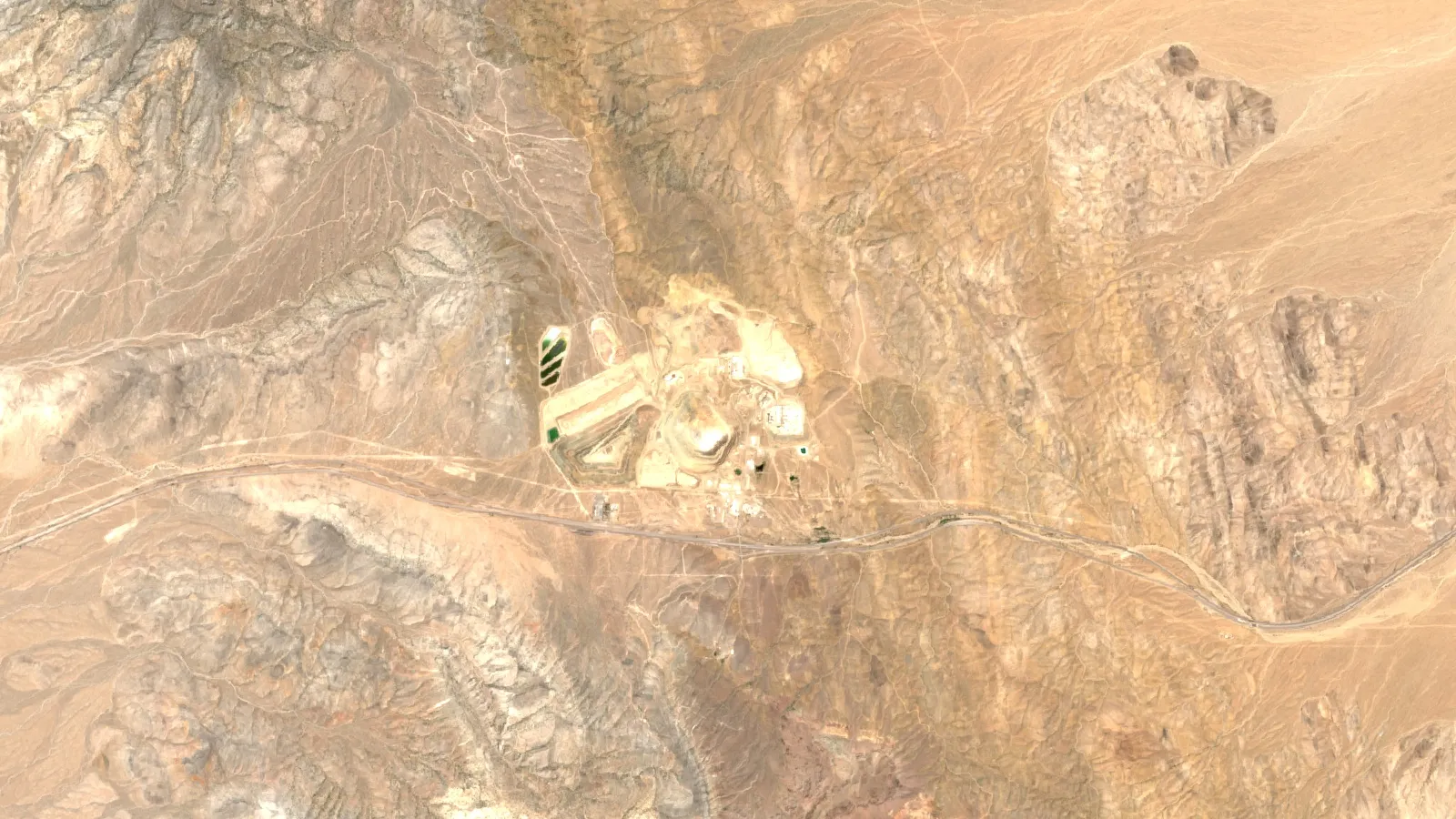
- Bastnaesite, the carbonate mined at Mountain Pass, California, is the main rare earth mineral in the United States (USGS Mineral Commodity Summaries 2026, rare earths).
- Weathered carbonatite ore, such as Lynas’s Mt Weld in Western Australia, contains uranium-238 and thorium-232. The rare earth concentrate made there holds about 1,630 ppm thorium and 43 ppm uranium, with a total activity of about 6.3 becquerels per gram, above the 1 Bq/g level, so it is managed as NORM (EPA Western Australia, Report 1752).
Concentration raises the numbers. In heavy-mineral sands, the World Nuclear Association table (based on IAEA data) shows thorium at 5-70 ppm in the raw ore, 80-800 ppm in heavy-mineral concentrate and 10,000-55,000 ppm in monazite concentrate. Most of that thorium ends up in the waste streams, so the final zircon, ilmenite or rare earth product is much cleaner than the residue.
When does ore become regulated “source material” in the US?
Under US Nuclear Regulatory Commission rules, ores containing 0.05% or more by weight of uranium, thorium or any mix of the two are “source material” (10 CFR 40.4). That is 500 ppm combined. A monazite concentrate at 7% thorium is 140 times over it. A run-of-mine ore at 50 ppm is ten times under it. Licensing then depends on what is done with the material and on state rules, since many US states regulate source material under agreements with the NRC. Use the calculator below for a first screen, then confirm with a radiation safety specialist and the regulator.
Calculator
Does your sample cross the US source-material line?
Enter thorium and uranium assays (ppm) and the tonnage of the ore or concentrate.
- Times the 0.05% source-material threshold: 3.3
- Thorium in the lot (kg): 163.0
- Uranium in the lot (kg): 4.3
Defaults are the Mt Weld concentrate assays reported by EPA Western Australia (Report 1752) with an example 100 t lot. The 0.05% (500 ppm) combined U+Th threshold is from 10 CFR 40.4. This is a first screen only, not a licensing decision.
Why rare earth mining produces radioactive waste
Separating a dozen chemically similar elements takes many stages: crushing, flotation or gravity to make a concentrate, cracking the mineral with acid or alkali, then solvent extraction circuits that pull the elements apart one by one. Thorium and uranium have to be split off early. The World Nuclear Association notes that rare earth production has produced large volumes of thorium hydroxide and residues containing radioactive lead and radium, and cites 30,000 tonnes of NORM residues held in temporary storage in China (WNA).
For a project, that brings practical costs that do not exist for, say, a copper mine: radiation surveys of the site and workers, dust control, gamma monitoring of stockpiles, transport rules for concentrate classed as radioactive, and a long-term plan for thorium-bearing residues. At Mt Weld, the WA assessment lists drinking water, food, dust and soil as exposure routes that were each assessed for their contribution to worker dose. These items belong in any early economic screen of a rare earth deposit.

▶ The seven environmental impacts of mining, explained in clay · 2:31
Where neodymium is mined
World mine production of rare earths was about 390,000 tonnes of rare earth oxide (REO) equivalent in 2025, according to USGS estimates. China produced about 270,000 tonnes, the United States 51,000, Australia 29,000 and Burma about 22,000 (USGS MCS 2026). The USGS gives world reserves of more than 75 million tonnes, with China holding about 44 million tonnes and Brazil 11 million tonnes.
Chart
Rare earth mine production, 2025 estimate
Thousand tonnes of rare earth oxide equivalent, selected countries
In the United States, bastnaesite is mined at Mountain Pass, California, and monazite comes from heavy-mineral sands in the southeastern states. The USGS estimates that US mines produced 51,000 tonnes of REO in concentrate in 2025, worth about US$240 million. For a state-by-state view of US deposits, see our US rare earth minerals map, and for one district in detail, our guide to Wyoming rare earth deposits.
Neodymium prices and what drives them
Neodymium is sold mostly as neodymium oxide or as mixed neodymium-praseodymium (NdPr) oxide. The USGS average price for NdPr oxide (99% minimum) was US$92 per kg in 2021, US$124 in 2022, US$75 in 2023, US$55 in 2024 and an estimated US$69 in 2025. Neodymium oxide alone averaged an estimated US$73 per kg in 2025 (USGS MCS 2026).
Chart
NdPr oxide average price
US$ per kg, 99% minimum, annual average (2025 estimated)
For a daily figure, Trading Economics quoted neodymium at 922,500 yuan per tonne on 5 November 2026, 35.66% higher than a year earlier (Trading Economics, neodymium). Chinese domestic quotes and US or European contract prices differ, so check which market a price refers to before using it in a valuation.
The USGS notes that the leading global use of rare earths is magnets. Demand for NdFeB magnets from electric vehicle motors, wind turbines, robotics and defence systems is what sets the neodymium price, while lanthanum and cerium, produced in larger amounts from the same ore, trade at about US$1-2 per kg. That mismatch is why the share of neodymium and praseodymium in a deposit’s rare earth mix (its “basket”) matters more to its value than the total rare earth grade.
What a consultant should check on a rare earth project
When a client brings a rare earth licence, the radioactivity question is part of the first screen, not an afterthought. A short checklist:
Infographic
Radiation screen for a rare earth licence in 5 steps
- 1MineralogyIdentify monazite, xenotime, bastnaesite or clay hosts.
- 2Assay U and ThAdd uranium and thorium to every rare earth assay.
- 3ClassifyCompare with 0.05% U+Th or 1 Bq/g NORM levels.
- 4Plan residuesDecide where thorium-bearing waste goes.
- 5ConfirmCheck licensing with the regulator.
- Mineralogy. Is the rare earth carried by monazite, xenotime, bastnaesite or an ionic clay? Monazite-rich ore brings the most thorium.
- Uranium and thorium assays. Ask for U and Th on every rare earth assay, in ppm, for ore and for any concentrate test work.
- Basket. What share of total rare earth oxide is NdPr, and is there dysprosium or terbium? This drives value more than total grade.
- Regulatory class. Compare combined U and Th with the 0.05% source-material threshold in the US, or the 1 Bq/g NORM level used in Australia and many other places.
- Residue plan. Where will thorium-bearing tailings or leach residues go, and who licenses that?
- Ground conditions. Satellite imagery and terrain data help screen a licence before a field visit: mapping outcrop, alteration, access and existing disturbance, and flagging heavy-mineral sand ridges or carbonatite ring structures worth sampling.
Uranium is also a value element in some of these deposits; our world map of uranium deposits shows where the two overlap. Farmonaut’s satellite mineral screening covers rare earth targets among 20+ minerals and returns results for a licence boundary in 5-20 business days, ahead of any drilling or resource estimate.

▶ Six kinds of AI tools geologists use in mineral exploration · 3:18
Frequently asked questions
Is neodymium radioactive?
For all practical purposes, no. Two of its seven natural isotopes decay, but with half-lives of about 2 × 10¹⁵ and 9 × 10¹⁸ years, so pure neodymium gives off roughly 0.01 decays per second per gram, far below the 1 Bq/g level used for naturally occurring radioactive material.
Are neodymium magnets radioactive?
No. The neodymium in a magnet comes from refined oxide with the ore’s thorium and uranium removed, and the iron and boron in the alloy are not radioactive. The risks of strong magnets are pinching, shattering and swallowing, not radiation.
Is neodymium a rare earth element?
Yes. It is element 60, a light rare earth in the lanthanide series, and with praseodymium it is the most valuable part of most rare earth ores because of its use in permanent magnets.
Which rare earth elements are radioactive?
Only promethium has no stable isotope. Lanthanum, neodymium, samarium and lutetium each have one very long-lived natural isotope, used for rock dating, but are not hazardous. Thorium and uranium, which are often found with rare earths, are actinides rather than rare earths.
Are rare earth metals radioactive?
Separated rare earth metals and oxides, apart from promethium, are not radioactive in any meaningful way. Rare earth ores and concentrates often are, because they contain thorium and uranium.
Why is rare earth mining radioactive?
Monazite holds 5-12% thorium, and other rare earth minerals carry thorium and uranium too. Processing concentrates these and leaves radioactive residues such as thorium hydroxide that must be stored and licensed.
How much thorium makes ore regulated in the US?
The NRC defines source material as ore with 0.05% or more uranium, thorium or both by weight, which equals 500 ppm combined. State rules and the planned use then decide what licence is needed.
Where does most neodymium come from?
China mined about 270,000 of the world’s roughly 390,000 tonnes of rare earth oxide in 2025, followed by the United States, Australia and Burma, according to the USGS.
How is neodymium pronounced?
Nee-oh-DIM-ee-um, from the Greek for “new twin”.
More from Farmonaut: agro admin app, carbon footprinting, farmonaut satellite weather api developer docs, fleet management, product traceability.
This page is for information only. It is not radiation-safety, legal or investment advice. Confirm classification and licensing of any ore or concentrate with a qualified radiation safety officer and the regulator.
Farmonaut mining
Map your mining site from space
Consultants use satellite maps to screen a rare earth licence for outcrop, access and disturbance before planning field sampling.

Mining Pro sample view, synthetic data
Keep reading
Sources
- Royal Society of Chemistry, Periodic Table: Neodymium: periodic-table.rsc.org
- Royal Society of Chemistry, Periodic Table: Promethium: periodic-table.rsc.org
- Isotopes of neodymium (NUBASE half-lives): en.wikipedia.org
- Rare-earth element overview: en.wikipedia.org
- US EPA, TENORM: Rare Earths Mining Wastes (updated 2026): epa.gov
- World Nuclear Association, Naturally-Occurring Radioactive Materials (NORM): world-nuclear.org
- USGS, Mineral Commodity Summaries 2026: Rare Earths: pubs.usgs.gov
- USGS, Mineral Commodity Summaries 2026: Thorium: pubs.usgs.gov
- USGS Fact Sheet 2014-3078, The Rare-Earth Elements: pubs.usgs.gov
- EPA Western Australia, Report 1752: Mt Weld Rare Earths Project: epa.wa.gov.au
- 10 CFR 40.4 Definitions (source material), via Cornell LII: law.cornell.edu
- Trading Economics, Neodymium price (5 November 2026): tradingeconomics.com
Discussion
Questions, corrections or field experience? Share them below. First-time comments are reviewed before they appear, and your email is never published.
No comments yet. Be the first to add a question or your experience.

 Faith At Work (Pty) Ltd
 Geotech Mining Solutions plc
 Vulcan International Limited
 Kidepo Associates
 GKY Mining
 Alkimy SARL
 Double A Trading
 GemSprout Metals Limited
 Qader Group
 Ileys General Trading
 SG Gold Mining LLC
 VRV Global Pte Ltd
 Omsri International FZE
 G.I.T.T.
 Jaunita Erss Ltd
 Almosi SARL
 SRK Consulting
 Berks Gold Limited
 Mwerezi Minerals Company Limited
 Mining SARL
 SenGold Invest SAS

 Exploration consultancy · South Africa · Gold
 Client · Oregon, USA · Gold










