

Tungsten · Ore, uses and price guide
Wolframite Tungsten Ore: Uses, Price and Carbide Guide
Wolframite, (Fe,Mn)WO4, is one of the two main tungsten ores. Most mined tungsten becomes carbide tools. China mined about 79% of world output in 2025 (USGS). Compare the materials, read the mtu price basis and value a concentrate.
Key takeaways
- Wolframite is an ore mineral, tungsten the refined metal, and tungsten carbide a manufactured compound.
- USGS estimates 85,000 t of tungsten were mined in 2025, including 67,000 t from China.
- About 60% of US tungsten use went to cemented carbide parts (USGS, 2026 estimate for 2025).
- Prices are per mtu: 10 kg of WO3. Fastmarkets put APT at US$2,900 to US$3,210 per mtu on 19 June 2026.
- From 1 January 2027 a US defense clause reaches back to the mine for covered tungsten.
In this article
- What is wolframite?
- Wolframite vs tungsten vs tungsten carbide
- What tungsten and wolfram carbide are used for
- From wolframite ore to carbide powder
- Where wolframite is found
- Which countries produce the most tungsten
- Wolframite price: how tungsten concentrate is quoted
- Checks for a wolframite project
- Responsible sourcing and environmental points
- What to watch next in the tungsten market
- Frequently asked questions
Wolframite is the iron-manganese tungstate mineral, (Fe,Mn)WO4, that is one of the two main ores of tungsten. USGS names scheelite and wolframite as the principal minerals mined for the metal. “Wolfram” is the old name behind tungsten’s symbol W, and “wolfraam” is the Dutch spelling of the same word. Most mined tungsten ends up as tungsten carbide, the hard material in drill bits and cutting tools.
This guide is written for consultants and project owners who need to place a wolframite occurrence in context. It covers how the mineral differs from scheelite, tungsten metal and carbide; where it occurs; how it is priced per metric ton unit; and what a concentrate is worth at your own numbers.
What is wolframite?
Wolframite is not one fixed composition. It is a series between two end members: ferberite, rich in iron, and hübnerite, rich in manganese. A sample can sit anywhere between them. Pure material holds about 60.6% tungsten by weight, which works out at about 76% tungsten trioxide (WO3), the unit the tungsten trade uses. That second figure is our calculation from the formula.
Physically it is a dark, heavy mineral. The same reference lists a Mohs hardness of 4 to 4.5, a specific gravity of 7 to 7.5, a reddish-brown streak and perfect cleavage in one direction. Mohs hardness is a 1 to 10 scratch scale. Specific gravity is density compared with water, so wolframite is about seven times as heavy as the same volume of water and clearly heavier than ordinary quartz vein rock.
How to tell wolframite from scheelite
Both are tungsten ores, but they call for different field checks and often different deposits. Scheelite is calcium tungstate, CaWO4, and it glows bright blue to yellowish under short-wave ultraviolet light. Wolframite is dark and has the reddish-brown streak described above. A hand-held UV lamp therefore helps with scheelite but will not confirm wolframite. Neither test replaces an assay, which is a laboratory measurement of the metal content.
Wolframite vs tungsten vs tungsten carbide
Search results often blur these three terms, along with “wolfram metal”, “wolfram material” and “wolfram carbide”. They are three different things at three points in one supply chain: an ore mineral, a metal and a manufactured compound.
| Property | Wolframite | Tungsten metal | Tungsten carbide |
|---|---|---|---|
| What it is | Natural ore mineral | Refined element W | Compound of tungsten and carbon, WC |
| Mohs hardness | 4 to 4.5 | 7.5 | 9 to 9.5 |
| Density | 7 to 7.5 (specific gravity) | 19.25 g/cm3 | Varies with binder in finished parts |
| Main use | Feed for tungsten chemicals and metal | Alloys, electrodes, filaments, wire | Cutting, drilling and wear parts |
| Who buys it | Concentrate traders and processors | Alloy and electrical makers | Toolmakers and drilling suppliers |
Figures come from reference entries for wolframite, tungsten and tungsten carbide. Tungsten has the highest melting point of any known element, 3,422 °C. Carbide scores close to diamond, which sits at 10 on the Mohs scale, but it is not as hard as diamond.
What tungsten and wolfram carbide are used for
USGS estimates that about 60% of the tungsten consumed in the United States went into cemented carbide parts for cutting and wear-resistant work, mainly in construction, metalworking, mining and oil and gas drilling. The rest went to alloys and specialty steels; electrodes, filaments and wire for electrical, lighting and welding uses; and chemicals. That split is a US figure for 2025, not a world one.
- Mining and construction: drill bit inserts, picks and other parts that must survive abrasive rock.
- Metalworking: cutting inserts, dies and wear parts.
- Electrical and welding: electrodes and filaments, where the melting point matters.
- Defense and shielding: penetrating projectiles and radiation shielding rely on the metal’s hardness and density.
How carbide tools are made
Cemented carbide is not cast. Carbide powder is mixed with a metal binder, usually cobalt, pressed, then sintered at about 1,400 to 1,600 °C. The binder holds the hard grains together, so the part resists cracking better than a brittle block of pure carbide would.
Workplace dust needs care. The US National Toxicology Program lists cobalt-tungsten carbide powders and hard metals as reasonably anticipated to be a human carcinogen, based largely on lung-cancer findings among workers in hard-metal manufacturing. Finished parts in normal use are a different matter from grinding and powder exposure, so plant operators should follow their local exposure limits.
Can tungsten carbide be replaced?
Only in part. USGS lists cemented carbides based on molybdenum, niobium or titanium carbide, ceramics, cermets and tool steels as possible substitutes, but notes that most of these reduce rather than replace the tungsten used. For a project owner, that limits how far users can switch away, although high prices can still push them to use less.
From wolframite ore to carbide powder
A mine rarely sells rock. It sells a concentrate, and processors turn that into intermediates. USGS describes US converters taking concentrates, ammonium paratungstate (APT), tungsten oxide and scrap and making metal powder, carbide powder and chemicals. APT is the white intermediate salt that sets the headline market price.
Infographic
From ore to carbide tool in 5 steps
- 1MineVeins or placers yield wolframite ore.
- 2ConcentrateGravity steps lift the grade, often toward 65% WO3.
- 3ConvertProcessors make APT and tungsten oxide.
- 4PowderOxide becomes metal and carbide powder.
- 5SinterCarbide and cobalt are pressed and sintered into parts.
Wolframite’s high density makes gravity separation the natural first step. At Hemerdon in England, published plant descriptions show dense-media and fine concentrates feeding a section that separates wolframite from tin, iron oxides and arsenic minerals. Impurities like these matter, because buyers specify limits and may charge penalties, so a consultant should test them early rather than rely on WO3 grade alone.
Where wolframite is found
Wolframite forms mainly in greisens and veins tied to granitic rocks. A greisen is granite altered by hot fluids into quartz and mica. USGS adds that wolframite is also recovered from placer deposits, which are loose sediments where heavy minerals have collected. The same USGS report, first posted in 1998, says most mine production then came from vein and stockwork, skarn, porphyry and strata-bound deposits. See our guide to types of ore deposits for what those terms mean.
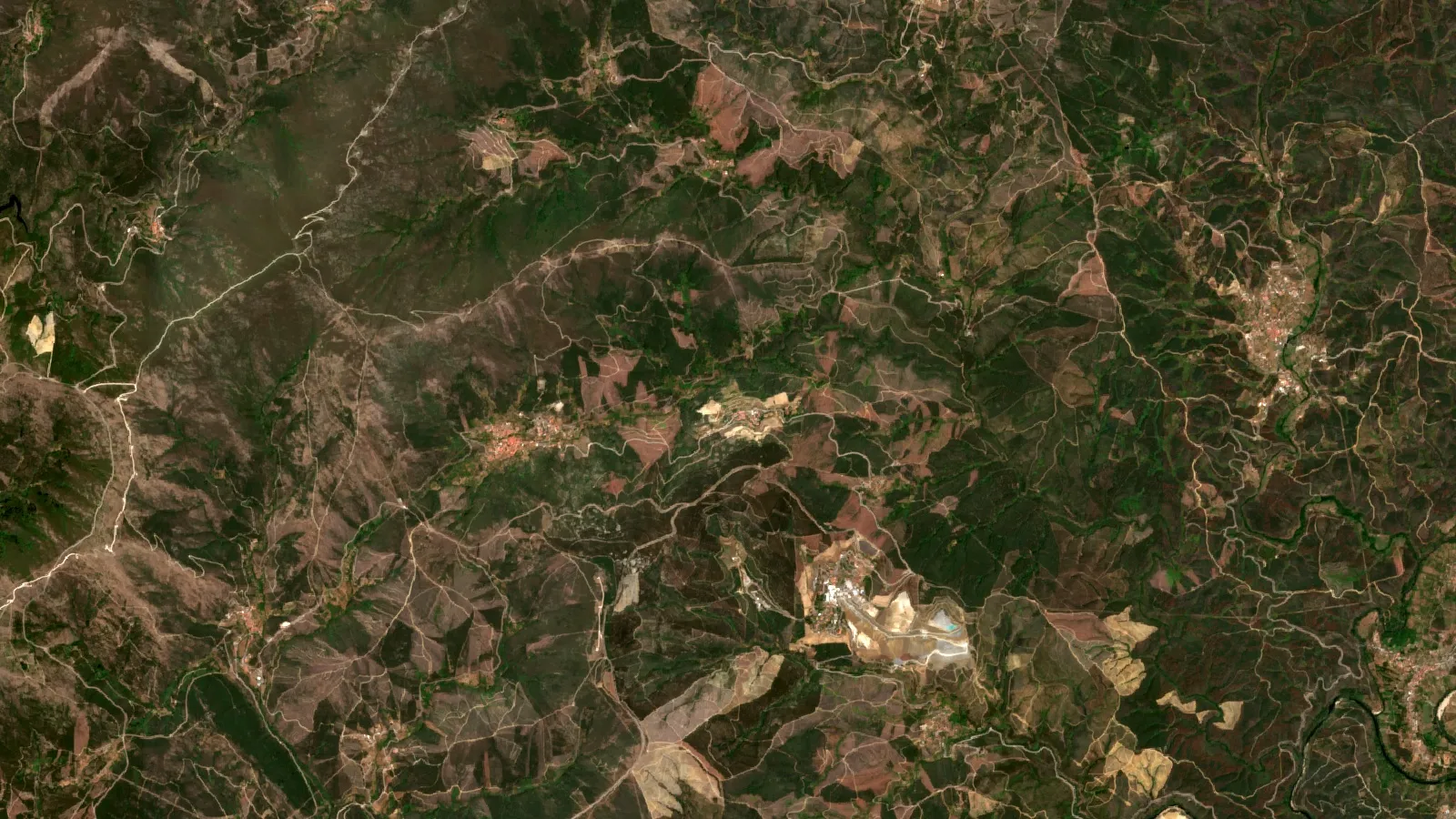
The practical targets on the ground are quartz veins around granite, tin-tungsten districts, and streams draining them. Satellite imagery cannot see wolframite itself, but it can help a consultant map granite contacts, linear structures and alteration before sampling.
▶ How remote sensing measures ground from a distance, and why several instruments are compared. · 2:01
Which countries produce the most tungsten
USGS estimates world mine output at 85,000 tonnes of tungsten content in 2025, of which China produced 67,000 tonnes, or about 79%. Vietnam and Kazakhstan follow at 3,000 and 2,400 tonnes. Kazakhstan’s figure is new, reflecting the start of the Boguty deposit. These figures count contained tungsten across all ore minerals. USGS does not split them into wolframite and scheelite, so they do not show wolframite output by country.
Chart
Tungsten mine output, selected countries, 2025
Tonnes of contained tungsten, all ore minerals (estimates)
Reserves tell a similar but wider story. China holds 2.5 million tonnes of the more than 4.7 million tonnes USGS lists, followed by Australia at 570,000 and Russia at 400,000. A reserve is the part of a known deposit that can be mined economically today. USGS gives no reserve number for Bolivia, Rwanda or Kazakhstan.
Wolframite operations outside China
| Mine | Country | Operator | What the record shows |
|---|---|---|---|
| Panasqueira | Portugal | Almonty Industries | Wolframite mining dates from 1896; Portugal mined about 700 t of tungsten in 2025 (USGS) |
| Hemerdon | United Kingdom | Tungsten West | Company reported restart concentrate production in its September 2026 results; the ore has been identified as ferberite, the iron-rich end of the wolframite series |
| Nyakabingo | Rwanda | Trinity Metals | Listed among the mines of this tin, tungsten and tantalum producer; Rwanda mined about 1,300 t in 2025 (USGS) |
This is a short set of examples, not a ranking. For North America, our page on tungsten in Canada covers Mactung, Sisson and Cantung. The United States has had no commercial tungsten mining since 2015.
Chart
Tungsten reserves, selected countries
Thousand tonnes of contained tungsten, USGS 2026 listing
Wolframite price: how tungsten concentrate is quoted
Tungsten has no simple per-ounce quote. Prices are per metric ton unit (mtu). One mtu is 10 kg of WO3, which contains about 7.93 kg of tungsten (our calculation from atomic weights). A tonne of 65% WO3 concentrate therefore holds 65 mtu.
Chart
Tungsten concentrate price, annual average
US$ per dry mtu of WO3, in-warehouse Rotterdam; 2025 is an estimate
USGS reports that Rotterdam prices rose during 2025 from US$266 to US$551 per mtu for 65% concentrate, and from US$331 to US$675 for APT. The rise then steepened. Fastmarkets assessed APT delivered to Rotterdam and Baltimore at US$2,900 to US$3,210 per mtu on 19 June 2026, up 575% on a year earlier, according to an October 2026 report that also describes a planned CME futures contract. APT and concentrate are different products, so never apply an APT quote to a concentrate tonne without a discount. The same report says Fastmarkets had concentrate at US$2,500 to US$2,800 per mtu from 29 May 2026, up from US$750 to US$850 at the start of the year.
Two policy moves sit behind the rise. China introduced export controls on tungsten items through Commerce Ministry Announcement No. 10 of 2025, effective in February 2025, and the United States raised Section 301 tariffs on several Chinese tungsten products at the end of 2024 (USGS). The next date to watch: from 1 January 2027, a US defense procurement clause extends to covered tungsten mined, refined or produced in covered countries. Check the clause and its exceptions for the exact products.
What a wolframite concentrate is worth
Payable value depends on grade, recovery, the buyer’s payable share and penalties. The calculator below lets you test those numbers. An offtake agreement is where the payable terms are actually written down. A headline price is not a sale price, and prices have moved fast enough that any figure here should be replaced with a fresh quote.
Chart
Rotterdam tungsten prices during 2025
US$ per mtu, start and end of 2025
Calculator
What would your wolframite concentrate be worth?
Enter your own ore tonnage, grade, recovery and buyer terms.
- WO3 recovered (mtu): 2,250
- Concentrate at 65% WO3 (tonnes): 34.6
- Tungsten contained (tonnes): 17.8
Example values only, not a benchmark or forecast. Price is an input: example, use today’s price. One mtu is 10 kg of WO3. Tungsten content uses 79.3% W in WO3, from atomic weights. Costs and penalties are not included. All money in US$.
Checks for a wolframite project
A consultant reviewing a wolframite claim or licence can work through these steps before spending on drilling.
- Confirm title. Check the licence with the national cadastre or regulator, including minerals covered and expiry date.
- Confirm the mineral. Send samples for WO3 assay and mineral identification. Colour and weight alone can mislead.
- Read the geometry. Narrow veins can show high grades but small tonnages. Measure vein width, spacing and continuity.
- Check impurities. Test tin, arsenic, molybdenum and sulfur, which affect processing and payment.
- Run a gravity test. A small test shows whether the ore liberates and how much reports to concentrate.
- Map access and water. Roads, power, settlements and protected ground all affect cost.
- Plan traceability. Buyers increasingly ask for origin records, as the next section explains.
Prospecting needs the right licence and landowner permission, and small-scale workers should never use mercury. A satellite screen can help rank ground before sampling. It gives exploration targets only and is not a resource estimate. Farmonaut offers this kind of screening from a claim boundary; its results sit ahead of any drilling.
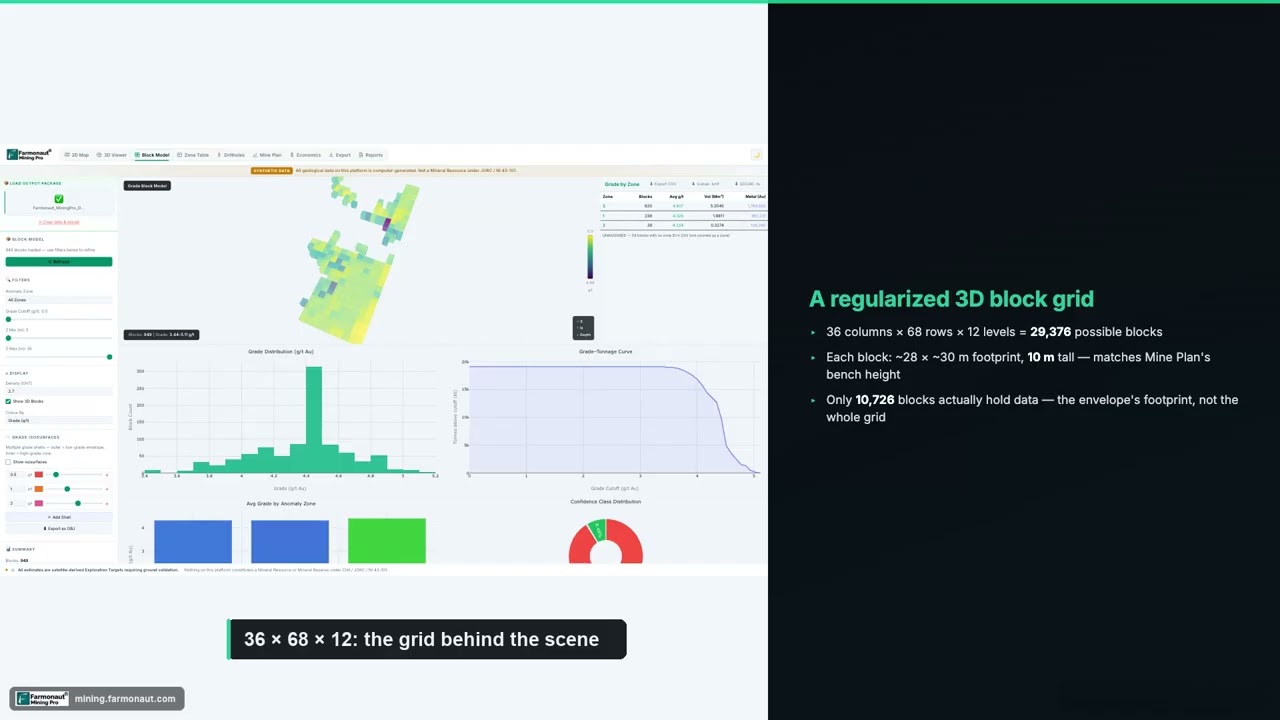
▶ What a block model is and how it sits under a mine plan, shown with de-identified demo data. · 5:23
Responsible sourcing and environmental points
Tungsten is one of the four minerals known as 3TG. The EU Conflict Minerals Regulation covers tin, tantalum, tungsten and gold, because their trade can finance armed groups or rely on forced labour. Importers above set volume thresholds must check their supply chains. Our page on tantalum mines covers the same rules for a sister metal. A wolframite seller aiming at Western buyers should expect to show mine origin and chain-of-custody records.
Site risks are those of hard-rock mining generally: dust, water quality, tailings and arsenic where it occurs with the ore, as it does in the Hemerdon concentrate stream. Recycling also matters. Scrap is a recognized feed for US converters, although USGS withholds secondary tonnage to protect company data. An older figure puts recycled scrap at about 34% of total tungsten production in 2013, which is dated but shows the scale.
For related operational topics, Farmonaut’s site has pages on carbon footprinting, fleet management, product traceability, loan and insurance verification and its developer API documentation.

▶ Seven environmental impacts of mining explained in plain words. · 2:31
What to watch next in the tungsten market
- The gap between prices. Buyers outside China paid more than twice the Chinese domestic price in June 2026, per the report cited above. Whether that gap holds decides how much non-Chinese supply looks viable.
- Restarts and new mines. USGS notes Defense Production Act awards for projects in Nevada, New Brunswick and Yukon, and a tungsten joint venture between Kazakhstan and the United States announced in October 2025.
- The January 2027 sourcing date. It may raise demand for documented non-Chinese material.
- Demand response. Very high prices push users toward recycling and thrifting, which is why project economics should be tested at well below peak prices.
Frequently asked questions
What is wolframite used for?
Wolframite is rarely used directly. It is processed into tungsten chemicals, metal and carbide. Those go into cutting tools, drill bits, alloys, electrodes and shielding.
Is wolfram the same as tungsten?
Yes. Wolfram is another name for the element tungsten, which is why its chemical symbol is W. “Wolfraam” is the Dutch spelling.
What is wolfram carbide?
It is another name for tungsten carbide, WC, a compound of tungsten and carbon. It ranks about 9 to 9.5 on the Mohs scale and is usually bonded with cobalt to make tools.
What is wolfram ore?
The term usually means wolframite, though scheelite is the other main tungsten ore. Check an assay and mineral report to see which one a seller actually has.
What is the difference between ferberite and wolframite?
Ferberite is the iron-rich end of the wolframite series, and hübnerite is the manganese-rich end. Wolframite is the name for the series and its intermediate members.
How much tungsten is in wolframite?
Pure wolframite holds about 60.6% tungsten, or roughly 76% WO3. Traded concentrates are commonly quoted at 65% WO3, the basis USGS uses for its Rotterdam figure.
How is wolframite priced?
It is priced per metric ton unit of WO3, where one mtu is 10 kg of WO3. Buyers pay a share of a benchmark and adjust for grade and impurities.
Which country produces the most tungsten?
China, with an estimated 67,000 of the world’s 85,000 tonnes of mined tungsten in 2025 (USGS, 2026). The next largest was Vietnam, at 3,000 tonnes.
Is tungsten harder than steel?
Tungsten metal scores about 7.5 on the Mohs scale, and its carbide about 9 to 9.5. That is why carbide inserts are used to cut steel and rock.
Is tungsten mined in the United States?
Not commercially since 2015, according to USGS. The country relies on imports and scrap, with a net import reliance above 50%.
Is tungsten a conflict mineral?
It is one of the four minerals covered by the EU Conflict Minerals Regulation. That does not mean all tungsten is linked to conflict; it means importers must check where it came from.
This page is for information only. It is not investment or legal advice. Confirm prices with a current assessment and rules with the regulator. Prospecting needs permission, the right licence and no mercury.
Farmonaut mining
Map your wolframite ground from space
Consultants can send a licence boundary for a satellite screening that ranks ground for field sampling.

Mining Pro sample view, synthetic data
Keep reading
Sources
- USGS, Mineral Commodity Summaries 2026: Tungsten: pubs.usgs.gov
- USGS Circular 930-O, Tungsten summary report (Werner, Sinclair and Amey): pubs.usgs.gov
- Wikipedia, Wolframite: en.wikipedia.org
- Wikipedia, Tungsten: en.wikipedia.org
- Wikipedia, Tungsten carbide: en.wikipedia.org
- Wikipedia, Scheelite: en.wikipedia.org
- Wikipedia, Hemerdon Mine: en.wikipedia.org
- 48 CFR 252.225-7052, Restriction on certain magnets, tantalum and tungsten: law.cornell.edu
- IEA, China Ministry of Commerce Announcement No. 10 of 2025: iea.org
- European Commission, Conflict Minerals Regulation explained: policy.trade.ec.europa.eu
- US National Toxicology Program, Report on Carcinogens: cobalt-tungsten carbide: ntp.niehs.nih.gov
- Almonty Industries, Panasqueira Mine: almonty.com
- Trinity Metals, company site: trinity-metals.com
- Sovereign Magazine, tungsten futures report citing Fastmarkets (October 2026): sovereignmagazine.com
- Press release on tungsten projects, carried by BNN Bloomberg (27 October 2026): bnnbloomberg.ca
Discussion
Questions, corrections or field experience? Share them below. First-time comments are reviewed before they appear, and your email is never published.
No comments yet. Be the first to add a question or your experience.

 Mineral Gulf Transhipment DMCC
 G.I.T.T.
 Jaunita Erss Ltd
 Almosi SARL
 SRK Consulting
 Berks Gold Limited
 Mwerezi Minerals Company Limited
 Mining SARL
 SenGold Invest SAS
 Sean Mining Limited
 NTS Group (Pty) Ltd
 Mine4Africa
 Lithspo Minerals Limited
 Tintina Mining Group
 Dalgety Minerals Pty Ltd
 Vortex Minerals Pty Ltd

 Licence holder · Nigeria · Gold + lithium
 Client · Somalia · Gold










