

Irrigation · Farm buyer's guide
Remote Controlled Irrigation Systems: Farm Buyer's Guide
Remote irrigation control lets you run valves, pumps and pivots from a phone. This guide compares WiFi, cellular, radio, pivot and full-platform systems, shows how US farms schedule water today, and helps you test payback with your own numbers.
Key takeaways
- In USDA’s 2023 survey, about 77% of irrigated farms reporting a method judged when to irrigate by crop condition; only about 13% used soil moisture sensors and under 1% used computer models.
- Remote control saves trips; water savings come when weather or soil data drive the schedule (EPA WaterSense).
- Pressurized irrigation covered 74% of western US irrigated cropland in 2023, up from 37% in 1984 (USDA ERS), which makes automation easier.
- Choose by signal (WiFi, cellular, radio), equipment to control, power, data inputs and offline behaviour.
In this article
- What remote controlled irrigation systems do
- How US farmers decide when to irrigate today
- The 5 main types of remote irrigation control
- How to choose remote controlled irrigation systems for your farm
- Water use and why scheduling matters
- Cost and payback of remote irrigation control
- Setting up a remote system step by step
- Adding satellite crop data to your irrigation plan
- Common mistakes with remote irrigation
- FAQ
Remote controlled irrigation systems let you start, stop and change watering from a phone or computer instead of walking to each valve or pump. On a farm they link a controller to valves, pumps and sensors over WiFi, cellular or long-range radio, and many skip a cycle when soil is wet or rain is forecast. Uptake of sensor-based scheduling is still low in the US: only 13% of irrigated farms used soil moisture sensors to decide when to irrigate in 2023, according to USDA’s 2023 Irrigation and Water Management Survey.
This guide explains the five main types of remote irrigation control, which one fits which farm, what to check before you buy, and how to judge payback. It includes a calculator for your own acres and water costs, plus charts built from USDA data on how US farmers schedule water today.
What remote controlled irrigation systems do
A basic irrigation timer opens a valve at a set hour for a set number of minutes. It has no idea whether it rained last night. A remote controller adds two things: a link to the outside world, and the ability to change its plan.
The link can be home or farm WiFi, a cellular modem, a long-range radio network, or a satellite modem in remote country. Through that link you can:
- Start, stop or pause any zone, pump or pivot from a phone app or web page.
- Change run times by zone or field without visiting the site.
- Get alerts when pressure drops, flow is too high, a pump fails or a pivot stops.
- Log every run, so you have a record of how much water went where and when.
- Let weather data or soil sensors adjust the schedule on their own.
The last point is where water savings come from. The US Environmental Protection Agency’s WaterSense programme certifies two kinds of smart controller for landscapes. A weather-based controller can save an average home nearly 7,600 gallons of water a year compared with a clock-based timer, EPA says. A soil moisture-based controller can save more than 15,000 gallons a year for an average home with an automatic system. Those numbers are for lawns and gardens, not field crops, but the logic is the same on a farm: water only when the root zone needs it.
How US farmers decide when to irrigate today
Most irrigated farms still schedule water by eye and by hand. In the 2023 USDA survey, 212,714 farms reported at least one method. Farmers could pick more than one, so the shares add to more than 100%.
Chart
How US irrigated farms decide when to irrigate
Percent of the 212,714 farms reporting a method, 2023; farms could pick more than one
Looking at the crop was the most common method, used by about 77% of these farms. About 40% judged by the feel of the soil, and about 21% followed a personal calendar. Soil moisture sensors were used on about 13% of farms, daily crop water-use (evapotranspiration, or ET) reports on about 7%, and computer simulation models on under 1%.
This matters when you choose a controller. A remote system with no sensor or weather input only saves you the drive to the field. The water savings come when the controller acts on measured data. Research at the University of Nebraska found that soil moisture probes were used in only 7 to 12% of fields, and that uncertain farmers tend to put on extra water for insurance. In their trial, the hand-feel method prescribed the largest irrigation depth in three of four cases at the full irrigation level, while sensor-based methods prescribed less.
Adoption varies a lot by state. Mississippi Extension reports that soil moisture sensors were used on 30% of irrigated farms in Mississippi in 2023, against 13% nationally. The scatter chart below shows the share for selected large irrigation states, worked out from the USDA table.
Chart
Soil moisture sensor use in selected irrigation states
Selected states, 2023; share of farms reporting any scheduling method
The 5 main types of remote irrigation control
There is no single best controller. The right one depends on your water source, how spread out your fields are, the signal you have, and how much you want the system to decide on its own. Here are the five main types, from simplest to most complete.
1. WiFi smart controllers
Best for: greenhouses, nurseries, market gardens, farmyards and small orchards close to a building with WiFi.
These are the wall-mounted units sold for homes and commercial landscapes, usually with 4 to 24 zones. They connect to your router, pull local weather data and run from a phone app. Many carry the EPA WaterSense label, which means they passed independent tests for weather-based scheduling. The limit is range: WiFi rarely reaches fields more than a few hundred feet from the building, and the valve wires still run back to the box.
2. Cellular controllers and pump panels
Best for: single pumps, wells and drip blocks far from buildings but inside mobile coverage.
A cellular modem in the controller or pump panel lets you start and stop a pump, see pressure and flow, and get a text when something fails. Most need a monthly data plan. Check coverage at the exact site before you buy: a valley or a tree line can block the signal.
3. Long-range radio networks
Best for: larger drip and micro-sprinkler farms with many valves spread across blocks.
Battery or solar-powered radio nodes at each valve talk to a base station, which links to the internet. One base can cover a wide area, so you avoid running wire to every valve. Irrigation suppliers such as Netafim sell cloud platforms that tie controllers, sensors and phones into one system with remote valve control, alerts and reports.
4. Pivot and lateral move remote panels
Best for: row-crop farms on center pivots, a common setup on large US irrigated farms (center pivots serve about 49% of irrigated open fields nationally).
Remote panels let you start, stop, reverse and change the speed of a pivot, see its position, and set different water depths by sector. With variable rate irrigation (VRI), the pivot can change the rate along its length as well. The Nebraska team mounted crop canopy sensors on the pivot itself, so the machine measured crop stress as it moved and the data fed an automated scheduling tool.
5. Full farm platforms with sensors and scheduling
Best for: farms that want the controller to decide, not just to obey.
These combine controllers, soil moisture probes, flow meters, weather stations and scheduling software. The software works out a water balance for each block and can send the run plan to the valves directly. This is the most complete option and the most costly, and it needs the most set-up time.
How to choose remote controlled irrigation systems for your farm
Work through these questions before you talk to a dealer.
- What signal do you have at each site? Walk the fields with a phone. WiFi, cellular and radio each fit a different map.
- What do you need to control? Valves only, pumps, fertigation injectors, or pivots? Count them.
- What power is there? Mains, solar or battery. Battery nodes need checking each season.
- Which inputs will drive the schedule? Weather, soil moisture, flow, or crop data. Without one of these, the system is a remote switch.
- Does it work offline? If the link drops, the controller should keep running its last schedule and stop safely on a fault.
- Who can use it? Check for user accounts with different rights, so staff can run zones without changing settings.
- Can it read your existing equipment? Ask whether it fits your current valves, solenoids and pump starters, and whether it can share data with other farm software.
- What are the running costs? Data plans, software subscriptions and sensor replacement add up over five years.
Pressure is also a factor. Pressurized systems (sprinkler and drip) are the easiest to automate, because each valve can be opened by a signal. Gravity furrow and flood systems need gates or valves that can be driven by a motor. USDA’s Economic Research Service reports that pressurized systems covered 74% of irrigated cropland in the western US in 2023, up from 37% in 1984. That shift has made remote control practical on more farms.
Chart
Pressurized irrigation in the western US
Share of irrigated cropland in the western United States using sprinkler or drip systems
Water use and why scheduling matters
Irrigation is a large share of US water use. The US Geological Survey estimated that about 63.5 million acres were irrigated in 2015, and that sprinkler and microirrigation systems served 63% of that land (USGS Circular 1441). ERS reports that irrigation accounted for 47% of the nation’s total freshwater withdrawals between 2010 and 2020, and that the 2022 Census of Agriculture counted 54.9 million irrigated acres of crop and pasture land.
Scheduling is the step a remote system improves most. Colorado State University Extension explains the water balance approach: track the water that enters the root zone from rain and irrigation and the water that leaves through crop use, and irrigate before the soil dries past a set level. A controller that reads soil sensors or ET data can run this check every day without anyone walking the field.
For vegetable growers on drip, Penn State Extension notes that drip irrigation puts water close to the roots and works well with automatic timers and fertigation. Drip blocks are a good first step for remote control because each block already has its own valve.

▶ A walkthrough of satellite and AI crop monitoring on the web app, including crop health indices. · 8:43
Cost and payback of remote irrigation control
Prices range widely. A WiFi landscape controller is a small purchase. A farm system with radio nodes, sensors, flow meters and software costs much more and depends on the number of valves and the distance between them. Vendor figures are a starting point only: one irrigation automation supplier, Wiseconn, states that payback typically runs 2 to 5 years depending on farm size, crop and efficiency. That is the seller’s estimate, not an independent study.
In the US, the Natural Resources Conservation Service (NRCS) supports irrigation water management through its EQIP programme. Its Pennsylvania cost list for fiscal year 2026 shows payment rates for irrigation water management design, from about US$5,260 for a design without a pump test on one to two units. Rates differ by state and change each year, so ask your local NRCS office what applies to you.
The simplest way to judge payback is to compare the yearly saving on water and pumping with the cost of the system. Pumping cost per acre-inch depends on lift, pressure, energy price and pump efficiency, so use your own figure from power bills or a pump test. Labour savings from fewer trips to the field are real but harder to price, so the calculator leaves them as a separate input.
Try the numbers for your own farm below.
Calculator
How long would a remote irrigation system take to pay back?
Enter your own acres, water use, costs and expected saving.
- Acre-inches of water saved per year: 115.2 ac-in
- Pumping cost saved per year: $1,152 US$
- Net yearly saving after fees: $1,252 US$
Example values only, not a benchmark or a forecast; every number is your input. The default saving and costs are round examples; with them, payback is about 4 years. Pumping cost per acre-inch depends on lift, pressure, energy price and pump efficiency: use your own bills or a pump test. Payback ignores interest, repairs and any cost-share payment. Get professional advice before a large purchase.
Setting up a remote system step by step
- Map your water. List each pump, well, valve and zone, with its flow and the crop it serves.
- Test the signal. Check WiFi, cellular and radio at every site before you choose hardware.
- Start with one block. Automate the field where water is most costly or hardest to reach.
- Add one data input. Weather or a soil moisture probe at two depths is a good start.
- Set safe limits. Program maximum run times, low-pressure and high-flow shutoffs, and alerts to more than one phone.
- Compare a season. Record water applied and yield on the automated block and a similar manual block.
- Scale up. Add blocks once the first one runs reliably for a full season.
Keep a manual override at each pump and valve. Remote systems fail like any machine, and a stuck valve on a hot day can cost a crop. Check local water rights, metering rules and electrical codes before you install pumps or controls, and get a licensed electrician for pump panels.
▶ Six plain steps to start precision farming without buying a robot. · 4:18
Adding satellite crop data to your irrigation plan
Sensors measure one point in a field. Satellite images show the whole field, so they can point to the dry corner, the blocked emitter line or the pivot sector that a single probe misses. Vegetation and water-stress indices from Sentinel-2 are updated every few days in clear weather.
Farmonaut Satellite + AI Farm Monitoring System gives these field maps on web, Android and iOS. It does not open valves; it shows where the crop looks stressed so you can check the field and adjust the schedule in your controller. Used together, a remote controller handles the “when” and “how much”, and satellite maps help with the “where”.
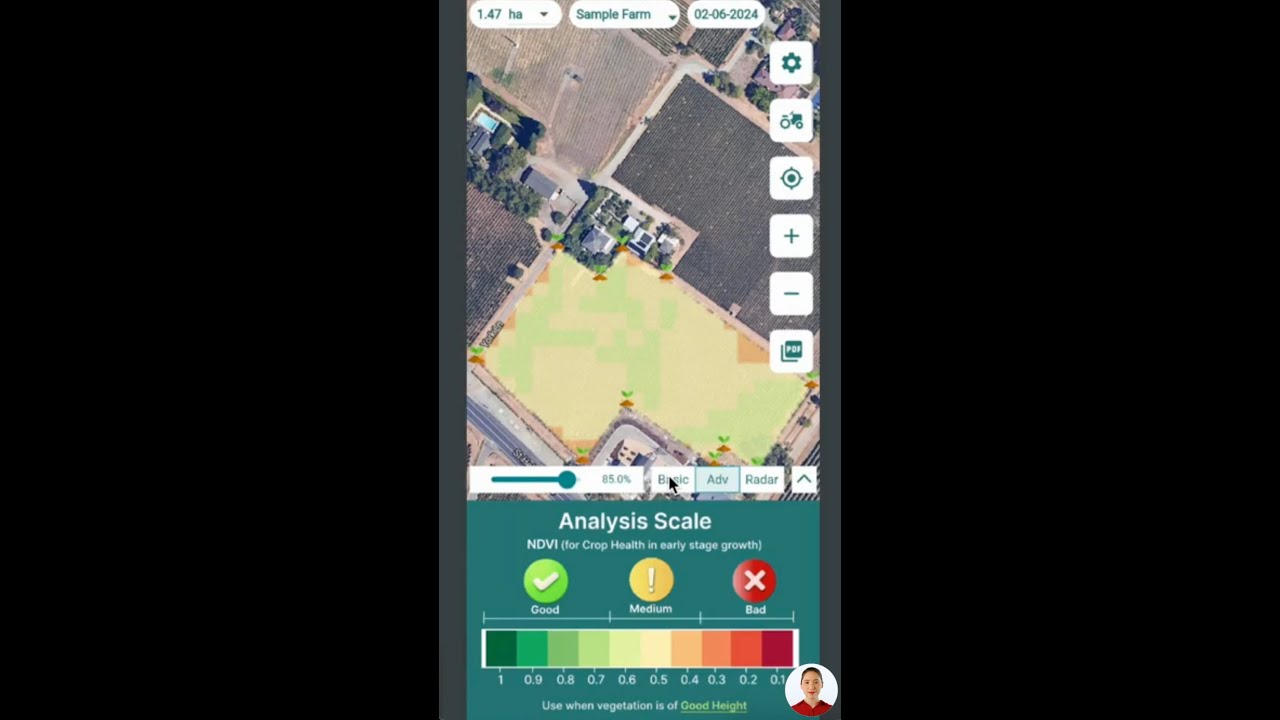
▶ How to read satellite crop maps in the Farmonaut apps, useful for spotting dry patches before you change a schedule. · 4:01
Common mistakes with remote irrigation
- Buying a controller with no data input. Remote on/off saves trips but not water.
- One sensor for a whole farm. Soils change across a field. Put probes in each soil type and crop block.
- Ignoring alerts. Too many alerts get muted. Set thresholds that only fire for real problems.
- No power backup. A power cut can stop the modem but not the pump. Make sure faults fail safe.
- No records. Download the logs each season. They help with water reports, audits and next year’s plan.
FAQ
What is a remote controlled irrigation system?
It is an irrigation controller you can run from a phone or computer over WiFi, cellular, radio or satellite. It opens and closes valves and pumps, sends alerts, logs water use, and can adjust schedules using weather or soil data.
Is a WiFi controller enough for a farm?
For a greenhouse, nursery or field close to a building, often yes. For fields far from WiFi, choose a cellular controller or a long-range radio network, which can cover larger and more spread-out areas.
How much water can a smart controller save?
EPA estimates that a WaterSense labeled weather-based controller saves an average home nearly 7,600 gallons a year, and a soil moisture controller more than 15,000 gallons. Farm savings depend on crop, soil and how much you over-water now, so measure your own results on a test block.
Do remote irrigation systems work without internet?
Good systems keep running their last schedule if the connection drops and stop safely on a fault. Ask the supplier how the controller behaves offline before you buy.
Can I get help paying for irrigation automation?
In the US, NRCS programmes such as EQIP support irrigation water management practices. Payment rates vary by state and year. Other countries have their own schemes, so check with your local agriculture department.
Related pages on our site: crop loans and insurance, product traceability, carbon footprinting, fleet management, farm admin app, weather API developer docs, satellite data API and web app.
Farmonaut crop monitoring
See which parts of your fields need water
Draw your fields once and Farmonaut shows satellite crop and water-stress maps for them through the season, on web, Android or iOS.




Keep reading

Sources
- USDA NASS, 2023 Irrigation and Water Management Survey, Table 25: Methods Used in Deciding When to Irrigate: nass.usda.gov
- US EPA WaterSense, Weather-Based Irrigation Controllers: epa.gov
- US EPA WaterSense, Soil Moisture-Based Irrigation Controllers: epa.gov
- US EPA WaterSense, WaterSense Labeled Controllers: epa.gov
- University of Nebraska CropWatch, Sensors on the Pivot for Automated Irrigation Scheduling in the Great Plains (2022): cropwatch.unl.edu
- Mississippi State University Extension, Publication 4092 (2025): extension.msstate.edu
- USDA Economic Research Service, Irrigation & Water Use: ers.usda.gov
- USGS, Estimated Use of Water in the United States in 2015, Circular 1441: pubs.usgs.gov
- Colorado State University Extension, Irrigation Scheduling: The Water Balance Approach: extension.colostate.edu
- Penn State Extension, Drip Irrigation for Vegetable Production: extension.psu.edu
- Netafim, GrowSphere digital farming platform: netafim.com
- Wiseconn, Cost of an automated irrigation system: wiseconn.com
- USDA NRCS Pennsylvania, FY26 EQIP and CSP published cost list: nrcs-prod.azureedge.us
Discussion
Questions, corrections or field experience? Share them below. First-time comments are reviewed before they appear, and your email is never published.
No comments yet. Be the first to add a question or your experience.

 FieldZero
 Indico Company
 Byju’s
 Kubota
 FFBS
 Jontra
 Kalustyan
 Tucor
 Geno
 Hayleys Agriculture
 Linx Agritech
 Adinet
 Save Your Soils
 Grandstream Algérie

 Licence holder · Niger · Gold
 Client · Tanzania · Gold
 Client · Somalia · Gold
 Client & affiliate partner · Ghana · Gold










