

Gold exploration · Funding guide
Mining Funding: How to Raise Money for Gold Exploration
Mining funding for a gold exploration project follows the stages: title, data, targets, then a budget that buys one milestone. Who pays at each stage, what they check, how deals are structured, plus a Phase 1 raise calculator.
Key takeaways
- Junior and intermediate miners raised US$21.43 billion in 2025 (+109%), but junior exploration budgets fell 13% to US$4.39 billion and grassroots work hit a record-low 21% share (S&P Global, reported April 2026).
- Each stage has its own money: personal and angel funds for early work, placements and earn-ins for drilling, larger equity and royalties for resource work.
- Investors check title, jurisdiction, data, team, budget and terms; Fraser Institute respondents give policy about 40% of the weight (Fraser Institute, 2026).
- Technical claims need a qualified person under NI 43-101; JORC says an exploration target must be a conceptual range and never called a resource.
- A TSX Venture Tier 2 mining listing needs a first work-program phase of at least $200,000 recommended in a geological report (TSX Venture Policy 2.1, March 2026).
In this article
- Where exploration money comes from and where it goes
- Who funds a gold exploration project at each stage
- What mining investors look for before they invest in an exploration project
- Why geological data matters when raising capital for a mining project
- How to convince investors to fund your gold mining project
- From mining concession to investment case: a seven-step plan
- Deal structures: equity, earn-in, royalty, stream and offtake
- Going public: what an exchange asks of an exploration company
- Mining business plan and project proposal: what to include
- Investing in gold mines from the other side of the table
- Frequently asked questions
Mining funding for a gold exploration project arrives when funders can see three things: clean title to the ground, evidence that points to a target worth drilling, and a budget tied to a clear milestone. This guide shows who pays at each stage, what they check, how the main deal structures work and how to build the case from a bare concession to a first raise. It is written for licence holders and consultants who need to raise money, not for people picking shares.
Money exists but it is selective. S&P Global Market Intelligence counted US$21.43 billion raised by junior and intermediate mining companies in 2025, up 109%, yet junior exploration budgets fell 13% to US$4.39 billion in the same year (S&P, reported by BusinessDay, April 2026). Capital is flowing to building mines and to drilling around existing ones. Early-stage ground has to earn its share with evidence. If you want to meet funders first and read about checks second, our guide on where to meet investors covers the networking side; this page covers the gold-specific case you bring to them.
Where exploration money comes from and where it goes
Global exploration budgets slipped 1% to US$12.4 billion in 2025, the third fall in a row, from a recent peak of US$13.1 billion in 2022, according to S&P’s World Exploration Trends report. Gold was the exception: gold budgets rose 11% to US$6.15 billion, half of all spending. Copper rose 2% to US$3.27 billion, while lithium fell 46% to US$595 million and nickel fell 37% to US$332 million (BusinessDay, 9 April 2026).
Chart
Exploration budgets by metal, 2025
US$ billion, global nonferrous exploration budgets
The split by stage matters more to a licence holder than the total. Money spent at and around existing mines rose 13% to a record US$5.63 billion, or 45% of all budgets. Grassroots exploration, the search for new deposits before any resource exists, fell 8% to US$2.57 billion, a record-low 21% share. S&P also reported that much of the 2025 fundraising went to mine development rather than exploration, which explains why strong fundraising did not lift exploration budgets.
For context on the market, spot gold was about US$4,075 per troy ounce on the morning of 10 November 2026 (Kitco spot quote). S&P linked the 2025 recovery in fundraising to lower interest rates and stronger prices for gold, copper and silver. Prices move daily, and no funder will pay for your project because of the gold price alone. They pay for the ground and the evidence.
Who funds a gold exploration project at each stage
No single source pays for the whole journey from licence to mine. Each stage has its own question, its own kind of money and its own evidence. The table shows the usual pattern for gold; real deals mix and overlap.
Chart
Budgets by metal against funds raised by juniors
US$ billion; funds raised = junior and intermediate mining companies
| Stage | The funder’s question | Usual source of money | Evidence they expect |
|---|---|---|---|
| Concession in hand, no work done | Is the title clean and the ground credible? | Your own cash, friends and family, angel investors | Licence document, map, public geology, a one-page summary |
| Target generation (mapping, soil sampling, geophysics, satellite screening) | Do the data point to targets? | Angels, small private placements, a partner who wants access to ground | Ranked targets, sample results, a Phase 1 budget |
| First drilling | Does mineralisation continue at depth, and at what grade? | Equity raises, earn-in partners, flow-through shares in Canada | Plan signed off by a qualified person, permits, drill targets |
| Resource definition | How big, and at what grade? | Larger equity raises, strategic stakes, royalty money | Drill results with quality control, a resource estimate under a recognised code |
| Studies | Can it be mined at a profit? | Equity, partners, early royalties and streams | Scoping and pre-feasibility work (see pre-feasibility study in mining) |
The sources differ in what they want back. Private individuals and family offices tend to back people and a story that is easy to test. Public-market money arrives through listed exploration companies. Larger miners behave differently: reporting on S&P’s findings, Crux Investor describes major miners paying cash for early-stage ground, taking equity stakes in juniors and funding exploration through earn-ins to replace depleted reserves. A funder like that wants ground in a district it already knows. Specialist funds and private equity look for projects with a path to a study; our note on how mining private equity and venture funds pick projects lists their filters.
Debt comes later. Banks lend against a bankable study and permits, not against a concession; the later stages of capital are laid out in our guide to mine finance from licence to mill. Until then, exploration is paid for with risk capital, which means equity or its cousins.
What mining investors look for before they invest in an exploration project
Investors cannot walk your ground before the first call. They read documents, then decide whether a site visit is worth the flight. These are the checks that decide it, in the order most people run them.
Chart
Investment Attractiveness Index, selected jurisdictions
Score out of 100; 60% mineral potential, 40% policy perception; 68 jurisdictions
Title, tenure and obligations
A funder starts with the licence. They ask who holds it, what minerals and area it covers, when it expires, what you must spend or pay to keep it, and whether anyone else holds a royalty or an option on it. They also check for overlaps with other licences, protected areas or community land. A strong title pack has the licence certificate, the official map or coordinates, proof of payment of fees, and a line from a lawyer in the country. Use the cadastre of the country (our guide to mining cadastre portals by country lists them) and run the steps in check your licence area before you send anything. Rules on foreign holders differ widely, which is why the video below matters to anyone raising money from outside the country.
Jurisdiction and permits
Investors price political and permitting risk into every deal. The Fraser Institute’s Annual Survey of Mining Companies is the most quoted ranking. The 2025 edition, published in February 2026, collected 256 responses on 68 jurisdictions between 5 August and 26 November 2025. It combines a mineral potential index (60% weight) and a policy perception index (40% weight) into one Investment Attractiveness Index. Respondents say policy drives about 40% of an investment decision and mineral potential the rest (Fraser Institute, 2026).
Nevada ranked first on the index at 90.87, followed by Ontario (89.98), Saskatchewan (89.66), South Australia (89.19), Arizona (87.06) and Western Australia (87.01). Botswana ranked seventh at 85.99. Tanzania scored 68.04 (34th of 68), Ghana 55.21 (53rd) and Mali 46.58 (64th). The scores are opinions of survey respondents, not law, but they show how a funder may see your country before reading a word about your geology. If your licence is in a lower-scoring place, answer the concern directly: show the permit path, the licence timeline and who in-country supports you.
Geology and data
This is where most projects win or lose, so it has its own section below. In short, a funder wants to see how you know the ground is prospective, not just that you hold it.
Team and the qualified person
Who will run the work and who will sign off the technical statements? In Canada, National Instrument 43-101 (the rule that governs public disclosure of mineral projects) defines a qualified person as an engineer or geoscientist with a relevant degree, at least five years of relevant experience, experience that fits the project, and good standing with a professional association (NI 43-101, OSC unofficial consolidation to June 2023). The JORC Code, used in Australia and New Zealand, has a similar figure called a Competent Person. Even in a private raise, investors look for someone with those credentials behind the technical claims. A named geologist with a record in your region is worth more than a long list of advisers.
Budget and use of funds
Funders want each dollar tied to a task and a result. A raise that says “US$500,000 for general working capital” is harder to back than one that says “US$320,000 to drill 1,600 m on two targets, with results due in 14 weeks”. Our guide to the first-year exploration budget for a small licence shows how to split the spend. The calculator further down sizes a Phase 1 ask and the share of the company it would cost.
Terms and exit
Last, they read what they get: shares, a stake in the project, a royalty, or a right to buy later. They also want to know how and when they could be bought out, listed or diluted. Terms are covered in the deal-structures section.

▶ Explains who can hold a small-scale mining licence in Africa and the routes open to foreigners. · 5:16
Why geological data matters when raising capital for a mining project
A gold licence with no data is a claim to a rumour. Data turn it into a case. Every funder asks the same question in different words: how do you know? The answer is a chain of evidence from cheap, wide work to expensive, narrow work, and each link makes the next raise easier and cheaper in terms of the share of the company you give away.
| Evidence | What it shows | What an investor will ask |
|---|---|---|
| Old drill logs, maps, reports | What earlier explorers found and where | Can the records be verified, and who holds the core? |
| Geological mapping and structure | Host rocks, faults, veins, alteration | Why would gold gather here? |
| Satellite and remote screening | Surface and near-surface signatures across the whole licence | Which targets rank first, and how was the ranking made? |
| Soil, rock and stream sampling | Gold and pathfinder elements (elements that travel with gold, such as arsenic) in the ground | Where is the laboratory, and what quality control was used? |
| Geophysics | Structures and rock contrasts below cover | Does it line up with the geochemistry? |
| Drilling | Grade, thickness and continuity at depth | Are intercepts reported fairly, with true widths? |
Historical data are worth real money when they can be verified. Crux Investor notes that preserved core and reliable records let a new team ask new questions without repeating every drill metre, but the value depends on the condition, coverage and verifiability of the data. Collect them early.
How to describe your data without overselling
The wording of your claims matters as much as the data. NI 43-101 requires that scientific or technical information on a material property be prepared, supervised or approved by a qualified person (section 2.1) and that written disclosure of exploration results name that person, state whether the data were verified and describe the quality assurance and quality control used (sections 3.1 to 3.3). Section 4.2 requires a technical report to support such information in a preliminary prospectus.
The JORC Code (2012 edition) is stricter about potential size. An Exploration Target must be given as a range of tonnes and a range of grade, must not use the words Resource or Reserve, and must state that the quantity and grade are conceptual, that exploration has been insufficient to estimate a Mineral Resource and that it is uncertain whether further exploration will result in one. The code says a target tonnage or grade must not be a headline, and the planned work to test it must be described with a timeframe (JORC Code 2012, clause 17). Even if you are not listed, follow the same discipline. A teaser that says “10 million ounces” without drilling loses serious readers in the first paragraph.
Satellites add a cheap first layer. They cannot see gold, but they can map iron-oxide staining, clay and mica alteration, silica and fault patterns across a whole licence in one pass. Satellites map surface and near-surface signatures; sampling and drilling confirm. A Farmonaut satellite mineral report works from your KML or KMZ boundary, covers gold among more than 20 minerals and is delivered in 5 to 20 business days; it gives an exploration target, not a resource. To see what such a report contains, read what is inside a mineral exploration report sample, and for how it compares with soil sampling and geophysics see satellite vs geochemistry vs geophysics.
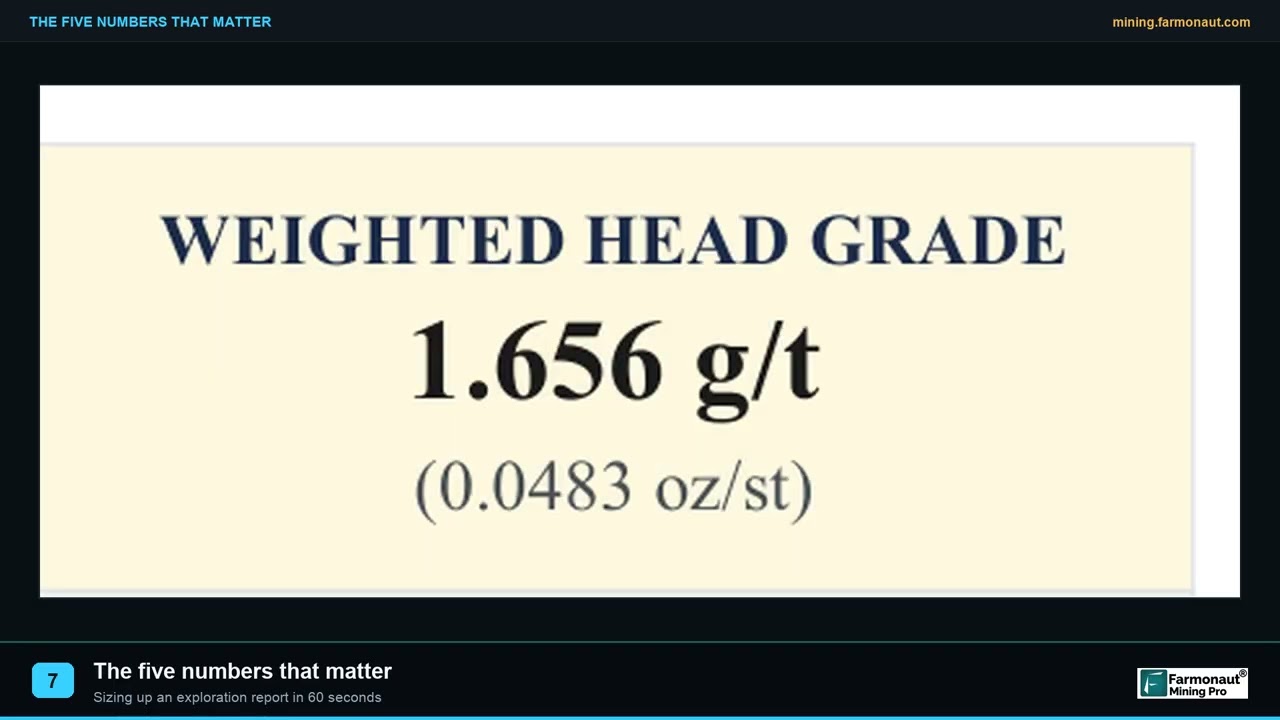
▶ Explains the five numbers in a satellite gold exploration report and the one people misquote. · 2:00
How to convince investors to fund your gold mining project
You do not convince funders with adjectives. You convince them by making the decision easy: a short document, a specific ask and a result that is soon and checkable. The order below works for a one-page summary and for a first call.
- One sentence on the opportunity. What is the target, where, and why do you think gold is there?
- The ground. Licence number, area, expiry, ownership, obligations, who else has rights.
- The evidence. Three to five facts from the data, each with its source and date.
- The targets and Phase 1. What you will drill or sample, how many metres or samples, and which result would stop the project.
- The budget and the timeline. A table that sums to the amount you ask for, with a contingency line.
- The terms and the team. What the funder gets, who runs the work and who is the qualified person.
Put the risks in. Funders find them anyway, and a page that names the three biggest risks reads as honest. Never promise a return or a discovery. Do not call a target a resource. If a drill hole in the district hit gold, say so and say it is not your ground.
Size the ask to one milestone, not to a dream. The calculator below turns drilling metres, a cost per metre, sampling, licence and overhead costs and a contingency into a Phase 1 raise, then shows the share of the company an investor would hold at a pre-money value you choose. Pre-money value is what the company is worth before the new money; post-money is that value plus the new money. All costs are example inputs, not benchmarks.
A word on securities law. In the United States, a company that offers or sells securities must register them with the SEC or find an exemption, and Rule 506 of Regulation D lets a company sell to accredited investors (Investor.gov). Other countries have their own rules on who may be approached and how. Ask a securities lawyer before you send a teaser to people you do not know.
Calculator
How much should a Phase 1 raise be, and what does it cost in equity?
Enter your own quotes. Every default is an example.
- Phase 1 cost per metre drilled: 362 US$/m
- Post-money value: 3,724,500 US$
- Share held by the new investor: 19.5%
Example values only, not benchmarks. Get cost per metre from a driller’s quote. Pre-money value is what you and the investor agree the company is worth before the new money. The investor’s share is raise divided by (raise plus pre-money). It ignores warrants, fees and option pools.
From mining concession to investment case: a seven-step plan
Most licence holders raise money too early, before they have a story, or too late, after the licence has run down. This plan takes the ground from title to a data room in order. Each step is cheap compared with the next, and each one improves the terms you can ask for.
- Confirm title and obligations. Check the licence against the official register and note every deadline and payment (see check your licence area).
- Collect public and historical data. Geological survey maps, old reports, drill logs, airborne geophysics, nearby mines. Note the source and date of each file.
- Screen the whole licence. Use satellite imagery to rank areas for alteration and structure, so field work starts on the best ground. The video below explains what a satellite can and cannot show.
- Field-check and sample the top areas. Mapping, rock chips and soil lines, with a named laboratory and quality control samples.
- Write the target statement. Give each target a rank, a reason, an expected style of gold system, and the work that would test it. Use the exploration-target wording described above.
- Build the Phase 1 budget and the data room. Tie each dollar to a task. Then collect the documents (list below).
- Choose a structure and approach funders who fit. Match the structure (next section) to the stage and the investor type.
What goes in the data room and the teaser
A data room is a shared folder, usually online with access controls, where a serious funder reads your documents. A teaser is the one or two pages that get them to ask for access. Keep the teaser short and factual: location map, licence facts, three evidence points, target images, Phase 1 plan and budget, contact. Share it only after the funder accepts a confidentiality agreement.
- Licence certificate, official map, coordinates in a standard format and proof of fees paid.
- Legal summary: ownership chain, royalties, options, any dispute or overlap.
- Geology report and map, with historical reports and logs, each with its source.
- Sampling data: sample locations, results tables, laboratory certificates and quality control.
- Geophysics and satellite products with a short method note.
- Target list with ranks and a Phase 1 programme and budget.
- Permits and community or landowner agreements, or the plan to obtain them.
- CVs of the team and the qualified person.
- Draft terms: what you offer and what you will not give up.
Bad news belongs in the data room too. A negative hole, an expired option or a boundary dispute found by the funder on their own ends the talks. Disclosed up front, the same fact becomes a risk with a plan. Funders know that drill holes miss, and they read a miss calmly when it is explained: see our guide to dry holes in mineral exploration.
▶ Explains what a satellite can and cannot detect when screening a gold licence. · 2:00
Deal structures: equity, earn-in, royalty, stream and offtake
The structure decides who owns what after the money arrives. The table summarises the structures that fit gold exploration and the points to check in each.
| Structure | How it works | What you give up | Check before you sign |
|---|---|---|---|
| Equity placement | Investors buy new shares in your company | A share of the company (dilution) | Pre-money value, warrants, board seats, securities-law exemption |
| Earn-in or option | A partner earns an interest in the project by spending money in stages | Part of the project, in steps | Spend per stage, deadlines, buy-back if the partner stops, who operates |
| Joint venture | Parties hold interests in the project and share costs | Part of the project and some control | Dilution formula, deadlock rules, funding calls (see mining joint ventures) |
| Royalty | A funder pays upfront for a share of future revenue | A slice of revenue if the mine is built | Type (net smelter return, gross, net profit), buy-back right, security |
| Stream | A funder pays upfront for the right to buy a share of production at a discount | Part of the metal, often for the life of the mine | Per-unit price, delivery terms, top-up rules, link to later debt |
| Offtake prepayment | A buyer pays ahead for future output | Sales flexibility | Mostly a development-stage tool (see mining offtake agreements) |
| Flow-through shares (Canada) | The company passes eligible exploration expenses to investors for tax purposes | A share of the company, at a price that reflects the tax benefit | Eligible spend, deadlines, the rate in force |
Earn-ins and joint ventures with real terms
An earn-in suits an owner who cannot yet fund the next stage of work. The partner does not buy an interest; it earns one by spending set amounts within set times. Two public deals show the shape. In March 2026 GGL Resources (TSX Venture: GGL) closed an agreement under which ASX-listed Nelson Resources can earn up to 90% of the Gold Point gold-silver project in Nevada. After an initial 25%, Nelson must meet staged spending of US$250,000, US$750,000 and US$2,000,000 (US$3,000,000 in total) to reach 45%, 65% and 90% within 12, 24 and 36 months, with cash and share payments on top. If a stage is not completed, GGL can buy back Nelson’s interest for US$1. GGL also keeps a 2% net smelter return royalty, although Nelson can buy back half of it for up to US$1,000,000 (GGL, 16 March 2026; closing, 24 March 2026).
In 2018 Andromeda Metals signed an earn-in and joint venture on its Drummond gold project with Evolution Mining. Evolution paid A$300,000 on signing and could earn 51% by funding A$2.0 million of exploration within two years, then elect to reach 80% by paying A$200,000 and spending A$4.0 million over a further two years. A party that falls below 10% converts its interest into a 2% net smelter return royalty (Andromeda Metals ASX announcement, 3 September 2018). These are examples of structure, not market norms; your terms depend on your ground and your partner. Our guide to mining joint ventures explains the checks on the partner and the dilution formulas.
Royalties and streams
A net smelter return (NSR) royalty is a percentage of the sale price of the metal after agreed deductions such as transport, smelting and refining charges. Royalty and stream funding can fund a project without diluting the owner. According to law firm Clayton Utz, in a royalty financing the financier pays upfront for a royalty interest, while in a streaming deal the financier pays upfront for a percentage of production at a discounted price and then pays for each unit delivered. For the miner the advantages include no dilution, no repayment until production starts, and payments that fall if output falls; the financier will want protections such as security and reporting rights (Clayton Utz, August 2024). The cost is a permanent slice of the project’s economics. For gold explorers this route is more often open once a resource exists; before that, equity and earn-ins dominate.
Flow-through shares in Canada
Canada has a tax tool for exploration equity. A flow-through share lets a company pass eligible exploration spending to investors. Natural Resources Canada says investors receive a 100% deduction for the amount invested, plus a 15% mineral exploration tax credit on eligible expenses (30% for specified critical minerals). Gold exploration falls under the 15% credit. The agency’s page notes that a further extension was proposed in March 2025 (Natural Resources Canada). Check the Canada Revenue Agency for the rules in force before you price a raise.
Going public: what an exchange asks of an exploration company
For a company that wants to list, the exchange sets the minimum evidence. Under TSX Venture Exchange Policy 2.1 (as at 31 March 2026), a Tier 2 mining issuer needs a significant interest in a qualifying property (or, at the exchange’s discretion, a right to earn one), evidence of at least $100,000 of approved expenditures on the property in the 36 months before applying, and a work program with an initial phase of at least $200,000 as recommended in a geological report. It also needs working capital for 12 months plus $100,000 in unallocated funds, and a public float with 200 public shareholders each holding a board lot and 20% of shares in public hands. The work program must be recommended in a current geological report prepared under NI 43-101, and the exchange may waive the approved-expenditures test if Phase 1 exceeds $400,000 (TSX Venture Exchange Policy 2.1). The policy states amounts in dollars; TSX Venture is a Canadian exchange.
These numbers show the scale of a first listed raise and why a Phase 1 plan with a signed-off budget is the core asset. For the differences between exchanges, see TSX vs TSXV vs CSE listing requirements for miners. Listing is not the only way to raise money, and it adds costs and reporting duties. Many licence holders raise privately first.
Mining business plan and project proposal: what to include
A mining business plan or project proposal for an exploration-stage gold project is not a financial model of a mine. It is a short document that explains why the next dollar should be spent and what it will buy. Keep it to 10 to 15 pages and make the first page stand alone.
| Section | What it must say |
|---|---|
| Summary | The target, the ask, the milestone and the terms in one page |
| Property and title | Licence facts, obligations, ownership chain, access, permits |
| Geology and data | Regional setting, deposit model, results to date with sources |
| Targets | Ranked list with the reason for each and the test planned |
| Work program and budget | Tasks, metres or samples, unit costs, timeline, contingency |
| Team | Management, qualified person, contractors, local partners |
| Risks and permits | Technical, legal, community, funding and price risks, each with a response |
| Funding and terms | Amount, use of funds, structure, what happens after Phase 1 |
If the project is further along, the plan grows into scoping and pre-feasibility studies, which are the base for project debt. Those are covered in pre-feasibility study in mining and in the wider mining project financing guide.
Investing in gold mines from the other side of the table
Some readers want to put money in, not raise it. The ways in range from low to high risk: shares in listed producers, shares in listed explorers, royalty and streaming companies, funds, and direct stakes in private projects. Direct stakes in private companies are usually limited to accredited or qualified investors under securities law. Exploration sits at the risky end because the outcome is a binary result from a drill hole. The JORC Code itself warns that an Exploration Target is conceptual and that it is uncertain whether further exploration will define a resource. Read the technical report, check the qualified person, and compare the stage of the project with the size of the promise. This page is general information and not investment advice.
Frequently asked questions
How do I find investors for a gold mine?
Start with your evidence, then match it to investors who fund that stage: individuals and family offices for early work, public-market and private placements for drilling, strategic miners for ground in districts they know. Introductions from geologists, lawyers and brokers work better than cold emails. Our guide on where to meet mining investors lists the channels.
What do funders check in an exploration project?
Clean title, a credible jurisdiction, data that point to targets, a named qualified person, a budget tied to a milestone and fair terms. The Fraser Institute survey says respondents give policy about 40% of the weight in an investment decision and geology the rest.
How much money do I need to start gold exploration?
It depends on area, access and method. Early mapping and sampling cost far less than drilling. For scale, GGL’s Gold Point earn-in with Nelson Resources totals US$3,000,000 of exploration spending over three years for up to 90% of a project, and a TSX Venture Tier 2 mining listing requires an initial work-program phase of at least $200,000. Use the calculator above with your own quotes.
Can I raise money with only a licence and no drilling?
Yes, but it is harder and the terms are tougher. You will usually raise small amounts from people who know you, or offer an earn-in to a partner who wants the ground. Mapping, sampling and a satellite screen first make the ask smaller and better evidenced.
How do I convince investors to fund my gold mining project?
Give them a short, honest document: the ground, three to five evidence points with sources, ranked targets, a Phase 1 budget that sums correctly, the team and the terms. Name the risks. Never present a target as a resource.
What is the difference between an earn-in and a joint venture?
In a joint venture each party already holds an interest and shares costs. In an earn-in the funder earns an interest by spending money in stages and gets nothing more if it stops. Many earn-ins turn into joint ventures once the partner reaches its target stake, as in the Gold Point deal.
Do I need an NI 43-101 or JORC report to raise money?
For a public company, yes in practice: NI 43-101 requires technical information on a material property to come from or be approved by a qualified person, and requires a technical report to support a preliminary prospectus. JORC governs public reports of exploration targets and results on the ASX and NZX. For a private raise the rules depend on who you approach: NI 43-101 also requires a technical report to support an offering memorandum unless it goes only to accredited investors, and investors expect the same discipline anyway. Ask a securities lawyer about your case.
Which countries do funders prefer?
The Fraser Institute’s 2025 survey ranked Nevada, Ontario, Saskatchewan, South Australia, Arizona and Western Australia as the top six, and Botswana seventh. Gold projects also exist in lower-ranked places, such as Ghana and Tanzania, so expect more questions about permits and security there.
Does satellite data help raise money for a gold project?
It gives a cheap, whole-licence first look at alteration and structure, so your first targets are ranked with a method and not a guess. It does not replace sampling and drilling, and it does not give a resource. Use it as one layer in the data room.
How do I invest in gold mines?
The main routes are listed producers and explorers, royalty and streaming companies, funds and direct stakes in private projects. Each has different risk. Exploration carries the highest risk. Read the technical reports and talk to a licensed adviser. This page is not investment advice.
This page is for information only. It is not investment advice and not legal advice. It does not promise that any project will be funded. Securities, tax and licence rules differ by country: confirm them with a securities lawyer, your tax adviser and the mining regulator. Satellite results are exploration targets, not a JORC, NI 43-101 or SAMREC resource.
Farmonaut Mining
Add a satellite screen to your data room
Send your licence boundary and we will reply about a Farmonaut satellite mineral report to rank targets before you approach funders.

Mining Pro sample view, synthetic data
Sources
- S&P Global Market Intelligence, World Exploration Trends 2026, reported by BusinessDay (9 April 2026): businessday.co.za
- Crux Investor, citing S&P Global: funded explorers (20 October 2026): cruxinvestor.com
- Mining.com, Global exploration budgets fall as juniors tighten belts: S&P (21 February 2025): mining.com
- Fraser Institute, Annual Survey of Mining Companies, 2025 (February 2026): fraserinstitute.org
- Ontario Securities Commission, NI 43-101 unofficial consolidation (June 2023): osc.ca
- JORC Code, 2012 Edition: jorc.org
- TSX Venture Exchange, Policy 2.1 Initial Listing Requirements (as at 31 March 2026): tsx.com
- Natural Resources Canada, Mining-specific tax provisions: natural-resources.canada.ca
- Clayton Utz, Digging into mining royalties (22 August 2024): claytonutz.com
- GGL Resources, earn-in update, Gold Point (16 March 2026): gglresourcescorp.com
- GGL Resources, closing of earn-in with Nelson Resources (24 March 2026): gglresourcescorp.com
- Andromeda Metals, Drummond joint venture with Evolution Mining, ASX announcement (3 September 2018): announcements.asx.com.au
- Investor.gov (SEC), Accredited investors: investor.gov
- Kitco, gold spot price (10 November 2026): kitco.com
Discussion
Questions, corrections or field experience? Share them below. First-time comments are reviewed before they appear, and your email is never published.
No comments yet. Be the first to add a question or your experience.

 Huckleberry Garnet LLC
 Dalgety Minerals Pty Ltd
 Vortex Minerals Pty Ltd
 Faith At Work (Pty) Ltd
 Geotech Mining Solutions plc
 Vulcan International Limited
 Kidepo Associates
 GKY Mining
 Alkimy SARL
 Double A Trading
 GemSprout Metals Limited
 Qader Group
 Ileys General Trading
 SG Gold Mining LLC
 VRV Global Pte Ltd
 Omsri International FZE
 G.I.T.T.
 Jaunita Erss Ltd
 Almosi SARL
 SRK Consulting
 Berks Gold Limited
 Mwerezi Minerals Company Limited

 Exploration consultancy · South Africa · Gold










