

Farm software · Australian buyer guide
Farm Management Apps Australia: 7 Compared With Prices
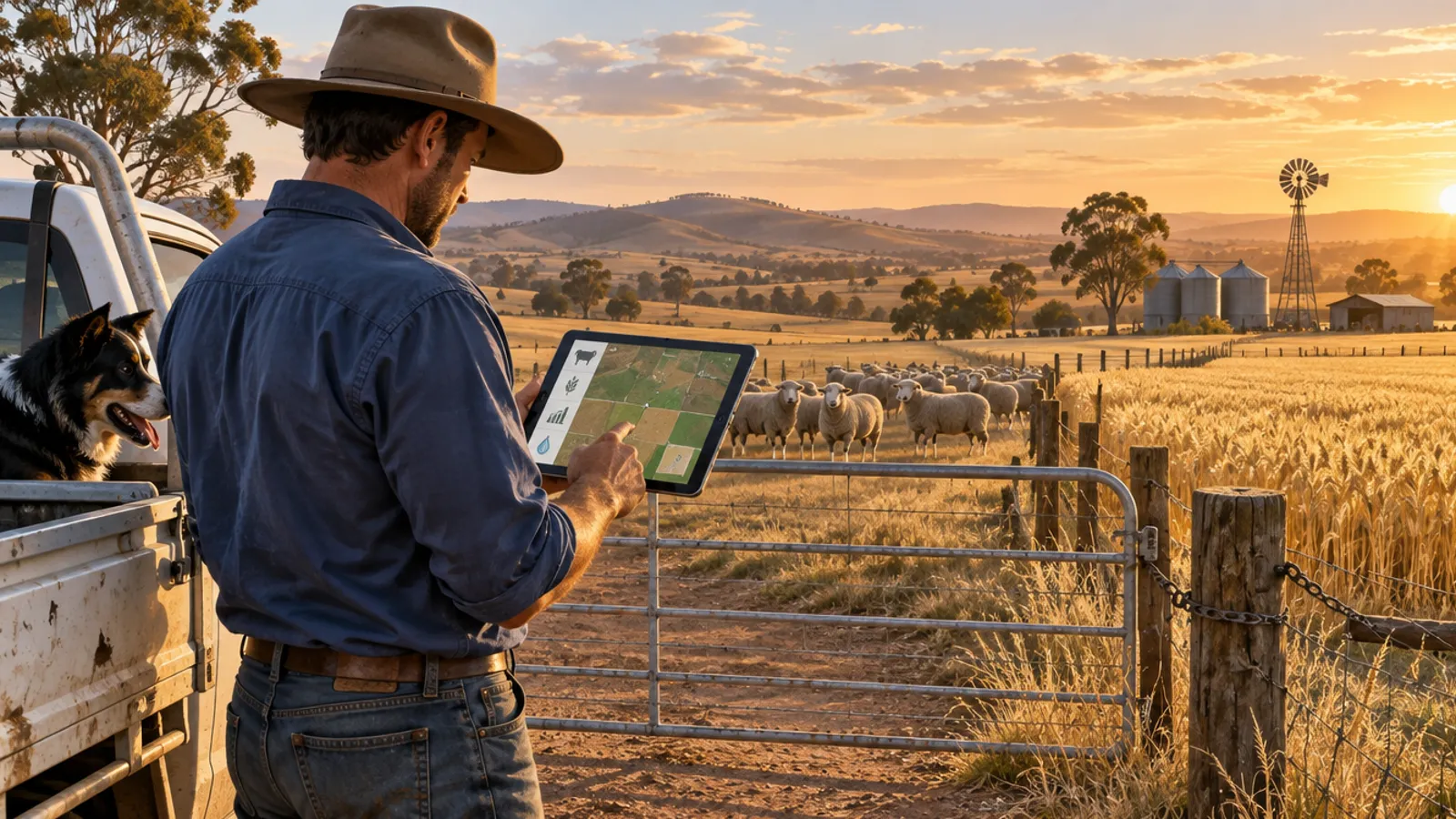
No single app fits every farm. AgriWebb suits livestock records, Agworld crop plans, Pasture.io pasture cover, CliMate weather risk and Figured budgets. Prices below are from each vendor’s own page on 26 October 2026.
Key takeaways
- Agworld’s Australian page listed grower plans at $1,795, $3,195 and $3,995 a year (26 Oct 2026); satellite imagery starts at the middle plan.
- Farmbrite bills in US dollars: livestock plans were US$29, US$49 and US$79 a month, or US$290, US$490 and US$790 a year (26 Oct 2026).
- AgriWebb prices by animal numbers through an online calculator and excludes GST (26 Oct 2026).
- CliMate became web-only on 1 July 2025 and supports no new iOS users from January 2026 (CliMate site).
- In an NFF member survey reported by nbn Co (2021), 59% named business compliance reporting among technologies that need connectivity.
In this article
- How we chose these seven apps
- Farm management apps Australia: the 7 at a glance
- 1. AgriWebb: livestock records and paddock maps
- 2. Agworld: crop plans shared with your agronomist
- 3. Farmbrite: records, tasks and accounts for smaller farms
- 4. Pasture.io: pasture cover from satellite images
- 5. CliMate: weather-risk questions for sowing and inputs
- 6. Figured: farm budgets, reports and plans
- 7. Xero and other accounting links
- Price comparison: what the plans cost
- How to choose a farm management app
- What farmers say needs a connection
- Compliance and traceability: why records matter
- Satellite crop and pasture monitoring
The best farm management apps in Australia depend on what you run. AgriWebb suits livestock records, Agworld suits cropping teams that work with an agronomist, Pasture.io tracks pasture from satellite images, CliMate answers weather-risk questions, and Figured with Xero covers the money side. Prices below come from each vendor’s own page on 26 October 2026.
This guide compares seven farm management apps that Australian farmers can use, with list prices where the vendor shows them, a chart of what farmers say needs a connection, and a calculator to test whether an app pays for itself on your place. It also explains how to choose, because the cheapest plan is rarely the right one.
How we chose these seven apps
We looked for tools that an Australian farm can sign up to today and that do one clear job well. We opened each vendor’s own site on 26 October 2026 and used only what that page says. Where a page shows no price, we say so instead of guessing.
Ratings and star scores are not shown. A score needs a stated method and a sample, and we could not find one that covers all seven. Instead, the table gives the job each tool does, who it suits and what the vendor lists as the price.
We left out one packhouse tool that an earlier version of this page listed, because its website did not open for us and we could not check its current features. Packhouse operators should ask any vendor for a demo and a written quote.
Farm management apps Australia: the 7 at a glance
The table gives the main job, the platforms and the price as shown by each vendor on 26 October 2026. Prices are list prices from the vendor page, not quotes. Check GST and currency before you compare.
| App | Main job | Best for | Price shown by vendor |
|---|---|---|---|
| AgriWebb | Livestock and paddock records | Beef, sheep, mixed farms | Set by animal numbers; excludes GST |
| Agworld | Crop plans, records, budgets | Cropping with an agronomist | $1,795 to $3,995 a year |
| Farmbrite | Records, tasks, accounts | Small mixed farms | US$29 to US$79 a month |
| Pasture.io | Pasture cover, grazing plans | Grazing farms | No price on home page |
| CliMate | Rain, soil water, risk | Sowing and input timing | No price listed |
| Figured | Farm budgets and reports | Farm owners and advisers | Demo; no price on home page |
| Xero | General accounting, GST | The books and BAS | Comprehensive A$107 a month; lower Ignite and Grow plans also listed |
1. AgriWebb: livestock records and paddock maps
AgriWebb is built for livestock producers. Its site says you can manage livestock, grazing, cropping and tasks, and keep records ready for audits. It offers a trial for managing animals by mob or by individual animal, and its page says the app works offline.
Price depends on how many cattle and sheep you run. The pricing page has a calculator: you enter head numbers and it returns a cost per year or per month, excluding GST. It lists three plans: Essentials (interactive farm map, livestock reconciliation, team tasks, mob movements), Compliance (audit and biosecurity tools, treatment and weight records, cropping records) and Performance (weight projections, grazing management, financial reporting, stocking rate versus carrying capacity). The page marks Compliance as the most popular plan.
Best for: producers who need clean movement and treatment records for audits. Watch for: the price rises with herd size, so run the calculator with your own numbers before you commit.
2. Agworld: crop plans shared with your agronomist
Agworld links the grower, the agronomist and the contractor in one record. Its Australian site says its sales and support team is based across regional Australia and New Zealand, with a head office in Perth, and that the apps work offline. Spray jobs can be turned from a recommendation into a record with one step, which helps with compliance.
The Australian pricing page lists three grower plans and an enterprise tier on quote. Basic ($1,795 a year) covers records, agronomist connection, a label and safety data sheet library and yield records. Plus ($3,195) adds planning and budgeting, gross margin reports, work orders, NDVI satellite imagery and weather data. Pro ($3,995) adds machinery and weather station integrations and custom reports. The page shows dollar prices without naming the currency, so confirm GST and currency at sign-up. A 7-day trial is offered.
Best for: cropping farms where an agronomist writes the plan. Watch for: satellite imagery sits in the middle plan, not the entry plan.
3. Farmbrite: records, tasks and accounts for smaller farms
Farmbrite is a US-based tool that sells to farms in several countries. Its pricing page states that all prices are in US dollars, so Australian buyers pay in US$ and should allow for exchange rates and card fees.
The livestock plans on 26 October 2026 were Essentials at US$29 a month (US$290 a year, up to 300 active animals, sets or flocks), Performance at US$49 a month (US$490 a year, up to 500, with grazing management, and historic climate reporting and satellite mapping) and Premium at US$79 a month (US$790 a year, 5,000 or more). Complete plans for farms with crops and livestock start at US$59 a month, and an accounting-only plan is listed at US$119 a year. The page also advertised 25% off any plan for sign-ups before 30 November. The page also lists tax reporting tied to the US Schedule F form, which does not apply in Australia.
Best for: a small mixed farm that wants one low-cost system. Watch for: US-dollar billing and US-focused tax features.
4. Pasture.io: pasture cover from satellite images
Pasture.io says it builds a picture from satellite imagery, weather and farm records, with daily pasture cover and growth rates, a feed wedge and a grazing planner. You can add your own plate meter readings. The site says no hardware is needed to get started, and its customer quotes include farms in Victoria, Australia and in New Zealand.
The home page we read shows no price. Ask for a quote and check what is included per paddock or per hectare.
Best for: rotational grazing farms that plan feed week by week. Watch for: satellite pasture estimates are estimates; compare them with a few plate meter or walk readings in your own paddocks.
5. CliMate: weather-risk questions for sowing and inputs
CliMate answers questions such as how this season compares with past seasons, how often a sowing rain occurs, how soil water and nitrate changed over a fallow, and what yield the water supply allows. The tool’s overview says it uses Bureau of Meteorology data and the Queensland Government’s SILO climate database, which holds daily Australian data from 1889 to the present.
The CliMate home page says it became a web-only app on 1 July 2025. Existing iOS users can keep their version, but no new iOS users are supported from January 2026. Its site lists no subscription price. It is a decision tool, not a record-keeping system, so pair it with one of the apps above.
The Bureau of Meteorology publishes national climate information on its climate pages.
Best for: deciding when to sow, spray or buy inputs. Watch for: there is no phone app for new users.
6. Figured: farm budgets, reports and plans
Figured is a farm financial planning platform. Its site says it pulls live numbers from QuickBooks Online or Xero, builds forecasts and scenarios, and joins livestock and crop production data to the accounts. It says it is used by more than 35,000 farm businesses across the US, New Zealand, Australia and the UK. The home page is written mainly for US farms, and it shows no price (it offers a demo), so ask whether the Australian setup, GST and BAS reporting fit your books.
Best for: farm owners and advisers who want a live budget against actuals. Watch for: it sits on top of your accounting software; it does not replace it.
7. Xero and other accounting links
Many farm apps connect to an accounting package, and Xero is one example. Its Australian pricing page names Ignite, Grow, Comprehensive and Ultimate plans, with Comprehensive at A$107 a month and Ultimate 10 at A$143 a month (check the page for the lower Ignite and Grow prices), with prices in Australian dollars including GST. New customers were offered 90% off the first three months until 2 November 2026. Plans include GST tracking and BAS lodgement.
Before you buy a farm app, check that it connects to the accounting software your bookkeeper already uses. Ask your bookkeeper or accountant which plan you need.
Price comparison: what the plans cost
Agworld’s grower plans rise from $1,795 to $3,995 a year, a difference of $2,200 between Basic and Pro, and the middle plan ($3,195) is where satellite imagery appears.
Chart
Agworld grower plans, yearly list price
Dollars a year as shown on Agworld’s Australian pricing page; currency not stated on the page
Chart
Farmbrite livestock plans: monthly vs yearly
US dollars a year; monthly price times 12 against the yearly price on the page
How to choose a farm management app
Start with the job, not the brand. A cattle producer who must pass audits needs movement and treatment records first. A cropper who works with an agronomist needs a shared plan and spray records. A grazier needs feed budgeting.
- List your three biggest jobs. Examples: livestock movements, spray records, feed budget, weather risk.
- Check offline use. Poor connectivity is a known issue in rural Australia (see the 2022 review below). An industry survey of Australian farmers shows connectivity needs are broad, as the chart below shows.
- Check the price basis. Look for currency, GST, billing per animal or per hectare, and the difference between monthly and yearly payment.
- Check data rules. The National Farmers’ Federation’s Australian Farm Data Code is a voluntary code that tells farmers how providers should handle farm data, and providers that fully comply can be certified. Ask whether a vendor follows it.
- Test with one season. Use the trial, load one mob or one block, and compare it with your current records.
What farmers say needs a connection
A November 2021 report by nbn Co includes a survey of National Farmers’ Federation members on which technologies on their property need connectivity. The top answer was business compliance reporting. This is a survey of members who answered, not of every farm.
Chart
Technologies on farm that need connectivity
Share of surveyed NFF members naming each, 2021; selected answers shown
The tools above sit under compliance reporting, weather stations, tag readers and sensors. A 2022 review in Crop and Pasture Science describes digital agriculture in Australia as immature with ad hoc adoption, and notes that poor connectivity reduces the value of sensor networks in remote areas. In a survey of 1,000 Australian farmers cited there, more than 75% of those who owned sensor networks rated them moderately to extremely challenging to maintain. That is why offline use is worth checking.
Compliance and traceability: why records matter
For cattle, sheep and goats, the National Livestock Identification System combines three parts: an electronic or visual eartag, a Property Identification Code for each location, and a central database that records movements. Your state agriculture department handles PIC registration, device orders and transfer timeframes. A farm app can hold your own treatment, weight and paddock records, but the NLIS database remains the official movement record. Confirm with your state department what you must record and how soon.
Satellite crop and pasture monitoring
Satellite images show vegetation change across a paddock. They do not name the cause, so walk the paddock to confirm. Agworld (Plus plan), Farmbrite (Performance plan) and Pasture.io include satellite views. Standalone tools also exist; one example is the Farmonaut Satellite + AI Farm Monitoring System, which shows crop-health maps for fields you draw.

▶ A web tutorial on monitoring a farm with satellite imagery and crop health indices. · 8:43
Which app fits which type of farm
These pairings are a starting point, based on what each vendor says its tool does. They are not rankings.
- Beef or sheep property with audits: start with AgriWebb for mob movements, treatments and weights, then add CliMate for weather-risk checks. Keep NLIS transfers up to date on the official database.
- Broadacre cropping with an agronomist: Agworld lets the agronomist write the plan and you record the jobs. Add Xero or Figured for the money side.
- Intensive grazing: Pasture.io is built around pasture cover and grazing rotations, so test it against your own plate meter readings.
- Small mixed farm or hobby farm: Farmbrite covers animals, crops, tasks and basic accounts at a low monthly price, in US dollars.
- Farm business with an accountant and several owners: Figured sits on top of your accounting software and gives everyone one live budget.
A simple first 30 days with a farm record app
A small first step is easier than moving the whole business at once. Do not move the whole business in a week.
- Week 1: sign up for a trial and draw your paddocks or blocks on the map. Name them the way your team does.
- Week 2: load one mob or one crop. Record every job for that group in the app, even if you also keep your old notes.
- Week 3: run one report you actually need, such as a spray diary, a withholding period list or a stocking rate check. Compare it with your paper records.
- Week 4: ask your staff and adviser what slowed them down. Decide whether to move the rest of the farm, change plans or try another app.
If the trial report matches your own records and your team uses it without being asked, the tool is likely worth paying for. If not, a cheaper plan or a different app may fit better. Any app is only as good as the records entered into it.

▶ Six plain steps to start digital farming without buying a robot. · 4:18
Farm record keeping and tracking: what to look for
A farm record keeping app or farm tracking app mostly has to cover four things: where things are, what was done, what it cost, and what you must prove to a buyer or auditor. Check that the app can print or export a record in a form your buyer or auditor accepts, that it keeps a history of changes, and that more than one person can enter data from the paddock.
Also check the boring parts. Does it let you back up your records? Can you export them if you leave? Does it keep working when a team member enters data without signal and syncs later? These questions matter more over five years than an extra feature does in the first month.
Do the numbers work for your farm?
The calculator below compares the yearly cost of an app and an accounting plan with the value of the time you save. Every number is your input. The starting values are examples, not benchmarks, and sit near break-even on purpose.
Try the numbers for your own farm below.
Calculator
Does a farm app pay for itself on your farm?
Enter your own fees and time. Start values are examples only.
- Total yearly cost (A$): $3,084
- Value of time saved (A$): $3,120
- Hours a week to break even: 2.0 h
Example values only, not benchmarks or a forecast. Prices are inputs: use today’s price from the vendor and add GST if it is not included. Time saved is your own estimate and is counted over 52 weeks.
Costs and limits to expect
List prices are only part of the cost. Add set-up time, training for staff, extra users, ear tags or readers if you run livestock, and any exchange-rate cost if the vendor bills in US dollars. Trials are the cheapest way to find out whether your team will use the app every week. An app nobody opens saves no time.
The Farm Data Code and your contract also matter when you leave: ask how you can export your records and who owns them. Pesticide and chemical records you keep in an app do not replace the product label or your state rules; follow the label and local rules, and get professional advice on tax and legal records.
FAQ
What is the best farm management app in Australia?
No single app wins for every farm. AgriWebb is aimed at livestock records, Agworld at crop plans shared with an agronomist, Pasture.io at pasture cover, and Figured at budgets. Pick by your biggest job and test it in a trial.
How much do farm management apps cost in Australia?
On 26 October 2026, Agworld’s grower plans ranged from $1,795 to $3,995 a year, Farmbrite’s livestock plans from US$29 to US$79 a month, and AgriWebb prices depend on animal numbers and exclude GST. These are list prices; confirm currency and GST with the vendor.
Do these apps work without phone signal?
AgriWebb and Agworld both say their apps work offline. Check this for any app before you rely on it in a paddock with weak coverage.
Is CliMate available as a phone app?
Not for new users. Its site says it became web-only on 1 July 2025 and that no new iOS users are supported from January 2026.
Can a farm app replace my accounting software?
Usually not. Figured says it pulls data from QuickBooks Online or Xero rather than replacing them. Keep your bookkeeper involved for GST and BAS.
Who owns my data?
Read the vendor’s terms. Agworld’s site says you own your data and it does not sell it. The Australian Farm Data Code gives farmers a standard to compare providers against.
Related pages on our site: digital farming trends, digital agronomy, remote sensing for precision farming, product traceability, carbon footprinting, fleet management, crop loan and insurance checks, large-farm admin tools, weather and satellite data API, farm monitoring apps.
Farmonaut crop monitoring
See your own fields from space
Draw your fields once and view satellite vegetation maps through the season on web, Android or iOS.




Keep reading

Sources
- AgriWebb, Pricing (read 26 Oct 2026): agriwebb.com
- AgriWebb, home page (read 26 Oct 2026): agriwebb.com
- Agworld Australia, Pricing (read 26 Oct 2026): agworld.com
- Agworld Australia, home page (read 26 Oct 2026): agworld.com
- Farmbrite, Plans and pricing (read 26 Oct 2026): farmbrite.com
- Pasture.io, home page (read 26 Oct 2026): pasture.io
- CliMate, home page (read 26 Oct 2026): climateapp.net.au
- CliMate, Overview (read 26 Oct 2026): climateapp.net.au
- Figured, home page (read 26 Oct 2026): figured.com
- Xero Australia, Pricing plans (read 26 Oct 2026): xero.com
- National Farmers’ Federation, Australian Farm Data Code: nff.org.au
- Integrity Systems, National Livestock Identification System: integritysystems.com.au
- Queensland Government, SILO (LongPaddock): longpaddock.qld.gov.au
- Hansen et al., Crop and Pasture Science (2022), digital agriculture in Australia: doi.org
- nbn Co, Connecting Australian Agriculture (Nov 2021): nbnco.com.au
- Bureau of Meteorology, Climate: bom.gov.au
- Queensland Government, SILO helping farmers with CliMate: data.qld.gov.au
Discussion
Questions, corrections or field experience? Share them below. First-time comments are reviewed before they appear, and your email is never published.
No comments yet. Be the first to add a question or your experience.

 Marei Nursery
 Sayaji Group
 eKGIS
 Mostas Tech
 Native Seeds
 Andex
 FCF India
 Unifrutti Gulf
 Deluxe Conseil
 TVS Electronics
 BW Pipelines
 WICO
 Chimera Innovation
 SkyHarvest
 Polaris Digitech

 Licence holder · Niger · Gold










