

Farming Vehicles: 7 Main Types, Compared
Reviewed August 2026 against the Association of Equipment Manufacturers (AEM), Penn State Extension’s NIOSH-sourced tractor-safety data, and University of Illinois farmdocdaily’s farm machinery market reporting.
Try it: Farm Vehicle Cost-Per-Hour Calculator →



There are seven core types of powered farming vehicles in everyday use on U.S. farms: tractors, combine harvesters, self-propelled sprayers, balers, utility vehicles (ATVs/UTVs), telehandlers, and forage harvesters — plus livestock trailers as a common eighth category. Each is built for a different job: pulling implements, cutting and threshing grain, applying inputs, baling forage, hauling gear and people, lifting materials, or chopping silage. Each also spans a wide horsepower range, so the right pick depends on your acreage and task, not the sticker price alone.
The sections below break down what each type actually does, what current sales and safety data say about buying one, and how to price out the real cost of running it per hour — with a calculator you can plug your own numbers into.
Introduction
The 7 Types of Farming Vehicles at a Glance
How Farming Vehicles Evolved From Horses to GPS
The 7 (Plus 1) Types of Agricultural Vehicles Explained
Is Now a Good Time to Buy? What the Sales Data Shows
Precision Technology in Modern Farm Vehicles
Farm Vehicle Safety: What the Injury Data Says
Economic and Sustainability Impact
How Farmonaut Fits Into Your Vehicle Fleet
FAQs on Agricultural Vehicles
Conclusion
The 7 Types of Farming Vehicles at a Glance
Here is how the seven main categories of agricultural vehicle compare on power, job, and who typically runs one. Use it as a quick reference before the deep dive below.
| Vehicle Type | Primary Job | Typical Power / Size Range | Precision Tech Now Common | Who Uses It |
|---|---|---|---|---|
| Tractor | Pulls and powers implements: plowing, tilling, planting, hauling | 20–830 HP (the largest, the John Deere 9RX 830, is rated 830 HP: AGDAILY) | GPS auto-steer, ISOBUS implement control | Nearly every crop and livestock farm |
| Combine Harvester | Reaps, threshes, cleans grain in one pass | 200 to nearly 800 HP (CLAAS Lexion 8900: 779 max HP, CLAAS); wide draper heads | Yield mapping, automatic header height, GPS guidance | Wheat, corn, soybean, rice, canola operations |
| Self-Propelled Sprayer | Applies herbicide, pesticide, liquid fertilizer | 120–350 HP; booms up to 120 ft (36–40 m) | Variable-rate application, boom section control | Row-crop and specialty-crop farms |
| Baler | Compresses hay or straw into bales | 30–200 HP (tractor-drawn or integrated) | Moisture and density sensors, auto-wrap/tie | Livestock and forage operations |
| Utility Vehicle (ATV/UTV) | Transport, herding, spot spraying, field checks | 15–120 HP; payload 200–800 kg (440–1,760 lb) | GPS trackers, spot-spray controllers | All farm types, especially livestock and mixed operations |
| Telehandler | Lifts and stacks heavy loads | 75–250 HP; reach up to 18 m (59 ft) | Load-sensing, boom-angle safety cutoffs | Livestock, hay, and grain-storage operations |
| Forage Harvester | Chops silage crops for feed | 200 to over 1,000 HP (CLAAS Jaguar 1200: 1,110 HP, High Plains Journal) | Chop-length sensors, NIR moisture/yield monitors | Dairy and beef operations |
These ranges reflect commonly listed manufacturer specifications across current North American product lines. Manufacturers revise horsepower tiers and pricing without a fixed schedule, so check a dealer’s current lineup for the exact model you’re considering.
How Farming Vehicles Evolved From Horses to GPS
Mechanized farm vehicles are barely a century old. USDA’s National Agricultural Statistics Service traces the shift plainly: American farms ran almost entirely on animal power in 1900, and tractors had essentially replaced draft horses and mules by 1970, according to NASS’s own account of U.S. farm mechanization (USDA NASS). The jump from there to a GPS-guided combine ran through a few distinct steps:
- Steam, then gasoline, then diesel. Steam traction engines came first in the 19th century but were too heavy for wide use. Gasoline tractors spread after about 1915 as lighter, cheaper models arrived (USDA NASS). Diesel later became the standard for its fuel efficiency and torque.
- Rubber tires. Steel wheels gave way to pneumatic rubber tires in the 1930s, cutting soil compaction and letting tractors move faster between fields (zehabsd.com).
- GPS and onboard computers. From the late 20th century onward, satellite positioning and onboard computing turned tractors and combines into guided, self-correcting machines — the base layer of what’s now called precision agriculture (zehabsd.com).
- Try it: Farm Vehicle Cost-Per-Hour Calculator
Each step did the same thing: it let one operator cover more acres per hour. That trend hasn’t stopped, and it’s why choosing which implements to pair with a tractor now involves as much software comparison as steel comparison.
The 7 (Plus 1) Types of Agricultural Vehicles, Explained
1. Tractors: The Backbone of the Fleet
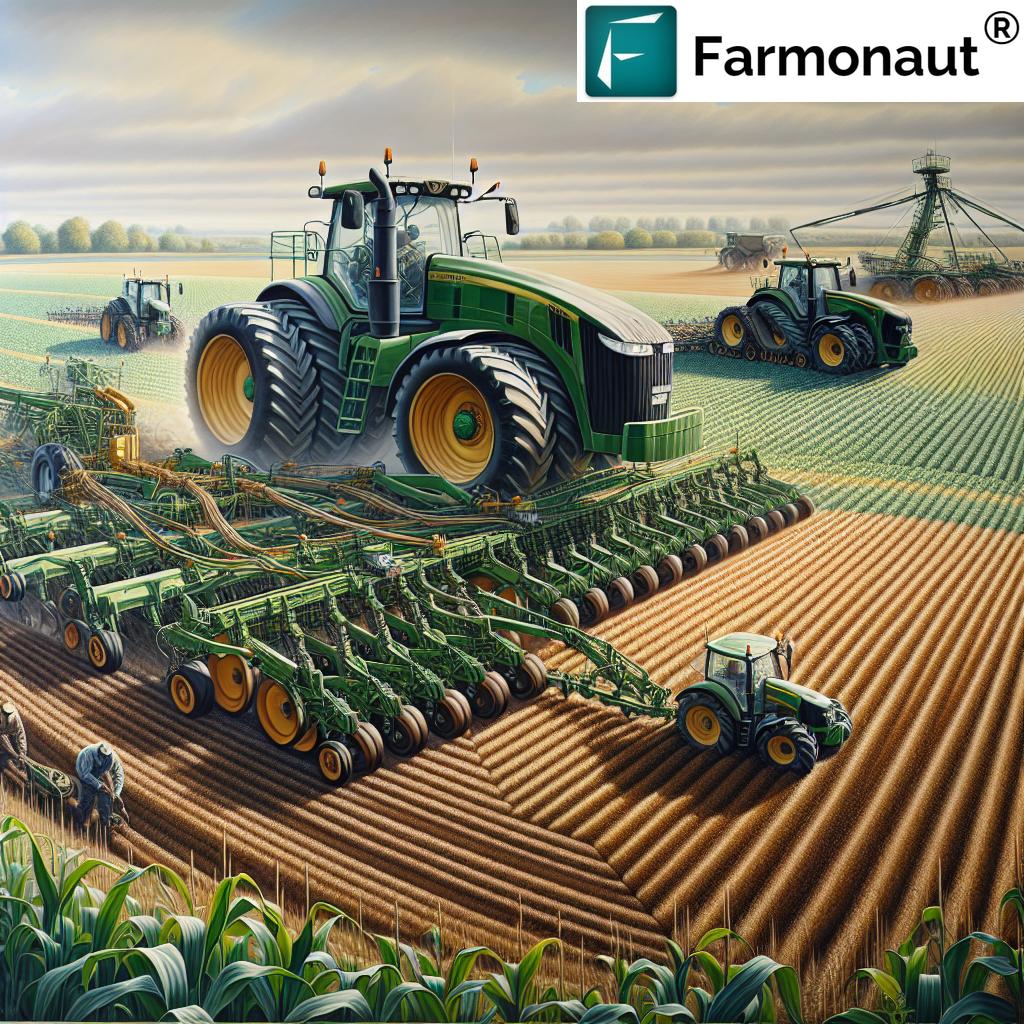
Tractors are the primary power source for the widest range of farm implements — seeders, plows, balers, sprayers, mowers, and trailers all attach to the same three-point hitch or PTO shaft. That versatility is why a single farm typically owns more tractors than any other vehicle type, sized from small compact units for orchards and specialty crops up to articulated units of 830 HP for large-scale tillage (AGDAILY).
- Versatile tasks: plowing, tilling, planting, hauling, mowing, and powering stationary equipment via PTO.
- Attachments: a single tractor can run a dozen different implements across a season, which is why implement selection matters as much as the tractor itself.
- Power and size: GPS auto-steer is now standard on mid-size and larger models, holding pass-to-pass accuracy tight enough to cut overlap and skipped strips.
2. Combine Harvesters: One Pass, Four Jobs
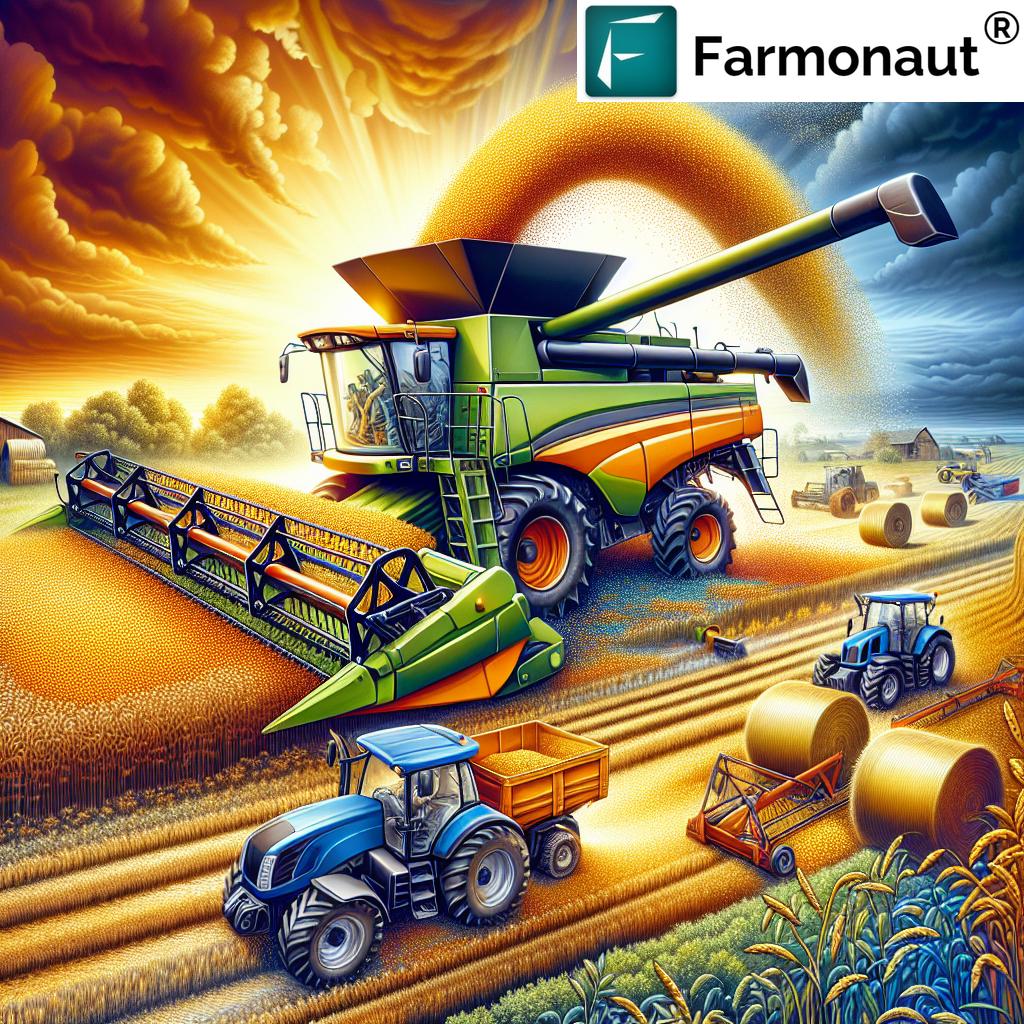
A combine’s name describes exactly what it does — it combines reaping, threshing, gathering, and winnowing into a single pass through the field, harvesting wheat, corn, barley, rice, soybeans, or canola depending on the header fitted to the front.
- Efficiency: one operator now covers ground that used to take a full harvest crew days to clear by hand.
- Technology: automatic grain-loss monitors and yield mapping feed straight into next season’s planting plan.
- Versatility: swapping headers lets the same chassis handle grain, corn, or specialty crops across a rotation.

3. Sprayers: Precision Input Application
Self-propelled sprayers are built for one job — putting exactly the right amount of pesticide, herbicide, or liquid fertilizer exactly where it’s needed, at highway speed across booms up to 120 feet wide.
- Variety: from handheld units for small plots to boom-equipped machines that treat hundreds of acres in a day.
- Precision: section control shuts off individual boom segments over already-treated ground, cutting overlap and chemical waste.
- Safety: enclosed, filtered cabs reduce operator exposure to agrochemicals during application.

4. Balers: Turning Loose Forage Into Bales
Balers compress hay, straw, or corn stover into bales that can be stored, stacked, and moved without a fork and a lot of patience. Round balers make cylindrical bales; square (or “big square”) balers make rectangular ones that stack tighter in a barn or on a truck.
- Types: round vs. square is mostly a storage and transport decision, not a quality one.
- Sensors: moisture and density sensors flag bales at risk of heating or molding in storage before they go under a roof.
- Labor: a modern baler replaces what used to be a multi-person hay crew with one operator.
5. Utility Vehicles (ATVs & UTVs): The Farm’s Daily Driver
ATVs (All-Terrain Vehicles) and UTVs (Utility Task Vehicles) are the vehicles a farm actually uses every day, for jobs too small to justify moving a tractor:
- Transporting tools, fencing supplies, and feed across large properties
- Herding and checking on livestock
- Inspecting irrigation lines and remote fields
- Spot-spraying or treating small trouble areas
With payload capacities up to roughly 1,760 lb (800 kg), four-wheel drive, and quick-attach implements, they cover terrain a full-size truck can’t reach.

6. Telehandlers: Lifting Without a Crane
Telehandlers blend a forklift’s mast with a crane’s telescopic reach. On a farm, that combination shows up in:
- Lifting and moving hay bales, feed bags, and pallets
- Stacking materials in barns using a boom that reaches up to about 59 ft (18 m)
- Unloading trailers without a fixed loading dock
- General infrastructure work — silo repairs, roof access, moving construction material
Load-sensing systems and boom-angle cutoffs stop the machine before it tips, which matters most on the uneven ground a barn yard usually is.
7. Forage Harvesters: Feeding the Herd
Forage harvesters chop grass, alfalfa, and corn into silage for livestock feed, either self-propelled or tractor-mounted, with interchangeable heads matched to the crop in the field.
- Speed and precision: chop-length sensors hold a consistent cut for reliable fermentation and nutrition in the silage pile.
- Monitoring: near-infrared (NIR) sensors estimate moisture and yield on the move, so the operator knows what’s coming off the field in real time.
- Scale: at 200 to over 1,000 HP, these are among the largest machines on a dairy or beef operation.
(Bonus) Livestock Trailers: Getting Animals There Safely
Not a “machine” in the mechanical sense, but specialized livestock trailers are an essential vehicle type for moving cattle, sheep, pigs, or horses. They’re built with ventilation to protect animal welfare in transit, lighting and watering systems for longer hauls, and secure partitions to prevent injuries between animals sharing the trailer.
Who Makes Agricultural Vehicles
Five groups build most of the large farm vehicles sold in North America and Europe. Revenue below is each company’s latest full year and includes non-farm lines such as construction equipment.
| Company | Main farm brands | Latest full-year revenue |
|---|---|---|
| Deere & Company (US) | John Deere | $45.68 billion, fiscal 2025 (Deere) |
| CNH (UK/US) | Case IH, New Holland | $18.10 billion, 2025 (CNH) |
| Kubota (Japan) | Kubota | ¥3,018.9 billion, 2025 (Kubota) |
| AGCO (US) | Fendt, Massey Ferguson, Valtra | About $10.1 billion, 2025 (AGCO) |
| CLAAS (Germany) | CLAAS (Lexion combines, Jaguar forage harvesters) | €4.9 billion, fiscal 2025 (CLAAS) |
Deere is the largest by a wide margin. Kubota is strongest in compact and utility tractors. CLAAS is best known for combines and forage harvesters. Every one of these firms reported lower or flat sales for 2025, in line with the AEM figures below.
UTVs and ATVs come mostly from powersports makers such as Polaris, Honda and Can-Am, as well as from Deere and Kubota. Telehandlers are made by JCB, Manitou and others, alongside the farm brands.
Is Now a Good Time to Buy? What the Sales Data Shows
Manufacturer Inventory and Machinery Spending Are Both Down
Farm machinery manufacturers built up inventory through the supply shortages of the early 2020s, then had to work it back down as farmer demand cooled. University of Illinois farmdocdaily reported manufacturer ag-equipment inventory peaked at $7.23 billion in October 2022 and had fallen to $5.65 billion by July 2025 — a 21.85% decline — while the Rural Mainstreet farm-equipment-sales index (where 50 marks growth-neutral) sat at 18.8 in October 2025, one of its lowest readings since 2020 (University of Illinois farmdocdaily). Farm machinery loan volume told the same story: $2.63 billion in Q2 2025, $2.61 billion in Q3 2025, both below the 2020–2023 range. The Producer Price Index for agricultural machinery, which peaked above 19% year-over-year growth in April 2022, had cooled to 1.34% by August 2025.
Farm Vehicle Cost-Per-Hour Calculator
Assumes straight-line depreciation over the useful-life hours entered and a flat annual maintenance budget. Excludes financing interest, insurance, operator labor, and resale value.
Monthly Sales Are Swinging Hard, Not Just Trending Down
AEM’s monthly U.S. Ag Tractor and Combine Report shows the decline isn’t smooth. U.S. agricultural tractor sales fell 14.8% in December 2025 versus December 2024, then 4.7% in January 2026, then 9.1% in March 2026 — all year-over-year (AEM, December 2025 report; AEM, January 2026 report; AEM, March 2026 report). Combine sales moved even more erratically over the same three months: down 4.3% in December 2025, up 68% in January 2026, then down 25.3% in March 2026. AEM’s senior vice president attributed the swings to “economic instability and pressures farmers have faced” while adding that “equipment manufacturers remain committed to supporting farmers with the equipment they need” (AEM).
- AEM’s monthly U.S. Ag Tractor and Combine Report (aem.org) — released within days of month-end, it tells you whether the segment you want is still falling or has leveled off.
- USDA NASS Quick Stats (quickstats.nass.usda.gov) — the Census of Agriculture’s machinery tables, refreshed roughly every five years, show how many tractors and combines your state actually has in service.
- BLS Occupational Employment and Wage Statistics — updated annually, it prices out what an operator costs to hire versus running the machine yourself.
Precision Technology in Modern Farm Vehicles
Today’s agricultural vehicles do more than replace muscle. They’re rolling data collectors that feed decisions back to the operator in real time.
- GPS guidance: auto-steer keeps rows straight and overlaps tight, cutting fuel use and input waste on every pass.
- Yield monitoring and mapping: onboard sensors log yield and moisture as the machine moves, building a field-by-field record for next season.
- Variable-rate application: sprayers and seeders adjust rate by field zone instead of applying one blanket rate across a whole field.
- Telematics and fleet management: connected systems track location, fuel, and service intervals across a whole fleet. Explore Farmonaut’s Fleet Management tools for monitoring farm vehicles remotely.
- Emissions control: under EPA’s Tier 4 rules for nonroad diesel engines, new tractors, combines, and sprayers carry advanced emissions-control hardware — most commonly urea-based selective catalytic reduction — that changes real-world fuel and diesel-exhaust-fluid consumption versus older machines (U.S. EPA).
If you’re managing a plantation or multi-block operation, Farmonaut Large Scale Farm Management adds automated monitoring and operator management on top of the vehicle data itself.
Farm Vehicle Safety: What the Injury Data Says
Tractor overturns are the leading cause of fatal injury on U.S. farms, and the fix for most of it is decades old and still not universal. Penn State Extension, citing NIOSH data, puts the U.S. tractor fleet at about 4.8 million units, with close to half still lacking a rollover protective structure (ROPS) (Penn State Extension).
Penn State Extension, citing NIOSH data
The same source puts the stakes in concrete terms: farmers involved in tractor overturns are permanently disabled in 1 out of 7 cases, and 7 out of 10 farms that suffer a tractor-overturn fatality go out of business within five years. NIOSH data cited in the same article puts overall farmer on-the-job deaths at about 20 per 100,000 workers per year — several times the average across all U.S. industries.
For working safety guidance you can apply this planting season, see Farmonaut’s Farm Equipment Safety Tips. If you’re buying a used, cab-less tractor, a folding ROPS retrofit kit typically exists for common models — it’s worth checking against the model year before you decide the machine is a bargain.
Driving Agricultural Vehicles on Public Roads
Most agricultural vehicles spend some time on public roads, moving between fields. In the US, the main visible rule is the slow-moving vehicle (SMV) emblem.
- What it is: a fluorescent orange triangle with a reflective red border, built to the ASABE S276 standard and referenced in OSHA rule 29 CFR 1910.145(d)(10) (OSHA text).
- When to use it: on machines that travel at 25 mph or less. It should not be shown at higher speeds or when equipment is carried on a truck or trailer (Ohio State University).
- Where to mount it: at the rear, point up, centered or near left-center, 2 to 10 feet above the ground (Ohio State University).
- Do not use it as a marker on mailboxes, gates or fences. That misuse teaches drivers to ignore it.
Lighting, width and escort rules for wide machines are set by each state, so check your state department of transportation or extension service before moving a combine or wide sprayer on a highway.
Economic and Sustainability Impact
Beyond the individual machine, fleets of farm vehicles now touch sustainability reporting and farm finance directly.
- Sustainable resource management: reduced-tillage passes, precision input dosing, and fuel-use tracking all feed into a farm’s environmental footprint. Track it with Farmonaut Carbon Footprinting.
- Supply chain transparency: vehicle and field data increasingly back up traceability claims from farm to shelf — see Farmonaut’s Product Traceability tools.
- Financing and insurance: remote-sensing verification of field activity is starting to speed up loan and claims processing. Learn more about Farmonaut Crop Loan and Insurance.
How Farmonaut Fits Into Your Vehicle Fleet
Whatever mix of tractors, sprayers, and utility vehicles you run, the value of each one depends on the data behind it. Farmonaut layers on top of your existing fleet with:
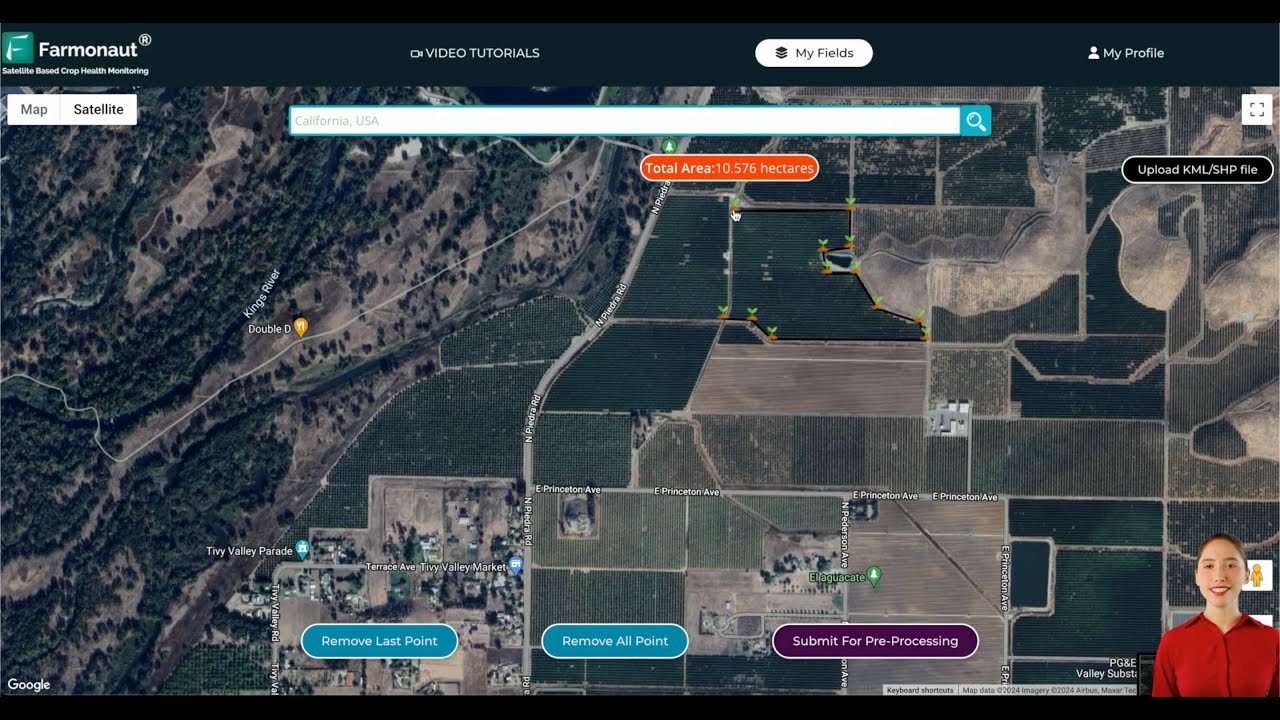
- Satellite-based monitoring: crop health and soil-moisture data that tells you where a vehicle needs to go next, before you drive out to check.
- AI-based advisory (Jeevn): planting and input-timing guidance inside the mobile or web app.
- Fleet and resource management: monitor vehicles, plan fuel and maintenance, and support the equipment-safety practices covered above, all in one platform.
Access Farmonaut via web, Android, and iOS apps, or build against the platform directly via API with support from the Developer Docs.
Subscribe To Farmonaut and Transform Your Farm Operations
FAQs on Agricultural Vehicles
-
What are the main types of agricultural vehicles?
Seven types cover almost every farm: tractors, combine harvesters, self-propelled sprayers, balers, utility vehicles (ATVs/UTVs), telehandlers, and forage harvesters. Livestock trailers are a common eighth category for operations that move animals. -
Is there a difference between a “farm vehicle” and an “agricultural vehicle”?
Not a formal one. “Agricultural vehicle” tends to be used for production machinery — tractors, combines, sprayers — while “farm vehicle” is often used more broadly to include support vehicles like UTVs and livestock trailers. In practice the two terms overlap almost completely, and this guide treats them as synonyms. -
What’s the best farm vehicle for a small operation?
On operations under about 50 acres, a compact tractor (20–50 HP) paired with a UTV for daily transport typically covers most jobs without the fuel and storage overhead of full-size equipment. Use the cost-per-hour calculator above with your own fuel and usage numbers before comparing models. -
How much horsepower do I actually need?
It depends on the implement’s draft requirement, not just acreage — heavy tillage needs more HP per acre than light mowing or hauling. Check the table and horsepower chart above for the range each vehicle type typically covers, then confirm against the specific implement’s manufacturer spec sheet. -
Why are tractor and combine sales down?
AEM’s monthly reports point to broader softness in the farm economy: U.S. tractor sales were down 14.8% in December 2025, 4.7% in January 2026, and 9.1% in March 2026, all year-over-year, while manufacturer inventory and farm machinery loan volumes have also fallen since 2022–2023. -
Do all tractors need a ROPS?
Not legally on most farms, since most farms fall outside OSHA’s jurisdiction — but functionally, yes. Penn State Extension, citing NIOSH data, reports that a ROPS with a seatbelt is 99% effective at preventing death or serious injury in a rollover, and close to half the roughly 4.8 million tractors on U.S. farms still don’t have one. -
How do I manage a mixed fleet of tractors, sprayers, and UTVs?
Telematics-based fleet management platforms track location, fuel, and service intervals across every vehicle type from one dashboard — see Farmonaut’s Fleet Management tools linked above for one option. -
Where can I get more current sales and safety figures than this article?
AEM publishes a new U.S. Ag Tractor and Combine Report every month, USDA NASS refreshes machinery counts with each Census of Agriculture, and NIOSH/Penn State Extension periodically update tractor-safety statistics. All three are linked in the sections above.
Further reading:
Conclusion: Match the Vehicle to the Job, Not the Other Way Around
Seven vehicle types cover nearly every job on a working farm, and each one has a horsepower range wide enough that “best” only means something once you attach it to your acreage, crop, and budget. The market data above says buyers currently have some leverage — inventory and loan volumes are both down from their 2022–2023 highs — but the safety numbers say the leverage runs out fast in a rollover without a ROPS. Use the comparison table, the calculator, and the three data sources listed in the market section to check both before you sign anything.
Ready to put satellite and fleet data behind your own vehicles? Try Farmonaut via our web and mobile apps or integrate our API into your agri-business for custom solutions.
Discover the power of smart agriculture and join the movement that’s shaping the farms of tomorrow.

 AgriBazaar
 Geno
Geno Hayleys Agriculture
 Linx Agritech
 Adinet
 Save Your Soils
 Grandstream Algérie
 XOS Realty
 Geospatial Lab Africa
 Agro La Gándara
 HIPSAC
 ZOL Zimbabwe
 Juligerm
 AdBio
AdBio MISE Maroc
 NWNS
NWNS Red August Group
 Farm Inc
 WeMe Global
