

Farm Utility Vehicles: Types, Specs & Buying Guide
Reviewed August 2026 against USDA’s Census of Agriculture, EPA’s nonroad diesel emission standards, and the ANSI/ROHVA safety standard for off-highway utility vehicles.
Try it: Run your own numbers →
A farm utility vehicle is a compact, off-highway machine — gasoline, diesel, or battery-electric — built to haul people, tools, and small loads across fields, pastures, and forest trails faster than a truck and more nimbly than a full-size tractor. The category covers everything from two-seat ATVs to four- and six-seat UTVs like the John Deere Gator, plus a growing lineup of electric farm vehicles such as the Alkè ATX and Westward MAX-EV built specifically for zero-tailpipe-emission work. This guide covers what each type actually costs to run, which U.S. rules govern them, and includes a calculator so you can check whether an electric model pays for itself using your own fuel and maintenance numbers.
Demand for this category is measurable. The global market for utility terrain vehicles (UTVs) was valued at $9.6 billion in 2025 and is projected to reach $10.2 billion in 2026, climbing to $16.1 billion by 2035 — a compound annual growth rate of 5.3% for 2026–2035 — according to GM Insights’ Utility Terrain Vehicle Market report. Agriculture is one of the reasons: the United States had 1,900,487 farms averaging 463 acres each in the 2022 Census of Agriculture, the most recent nationwide count, released by USDA’s National Agricultural Statistics Service on February 13, 2024 (USDA NASS, 2022 Census of Agriculture). Whether you search for small farm utility vehicles, utility farm vehicles, or agricultural utility vehicles, you’re looking at the same equipment category described from different angles — and the buying decision comes down to the same handful of variables covered below.



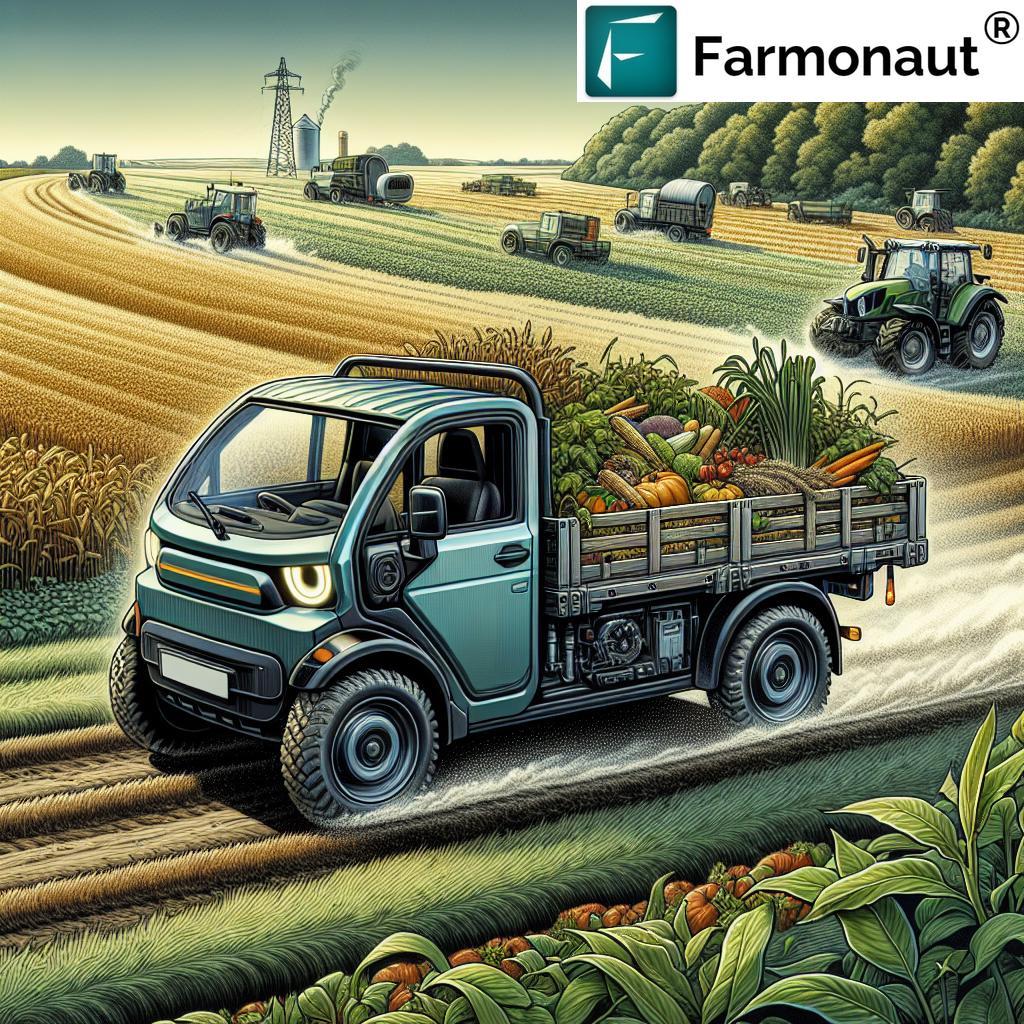
Table of Contents
- What Is a Farm Utility Vehicle?
- How Big Is the Market — and Why It Matters to Buyers
- Types of Farm Utility Vehicles
- Comparison Table: UTV, ATV, Electric, Hybrid, Forestry
- Electric Farm Vehicles vs. Diesel: Emissions, Rules, Cost
- Applications: Transport, Field Work, Livestock, Forestry
- Seven Ways These Vehicles Boost Efficiency
- Selecting a Vehicle: A Safety-Standard Checklist
- Leading Farm Utility Vehicle Manufacturers
- Calculator: Electric vs. Gas/Diesel Payback
- How Farmonaut Fits Alongside Your Fleet
- FAQ
- Conclusion
- Try it: Run your own numbers
What Is a Farm Utility Vehicle?
A farm utility vehicle — sometimes called a small utility vehicle, an agricultural utility vehicle, or simply a farm UTV — is built around three traits: a low center of gravity for uneven ground, a cargo bed or bench big enough for tools and feed sacks, and a drivetrain sized for short, frequent trips rather than highway travel. That last point is what separates it from a pickup truck: most farm utility vehicles top out well under highway speed and are not designed, insured, or licensed for public roads unless a manufacturer specifically certifies a street-legal trim.
The category includes Utility Task Vehicles (UTVs, also called side-by-sides), All-Terrain Vehicles (ATVs), battery-electric utility vehicles, hybrid units, and specialized forestry or crop platforms built around quick-attach implements. All of them fall under the same practical question at purchase time: what does it carry, what powers it, and what happens if it rolls — covered in the sections below.
How Big Is the Market — and Why It Matters to Buyers
A fast-growing market means more competition among manufacturers, more financing options, and — usually — falling real prices for a given spec tier over time, which is worth knowing before you negotiate. GM Insights tracks the UTV segment specifically (it excludes ATVs and full farm tractors) and its 2026 report put the trajectory as follows:
The United States is the largest single national market inside that global figure, generating $7.1 billion of UTV sales in 2025 — about 74% of the entire global total that same year, per the same GM Insights dataset. That concentration is one reason U.S.-based readers see more model variety and dealer coverage for farm utility vehicles than almost anywhere else, and it’s discussed further in the manufacturers section below.
Types of Farm Utility Vehicles
Every model on the market is a variation on five configurations. Here’s what separates them in practice.
1. Utility Task Vehicles (UTVs / Side-by-Sides)
UTVs seat two to six people side by side with a steering wheel and a cargo bed or flatbed behind. The John Deere Gator is the reference point for this category: it was introduced in 1992 as a replacement for Deere’s five-wheeled AMT line, and the manufacturer’s recommended maximum payload for its civilian Gator models is 600 lb (272 kg), per Wikipedia’s entry on the John Deere Gator. Deere expanded the lineup with the heavy-duty HPX series and compact golf-cart-sized models in 2004, and the extreme-use XUV series in 2007. Military variants of the same platform, evaluated in 2016, carried higher ratings — 1,100 lb (500 kg) for 4×4 units and 1,200 lb (540 kg) for six-wheeled units — which gives a useful sense of how much headroom exists above the standard civilian spec when a heavier-duty chassis is used.
2. All-Terrain Vehicles (ATVs)
ATVs are single-rider, straddle-seat, four-wheel machines. As the smallest and most agile option, they’re the vehicles most often meant by the search term “small utility vehicle” when someone wants something lighter than a UTV for scouting fence lines, checking on livestock in rough pasture, or reaching parts of a property no truck or tractor can get to. Because they’re single-occupant, they carry far less cargo than a UTV — check the specific model’s owner’s manual for its rated payload rather than assuming a UTV-sized number applies.
3. Electric Utility Vehicles
Battery-electric utility vehicles run on a motor and battery pack instead of an internal combustion engine, which means zero tailpipe emissions on the farm itself (the emissions math for the electricity that charges the battery depends on the reader’s local grid mix, discussed in the next section). Alkè’s ATX line, built for farm, estate, and municipal use, is rated for payloads up to 1,575 kg (3,472 lb) and towing up to 4,500 kg on private property, with a 35% gradeability rating, per Alkè’s farm utility vehicle 4×4 product page. Westward Industries’ MAX-EV is a narrower, purpose-built electric platform aimed at the same farm and government fleet market; battery capacity and payload on that model are configurable per order, so confirm current figures directly on Westward Industries’ MAX-EV farm vehicle page before comparing it against a fixed-spec competitor.
4. Hybrid Utility Vehicles
Hybrid models pair a combustion engine with an electric drivetrain to extend range beyond what a battery-only unit can manage between charges, aimed at operations without reliable charging infrastructure at every work site. Because hybrid ag-UTV offerings are less standardized than gas or pure-electric models, get the manufacturer’s own duty-cycle numbers for the specific trim you’re considering rather than relying on a category-wide average.
5. Specialized Forestry and Crop Vehicles
These are UTV or ATV platforms fitted with task-specific attachments — log arches, mulching heads, boom sprayers, fencing tools — rather than a distinct chassis type. Most run on diesel because of the torque log-hauling and plowing require, which puts them squarely inside the EPA nonroad diesel program covered next.

Comparison Table: UTV, ATV, Electric, Hybrid, Forestry
Because published payload and emissions numbers only exist for specific named models, not for entire vehicle classes, the table below sticks to what’s actually verifiable: power source, the concrete example figures available for that class, tailpipe emissions status, and the safety standard that governs it in the U.S.
| Vehicle Type | Power Source | Example, Verified | Tailpipe Emissions | Governing U.S. Safety Framework |
|---|---|---|---|---|
| UTV (side-by-side) | Gasoline or diesel | John Deere Gator: up to 600 lb payload (civilian, mfr. max) | Regulated under EPA nonroad exhaust standards | ANSI/ROHVA 1 for ROV-classed trims |
| ATV (single-rider) | Gasoline | Model-specific — confirm rated payload with the dealer before purchase | Regulated under EPA nonroad exhaust standards | Manufacturer certification plus applicable EPA/CARB nonroad rules |
| Electric utility vehicle | Battery-electric | Alkè ATX: up to 1,575 kg (3,472 lb) payload; 4,500 kg tow, private property | Zero tailpipe emissions (no on-board combustion) | ANSI/ROHVA 1 where classified as a recreational off-highway vehicle |
| Hybrid utility vehicle | Gasoline/diesel + electric | Model-specific — ask the manufacturer for its published duty-cycle spec | Lower than a same-class diesel unit; not zero | Same framework as UTV/ATV, by classification |
| Specialized forestry/crop UTV | Diesel (most common) | Model-specific attachments (log arch, mulcher, boom sprayer) | Covered by the EPA Tier 4 nonroad diesel program (see next section) | Same as UTV row, plus applicable state forestry-equipment rules |

Electric Farm Vehicles vs. Diesel: Emissions, Rules, and Cost
The regulatory story behind “ev farm vehicles” and “electric vehicles for farms” searches is really two separate facts: what diesel-powered utility vehicles are required to emit, and what electric models emit by design.
On the diesel side, the EPA signed its Clean Air Nonroad Diesel final rule on May 11, 2004, phasing in Tier 4 standards between 2008 and 2015 across nonroad diesel engine classes, per DieselNet’s summary of U.S. nonroad diesel engine emission standards. For the 25–75 hp engine band that covers most diesel UTVs and forestry attachments, the particulate matter (PM) limit dropped from 0.30 g/kWh in 2008 to 0.03 g/kWh in 2013 — a 90% cut — while the combined NOx+HC limit for that band held at 4.7 g/kWh across both years. The EPA’s own rule page confirms the program is in force as a national nonroad diesel standard (EPA, Final Rule for Control of Emissions From Nonroad Diesel Engines).
On the electric side, the physics is simpler than the regulation: a battery-electric utility vehicle has no exhaust and produces zero tailpipe emissions at the point of use, full stop. What it does not eliminate is the emissions associated with generating the electricity that charges it — and that number is entirely local, driven by each region’s utility grid mix, which is why this article does not attach a single national percentage to “how much cleaner” an electric farm vehicle is. To get a number that applies to a specific farm, check the local utility’s published emissions factor or the EPA’s eGRID data for the relevant grid subregion, then compare it against the Tier 4 diesel figures above for an honest side-by-side.
Cost is the more decision-relevant question for most buyers, and it’s addressed directly by the calculator further down this page, using the reader’s own fuel, electricity, and maintenance figures rather than a generic industry average.
Applications: Transport, Field Work, Livestock, Forestry
Across every power type, farm utility vehicles are used for five recurring jobs:
- Farm transport: moving seed, feed, fencing supplies, harvested crop, and personnel between the barn, field, and storage — the core use case behind most “farm transport vehicle” searches.
- Field maintenance: towing plows, spreaders, and sprayers for soil prep, planting, and pest control on ground too tight or too wet for a full-size tractor.
- Livestock management: herding, feeding, and checking on animals across pasture, where a quiet electric drivetrain draws less attention from skittish stock than a combustion engine.
- Forestry operations: hauling logs, clearing trails, and running site assessments on grades and surfaces a wheeled tractor can’t reliably manage.
- Specialized tasks: precision spraying, mulching, and rapid response to equipment breakdowns or fencing failures elsewhere on the property.


Seven Ways These Vehicles Boost Efficiency
- Faster in-field movement: UTVs and ATVs cross narrow trails, rutted, or muddy ground that slows or stops a full-size truck, cutting the time spent moving people and small loads between tasks.
- Quick-attach versatility: one chassis switches between a plow, spreader, sprayer, trailer, or log arch, turning a single purchase into a year-round tool instead of a single-season machine.
- Lower physical labor: the vehicle carries what a person would otherwise carry on foot, which matters most on repetitive daily tasks like feed runs and fence checks.
- Fewer moving parts to fail on electric models: Alkè states its electric drivetrains are engineered for a service life three times longer than a comparable combustion drivetrain, per the same product page cited above — a manufacturer claim worth verifying against your own duty cycle before buying.
- Fleet data instead of guesswork: vehicles with GPS and telematics feed real-time location and usage data into a fleet platform, which is where Farmonaut’s fleet management tool plugs in for farms running more than one vehicle.
- Better livestock response times: agility across pasture means faster intervention when an animal is sick, loose, or calving in a hard-to-reach spot.
- A documented emissions trail: electric and Tier-4-compliant diesel units both generate the kind of usage data that supports carbon footprint tracking for farms working toward buyer or certification requirements.
Selecting a Vehicle: A Safety-Standard Checklist
Price and payload get most of the attention in buying decisions, but the durable question — one that doesn’t change with model years or fuel type — is whether a given vehicle meets a recognized safety standard. In the U.S., that standard is ANSI/ROHVA 1, published and maintained by the Recreational Off-Highway Vehicle Association. It has been revised repeatedly since work began in 2008 (editions in 2010, 2011, 2016, and the current 2023 release), and it sets requirements for the accelerator, clutch, and gearshift controls; lighting; tires; service and parking brake performance; lateral and pitch stability; occupant handholds; the Roll Over Protective Structure (ROPS); the Occupant Retention System (ORS, typically seat belts); and labeling and owner’s manual content, per ROHVA’s own summary of the ANSI/ROHVA 1 standard.
Use this as a checklist at the dealership or before an online purchase, regardless of power source:
- Ask for the ANSI/ROHVA 1 compliance documentation for the specific trim, not just the model family — options packages can change what’s fitted.
- Confirm the ROPS and ORS are factory-installed, not aftermarket add-ons, since aftermarket structures are not covered by the same certification.
- Check the vehicle’s rated payload and towing figures against your actual daily loads — feed, fencing, fertilizer, or harvested crop — rather than the marketing maximum.
- For electric models, confirm the charging infrastructure your operation has (voltage, amperage, dedicated circuit) matches what the vehicle needs for a full overnight charge.
- Check which edition of ANSI/ROHVA 1 is current at rohva.org before you buy — the standard is revised periodically, so the version cited here (2023) may not be the newest by the time you’re reading this.
Leading Farm Utility Vehicle Manufacturers
Three manufacturers illustrate the range available across gas, diesel, and electric platforms.
| Manufacturer | Flagship Line | Power Source | Published Capacity |
|---|---|---|---|
| John Deere | Gator (Traditional, HPX, XUV series) | Gasoline or diesel | Up to 600 lb payload, civilian mfr. maximum; military variants rated to 1,200 lb |
| Alkè | ATX | Battery-electric | Up to 1,575 kg (3,472 lb) payload; 4,500 kg towing, private property; 35% gradeability |
| Westward Industries | MAX-EV | Battery-electric, dual-motor 4WD option | Configurable battery and payload per order — confirm current specs on the manufacturer’s page |
When comparing manufacturers, weigh payload and towing figures against your actual loads first, then check whether the trim you want carries current ANSI/ROHVA 1 certification, and only then compare price — a cheaper unit that can’t carry your typical load or lacks a certified ROPS is not actually the lower-cost option once you account for a second purchase or an injury claim.
Calculator: Electric vs. Gas/Diesel Payback
Rather than quoting a single national savings percentage, use your own numbers — purchase premium, fuel cost, electricity cost, and maintenance savings — to see how long an electric model takes to pay for itself against a comparable gas or diesel unit.
Run your own numbers
Assumes the premium is paid up front, fuel and maintenance costs stay constant over the payback period, and excludes financing costs, resale value, and any purchase incentives or tax credits, which vary by state and program.
How Farmonaut Fits Alongside Your Fleet
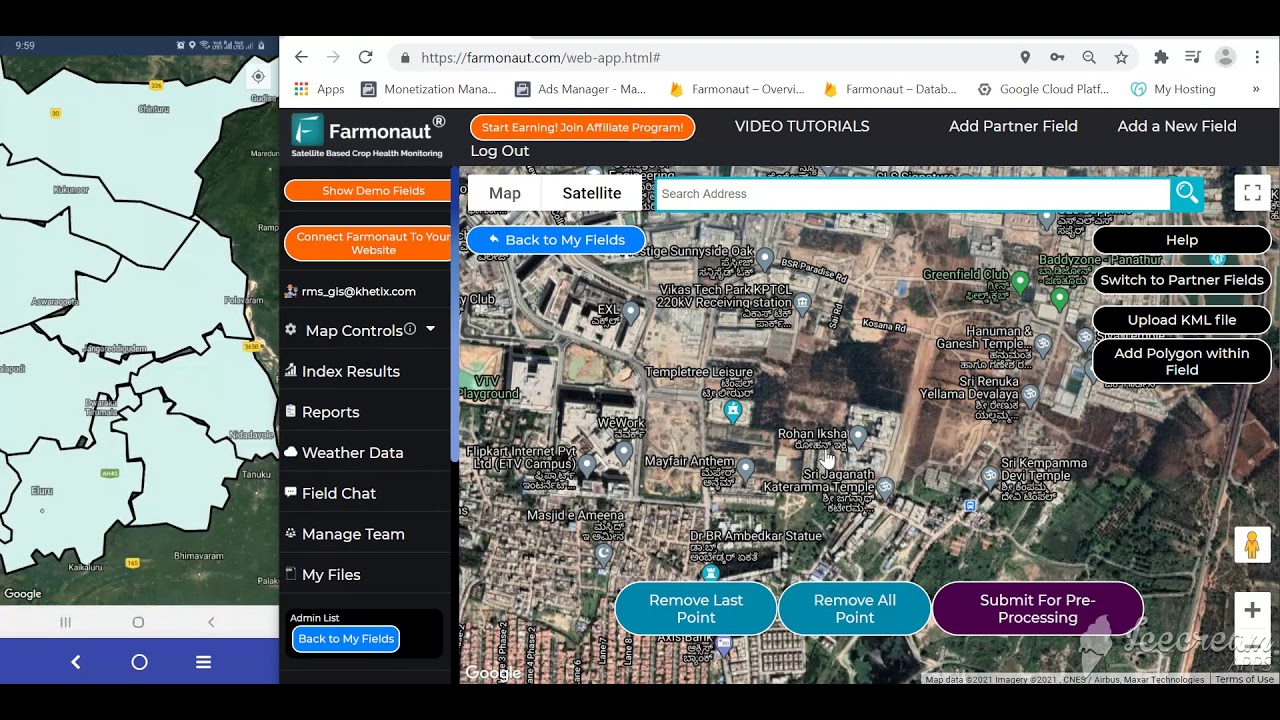
A farm utility vehicle is one piece of equipment; knowing where and how it's used across a season is a data problem, which is where Farmonaut's platform is built to help.
- Satellite-based crop health monitoring: high-resolution imagery flags soil moisture and pest risk early enough to route a utility vehicle to the right field before a problem spreads.
- Fleet and resource management: track vehicle location, schedule maintenance, and log usage with Farmonaut's Fleet Management solution, reducing downtime across ATVs, UTVs, and larger machinery alike.
- Large-scale plantation and farm oversight: the Agro Admin App gives multi-vehicle, multi-field operations a single view of equipment and crop status.
- Blockchain-based traceability: connect vehicle and field activity to the rest of the supply chain with Farmonaut's Product Traceability tools.
- Carbon footprint tracking: monitor emissions from both field practices and your vehicle fleet through Farmonaut's Carbon Footprinting platform.
Developers integrating vehicle or field data into their own systems can use Farmonaut's Satellite and Weather API and its developer documentation.
FAQ
1. What's the difference between a farm utility vehicle and a UTV?
"Farm utility vehicle" is the broader category; a UTV (Utility Task Vehicle, also called a side-by-side) is one type within it, alongside ATVs, electric utility vehicles, hybrids, and specialized forestry or crop platforms.
2. How much can a small farm utility vehicle carry?
It depends entirely on the model. The civilian John Deere Gator's manufacturer-recommended maximum is 600 lb (272 kg), while the Alkè ATX electric platform is rated up to 1,575 kg (3,472 lb). Always check the specific trim's owner's manual — payload varies more between models than between fuel types.
3. Are electric farm vehicles actually zero-emission?
At the point of use, yes — no tailpipe, no on-site combustion. The electricity used to charge the battery carries whatever emissions are associated with the local grid, which differs by utility and region; check your utility's published emissions data or the EPA's eGRID figures for your area for a specific number.
4. What safety standard should I check before buying a utility vehicle?
ANSI/ROHVA 1, maintained by the Recreational Off-Highway Vehicle Association, covers ROPS, occupant retention, stability, and brake performance for this category. Ask the dealer for the specific trim's compliance documentation and confirm which edition of the standard is current at rohva.org.
5. Which manufacturers make agricultural utility vehicles?
John Deere (Gator series, gas/diesel) is the longest-established name; Alkè and Westward Industries build electric-only platforms specifically for farm and municipal fleets. Each publishes its own payload, towing, and range specs — compare the current figures on their product pages rather than relying on category averages.
6. How do farm transport vehicles help with livestock management?
Their agility across pasture and rough terrain speeds up herding, feeding, and health checks, and electric models add quieter operation that causes less disturbance to animals during those tasks.
7. Are utility vehicles regulated for emissions like tractors are?
Diesel-powered units fall under the same EPA nonroad diesel program that covers agricultural equipment generally, including the Tier 4 particulate matter standards phased in between 2008 and 2015. Gasoline ATVs and UTVs are covered by separate EPA nonroad spark-ignition rules; electric models have no tailpipe standard to meet because they have no tailpipe.
8. Can I track utility vehicle usage digitally?
Yes. Platforms such as Farmonaut's fleet management solution combine location tracking, maintenance scheduling, and usage logs for ATVs, UTVs, and larger farm machinery in one system.
Further reading:
Conclusion
The decision between a gas UTV, a diesel forestry platform, and an electric model like the Alkè ATX or Westward MAX-EV comes down to three checkable facts, not marketing language: the payload and towing figures the manufacturer actually publishes for your target trim, whether that trim carries current ANSI/ROHVA 1 safety certification, and — for electric versus combustion — what the payback calculator above returns using your own fuel, electricity, and maintenance costs. A $9.6 billion global market in 2025, headed toward $16.1 billion by 2035 per GM Insights, means more competing models and more published specs to check against each other every year; the checklist and calculator on this page are built to stay useful regardless of which model year you're comparing.

 Exurbia Geospatial
 MWS Research Centre
 FieldZero
 Indico Company
 Kubota
 FFBS
FFBS Jontra
 Kalustyan
 Tucor
Tucor Geno
Geno Hayleys Agriculture
 Linx Agritech
 Adinet
 Save Your Soils
