

Farm machinery · Identification guide
Agriculture Machines With Name and Uses: 13 Compared
Name a farm machine by its shape, its hitch and its job. This guide covers 13 machines with uses and photo clues, plus field speeds and hire rates from the Manitoba government’s 2026/27 guide and Texas A&M’s 2026 survey.
Key takeaways
- A cab and engine mean a self-propelled machine; anything hitched behind a tractor is an implement.
- A planter has separate row units and suits wide rows; a seed drill has many closely spaced openers.
- Manitoba’s 2026/27 guide lists custom combining at C$31 to C$40 per acre and a harrow at C$7.50 to C$9.
- The same guide assumes field efficiency of 80% for most jobs, 70% for seeding and 64% for spraying.
- US spending on tractors and self-propelled machinery was US$18.7 billion in 2025, down from US$21.0 billion in 2024 (USDA NASS).
In this article
- 13 agriculture machines with name and uses
- How to name a farm machine from a picture
- Soil and seeding machines
- Crop care machines
- Harvest and forage machines
- Handling and residue machines
- What these machines cost to hire
- Owning or hiring: which costs less on your acres?
- What farms spend on machinery
- How to build your own machine picture list
- Common hand tools that work alongside machines
- Machines and field data
- How we checked the numbers
- FAQ
A farm machine is easiest to name from three things: its shape, where it hitches and the job it does. If you searched for agriculture machines images with name, this guide lists 13 common machines with the name, the use and what to look for in a photo, so any picture can be matched to the right label.
It also adds field speeds and hire rates from the Manitoba government’s 2026/27 machinery guide, Texas A&M survey rates, and a calculator that tests whether owning or hiring costs less on your acres.
13 agriculture machines with name and uses
The table runs in the order of the season. Speeds are the averages assumed in the Manitoba Cost of Production Farm Machinery guide, 2026/27. A dash means the guide gives no speed for that machine, or it does not move through the field at all.
| Machine | Main use | How to spot it in a photo | Field speed |
|---|---|---|---|
| Tractor | Pulls and powers other machines | Cab or roll bar, large rear tyres, hitch and PTO shaft at the back | – |
| Plough | Turns soil over, buries weeds and residue | Row of curved steel boards or angled discs behind the tractor | – |
| Harrow | Breaks clods, levels the seedbed | Wide frame with rows of discs, tines or chain | 7.5 mph |
| Seed drill | Sows seed in narrow rows at a set depth | Seed box or air cart, many closely spaced openers | 4.75-5.5 mph |
| Planter | Places single seeds in wide rows | Separate row units, each with its own small hopper or seed meter | 5-7.5 mph |
| Sprayer | Applies crop protection products and liquid fertilizer | Large tank, long folding boom with nozzles, tall thin wheels | 10 mph |
| Drip system | Delivers water to the root zone | Thin lines along the crop rows, filter station and valves | – |
| Combine harvester | Cuts, threshes and cleans grain | Large self-propelled body, wide header in front, unloading auger on the side | – |
| Forage harvester | Chops whole crops for silage | Tall curved spout that blows chopped crop into a moving truck or cart | 6.5 mph |
| Mower conditioner | Cuts grass or hay and crimps stems for faster drying | Low wide cutting head beside or ahead of the tractor, leaves a neat swath | 5-8 mph |
| Baler | Packs hay or straw into bales | Boxy body with a pickup at the front, round or square bale at the back | – |
| Loader | Lifts and moves bales, feed and soil | Two lift arms with a bucket or forks at the front | – |
| Mulcher or shredder | Cuts crop residue and brush into small pieces | Heavy closed hood close to the ground, spinning blades underneath | – |
A planter and a seed drill can look alike in photos, so they have separate lines here.
How to name a farm machine from a picture
Work through four questions. They narrow down the label quickly in a clear photo.
- Does it have its own engine? A cab and engine mean it is self-propelled, such as a combine or a high-clearance sprayer. Anything hitched behind a tractor is an implement.
- Where does it touch the crop or soil? Steel in the ground means tillage or seeding. A wide head at crop height means harvest or mowing.
- What comes out? Grain into a cart points to a combine. Chopped crop from a spout points to a forage harvester. A bale points to a baler.
- What does the field look like? Bare soil suggests a plough or harrow. Fresh rows suggest a drill or planter. Standing green crop suggests a sprayer. Mown lines suggest a mower conditioner.
Names change by country. “Plough” is the usual spelling in the UK, Australia and New Zealand, while “plow” is the US spelling. A “swather” in Canada is a machine that cuts a crop and lays it in rows. “Header” and “head” mean the same front attachment on a combine.
Soil and seeding machines
These machines do the early-season work, and the tractor runs all year.
Tractor
Best for: pulling and powering nearly everything else. Two-wheel drive, front wheel assist, four-wheel drive and tracked models are the four classes in the Manitoba guide. Its example prices start at C$160,000 for a 100-119 hp two-wheel drive tractor, and its smallest four-wheel drive class, 350-449 hp, is C$600,000. Larger tractors cost more.
Safety comes first with this machine. Penn State Extension estimates that a rollover protective structure used with a seat belt is 99% effective in preventing death or serious injury in a rollover. It also notes the US OSHA rule: tractors over 20 hp built after 25 October 1976 and operated by a hired employee need an approved structure. Ohio State University Extension says rollovers account for half of tractor-related deaths in the United States.
Plough
Best for: primary tillage where you need to bury residue or weeds. Mouldboard ploughs have curved boards that flip the soil, and disc ploughs use large angled discs. Reduced tillage is an alternative, so check what your rotation needs before you buy one. In the Texas AgriLife custom rates survey (February 2026), shallow moldboard work averaged US$27.53 per acre across the state, including operator, machine and fuel.
Harrow
Best for: finishing the seedbed after primary tillage. It breaks clods and levels the surface. The Manitoba guide assumes 7.5 mph and lists custom work on mid to heavy harrows at C$7.50 to C$9 per acre.
Seed drill and planter
Best for: a drill suits narrow-row crops such as wheat and canola. A planter suits wide-row crops such as corn, where the gap between single seeds matters. In a photo, a planter shows separate row units, while a drill has many closely spaced openers. Respondents to the Texas survey reported row-crop planting at an average of US$20.99 per acre, excluding seed.
Crop care machines
Once the crop is up, the work moves to protecting it and watering it.
Sprayer
Best for: applying crop protection products and liquid fertilizer across wide areas. Self-propelled high-clearance sprayers ride above the crop, and smaller ones hitch to a tractor. Calibration matters as much as machine size. Ohio State University’s sprayer calibration guide says to adjust the sprayer if the actual rate is more than 5% away from the expected rate. Always follow the product label and local rules, and get advice from a licensed adviser when unsure.
Drip irrigation system
Best for: getting water to the root zone with little surface wetting. It is a system rather than a moving machine, which is why it looks so different from the rest of this list. Cotton Incorporated’s irrigation guide names emitter clogging as the primary concern with subsurface drip, so the filter station matters. In a Kansas State University paper on corn at Colby, Kansas, about 80% of full irrigation gave efficient production across a wide range of weather on those soils. That result applies to that site and may not transfer to yours.
Harvest and forage machines
The combine and forage harvester are among the largest and costliest machines on this list.
Chart
Example machine prices in the Manitoba guide
C$ purchase price assumed by the guide, smallest listed size in each class shown, 2026/27
Combine harvester
Best for: grain, oilseed and pulse crops. It cuts the crop, threshes it, cleans the grain and stores it in a tank. The Manitoba guide uses C$600,000 as the price of a Class 6 rotary combine, without a header. Custom rates there run from C$31 to C$40 per acre. Where Texas respondents charged corn by a mix of acre and bushel rates in the 2026 survey, the acre part averaged US$34.73, with hauling on top at an average of US$0.38 per bushel.
Forage harvester
Best for: chopping whole-plant corn, grass or sorghum for silage. It is also called a silage harvester or chopper. The curved spout is the clearest visual sign. The Manitoba guide’s custom rate has the widest range in the chart below, at C$29 to C$79 per acre.
Mower conditioner
Best for: cutting hay and crimping the stems so they dry faster. Disc models run faster than sickle models: the guide assumes 8 mph for pull-type disc and 5 mph for pull-type sickle mowers.
Baler
Best for: packing hay and straw for storage and transport. The bale in the photo tells you the type. Manitoba custom rates are per bale: about C$13 to C$18 for round and C$6.75 to C$9.25 for large square.
Handling and residue machines
Loader
Best for: lifting bales, feed, manure and soil. It may be a front-end attachment on a tractor or a separate machine such as a skid-steer. OSHA’s agricultural hazards page lists skid-steer loaders and tractors among typical sources of noise on farms and says sound-reducing cabs can help.
Mulcher or shredder
Best for: cutting stalks, prunings or brush into small pieces that stay on the soil or break down faster. Look for a closed hood close to the ground. Keep guards in place and check for stones and wire first, since blades can throw debris.

▶ Smart farming and AI telematics for equipment, from the Farmonaut channel. · 2:17
What these machines cost to hire
Hire rates are a useful reference even if you own your equipment. A University of Illinois farmdoc daily article says it is prudent to compare your own machinery costs with published custom rates. The Manitoba figures below are guideline rates in Canadian dollars for farmer-to-farmer work. The guide says they are not valid for commercial custom operators, whose costs are higher, and that users should adjust them for their situation. Its diesel assumption is C$1.20 per litre.
Chart
Custom rates by machine in Manitoba
C$ per acre, guideline low and high, selected machines, 2026/27
Manitoba also lists rates per hour, which suit jobs where acres are hard to count. Texas figures are survey averages of what respondents reported, so they reflect reported prices rather than a cost model. Do not compare the two sources directly: they differ in country, currency and method.
Owning or hiring: which costs less on your acres?
Field speed alone overstates what a machine gets done. Turning, filling and cleaning all take time. The Manitoba guide calls this field efficiency and works out the rate like this: width in feet x speed in mph x field efficiency x 5,280 / 43,560. It assumes 80% for most jobs, 70% for seeding and 64% for spraying.
Chart
Field efficiency assumed by job
Percent of the instant work rate achieved over several hours
A 30 ft drill at 5 mph and 70% efficiency covers about 12.7 acres per hour. Enter your own numbers below to test a machine against a hire rate.
Try the numbers for your own farm below.
Calculator
Will owning or hiring cost less on your acres?
Enter your own machine, acres and hire quote.
- Work rate: 12.7 acres/hr
- Yearly cost to own and run (US$): $11,357
- Yearly cost to hire (US$): $11,000
- Owning minus hiring (US$): $357
Example values only, set near break-even; not a benchmark or forecast. Price inputs are examples, use today’s price. The work-rate formula is from the Manitoba Cost of Production Farm Machinery guide, 2026/27. Timing, tax and loan terms are not included, so get professional advice before you buy.
What farms spend on machinery
The USDA NASS Farm Production Expenditures 2025 Summary (July 2026) puts US spending on tractors and self-propelled machinery at US$18.7 billion in 2025, down from US$21.0 billion in 2024. Other farm machinery came to US$7.5 billion, down from US$8.3 billion. Farm supplies and repairs rose to US$24.8 billion.
Chart
US farm spending on machinery
US$ million per year, United States
The machines themselves are also changing. USDA’s Economic Research Service reports that auto-steer guidance was used on 5.3% of planted US corn acres in 2001 and 58% in 2016. So a modern photo may show a GPS receiver on the cab roof, which is a useful recognition clue for a newer tractor, sprayer or combine. Ohio State University also shows how the angle of guidance lines changes field efficiency in irregular fields.

▶ Six plain steps to start precision farming without buying a robot. · 4:18
How to build your own machine picture list
Training a new worker or a class? A labelled set of your own photos beats any general list, because it shows your actual machines.
- Take one side view and one rear view of each machine, in daylight, with a person or a gate nearby for scale.
- Label each photo with the common name, the make and model, and one line on its use.
- Group photos by task: soil, seeding, crop care, harvest, handling.
- Mark hazards in the label, such as the PTO shaft, pinch points and unguarded blades.
- Add the maintenance interval from the operator’s manual, and update the set when a machine changes.
If you reuse pictures from the web, check the licence and credit them as asked. Stock photos are often mislabelled, so have someone who runs the machine check each name.
Common hand tools that work alongside machines
Smaller tasks still need simple tools: a spade for digging, a rake for levelling, a hoe for weeding, pruning shears and loppers for trees and vines, a trowel for transplants, a wheelbarrow for moving material, a watering can or hose for delicate plants, a grafting knife for propagation, and micro-sprinklers for small plots. For pictures and more detail on each one, see our guide to farm tools and their uses. OSHA says all tools should be kept in good condition and used according to the maker’s instructions.
Machines and field data
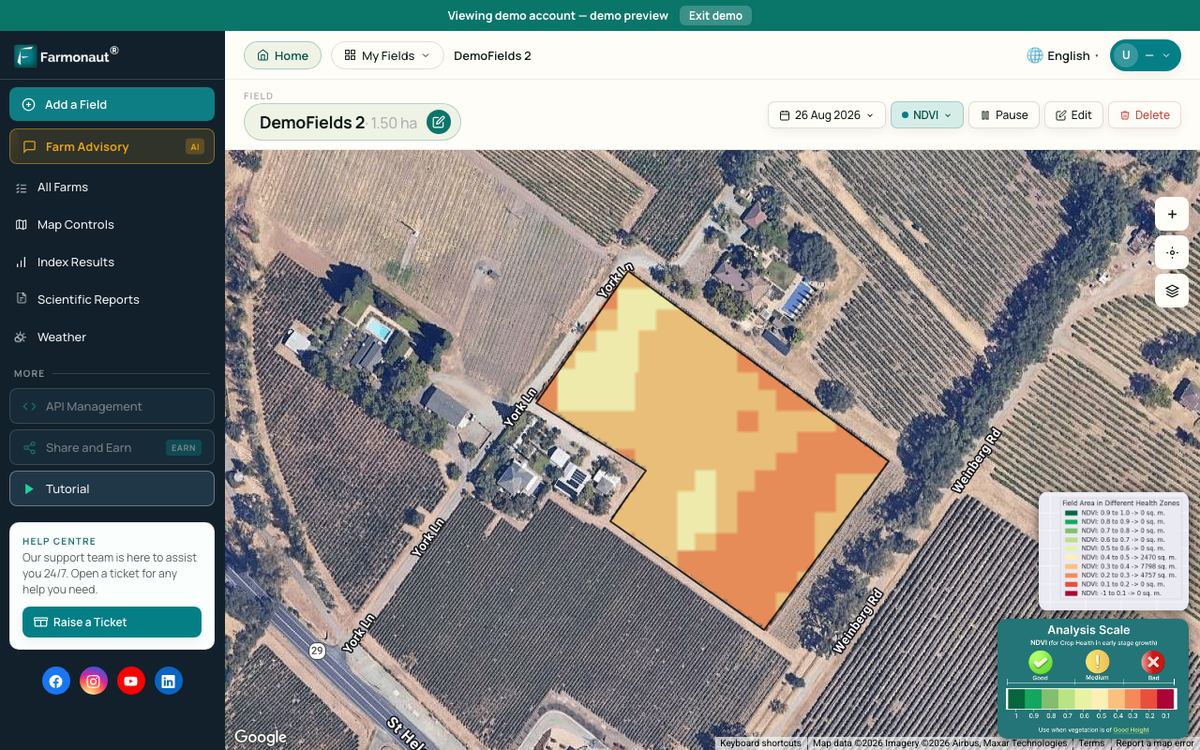
Machines do the work; field maps help decide where and when to send them. The Farmonaut Satellite + AI Farm Monitoring System shows satellite vegetation maps for fields you draw, which can help you decide which field to walk first. Satellites show change in plant cover, not its cause, so check the field before you act.
Related pages on our site: farm tool maintenance, fleet management, large farm management, carbon footprinting, product traceability, crop loan and insurance checks, satellite data API, developer documentation, web app.

▶ The Farmonaut Agro Admin app for large-scale farm management and task tracking. · 7:27
How we checked the numbers
This list is not a ranking; it follows the order of the season. Speeds, efficiencies, prices and Canadian rates come from the Manitoba guide for 2026/27. They are planning assumptions, not quotes from dealers. Texas rates are averages from the Texas A&M survey of February 2026. Spending is from USDA NASS. Check local prices before you decide.
FAQ
What are the main agriculture machines and their names?
Common machines include the tractor, plough, harrow, seed drill, planter, sprayer, combine harvester, forage harvester, mower conditioner, baler, loader and mulcher. A drip system is often listed with them, though it does not move through the field.
What is the difference between a seed drill and a planter?
A drill sows seed in narrow, closely spaced rows and suits crops such as wheat. A planter places single seeds in wider rows and suits crops such as corn. In a picture, look for separate row units on a planter.
What is the difference between a combine and a forage harvester?
A combine separates grain from the plant and keeps the grain. A forage harvester chops the whole plant for silage and blows it through a spout into a truck or cart.
How many acres can a machine cover per hour?
Multiply width in feet by speed in mph and field efficiency, then by 5,280 and divide by 43,560. The Manitoba guide uses 80% efficiency for most jobs, 70% for seeding and 64% for spraying. Soil, field shape and support equipment change the result.
Should a small farm own or hire machinery?
Compare the yearly cost of owning with the hire rate on your acres, as in the calculator above. Also weigh timing, because a contractor may not arrive when you need the work done. For tax or loan questions, get professional advice.
Farmonaut crop monitoring
See your own fields from space
Draw your fields once and Farmonaut shows satellite vegetation maps for them through the season, on web, Android or iOS.



Keep reading
Sources
- Manitoba government, Cost of Production Farm Machinery guide (2026/27): manitoba.ca
- USDA NASS, Farm Production Expenditures 2025 Summary (July 2026): esmis.nal.usda.gov
- Texas A&M AgriLife Extension, 2026 Texas Agricultural Custom Rates (February 2026): agecoext.tamu.edu
- USDA ERS, EIB-248 on digital agriculture adoption: ers.usda.gov
- Penn State Extension, Rollover Protection for Farm Tractor Operators: extension.psu.edu
- Ohio State University Extension, Rollovers and Rollover Protective Structures (ROPS) for Trainers and Supervisors: ohioline.osu.edu
- Ohio State University Extension, FABE-537 on sprayer calibration: ohioline.osu.edu
- Ohio State University Extension, Optimizing Field Traffic Patterns (FABE-5531): ohioline.osu.edu
- OSHA, Agricultural Operations: Hazards: osha.gov
- Cotton Incorporated, Cotton Irrigation Management for Humid Regions: cottoncultivated.cottoninc.com
- Kansas State University, ASABE Paper 095923 on subsurface drip irrigation: milab.ksu.edu
- University of Illinois farmdoc daily, Farm Machinery Costs and Custom Rates (2017): farmdocdaily.illinois.edu
Discussion
Questions, corrections or field experience? Share them below. First-time comments are reviewed before they appear, and your email is never published.
No comments yet. Be the first to add a question or your experience.

 Vizexec Transformation
 GalaxEye Space
 Sun Palm Australia
 Grandstream Algérie
 XOS Realty
 Geospatial Lab Africa
 Agro La Gándara
 HIPSAC
 ZOL Zimbabwe
 Juligerm
 AdBio
 MISE Maroc
 NWNS
 Red August Group
 Farm Inc
 WeMe Global
 Agrotoken
 Blue BearX
 Insignito
 DnCubed

 Licence holder · Niger · Gold
 Licence holder · Nigeria · Gold + lithium
 Client · Somalia · Gold
 Client & affiliate partner · Ghana · Gold










