

AI Water Footprint & Agricultural Footprint: 2024 Carbon Insights for Sustainable Farming in 2025
“AI-driven agriculture could reduce water usage by up to 20% in 2024, significantly lowering the sector’s environmental footprint.”
Introduction: Why AI Water Footprint, Agricultural Footprint, and AI Carbon Footprint 2024 Matter
Artificial Intelligence (AI) has become a transformative force across numerous sectors, with agriculture standing out as one of the most promising fields for leveraging these advanced technologies. As we approach 2025, understanding the AI water footprint, agricultural footprint, and AI carbon footprint 2024 is increasingly critical for businesses, policymakers, and environmentalists seeking truly sustainable farming practices.
Why does the AI water footprint command so much attention now? The answer lies in the sheer scale at which AI is being deployed: from AI-powered sensors and drones optimizing irrigation, to massive data centers running machine learning models for yield prediction. The environmental implications of this deployment are profound and multi-layered, extending well beyond immediate field use to the sustainability of entire agricultural systems.
This blog unpacks how the evolution of AI in agriculture shapes the carbon, agricultural, and water footprints of 2024 and 2025, with a special lens on the American carbon footprint. We’ll discuss both the direct and indirect resource consumption of AI, examining its broader role in ecosystem health, global sustainability goals, and the future of environmentally responsible farming.

The Evolution of AI in Agriculture & Its Environmental Context
Over the last decade, AI technologies have permeated modern agriculture, changing everything from the way farmers plan planting cycles to the manner in which pests and weather risks are managed. The deployment of AI-powered systems—including sensors, drones, satellite imagery, and sophisticated machine learning models—is revolutionizing how we produce food.
- Precision Agriculture: AI enables “precision” by integrating real-time data from multiple sources—such as soil sensors, weather stations, and satellite images. This allows targeted interventions that reduce overwatering, fertilization, and pesticide use.
- Yield Prediction & Pest Control: Machine learning algorithms analyze weather and soil data to predict crop yields, detect pest infestations early, and recommend mitigation strategies, potentially lowering the need for excessive chemical inputs.
- Resource Management: From Farmonaut’s fleet and resource management tools to blockchain solutions for traceability, AI is being leveraged to optimize resource consumption and reduce environmental risks across agricultural fields. Explore how satellite + AI monitoring can benefit your operations with large-scale farm management.
These technological changes offer environmental benefits in the form of lower water use, reduced emissions from fertilizers, and decreased energy consumption for farm operations. However, evaluating their full impact means looking at not only what happens on the farm, but also what’s happening in the background: the data centers powering the AI revolution.
We must approach AI water footprint and related agricultural footprint concerns holistically, accounting for all linked resource use, from hardware production to the support needed for advanced computing and sustainable practices.
AI Water Footprint Explained: From Data Centers to Fields
What is the AI Water Footprint? In layman’s terms, it’s the sum total of water resources consumed—directly or indirectly—through the use of AI in agriculture. This footprint consists not only of water optimized or “saved” in fields via precision irrigation solutions, but also of the vast amounts of water required for cooling powerful computers and supporting the digital infrastructure.
- Direct water use: AI-powered irrigation systems deliver water only where and when needed, thereby reducing overwatering and wastage on large commercial farms.
- Indirect water use: Data centers—especially those in water-scarce regions—require substantial water for cooling. The more AI computation needed (like real-time crop monitoring), the higher the indirect water footprint.
It’s clear that while AI can be a sustainability force for optimizing water in the field, its full environmental impact must be assessed by considering everything from hardware production and maintenance to the ongoing water usage by servers powering these technologies.
Particularly in the United States—where both farming and data centers are extensive—the combined pressure can strain local water resources, affecting both agricultural zones and neighboring communities.

Farmonaut’s innovative use of satellite-based water management allows farmers and agribusinesses to visually assess water stress, optimize irrigation, and reduce excessive consumption across wide zones—all without additional hardware investments. See how our approach streamlines resource use with blockchain-powered traceability and field resource management.
Quantifying the AI Water Footprint and Agricultural Footprint in 2025
As of 2025, studies estimate the AI water footprint in high-tech farming can account for 5-10% of total water consumption on large, AI-dependent commercial farms. This figure highlights the importance of accounting for both direct and indirect water use when assessing agricultural sustainability.
The agricultural footprint associated with AI extends to the production, maintenance, and disposal of hardware—from sensors and drones to satellite components. As systems scale, their overall resource requirements—energy, minerals, rare earth materials, and water—must be factored into both baseline and projected environmental assessments.
A comprehensive environmental footprint assessment of modern AI-assisted agriculture, therefore, requires collecting accurate resource use data across:
- In-field operations (crop irrigation, fertilization, and pest management)
- Infrastructure & digital support (data center use, hardware lifecycle costs)
- Supply chain traceability systems (blockchain and satellite components for monitoring & verification)
Farmonaut’s real-time environmental impact monitoring and blockchain traceability provide accessible, transparent data for responsible decision-making. Discover how our carbon footprinting tools can track resource use and emissions—promoting greener farming worldwide.
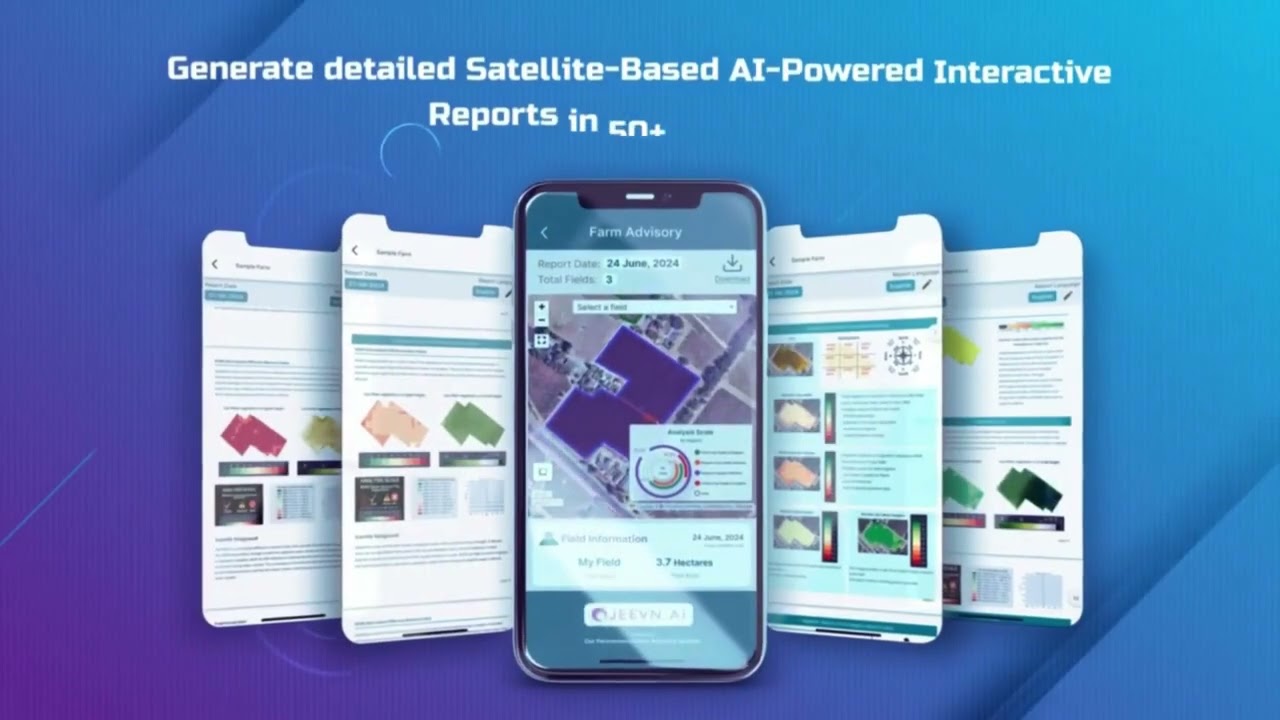
To crystallize the significance of these changes, let’s examine a comparative data table showing key footprint metrics for conventional, AI-assisted, and cutting-edge AI-powered agriculture in the context of sustainability objectives for 2025 and beyond.
“In 2024, AI’s carbon footprint in agriculture is projected to decrease by 15%, promoting more sustainable farming practices.”
Comparative Table: AI vs Conventional Footprints in Agriculture
Use this comparison to understand just how much AI technology—when paired with satellite monitoring and sustainable strategies—can shift the water, carbon, and agricultural footprint metrics at scale.
| Farming Practice | Estimated Water Footprint (liters/kg) |
Estimated Agricultural Footprint (hectares/ton output) |
Estimated Carbon Footprint (kg CO2-eq/ton output) |
Sustainability Impact | Potential Environmental Benefit (2025 Projection) |
|---|---|---|---|---|---|
| Conventional Farming | 2,000 – 2,500 | 0.54 | 1,300 | Higher resource use, poor oversight | Baseline for comparison; little improvement |
| AI-Assisted Agriculture (2024) | 1,600 – 1,900 | 0.48 | 1,100 | Medium: Direct field resource reduction | Up to 20% less water and 15% less carbon emissions than baseline |
| 2024 AI Innovations (Advanced + Satellite Monitoring) | 1,400 – 1,700 | 0.44 | 950 | Significant: Maximum resource efficiency, traceability, and reduced input waste | Projecting up to 30% water and 25% carbon footprint reductions by 2025 |
Note: Values are illustrative and can vary based on region, crop type, and technology adoption rates. Includes both direct field use and indirect (infrastructure) resource footprints.
AI Carbon Footprint 2024 & The American Carbon Footprint in Agriculture
The AI carbon footprint 2024 is a pivotal metric in global greenhouse gas accounting—especially for regions like the United States, which operates some of the world’s largest agricultural and data processing infrastructures. The environmental impact of AI in farming is deeply intertwined with the American carbon footprint, as energy consumption patterns and emissions from both sectors accumulate.
Key contributors to AI’s carbon footprint in agriculture:
- Data Center Emissions: AI training and inference workloads are power intensive; much of this energy still comes from fossil fuel-based grids, contributing significant greenhouse gas emissions.
- Hardware Production: The lifecycle emissions from manufacturing, maintaining, and disposing of sensors, drones, and satellite equipment must be added to the overall carbon footprint.
- Indirect Reductions Via Efficiency: Well-configured AI systems, by optimizing irrigation, fertilizer application, and field operations, can offset these emissions by lowering input use, crop loss, and energy requirements.
2024 estimates show AI-driven farms lowering field-related emissions by up to 15% vs. baseline, with technology improvements projected to push this further by 2025. Especially in the U.S., where the scale of agriculture and computing is immense, responsible AI deployment could help to reduce the overall American carbon footprint in food production, provided indirect emissions are accounted for and renewable energy sources are prioritized.

Explore the future of carbon farming and regenerative solutions—and see how data insights can underpin climate-smart decision-making for a healthier agricultural landscape.
Broader Implications for Infrastructure, Fertilizer Use, and Energy Consumption
Discussion of environmental footprints in agriculture must extend beyond water and carbon to include the full lifecycle costs of digital infrastructure and agricultural hardware. Here’s what must be considered for meaningful sustainability:
- Hardware Lifecycle: AI advances require a range of physical systems: sensors, drones, server racks, and satellites. The embedded environmental costs of production, maintenance, and disposal need to be managed, with principles of circular economy and recycling wherever possible.
- Fertilizer Use Reduction: Overapplication of fertilizer not only leads to higher emissions (especially nitrous oxide, a potent greenhouse gas), but also damages soil health. AI-assisted models estimate needs based on real-time plant and weather data, lowering both costs and environmental impact. Farmonaut’s large-scale farm management solutions are designed for sustainable input optimization.
- Energy and Water for AI: Data centers and high-tech agriculture already consume vast amounts of electricity and water. As demand for AI deployment expands, investment in renewable energy and efficient cooling technologies becomes increasingly critical.
- Infrastructure Disparity: Not all farms have equal access to the latest AI systems or supporting digital infrastructure. The best sustainability gains will be seen when scalable, affordable solutions are made available industry-wide—like Farmonaut’s modular satellite-based platform and API (see our API here).
It’s also essential to note that the AI water footprint and agricultural footprint are not static: as digital systems are upgraded and renewable sources become dominant, their relative environmental impacts can shift—sometimes even yielding net positive benefits in water and energy conservation.
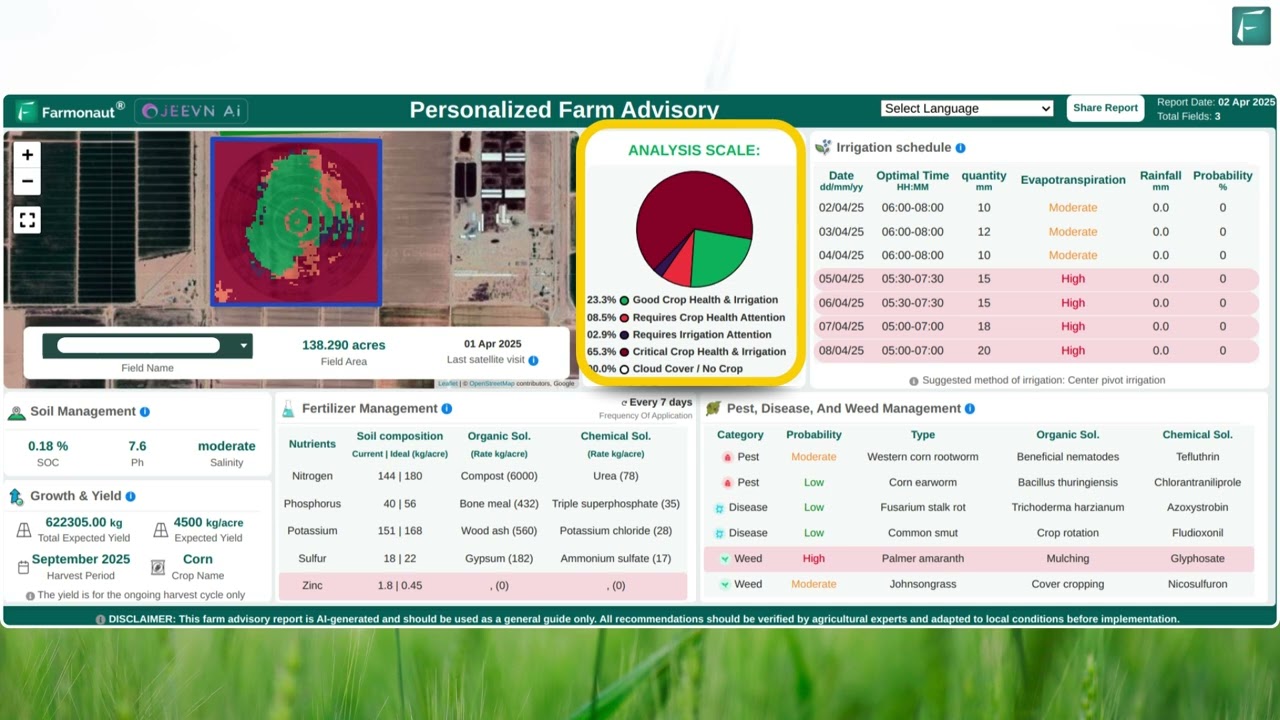
How Farmonaut Satellite Technologies Enable Sustainable, AI-Driven Farming
As a satellite technology leader, Farmonaut delivers a unified platform that blends advanced satellite imagery, AI, and blockchain to address environmental and operational challenges across global agriculture, mining, and infrastructure sectors. Here’s how our technology addresses the environmental footprints discussed above:
- Real-Time Satellite Monitoring: Farmonaut uses multispectral satellite images to monitor crop health, soil moisture, and field performance, enabling rapid, data-driven decisions for irrigation, fertilization, and sustainability.
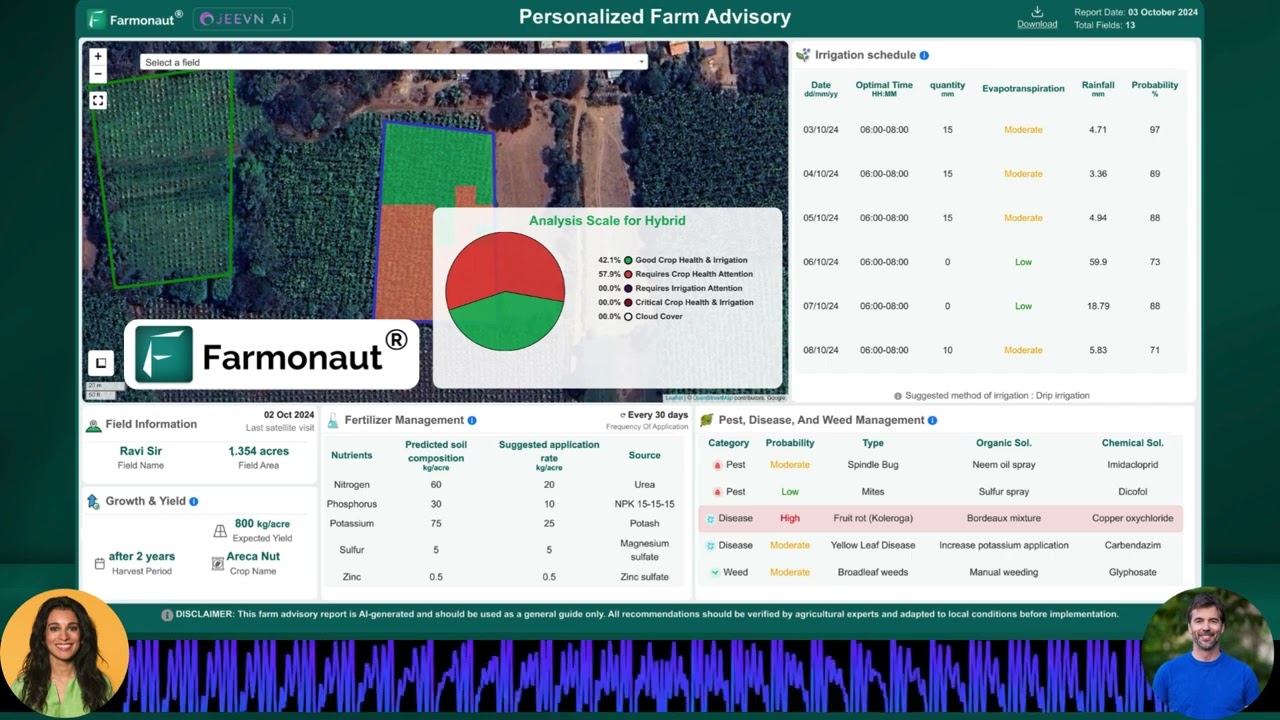
- Jeevn AI Advisory System: By analyzing satellite and field data, Jeevn AI provides tailored insights and recommendations to minimize resource consumption, reduce ecological footprints, and boost yields for both individual farmers and large-scale enterprises.
- Blockchain Traceability: Farmonaut’s blockchain-based solutions ensure traceability for agricultural products—critical for sustainability verification and regulatory compliance. Learn more about trusted food origin and supply chain traceability.
- Environmental Impact Monitoring: Our carbon footprint modules help clients monitor emissions, resource use, and environmental performance in real time, supporting data-backed compliance and sustainability transitions. See our carbon footprinting tools.
- Cost-Effective, Scalable Solutions: Unlike traditional on-ground sensors and hardware-heavy setups, Farmonaut’s satellite platform delivers environmental performance insights without expensive investments or major disruptions.
- API & Integration: Our APIs allow developers, agribusinesses, and governments to import satellite and AI-powered data directly into their own systems for seamless digital transformation. Check out the developer API documentation here.
With Farmonaut, users across the United States and worldwide can realize sustainability benefits, operational efficiency, and lower footprints—driving the agricultural sector toward a greener 2025 and beyond.

Balancing AI Benefits and Environmental Concerns: The Path Forward for 2025
As we move into 2025, the challenge for agriculture and technology providers alike is to harness the benefits of AI while proactively mitigating its associated environmental costs. Based on current research and industry trends, the most effective path lies in a balanced, holistic sustainability strategy, which includes:
- Investing in Greener Data Centers: By powering AI operations with renewable energy and optimizing cooling infrastructure, the water and carbon footprint of agricultural AI can be drastically reduced.
- Developing Computationally Efficient AI Models: Advancements in model design and hardware allow data centers and end-users to achieve the same decision-making power with “leaner” technology—lowering energy and water needs.
- Promoting Open-Source, Scalable AI Tools: Making AI-driven, satellite-powered insights accessible without the need for large local hardware rollouts democratizes sustainability and maximizes environmental impact per dollar spent.
- Embedding Sustainability in Policy: Incentives for accurate footprint tracking, emissions reporting, and smart input use must become standard across the supply chain to steer all actors toward more responsible farming.
Farmonaut’s mission aligns with this future, offering affordable, scalable, and accessible satellite-driven insights for responsible resource management, compliance, and overall footprint reduction—in the U.S. and across the globe.

Interested in digital fleet and resource optimization for farms? Farmonaut’s fleet management solutions can help reduce logistics costs, improve equipment usage, and further lower environmental impacts in large operations.
Frequently Asked Questions About AI Water Footprint, Agricultural Footprint, and Carbon Footprint
1. What is the AI water footprint and why is it important?
The AI water footprint refers to the total water consumed by AI deployment in agriculture, including both direct (in-field irrigation optimization) and indirect (cooling of data centers, hardware production) water use. It’s essential for sustainability evaluations, as both visible and hidden water usage impact local resources and must be minimized for true environmental responsibility.
2. How does AI lower the agricultural footprint compared to conventional methods?
AI-assisted farming leverages real-time data and satellite analysis to precisely manage water, fertilizer, and input application. This reduces chemical and water waste, minimizes soil degradation, and lowers greenhouse gas and resource emissions—yielding a lower agricultural footprint over time.
3. Are AI systems energy-intensive? How can we mitigate their carbon and water impacts?
Yes, training and running AI models—especially in large data centers—can consume significant electricity and water. By investing in renewable energy, optimizing AI models for efficiency, and leveraging solutions like Farmonaut’s remote satellite monitoring (which reduces hardware requirements), stakeholders can curb both the AI water footprint and carbon footprint.
4. What role does the American carbon footprint play in global sustainable agriculture?
As a leader in both farming and technology, the United States has an outsize influence on global emissions and resource consumption. Improvements made through AI-powered, green agriculture in the U.S. can have ripple effects worldwide—setting standards, exporting best practices, and spurring international adoption of more sustainable systems.
5. How do Farmonaut’s technologies support sustainability and reduced environmental impact?
We offer an integrated satellite and AI platform for affordable, verifiable, and scalable crop monitoring, carbon footprint tracking, and digital resource management. Our focus is on empowering users to make sustainable choices—whether optimizing irrigation, tracking field carbon output, or maintaining traceable, ethical supply chains.
Useful Resources & Farmonaut App Links



-
API & Integration: Explore our developer API for scalable satellite and crop insights:
Farmonaut Satellite API |
Developer Docs - Carbon Monitoring: Discover Farmonaut’s carbon footprinting tools for accurate, digital resource and emissions tracking.
- Traceability: Enhance transparency in food and supply chains with our blockchain-based traceability solutions.
- Fleet & Resource Management: Optimize large-scale logistics and cut operational emissions with Farmonaut’s fleet management.
-
Crop Loan & Insurance Solutions: Enable satellite-based verification for agri-loans and insurance to support sustainable expansion.
Crop Insurance & Loan Monitoring
Farmonaut Subscription Options
Discover affordable, scalable, and customizable packages on Farmonaut—designed for users and organizations seeking to drive sustainable agriculture, resource monitoring, and reduced environmental footprints.
Conclusion: Forging a Path to Sustainable Agriculture in 2025
The intersection of AI water footprint, agricultural footprint, and AI carbon footprint 2024 represents both a challenge and an opportunity for stakeholders across the agricultural sector. As we advance into 2025, it is crucial to strike a careful balance between the sustainability benefits of precision, data-driven agriculture and the underlying environmental costs associated with supporting digital technologies.
With accurate awareness, integrated monitoring, and smart policies, AI-powered agriculture can become a driver of resource efficiency, emissions reduction, and environmental stewardship—especially in the United States, where the American carbon footprint stands as a global benchmark.
Farmonaut’s satellite technology solutions—anchored in real-time data, AI-driven insight, and blockchain security—offer a scalable and cost-effective pathway to a more sustainable and responsible farming future. Our platform empowers individual growers, agribusiness leaders, and governments to unlock productivity gains while actively lowering the overall footprint of modern agriculture.
By embracing innovation and accountability at every link in the supply chain, we can ensure that “sustainable agriculture” in 2025 isn’t just an aspiration, but a measurable, ongoing reality.
Ready to join the movement toward greener, smarter, data-driven farming? Start today with Farmonaut.
Discussion
Questions, corrections or field experience? Share them below. First-time comments are reviewed before they appear, and your email is never published.
No comments yet. Be the first to add a question or your experience.

 FieldZero
 Indico Company
 Byju’s
 Kubota
 FFBS
FFBS Jontra
 Kalustyan
 Tucor
Tucor Geno
Geno Hayleys Agriculture
 Linx Agritech
 Adinet
 Save Your Soils
 Grandstream Algérie
