

Plant disease apps · Buyer guide
Plant Disease Detection Apps for Farms: 5 Compared
A disease app is a quick first opinion. In a 2020 Tanzania study, the Nuru app identified 65% of cassava test images correctly, against 86% for trained researchers. Here are five apps checked in October 2026, what a lab costs, and a calculator for your farm.
Key takeaways
- Plantix (Android) has 10M+ Google Play downloads and charges nothing to diagnose; it shows ads.
- Agrio runs on Android and iPhone; the US App Store lists its Plus plan at $9.99 and Plus year at $99.99.
- In a 2020 cassava image test, the 2020 version of the Nuru app scored 65%, while trained extension officers scored 49% and trained researchers 86%.
- A US university lab diagnosis costs about $25 to $35 base fee per routine sample among the clinics we checked; tests cost extra.
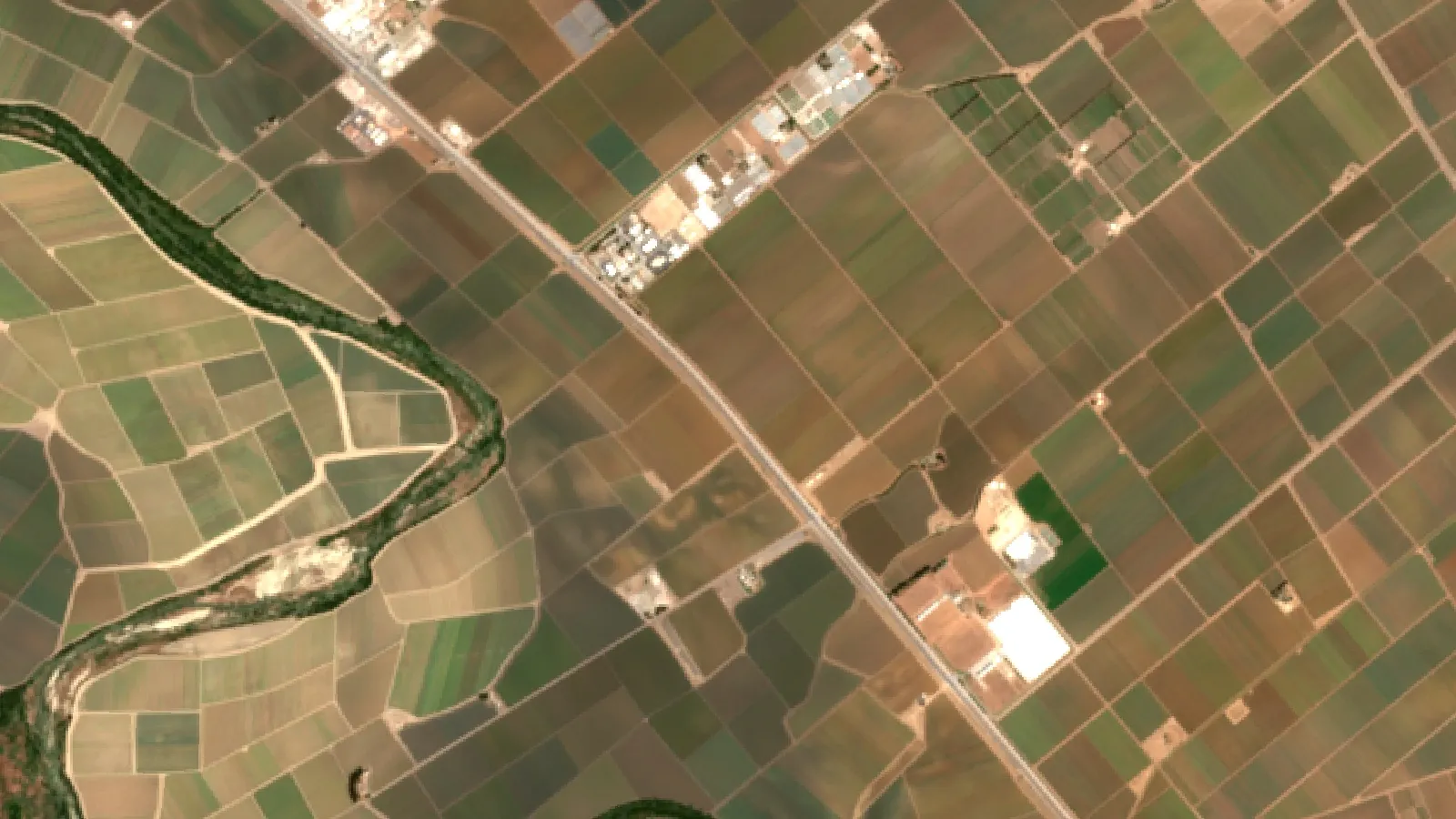
- Satellite monitoring such as Farmonaut shows where a field is stressed, not which disease is the cause.
In this article
- The five apps at a glance
- 1. Plantix
- 2. Agrio
- 3. PlantVillage+
- 4. PictureThis
- 5. Farmonaut (our product)
- How to choose the right app for your farm
- When to use a diagnostic lab instead of an app
- How accurate is a plant disease detection app?
- What disease and pests cost: crop loss estimates
- How to get a better diagnosis from any app
- Apps we removed from the older list
- How we chose and checked these apps
- FAQ
A plant disease detection app compares a photo of a sick leaf with images it was trained on and suggests the most likely disease, pest or deficiency. In a 2020 study in Tanzania, the 2020 version of the PlantVillage Nuru app identified 65% of 170 cassava test images correctly (the March 2018 version scored 54% on the phone used in the field test). On the same images, trained extension officers scored 49%, trained farmers 23% and trained researchers 86%. So an app is a fast first opinion, not a final answer.
Below we compare five apps that still exist under the same names, with platforms and prices checked on the US App Store and Google Play in October 2026. We also show what a lab diagnosis costs, what the research says about app accuracy, and a calculator to see whether paying for a diagnosis is worth it on your farm.
Disclosure: Farmonaut publishes this page, and one of the five entries is our own product. It is labelled “Our product” and gets the same checks and the same pros and cons as the others.
The five apps at a glance
| App | Best for | Platforms | Price in US stores |
|---|---|---|---|
| Plantix | Field and vegetable crops, Android users | Android | No charge to download or diagnose; shows ads |
| Agrio | Growers and crop advisers who want photo diagnosis plus field tools | Android, iOS | No charge to download; Plus $9.99 (Plus year $99.99) |
| PlantVillage+ | Smallholders, extension staff and projects | Android | No charge, says the developer |
| PictureThis | Gardens, ornamentals and houseplants | Android, iOS | Pro listed at $39.99, with lower-priced options |
| Farmonaut (our product) | Watching whole fields from satellite to decide where to scout | Android, iOS, web | Paid plans from $4.99 a month |
Ratings and prices change often. Every figure in this table and in the reviews below was read from the store listing on the date shown, and you should check the store before you pay.
1. Plantix
Best for: farmers who grow field or vegetable crops and use an Android phone.
Plantix has the most downloads of the farm-focused apps here. Its Google Play listing shows more than 10 million downloads and a 4.1-star rating from about 137,800 reviews (checked 15 October 2026, last updated 8 October 2026). The developer says it covers 30 major crops, recognises more than 780 types of plant damage and works in 19 languages. You take a photo, the app suggests a cause and a treatment, and a community forum lets you ask other growers and advisers.
In an independent review of 17 disease apps published in 2022, Plantix had the highest overall quality score, 4.56 out of 5. Even so, its score for diagnosis functions was 3.29, and the reviewers did not test whether its diagnoses were correct.
- Pros: no charge to diagnose; large crop list; many languages; active community.
- Cons: the free app shows ads; the official app is Android only. An iPhone app with the name “Plantix” on the US App Store is published by a different developer and is a general plant identifier, so check the developer name before you install.
Chart
High overall scores, weaker diagnosis features
Selected apps from a 2022 review of 17 disease apps; scores out of 5
2. Agrio
Best for: growers and crop advisers who want photo diagnosis together with field monitoring and treatment plans.
Agrio, made by Saillog Ltd, runs on Android and iPhone. Google Play shows more than 500,000 downloads and a 4.2-star rating from about 4,800 reviews; the US App Store shows 4.6 stars from 482 ratings (both checked 15 October 2026). The developer describes photo diagnosis of diseases, pests and nutrient problems, integrated pest management (IPM) protocols, disease risk alerts based on local weather, and satellite images of your fields.
Agrio has many paid tiers. The US App Store lists in-app purchases such as Plus at $9.99 (Plus year $99.99), expert response tokens at $19.99, and other packages listed from $4.49 to $349.99. The listing does not say what each tier includes, so read the plan screen inside the app before you buy.
- Pros: both phone platforms; diagnosis linked to IPM steps; field tools for advisers who manage many growers.
- Cons: the Play listing says the app contains ads; pricing is hard to compare because of the number of tiers.
3. PlantVillage+
Best for: smallholder farmers, extension workers and research or aid projects.
PlantVillage+ is the current Google Play version of the app that began as PlantVillage Nuru; its store package name is still plantvillage.nuru. Nuru was built by PlantVillage at Penn State with FAO and other research partners, as the cassava study authors describe, and it is the app tested in that study. PlantVillage+ Inc. now publishes the app. The developer describes it as a no-cost advisory and record-keeping app: you photograph a crop, get an AI suggestion of possible pests or diseases, and log planting, spraying, harvest and field notes with dates, photos and locations. The listing itself says the AI results should support, not replace, local experts.
- Pros: no charge; built with researchers; farm records you can share with buyers, certifiers or insurers if you choose.
- Cons: Android only in the stores we checked (the older Nuru app for iPhone was last updated in 2019); the listing says feature availability may vary by crop, country and language, and we did not check which US crops the AI covers; more than 10,000 downloads, so far fewer users than Plantix.
4. PictureThis
Best for: home gardeners and anyone who first needs to know what plant they are looking at.
PictureThis, made by Glority Global Group, is mainly a plant identifier with a “diagnose” feature for sick plants. It has more than 50 million downloads on Google Play (4.5 stars from about 804,000 reviews) and 4.8 stars from about 1.1 million ratings on the US App Store (checked 15 October 2026). The App Store lists PictureThis Pro at $39.99, with $3.99 and $7.99 options and a $49.99 family plan.
Identification and diagnosis are different tasks. In a University of Maryland Extension test of 90 photos of pasture and hayfield plants, PictureThis named the right species first 94% of the time, the best of the apps tested. That test did not cover diseases.
- Pros: very good at plant identification; easy to use; both phone platforms.
- Cons: built for gardens rather than farm crops; Pro is a paid subscription, so check which features need it before you rely on the app.
5. Farmonaut (our product)
Best for: farm owners and managers who want to see which parts of a field are falling behind, so they know where to walk and take photos.
The Farmonaut Satellite + AI Farm Monitoring System does not diagnose a disease from a leaf photo. It uses satellite images to map vegetation indices such as NDVI across each field you draw. NASA explains that unhealthy or sparse vegetation reflects more visible light and less near-infrared light, so a falling index flags a stressed patch. It does not tell you the cause: disease, pests, water or nutrients can all look the same from space. That is why it pairs well with a photo app and a field visit.
Farmonaut runs on Android, iPhone and in a browser through the Farmonaut web app. The US App Store lists plans from Mini at $4.99 a month or $49.90 a year up to Elite at $9,499.99 a year (checked 15 October 2026); the listing does not show the field area each plan covers. Developers can use the satellite and weather API developer docs.
Farmonaut also sells modules that have nothing to do with diagnosis: product traceability, carbon footprinting, fleet management, a crop loan and insurance module, and the Agro Admin app for managing many farms. We did not test these for this guide.
- Pros: covers whole fields without walking them; works in a browser as well as on phones.
- Cons: cannot name a disease; paid plans only; the Google Play listing says the app contains ads; few ratings so far on the US App Store (12 ratings, 3.9 stars).
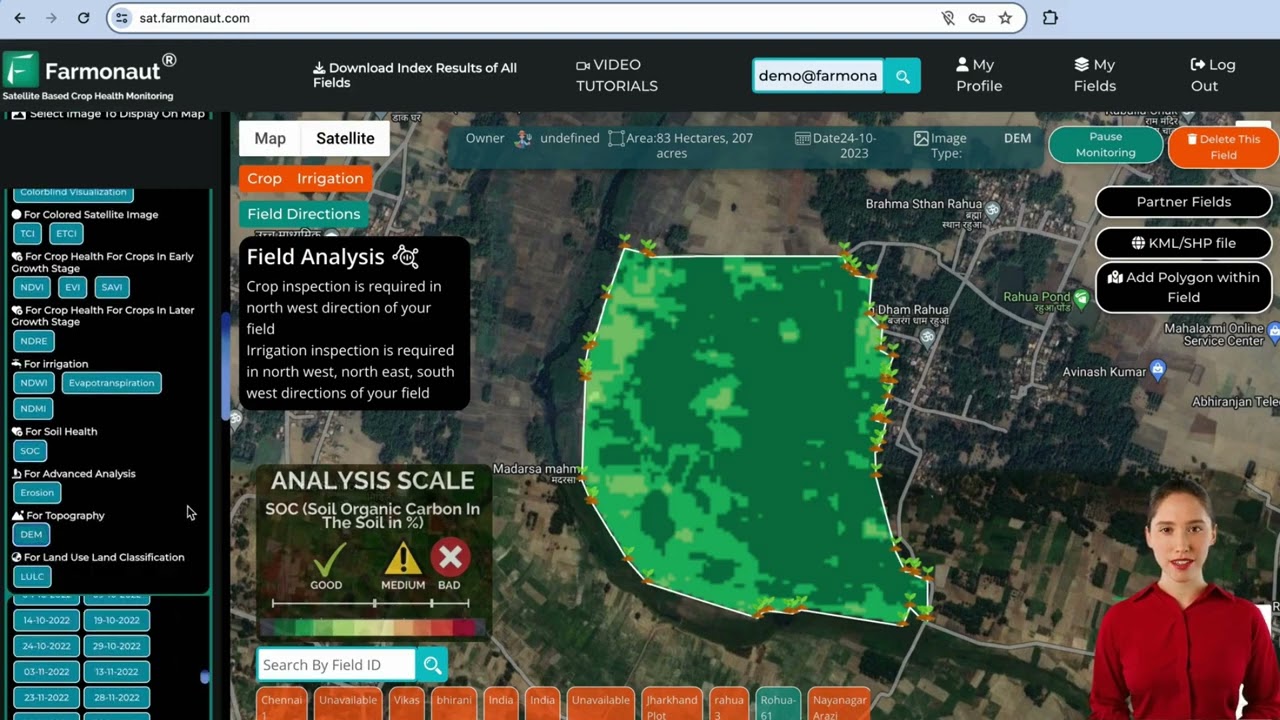
▶ A walkthrough of the Farmonaut web app: drawing a field and reading its satellite crop health maps. · 8:02
How to choose the right app for your farm
No app in this list does everything. Start from the decision you need to make, then pick the tool that answers it. These questions narrow the choice quickly.
What crop and what phone?
Field crop and vegetable growers on Android should try Plantix or PlantVillage+ first, because both are built for farm crops and charge nothing to diagnose. On an iPhone, Agrio is the farm-focused option among the apps we checked. If you mostly grow ornamentals, fruit trees in a garden or houseplants, PictureThis is easier and is very good at telling you what the plant is.
Do you need a name for the problem, or a map of where it is?
A photo app answers “what is this spot on this leaf?”. A satellite service answers “which part of my 200 acres looks worse than last week?”. On a large farm you often need both: the map tells you where to walk, and the photo app plus a lab tells you what you found there.
Who checks the answer?
Look for a way to reach a person. Plantix has a community of growers and advisers, Agrio sells expert response tokens, and your county extension office or state diagnostic lab can confirm a result. For any spray decision, follow the product label and local rules.
What will it cost over a season?
Add up the plan you would actually use for a full year, not the first-week offer, and compare it with a few lab samples. The calculator below does this for you.
Features listed by each developer
| App | Photo diagnosis | Satellite field maps | Alerts or forecasts | Ask a person |
|---|---|---|---|---|
| Plantix | Yes | Not listed | District disease alerts, weather | Community forum |
| Agrio | Yes | Yes | Weather-based risk alerts | Paid expert tokens |
| PlantVillage+ | Yes | Not listed | Not listed | Not listed |
| PictureThis | Yes | No | No | Not listed |
| Farmonaut | No | Yes | Weather forecasts | Not listed |
“Not listed” means the store listing does not mention the feature; it may still exist inside the app. We did not test every feature ourselves.
When to use a diagnostic lab instead of an app
Send a sample to a plant diagnostic lab when the crop is valuable, the app gives several possible answers, the problem is spreading, or a spray decision depends on the answer. The National Plant Diagnostic Network, a group of diagnostic labs in all US states and territories, keeps a directory where you can find your nearest lab. The network says some of its activities are paused or reduced from 1 September 2026 because of funding delays, so call your state lab before you post a sample.
Chart
What a routine lab diagnosis costs
Base fee per routine plant disease sample at selected US university clinics, US dollars
Base lab fees are low. The University of Wisconsin clinic charges a $30 base fee for a physical sample and $25 to review digital photos (fees from 1 January 2026), and the photo fee counts toward a physical sample if one is needed. It estimates most commercial samples at $200 or less once tests are added. At the other clinics we checked, the base fee for a routine grower sample was $25 to $35, with extra charges for culturing or molecular tests and higher fees for out-of-state samples at some labs.
Use the calculator below to compare the yearly cost of an app plus a few lab samples with the value of the crop you are trying to protect.
Try the numbers for your own farm below.
Calculator
Is paying for diagnosis worth it on your farm?
Enter your own area, crop value, app plan and lab fees. Every number below is yours to change.
- Total diagnosis cost per year: $190
- Total crop value: $60,000
- Loss you expect to avoid: $180
- Loss avoided minus diagnosis cost: -$10
Example values only, not benchmarks or forecasts. The loss and saving percentages are guesses you supply; no study gives a single figure for them. The calculator has no hidden constants: cost is app cost plus samples times fee, and the break-even line is that cost as a share of your crop value. The defaults land close to break-even on purpose.
How accurate is a plant disease detection app?
Accuracy depends on how the app was trained and on the photo you give it. A well-known 2016 study trained a model on 54,306 leaf photos of 14 crops and 26 diseases taken under controlled conditions. It reached 99.35% accuracy on held-out photos from the same set, but only about 31% on photos from other sources. Leaf photos taken under controlled conditions, on a plain background, are much easier than leaves in a field.
Field tests are the better guide. In the cassava study, the app’s accuracy on mild symptoms was low (13–37%), and one disease, cassava brown streak, was hard to spot. Accuracy rose sharply when the app looked at six leaves per plant instead of one, to 74–88% in the field.
The 2022 review of 17 apps found that most scored well on speed and ease of use but poorly on diagnosis functions, and only Plantix combined plant identification, disease detection, a disease database and treatment advice. The reviewers rated features and quality, not whether each diagnosis was right.
What this means for you
- Treat an app answer as a shortlist, not a verdict.
- Photograph several leaves, from the top and bottom of the plant, at different stages of the symptom.
- Confirm anything costly with a lab or your extension office.
Chart
App versus people: cassava symptom test
Share of 170 cassava leaf images diagnosed correctly, image test, Tanzania (%); app = 2020 version, average of several phones

▶ Phones, camera traps, drones and satellites tested as ways to spot crop pests early · 6:32
What disease and pests cost: crop loss estimates
FAO estimates that up to 40 percent of global crop production is lost to pests each year, and that plant diseases cost the world economy more than $220 billion a year (FAO, 2021). A 2019 study of 137 pathogens and pests estimated average global yield losses, from a survey of crop health experts, at 21.5% for wheat, 30.0% for rice, 22.5% for maize, 17.2% for potato and 21.4% for soybean, with higher losses in some food-deficit regions.
Chart
Yield lost to pathogens and pests
Range of expert-estimated losses across food-security hotspots, % of yield
These are averages across many farms and years. Your own loss depends on the crop, the disease, the weather and how fast you act, which is why the calculator above asks you for your own numbers.
How to get a better diagnosis from any app
- Walk the field first. Note how many plants show the problem and whether it follows a pattern, such as low spots, field edges or one variety.
- Take several clear photos. Use daylight without hard shadows, fill the frame with the leaf, and photograph both sides and the stem.
- Compare more than one answer. Read the app’s top three suggestions, not just the first, and check them against an extension fact sheet.
- Confirm before you spray. Send a sample or photos to a diagnostic lab when the decision is costly. Follow the product label and local rules for any treatment.
- Keep a record. Note the date, location, photos and what you did, so you can see next season whether it worked.

▶ A guide to identifying plant health problems in the field, from pests to diseases · 19:39
Apps we removed from the older list
An earlier version of this page listed accuracy percentages and star ratings for each app that we could not trace to any published test. We removed them. We also removed two entries:
- Leaf Doctor (University of Hawaii) measures how much of a leaf is diseased; it does not name the disease. It was designed for iPhone, the App Store shows its last update in October 2017, and we found no current Google Play listing. Researchers can still find the method in the 2015 paper that describes it.
- “Plant Disease Detector” is a generic name used by several small apps. We could not tie it to one maintained app with a known developer.
How we chose and checked these apps
We started from the apps on the old list and from the apps the 2022 review rated highest. Each app had to be live under the same name in the US App Store or Google Play in October 2026, with an update in 2026, and had to offer plant problem diagnosis or, in our own case, field-level crop health monitoring. We read platforms, ratings, download counts and in-app prices from the official store pages on 15 October 2026. We did not run our own accuracy test, so we report published studies instead.
FAQ
Is there a no-cost plant disease detection app?
Yes. Plantix (Android) lets you diagnose without paying and shows ads. PlantVillage+ (Android) is offered at no charge by its developer. Agrio is a no-cost download with paid plans.
What is the best app to diagnose plant problems on an iPhone?
Of the apps here, Agrio is the farm-focused choice on iPhone, and PictureThis suits gardens. The official Plantix and PlantVillage+ apps were on Google Play only when we checked.
Can an app replace a plant diagnostic lab?
No. In published field tests, apps were right often enough to be useful as a first check but missed many mild or look-alike symptoms. A lab can culture the organism or run molecular tests, which a photo cannot do.
Can satellites detect plant disease?
Satellites show where vegetation is weaker than the rest of the field. They cannot tell you whether the cause is disease, pests, water or nutrients, so a field visit and a diagnosis are still needed.
How much does a lab diagnosis cost?
Among the US university clinics we checked, the base fee for a routine sample is $25 to $35, and Wisconsin charges $25 to review photos (2026 fees). Tests, culturing and out-of-state samples cost more; Wisconsin estimates most commercial samples at $200 or less.
Farmonaut crop monitoring
See which part of your field to scout first
Farmonaut maps crop health across each field from satellite images, so you know where to walk and what to photograph.




Keep reading
Sources
- FAO, Climate change fans spread of pests and threatens plants and crops (news release, 2 June 2021): fao.org
- Savary et al., The global burden of pathogens and pests on major food crops, Nature Ecology and Evolution (2019): nature.com
- Mohanty, Hughes and Salathe, Using deep learning for image-based plant disease detection, Frontiers in Plant Science (2016): frontiersin.org
- Mrisho et al., Accuracy of PlantVillage Nuru in identifying cassava CMD and CBSD symptoms, Frontiers in Plant Science (2020): frontiersin.org
- Siddiqua et al., Evaluating Plant Disease Detection Mobile Applications: Quality and Limitations, Agronomy (2022), arXiv version: arxiv.org
- University of Maryland Extension, Snap it or scrap it: putting plant ID apps to the test (November 2025): extension.umd.edu
- NASA Earth Observatory, Measuring vegetation (NDVI and EVI): science.nasa.gov
- University of Wisconsin-Madison Plant Disease Diagnostics Clinic, Services and fees (effective 1 January 2026): pddc.wisc.edu
- North Dakota State University Plant Diagnostic Lab, Plant disease diagnosis fees: ndsu.edu
- Texas A&M Plant Clinic, Fees: plantclinic.tamu.edu
- Colorado State University Plant Diagnostic Clinic, Services and fees: agsci.colostate.edu
- SDSU Extension, SDSU Plant Diagnostic Clinic provides fast diagnoses of plant diseases (7 March 2025): extension.sdstate.edu
- National Plant Diagnostic Network, home page and lab directory: npdn.org
- Pethybridge and Nelson, Leaf Doctor: a new portable application for quantifying plant disease severity, Plant Disease (2015): doi.org
- Google Play, Plantix – your crop doctor (checked 15 October 2026): play.google.com
- Google Play, Agrio – Plant diagnosis app (checked 15 October 2026): play.google.com
- App Store (US), Agrio – Plant diagnosis app (checked 15 October 2026): apps.apple.com
- Google Play, PlantVillage+ (checked 15 October 2026): play.google.com
- Google Play, PictureThis – Plant Identifier (checked 15 October 2026): play.google.com
- App Store (US), PictureThis – Plant Identifier (checked 15 October 2026): apps.apple.com
- App Store (US), Farmonaut (checked 15 October 2026): apps.apple.com
- Google Play, Farmonaut (checked 15 October 2026): play.google.com
- App Store (US), Leaf Doctor by University of Hawaii (version history): apps.apple.com
- Plantix, official website: plantix.net
Discussion
Questions, corrections or field experience? Share them below. First-time comments are reviewed before they appear, and your email is never published.
No comments yet. Be the first to add a question or your experience.

 Progenseed
 SkyHarvest
 Sarvome
 Polaris Digitech
 Teledarbas
 Wild Oak Farm
 SFX
 BACF Africa
 Doodlakine
 Exurbia Geospatial
 FieldZero
 Indico Company
 Kubota
 FFBS
 Jontra

 Licence holder · Niger · Gold










