

Citrus pests · Identification and control guide
Lemon Tree Bugs: How to Identify and Control Them
The common lemon tree bugs are aphids, scales, mealybugs, the Asian citrus psyllid, citrus leafminer, mites, thrips and snails. Name the pest from its damage, check new leaves weekly, stop ants, protect natural enemies and spray a labelled soap or oil only when counts rise.

Key takeaways
- Sticky leaves with black sooty mold point to sap-feeders: aphids, soft scales, mealybugs or psyllids (UC IPM).
- The Asian citrus psyllid spreads HLB, which can kill a citrus tree in as little as 5 years and has no cure (UC IPM).
- Lemon trees over 4 years old with a dense canopy can usually tolerate citrus leafminer damage with negligible effect on growth and yield (UC IPM).
- US lemon production was 27.62 million boxes in 2025-26, worth about US$749 million at the packinghouse door (USDA NASS, August 2026).
- Work from cheap to strong: scouting, tree health, ant control, natural enemies, physical steps, soaps and oils, then local rules for regulated pests.
In this article
- Lemon tree bugs at a glance
- Common lemon tree pests: identification and impact
- Asian citrus psyllid and citrus greening
- Citrus leafminer
- Mites, thrips and other small pests
- Common lemon tree diseases: symptoms and solutions
- Why lemon pests matter for growers
- 7 powerful ways to control lemon tree pests and diseases
- How technology helps lemon growers
- Lemon tree pest and disease summary
- How we checked the facts
- FAQ
Lemon tree bugs fall into a few groups: sap-feeders such as aphids, scale insects, mealybugs and the Asian citrus psyllid; the citrus leafminer, whose larvae tunnel through new leaves; tiny mites and thrips that mark leaves and fruit; and chewers such as snails. The fastest way to protect a lemon tree from pests is to name the bug first, look under young leaves every week, keep ants off the trunk, let natural enemies work, and use a labelled soap or oil spray only when numbers climb.
This guide shows how to tell each pest apart from the damage it leaves, which ones matter and which a healthy tree can carry, and what to do in the right order. It is written for growers and gardeners in the United States, Canada, the UK, Europe, Australia and New Zealand. For planting and site advice, see our guide on how to grow a lemon tree orchard.
Lemon tree bugs at a glance
The table sums up the pests covered below. Each one has its own section with the source behind it.
| Pest | What you see | Where to look | First step |
|---|---|---|---|
| Aphids | Curled new leaves, sticky honeydew, ants | Soft new shoots | Strong water spray, protect lady beetles |
| Scale insects | Waxy bumps, yellow leaves, black sooty mold | Twigs, leaf undersides, fruit | Control ants, oil spray at the crawler stage |
| Mealybugs | White cottony clusters, honeydew | Leaf joints, fruit clusters, under the calyx | Wipe or prune, encourage the mealybug destroyer |
| Asian citrus psyllid | Small insects tilted at 45 degrees, twisted new leaves, white waxy threads | New flush | Report it where it is not known; follow local rules |
| Citrus leafminer | Silvery winding tunnels, curled young leaves | New flush | Mature trees can carry it; protect young trees |
| Mites | Mottled or speckled leaves, early leaf drop | Leaf surfaces, dry dusty trees | Rinse dust off, water well, use a labelled oil |
| Citrus thrips | Grey or silver ring scars on the rind | Young fruit under the sepals | Check fruit after petal fall |
| Snails | Ragged holes in leaves and fruit, slime trails | Skirts of the tree, low fruit | Copper bands on trunks, skirt pruning |
Common lemon tree pests: identification and impact
Most lemon tree bugs are small, so the damage is often what you notice first. Three signs point you to the right group.
- Sticky leaves and black film. Honeydew is the sweet waste of sap-feeders. A black sooty mold grows on it. If you see both, look for aphids, soft scales, mealybugs or psyllids on the shoots above.
- Ants running up the trunk. Ants farm honeydew-makers and drive off their natural enemies. A steady ant trail is a strong clue that sap-feeders are present.
- Damaged new growth only. Curled, twisted or tunnelled young leaves point to aphids, psyllids or leafminer. These pests lay eggs or feed on the soft flush, not on hardened leaves.
Look at the tree once a week while it is pushing new growth. Turn over ten young leaves on different sides of the tree and note what you see. A hand lens helps with mites, thrips and psyllid nymphs. Write the date and the count, so you can tell whether numbers are rising or falling before you act.
Aphids
Aphids are soft insects that cluster on new shoots. UC IPM notes that aphids can curl leaves and produce sticky honeydew that may attract ants and sooty mold. It also says most established plants can tolerate aphid feeding and outgrow the damage. On a lemon tree the leaves recover once the flush hardens.
Start with water. UC IPM suggests that you spray aphids with a strong stream of water to knock them off sturdy plants, prune badly infested tips and wait for hot weather, when some aphids die back. Lady beetles, lacewing larvae, syrphid fly larvae and tiny parasitic wasps all feed on aphids. If you see swollen, bronze “mummies” in a colony, wasps are already at work, so hold back on sprays. For the dark species common on citrus, see our page on the black citrus aphid.
Aphids also matter for a disease reason. The EPPO datasheet records that citrus tristeza virus is spread by several aphid species when feeding on citrus trees. That is one reason to buy certified trees from a registered nursery and not to move budwood between regions.
Scale insects
Scales look more like bumps than bugs. The RHS notes there are more than 25 species of scale insect found in British gardens, and several feed on citrus kept in pots and conservatories. In warm climates, outdoor lemon trees host armored scales (hard, flat covers) and soft scales (rounder, and they make honeydew).
The damage builds slowly. UC IPM says scale infestations can cause yellowing or premature dropping of leaves, sticky honeydew, and blackish sooty mold, and that twigs can die back when numbers are high. It also says most plants tolerate low to moderate numbers of scales, so a few bumps are not a reason to spray.
The weak point is the young “crawler” stage. Crawlers walk out from under the mother scale before they settle and build their own cover. A horticultural oil reaches them far better than it reaches settled adults. Wrap double-sided tape around a twig and check it every few days in spring: when tiny moving dots appear on the tape, crawlers are out.
Cottony cushion scale is a good example of biological control. The UC IPM citrus guide notes the vedalia beetle was introduced from Australia in the early 1890s and feeds on all stages of the scale. It adds that sprays are usually not needed unless broad-spectrum insecticides have killed off the beetles.
Mealybugs
Mealybugs are covered in white wax and gather in leaf joints, between touching fruit and under the green calyx. UC IPM describes them as small, soft, wax-covered insects that suck sap and often produce sticky honeydew. The citrus mealybug also feeds on many indoor plants. NC State Extension notes that citrus mealybugs do not survive winters outdoors in North Carolina, which is why the pest is a problem mainly in greenhouses and on lemon trees brought indoors in cold climates.
On a small tree, wipe colonies off with a cloth or a cotton bud dipped in soapy water, or prune the worst shoots. Outdoors, the mealybug destroyer beetle (Cryptolaemus montrouzieri) eats them; UC IPM lists it as a narrow-range option that does not survive winters well. Keep ants away so the beetles can do their job.

▶ Black aphids and leaf spots on lemon trees, and how monitoring helps catch infestations early. · 10:52
Asian citrus psyllid and citrus greening
The Asian citrus psyllid is the lemon tree bug that matters most, not for the damage it does itself but for what it carries. It spreads the bacterium that causes huanglongbing (HLB), also called citrus greening. According to UC IPM, HLB will kill citrus trees in as little as 5 years and there is no cure or effective control method for HLB.
The adult is small, mottled brown and easy to spot by its posture. UC IPM says it feeds with its head down and its body raised at an almost 45-degree angle, and that no other insect pest of citrus positions its body this way. Nymphs sit on new shoots and leave white, waxy threads. The new leaves they feed on twist and fail to open properly.
HLB signs on the tree are blotchy, uneven yellow mottling on leaves (not the even yellowing of a nitrogen shortage), small lopsided fruit that drops easily and bitter juice. If you see these signs, do not move leaves, fruit or plants. Report them to your state or provincial plant health office.
Rules differ by place. In California, the UC IPM HLB page explains that the state runs an eradication program: if psyllid nymphs test positive, treatment with conventional insecticides is mandatory, and removal of infected trees is mandatory. In quarantine areas, citrus plants and leaves cannot be moved freely. Check the rules for your county before you buy, sell or share citrus plants. For the Florida story, read citrus greening in Florida.
What a grower or gardener can do:
- Inspect new flush every week and look for the 45-degree tilt.
- Buy only certified nursery trees, and never graft with budwood of unknown origin.
- Keep trees in good health. UC IPM notes that maintaining trees in good health, especially root health, helps them withstand the disease, though it does not cure it.
- Follow the treatment plan set by local authorities in quarantine zones.

▶ Citrus greening symptoms, the psyllid that spreads it and the control measures used on infected orchards. · 13:17
Citrus leafminer
The citrus leafminer is a tiny moth. Its larvae tunnel just under the skin of young leaves and leave silvery, winding trails with a thin dark line of waste down the middle. UC IPM notes that newly emerged leaflets (flush) are the preferred egg-laying site, that eggs hatch about 4 to 5 days after being laid, and that larvae develop over 1 to 3 weeks.
Leafminer damage looks alarming but often costs little. UC IPM says mature trees (more than 4 years old) with a dense canopy of older leaves can tolerate damage on new leaves during part of the season with negligible effect on tree growth and fruit yield. Young trees are different: they have little mature foliage and keep pushing flush, so they need more care. Do not apply nitrogen when leafminer numbers are high, and avoid pruning that forces extra flush; in California the moth is most active from mid-summer through fall.
Leafminer wounds can let in bacterial diseases where citrus canker is present, so in canker areas leafminer control matters more. For a step-by-step on this pest, see our guide on citrus leaf miner control in the related pages below.
Mites, thrips and other small pests
Mites
Mites are spider relatives, too small to see clearly without a lens. In glasshouses and conservatories, the RHS describes glasshouse red spider mite as a common sap-feeding mite that can cause mottled leaves and early leaf loss. Outdoors in dry climates, citrus red mite and other species speckle leaves and dull the shine of the fruit. Dust, drought stress and broad-spectrum sprays that kill predatory mites all make outbreaks worse.
Rinse dust off the canopy, keep the tree watered and use a horticultural oil labelled for citrus if mites build up. Do not spray oil on a stressed, dry tree or in great heat.
Citrus thrips
Citrus thrips feed on young fruit, not leaves. UC IPM says they leave scabby, grayish or silvery scars on the rind, and that the larvae feed mainly at the calyx end under the sepals of young fruit. As the fruit grows, the damage spreads out into a ring scar. The flesh is fine to eat, so for home trees thrips are a cosmetic issue. For fresh-market growers, scarred fruit can lose grade, so check young fruit after petal fall.
Snails and other chewers
Brown garden snails climb trunks at night and chew ragged holes in leaves and low fruit. Copper bands around trunks stop them. UC IPM lists copper bands as a narrow-range, long-lasting option for brown garden snail only. Prune the lowest branches so the skirt does not touch the ground, which removes the snails’ ladder. Caterpillars such as orange dog and tortrix larvae chew leaves now and then; hand-pick them on small trees.

▶ The citrus blackfly, the damage it causes and ways to protect a citrus orchard. · 10:11
Common lemon tree diseases: symptoms and solutions
Several lemon tree diseases are linked to bugs, either because insects spread them or because the symptoms look like insect damage.
- Sooty mold. A black film on leaves and fruit that wipes off. It is not a disease of the tree itself but a fungus growing on honeydew. Control the sap-feeders and the ants, and the mold weathers away.
- Citrus greening (HLB). Spread by the psyllid, covered above.
- Citrus tristeza virus. Spread by aphids and by grafting infected budwood.
- Brown rot. UC IPM says brown rot is caused by several Phytophthora species when it is cool and wet, and that it develops mainly on fruit near the ground when spores from the soil are splashed onto the tree skirts during rainstorms. Raise the skirt and keep mulch off the trunk.
- Citrus black spot. A fungal disease present in parts of Florida. The UF/IFAS production guide describes hard spot lesions of 3 to 10 mm, nearly circular and sunken with a grey centre and a brick-red to black margin. It is a regulated disease, so report suspected cases.
For leaf and fruit diseases in more depth, read our guides on lemon tree disease and treatment and lemon tree diseases and pests. Mildew problems in other crops are covered in how to prevent downy mildew in crops.
Why lemon pests matter for growers
For a commercial grower, pest control is a cost that has to pay for itself. US lemon numbers show what is at stake. In the USDA NASS Citrus Fruits 2025 Summary, published in August 2026, US lemon production for the 2025-26 season was 27.62 million boxes from 62,500 bearing acres, worth about US$749 million at the packinghouse door. California grew 26.0 million of those boxes.
Chart
US lemon production by state, 2025-26
Utilized production, thousand boxes
The same report shows Arizona’s lemon production fell 36 percent in 2025-26, to 720,000 boxes, while Florida, which NASS has counted for lemons since the 2024-25 season, produced 900,000 boxes for processing. The US average yield was 442 boxes per bearing acre and the average price was US$27.12 per box (equivalent packinghouse-door returns, not retail prices).
At those figures, one acre of lemons returned about US$12,000 in 2025-26. A pest program that saves even 2 percent of the crop is worth around US$240 per acre, before you count savings from fewer culled or downgraded fruit. Use the calculator to test your own numbers.
Chart
US lemon yield per bearing acre
Boxes per acre, United States, by season
Try the numbers for your own farm below.
Calculator
Does a lemon pest program pay for itself?
Enter your own acres, yield, price, loss and cost.
- Crop value per acre: 11,987 US$
- Value saved per acre: 240 US$
- Break-even loss prevented: 2.0 %
Example values only, set near break-even; replace every number with your own. Defaults use the US average yield (442 boxes per acre) and price (US$27.12 per box, packinghouse-door equivalent) for 2025-26 from USDA NASS. ‘Fruit loss prevented’ is your own estimate of the crop share the program saves.
7 powerful ways to control lemon tree pests and diseases
These seven steps run from the cheapest and safest to the strongest. Use them in order and only move down the list when your weekly counts say you must.
Chart
Lemon price per box by state
US$ per box, equivalent packinghouse-door returns, 2024-25 vs 2025-26
1. Scout weekly and keep records
Walk the trees once a week during each flush. Check ten young shoots and ten fruit per tree or per block, note pests and natural enemies, and write the date. Records show you whether numbers are climbing and whether a spray worked. They are also what an adviser or inspector will ask for.
2. Keep the tree strong
Water deeply but not too often, feed for steady growth rather than bursts of soft flush, and mulch, keeping mulch a hand-width from the trunk. Stressed trees attract mites and scales, and heavy nitrogen feeds aphids and leafminer. A well-fed mature canopy can carry leafminer and low numbers of scale without yield loss.
3. Control ants
Ants guard honeydew-makers from lady beetles and parasitic wasps. Prune branches that touch walls, fences or the ground, and put a sticky barrier band on the trunk (over a wrap on young bark). Use ant baits placed at the base of the tree, not sprays on the canopy.
4. Protect natural enemies
Lady beetles, lacewings, the vedalia beetle, the mealybug destroyer, predatory mites and tiny parasitic wasps keep most lemon tree bugs in check. UC IPM warns that broad-spectrum insecticides such as pyrethroids and neonicotinoids can cause outbreaks of cottony cushion scale by killing its natural enemies. Avoid these sprays unless a regulator or adviser tells you to use them, for example in an HLB treatment zone.
5. Use physical methods
Spray aphids off with water, wipe mealybugs, prune infested tips, fit copper bands for snails and raise the tree skirt to cut brown rot and snail access. On potted trees, isolate any new plant for two weeks before it joins the others.
6. Use soaps and oils when counts rise
Insecticidal soaps and horticultural oils kill by contact, break down fast and spare most natural enemies once dry. UC IPM lists insecticidal soaps and oils as the option to try when aphid numbers are high and other control methods are not effective. Spray the undersides of leaves, cover well and repeat as the label allows. Do not spray in heat above the label limit or on drought-stressed trees, and test a few leaves first.
7. Follow local rules for regulated pests
For the Asian citrus psyllid, HLB, citrus canker and citrus black spot, your local plant health agency sets the rules. In some areas, treatment and tree removal are mandatory. Report suspect trees and follow the plan you are given.
Safety note: pesticide registrations differ by country, state and crop. Always read and follow the product label, check local rules, and get advice from your extension office or a licensed adviser before you spray, especially on trees that will be harvested.
How technology helps lemon growers
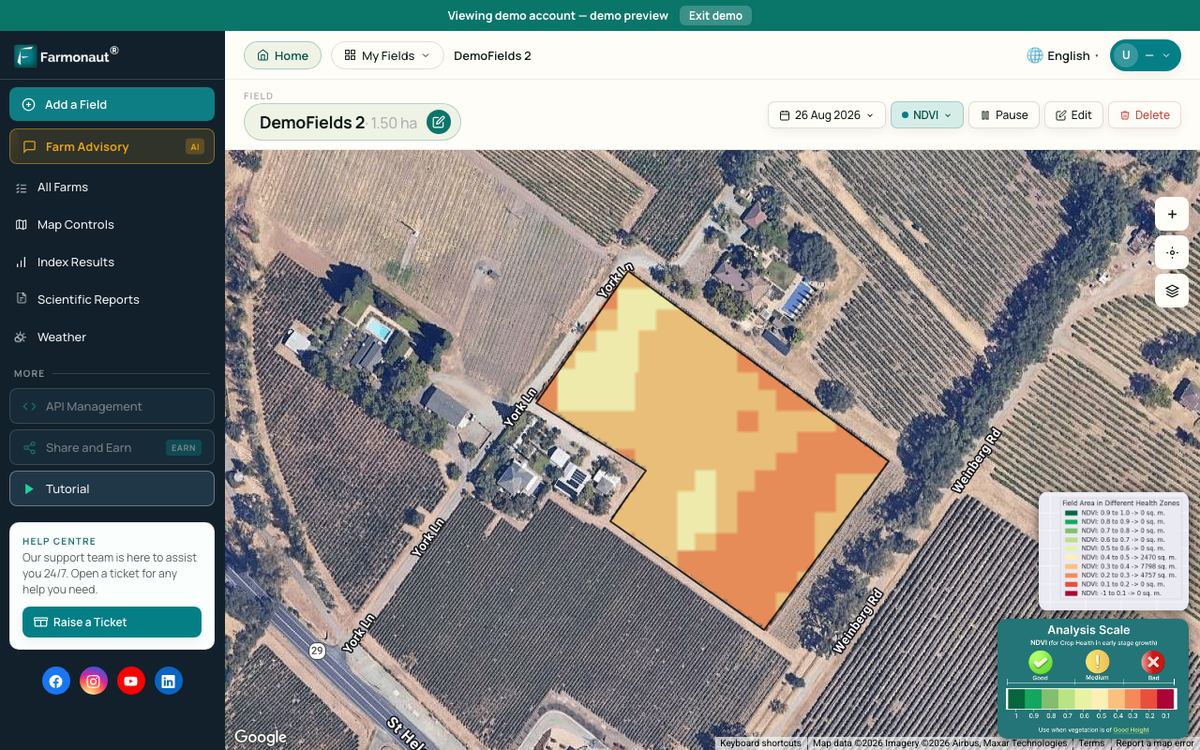
On a farm, the hard part is knowing which block to walk first. Satellite crop-health maps show where a canopy is getting weaker over time, which can point scouts to blocks with pest, water or root stress. They do not replace a hand lens: a map cannot tell a psyllid from a mite, so every flagged area still needs a field check.
Farmonaut Satellite + AI Farm Monitoring System maps vegetation health for each field you draw, through the season, on web, Android and iOS. Teams use these maps to plan scouting routes and keep a dated record of how each block changed.
Lemon tree pest and disease summary
| Problem | Main sign | Risk to tree | Best timing |
|---|---|---|---|
| Aphids | Curled flush, honeydew | Low on mature trees; spreads tristeza virus | Spring and autumn flush |
| Scales | Waxy bumps, sooty mold | Moderate if left for years | Crawler stage |
| Mealybugs | White wax clusters | Low to moderate | Early, before colonies spread |
| Asian citrus psyllid | 45-degree tilt, waxy threads | High: spreads HLB | Every flush; follow local rules |
| Citrus leafminer | Silvery tunnels | Low on trees over 4 years old | Young trees during summer flush |
| Mites | Speckled leaves | Moderate in dry, dusty conditions | Hot, dry spells |
| Citrus thrips | Ring scars on rind | Cosmetic | After petal fall |
| Brown rot | Brown, leathery fruit near the ground | Fruit loss | Cool, wet weather |
Related pages on our site: carbon footprint tracking, crop loans and insurance, weather data for developers, farm fleet tracking, produce traceability, large farm administration, mobile apps, citrus leaf miner control.
How we checked the facts
Pest descriptions and control steps come from the University of California Statewide IPM Program pest notes and citrus guidelines, NC State Extension, the Royal Horticultural Society and the UF/IFAS Florida Citrus Production Guide. Disease spread by aphids comes from the EPPO Global Database. Production, yield, price and value figures come from the USDA NASS Citrus Fruits 2025 Summary (August 2026) and use its season basis (packinghouse-door returns). Each source is listed at the end of the article.
FAQ
What are the small bugs on my lemon tree?
Small green, black or brown insects on new shoots are often aphids. White cottony clusters are mealybugs, waxy bumps on twigs are scales, and tiny insects tilted at 45 degrees on new leaves are Asian citrus psyllids. Silvery tunnels in young leaves are leafminer damage.
How do I protect my lemon tree from pests?
Check young leaves weekly, keep the tree watered and fed without forcing soft growth, stop ants climbing the trunk, protect lady beetles and other predators, and use a labelled soap or oil only when counts rise.
What is eating my lemon tree leaves?
Ragged holes with slime trails are snail damage; neat bites from the edge are caterpillars. Leaves that look eaten from the inside, with silvery trails, have citrus leafminer.
Why are my lemon tree leaves sticky and black?
Sap-feeding insects such as aphids, soft scales and mealybugs drop sugary honeydew, and black sooty mold grows on it. Control the insects and the ants that protect them, and the mold fades.
Can I treat citrus greening on my tree?
No. UC IPM states there is no cure for HLB. Infected trees decline and, in some areas, must be removed by law. Report suspect trees to your plant health agency.
Is soapy water safe for lemon trees?
Products sold as insecticidal soap and labelled for citrus are designed for this use. Home-made mixes can burn leaves. Test on a few leaves, avoid spraying in strong sun or heat, and follow the label.
Farmonaut crop monitoring
See your orchard blocks from space
Draw your orchard blocks once and Farmonaut shows satellite vegetation maps for them through the season, on web, Android or iOS.



Keep reading

Sources
- USDA NASS, Citrus Fruits 2025 Summary (August 2026): esmis.nal.usda.gov
- UC IPM, Aphids: Pest Notes for Home and Landscape: ipm.ucanr.edu
- UC IPM, Scales: Pest Notes for Home and Landscape: ipm.ucanr.edu
- UC IPM, Mealybugs: Pest Notes for Home and Landscape: ipm.ucanr.edu
- UC IPM, Asian Citrus Psyllid and Huanglongbing Disease (Home and Landscape): ipm.ucanr.edu
- UC IPM, Huanglongbing: Citrus Pest Management Guidelines: ipm.ucanr.edu
- UC IPM, Citrus Leafminer: Citrus Pest Management Guidelines: ipm.ucanr.edu
- UC IPM, Citrus Leafminer: Pest Notes for Home and Landscape: ipm.ucanr.edu
- UC IPM, Citrus Thrips: Citrus Pest Management Guidelines: ipm.ucanr.edu
- UC IPM, Cottony Cushion Scale: Citrus Pest Management Guidelines: ipm.ucanr.edu
- UC IPM, Brown Rot: Citrus Pest Management Guidelines: ipm.ucanr.edu
- UC IPM, pesticide and control option table for home citrus: ipm.ucanr.edu
- NC State Extension, Citrus Mealybug: content.ces.ncsu.edu
- UF/IFAS EDIS, Florida Citrus Production Guide: Citrus Black Spot (CG088): edis.ifas.ufl.edu
- EPPO Global Database, Citrus tristeza virus datasheet: gd.eppo.int
- Royal Horticultural Society, Citrus: grow your own: rhs.org.uk
Discussion
Questions, corrections or field experience? Share them below. First-time comments are reviewed before they appear, and your email is never published.
No comments yet. Be the first to add a question or your experience.

 BACF Africa
 Nivia
 Doodlakine
 Exurbia Geospatial
 FieldZero
 Indico Company
 Kubota
 FFBS
 Jontra
 Kalustyan
 Tucor
 Hayleys Agriculture
 Linx Agritech

 Licence holder · Niger · Gold
 Client · Tanzania · Gold
 Client · Somalia · Gold
 Client & affiliate partner · Ghana · Gold










