

Grain conversions · Canada calculator
Bushels to Tonnes Calculator for Canadian Crops
Multiply bushels by the crop’s standard bushel weight and divide by 2,204.62 to get metric tonnes. This guide gives the factors Canadian insurers and Statistics Canada use, converts the record 2025 yields to tonnes per hectare, and prices them with AAFC’s August 2026 outlook.
Key takeaways
- One tonne is 36.744 bushels of wheat (60 lb), 44.092 of canola (50 lb) and 39.368 of corn (56 lb), per the AFSC grain conversion table.
- Barley and oats have two bases: AFSC uses 50 lb and 41 lb, Statistics Canada’s trade weights are 48 lb and 34 lb.
- Canada’s 2025 canola yield was a record 44.7 bu/ac, about 2.5 t/ha; spring wheat averaged 58.8 bu/ac, about 3.95 t/ha (Statistics Canada, November 2025).
- The 2025-26 average Saskatchewan spot price for No. 1 CWRS wheat was $269/t, about $7.32 a bushel (AAFC, August 2026).
- Under the Advance Payments Program the federal government pays the interest on the first $250,000 of non-canola advances for 2025 and 2026, so loan sizing starts with tonnes × price.
In this article
- Bushels to tonnes: the short answer
- Bushels per tonne for Canadian crops
- Why the standard weight and the real weight differ
- Bushels per acre to tonnes per hectare
- Canadian crop yields in both units
- Turning tonnes into dollars
- Bushels to tonnes calculator
- Using converted yields for land, loans and planning
- Common conversion mistakes
- Converting a whole farm's harvest
- How we checked the numbers
- Where satellite data fits
- FAQ
- Summary
To convert bushels to tonnes, multiply the bushels by the crop’s standard bushel weight in pounds, then divide by 2,204.62 (the pounds in one metric tonne). For wheat, at 60 lb per bushel, one tonne is 36.744 bushels; for canola, at 50 lb, it is 44.092 bushels, according to the AFSC grain conversion table. The bushels to tonnes calculator below does this for any crop, turns bushels per acre into tonnes per hectare, and puts a dollar value on the result.
This guide is for Canadian growers, buyers and lenders who work in both units. Elevators, crop insurance and the Statistics Canada yield reports often use bushels per acre. Export contracts, government outlooks and research papers use tonnes and hectares. Getting the factor wrong by one crop, or by one province’s rule, can move a farm’s numbers by several per cent.
Bushels to tonnes: the short answer
A bushel is a measure of volume, not weight. In grain trading it has been turned into a fixed weight for each crop, called the standard bushel weight. That is why the number of bushels in a tonne changes from crop to crop.
The rule has two steps:
- Pounds = bushels × standard bushel weight (lb/bu).
- Tonnes = pounds ÷ 2,204.62.
To go the other way, from tonnes to bushels, multiply tonnes by 2,204.62 and divide by the bushel weight. The AFSC table puts it in one line: price per bushel × bushels per tonne = price per tonne.
Worked example: 300 bushels of wheat × 60 lb = 18,000 lb. Divide by 2,204.62 and you get 8.16 tonnes. The same 300 bushels of canola at 50 lb is 15,000 lb, or 6.80 tonnes. And 250 bushels of canola is 5.67 tonnes.
Bushels per tonne for Canadian crops
The table lists the standard weights that Alberta’s crop insurer, AFSC, uses for AgriInsurance and AgriStability. AFSC notes that its rates may differ from those used by grain elevators. Statistics Canada uses the older trade weights of 48 lb for barley and 34 lb for oats, shown in its weights and measures reference, so check which basis a figure uses before you compare.
| Crop | Pounds per bushel | Bushels per tonne | Tonnes per bushel |
|---|---|---|---|
| Wheat | 60 | 36.744 | 0.0272 |
| Durum | 60 | 36.744 | 0.0272 |
| Canola | 50 | 44.092 | 0.0227 |
| Barley (AFSC) | 50 | 44.092 | 0.0227 |
| Barley (StatCan) | 48 | 45.93 | 0.0218 |
| Oats (AFSC) | 41 | 53.771 | 0.0186 |
| Oats (StatCan) | 34 | 64.84 | 0.0154 |
| Corn | 56 | 39.368 | 0.0254 |
| Flaxseed | 56 | 39.368 | 0.0254 |
| Rye | 56 | 39.368 | 0.0254 |
| Soybeans | 60 | 36.744 | 0.0272 |
| Peas | 60 | 36.744 | 0.0272 |
| Lentils | 60 | 36.75 | 0.0272 |
| Mustard seed | 50 | 44.092 | 0.0227 |
Oats show the biggest gap. A tonne of oats is 53.8 bushels on the AFSC basis but 64.8 bushels on the 34 lb trade basis. A buyer quoting $4 per bushel on one basis and a seller thinking in the other can be more than $40 a tonne apart without either side noticing.
Chart
Bushels in one metric tonne, by crop
Bushels per tonne at the standard bushel weight shown
Why the standard weight and the real weight differ
The standard bushel weight is a fixed number for paperwork. The real weight of grain in a bushel, called test weight, changes with each load. The Canadian Grain Commission describes test weight as a measure of grain density, expressed in kilograms per hectolitre or pounds per bushel, and it is a grade-determining factor for many grains under the Canada Grain Act.
So there are two different questions:
- How many tonnes did I sell? The elevator weighs the truck. The scale ticket in tonnes is the answer, after dockage and moisture are taken off.
- How many bushels is that for my records? Use the standard weight your buyer, insurer or lender uses, so your numbers match theirs.
Test weight still matters for storage and grading. A light, frost-damaged wheat crop fills more bin space per tonne. For bin planning, use the test weight from a sample, not the standard weight.
Harvest losses also change the final tonnes. The Canola Council of Canada notes that untimely harvest, the wrong harvest method and poor handling can cut yield, value or both. Measure what reaches the truck, not what the field looked like in August.
Bushels per acre to tonnes per hectare
Yield conversion needs one more step, because an acre is smaller than a hectare. One hectare is 2.471 acres.
Tonnes per hectare = bushels per acre × pounds per bushel × 0.4536 ÷ 1,000 × 2.471.
For quick work, use these multipliers. Multiply bushels per acre by:
- 0.0673 for wheat, durum, soybeans and peas (60 lb bushel)
- 0.0628 for corn, flax and rye (56 lb)
- 0.0560 for canola (50 lb)
- 0.0538 for barley on the 48 lb basis
- 0.0381 for oats on the 34 lb basis
To go from tonnes per hectare back to bushels per acre, divide by the same number. A 4 t/ha wheat crop is about 59.5 bu/ac. A 2.5 t/ha canola crop is about 44.6 bu/ac.
Canadian crop yields in both units
Statistics Canada’s final 2025 survey showed record wheat and canola crops. Total wheat production rose 11.2% to a record 40.0 million tonnes, and canola rose 13.3% to 21.8 million tonnes, according to The Daily, Production of principal field crops, November 2025. The survey went to about 27,200 farms.
The table converts the national yields in that release to tonnes per hectare. The conversion uses the Statistics Canada bushel weights (barley 48 lb, oats 34 lb).
| Crop (2025) | Bushels per acre | Tonnes per hectare | Change from 2024 |
|---|---|---|---|
| Spring wheat | 58.8 | 3.95 | +12.9% |
| Canola | 44.7 | 2.51 | record high |
| Barley | 79.4 | 4.27 | +25.6% |
| Oats | 98.1 | 3.74 | +10.6% |
| Corn for grain | 162.2 | 10.18 | -3.9% |
| Soybeans | 43.5 | 2.93 | -11.4% |
Provincial numbers differ. Saskatchewan wheat averaged 49.7 bu/ac (3.34 t/ha), Alberta 57.0 bu/ac (3.83 t/ha) and Manitoba 65.6 bu/ac (4.41 t/ha). Canola reached 44.4 bu/ac in Saskatchewan, 45.4 in Alberta and 44.8 in Manitoba, all about 2.5 t/ha. In Ontario, corn averaged 175.6 bu/ac, or 11.0 t/ha, and soybeans 45.7 bu/ac, or 3.07 t/ha.
Eastern Canada had a harder year. Statistics Canada reports that dry conditions cut Quebec corn yields by 13.0% to 141.1 bu/ac, and hot, dry weather cut Ontario soybean yields by 11.8%.
Chart
Canada’s 2025 yields in tonnes per hectare
National average yields, converted from bushels per acre at Statistics Canada bushel weights
Turning tonnes into dollars
Most Canadian price outlooks are in dollars per tonne. Agriculture and Agri-Food Canada’s Outlook for Principal Field Crops (20 August 2026) gives crop-year average prices. For 2025-26, the final average Saskatchewan producer spot price for No. 1 CWRS wheat, 13.5% protein, was $269/t. These are average spot prices, not a quote for your grain.
To get a price per bushel, divide the tonne price by bushels per tonne:
- Wheat: $269 ÷ 36.744 = about $7.32 per bushel.
- Canola: $711 ÷ 44.092 = about $16.13 per bushel (AAFC’s canola price is No. 1 track Vancouver, so a Prairie farm-gate price is lower).
- Barley: $283 ÷ 45.93 = about $6.16 per bushel (48 lb basis).
AAFC’s forecasts for 2026-27 put CWRS wheat at $300/t and canola at $720/t, with durum lower at $270/t. AAFC expects principal field crop production to fall about 5% from the 2025 record but stay 9% above the five-year average. Forecasts change with each monthly outlook, so use today’s elevator bid for real decisions.
Chart
Crop prices per tonne: last crop year vs forecast
C$ per tonne, crop-year averages (wheat and durum: Saskatchewan spot; barley: Lethbridge; oats: CBOT; corn and soybeans: Chatham; canola: No. 1 track Vancouver)
Bushels to tonnes calculator
Enter your own crop, yield, area, price and cost. The calculator converts your yield into tonnes per hectare and total tonnes, then shows gross value and margin per acre. The default numbers are examples, set close to break-even; they are not benchmarks.
How to use it:
- Pick the bushel weight your buyer or insurer uses (60 for wheat, 50 for canola, 48 or 50 for barley).
- Enter yield in bushels per acre from your yield monitor or scale tickets.
- Enter the acres harvested.
- Enter a price per tonne. Use today’s bid, not the example.
- Enter your total cost per acre, including land, to see the margin.
Try the numbers for your own farm below.
Calculator
Convert your yield to tonnes and dollars
Enter your crop’s bushel weight, yield, acres, price and cost.
- Yield in tonnes per hectare: 3.4 t/ha
- Bushels per tonne: 36.7 bu/t
- Price per bushel: 7.3 C$/bu
- Gross value: 366,049 C$
- Margin per acre: 1 C$/ac
Example values only, set near break-even; they are not benchmarks or forecasts. Standard bushel weights: wheat, soybeans and peas 60 lb, corn and flax 56 lb, canola 50 lb, barley 48 lb (Statistics Canada) or 50 lb (AFSC), oats 34 lb or 41 lb (AFSC Grain Conversion Table). Constants: 2,204.62 lb per tonne, 2.471 acres per hectare. Price inputs are examples; use today’s price from your buyer. Not financial advice.
Using converted yields for land, loans and planning
The old version of this page called itself an agricultural land calculator. Converting yields is where land and loan maths begins, because lenders, insurers and land buyers all ask the same question: how many tonnes, worth how much, from how many hectares?
Land value per tonne of output
Farm Credit Canada’s 2025 Farmland Values Report found that farmland values across Canada rose by an average of 9.3% in 2025. Gains were 12.2% in Manitoba, 11.4% in Alberta and 9.4% in Saskatchewan, against 2.2% in Ontario and 4.8% in Quebec. British Columbia fell 1.7%. When land costs rise faster than prices, a farm needs more tonnes per hectare to carry the same land cost. Converting your yield history to tonnes per hectare lets you compare it with provincial averages and with the price per acre a seller asks.
In British Columbia, land inside the Agricultural Land Reserve has extra rules on non-farm use, set by the Agricultural Land Commission. Check these before you value or buy a parcel there.
Agricultural loan calculations
Many operating loans are sized against the value of the crop. Under the federal Advance Payments Program, producers can get up to $1,000,000 in advances based on the value of eligible products they will grow or have in storage. For the 2025 and 2026 program years, the Government of Canada pays the interest on the first $250,000 of non-canola advances and the first $500,000 of canola advances. The normal level is $100,000.
The advance is based on value, and value is tonnes × price. So the first step in any agricultural loan calculation is a clean bushels-to-tonnes conversion. Farm Credit Canada and the banks also offer farm financing for land, equipment and operating costs; their terms vary. For satellite-backed field checks used by lenders and insurers, see our page on crop loan and insurance verification. This is general information, not financial advice; talk to your lender or a farm financial adviser before you borrow.
Storage and hauling
Bins are sold by bushel capacity; trucks and rail cars carry tonnes. A 10,000-bushel bin holds about 272 tonnes of wheat at 60 lb, but only about 227 tonnes of canola at 50 lb. Plan hauling in tonnes and storage in bushels, using test weight for the bins. Larger operations that schedule trucks across many fields can use fleet management tools to track loads.

▶ How terrain analysis and field data help farms plan land use and lift yields. · 16:29
Common conversion mistakes
- Using short tons. A US short ton is 2,000 lb; a metric tonne is 2,204.62 lb. Canadian outlooks use metric tonnes. Mixing them gives a 10% error.
- Using one factor for every crop. Wheat and canola differ by about 20% in bushels per tonne.
- Mixing the barley and oats bases. Check whether a figure uses 48 or 50 lb for barley, and 34 or 41 lb for oats.
- Forgetting dockage and moisture. Paid tonnes are clean, dry tonnes. Field weight is higher.
- Confusing acres and hectares. Dividing by 2.471 when you should multiply gives a yield six times too small.
The US Department of Agriculture publishes its own weights, measures and conversion factors for farm products. Cross-border buyers often use them, and some differ from Canadian program weights, so state the basis in every contract.
Converting a whole farm’s harvest
Most farms grow more than one crop, so a single factor will not do. Work crop by crop, then add the tonnes. Here is an example for a mixed Prairie farm. The yields and areas are examples only.
| Crop | Acres | Yield (bu/ac) | Bushels | Tonnes |
|---|---|---|---|---|
| Wheat (60 lb) | 1,200 | 50 | 60,000 | 1,633 |
| Canola (50 lb) | 1,000 | 42 | 42,000 | 953 |
| Barley (48 lb) | 400 | 70 | 28,000 | 610 |
| Peas (60 lb) | 300 | 40 | 12,000 | 327 |
| Total | 2,900 | 142,000 | 3,523 |
Notice that the bushel total means little on its own, because a bushel of canola and a bushel of wheat weigh different amounts. The tonne total is the number that matches what trucks, elevators and export statistics count. When you report a farm’s output to a lender or an insurer, give tonnes by crop and state the bushel weight you used.
Keep the same factors year after year. If you switch the barley basis from 48 lb to 50 lb, your barley tonnes will jump by about 4% on paper with no change in the field.
How we checked the numbers
Every factor on this page comes from a published table: the AFSC grain conversion table for program weights, the Statistics Canada weights and measures reference for the 48 lb barley and 34 lb oats basis, and the pound-to-tonne ratio of 2,204.62. Yields come from Statistics Canada’s final November 2025 field crop survey, and prices from AAFC’s August 2026 outlook. We converted each yield with the formula shown above and rounded to two decimals. Prices are AAFC crop-year averages at different price points: Saskatchewan spot for wheat and durum, Lethbridge for barley, Chatham for corn and soybeans, track Vancouver for canola and the CBOT price for oats. They are not quotes for your grain.
Where satellite data fits
A conversion is only as good as the yield you put into it. Yield monitors and scale tickets give the final number after harvest. During the season, satellite crop maps can show which parts of a field are behind, so you can scout them and estimate tonnes earlier.
AAFC itself now uses satellite vegetation data: its 2026 outlook draws on the Canadian Crop Yield Forecast, which combines agroclimatic conditions with NDVI data collected from May to late July. Farm-level tools use the same type of data. The Farmonaut Satellite + AI Farm Monitoring System shows vegetation and moisture maps for each mapped field through the season, on the web and mobile apps. Farm managers with many growers can use the large-scale admin dashboard, and developers can pull the same data into their own systems through the satellite and weather API.

▶ A step-by-step tour of the Farmonaut web app for monitoring crop health by satellite. · 8:43
FAQ
How many bushels of canola are in a metric tonne?
About 44.09 bushels, using the standard 50 lb canola bushel. One bushel of canola is about 0.0227 tonnes, or 22.7 kg.
How do I convert 300 bushels to tonnes?
Multiply 300 by the crop’s bushel weight and divide by 2,204.62. For wheat that is 8.16 tonnes; for canola, 6.80 tonnes; for corn at 56 lb, 7.62 tonnes.
What is a good canola yield per hectare in Canada?
The 2025 national average was a record 44.7 bu/ac, which is about 2.5 tonnes per hectare (Statistics Canada, November 2025). Your own five-year field average is a better guide than any national number.
How many kilograms are in a bushel?
It depends on the crop. A 60 lb wheat bushel is 27.2 kg, a 56 lb corn bushel is 25.4 kg, a 50 lb canola bushel is 22.7 kg and a 48 lb barley bushel is 21.8 kg.
Why does my elevator use a different bushel weight?
Elevators, insurers and statistics agencies can use different standard weights, especially for barley and oats. AFSC notes that its conversion rates may differ from elevator rates. Ask which basis your buyer uses and stick to it.
Summary
The bushels to tonnes conversion is simple once you know the crop’s bushel weight: multiply by the weight, divide by 2,204.62. The harder part is using the same basis as your buyer, insurer and lender, and starting from real, clean tonnes. With the table, the yield multipliers and the calculator on this page, you can move between bushels per acre, tonnes per hectare and dollars without guesswork.
Related pages on our site: farm carbon footprint tracking · crop traceability
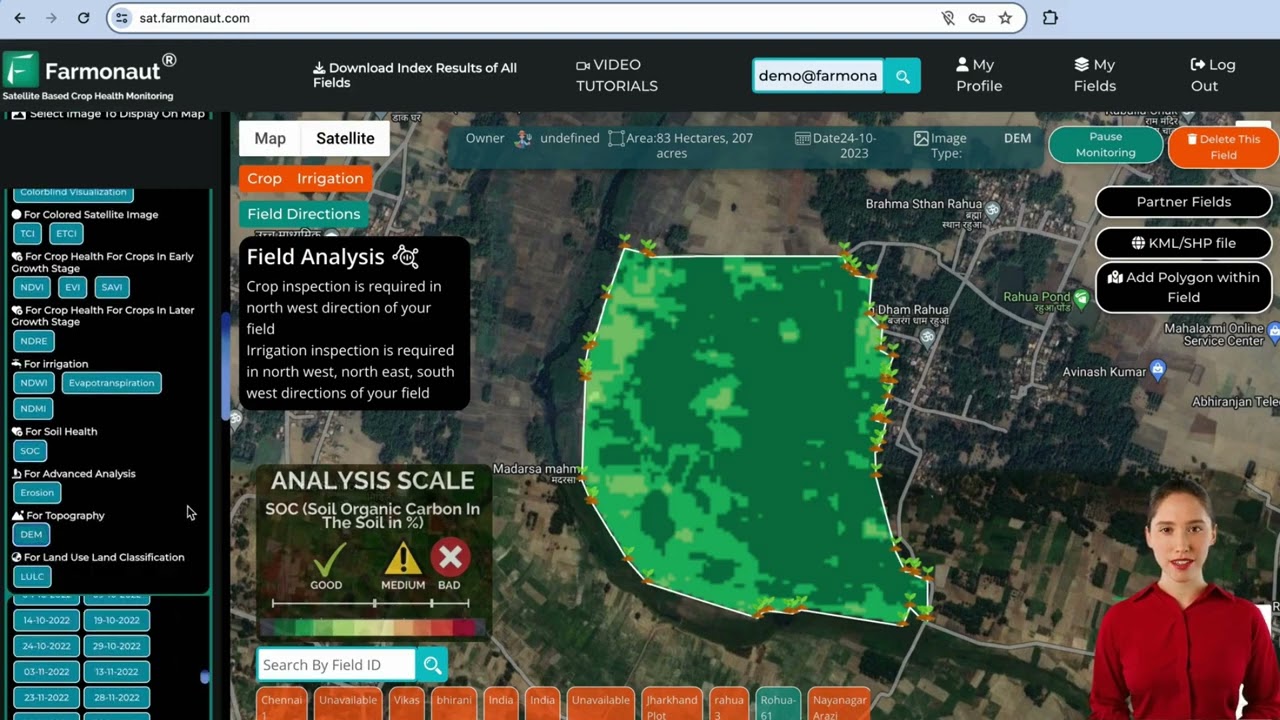
▶ Tutorial: drawing fields and reading satellite crop maps in the web app. · 8:02
Farmonaut crop monitoring
Watch your fields before the truck scale
Map your fields once and Farmonaut shows satellite vegetation maps for them through the season, on web, Android or iOS.




Keep reading


Sources
- AFSC, Grain Conversion Table (2013 program year onward): afsc.ca
- Statistics Canada, Weights and Measures and Other Interpretative Data (Canada Year Book reference): www66.statcan.gc.ca
- Statistics Canada, The Daily: Production of principal field crops, November 2025: www150.statcan.gc.ca
- Agriculture and Agri-Food Canada, Canada: Outlook for Principal Field Crops, 20 August 2026: agriculture.canada.ca
- Agriculture and Agri-Food Canada, Advance Payments Program: agriculture.canada.ca
- Canadian Grain Commission, Test weight for Canadian grains: grainscanada.gc.ca
- Canola Council of Canada, Canola Encyclopedia: Harvest management: canolacouncil.org
- Farm Credit Canada, 2025 Farmland Values Report: fcc-fac.ca
- Farm Credit Canada, Financing: fcc-fac.ca
- Agricultural Land Commission (British Columbia): alc.gov.bc.ca
- USDA Economic Research Service, Weights, Measures, and Conversion Factors for Agricultural Commodities and Their Products: ers.usda.gov
Discussion
Questions, corrections or field experience? Share them below. First-time comments are reviewed before they appear, and your email is never published.
No comments yet. Be the first to add a question or your experience.

 Byju’s
 Kubota
 FFBS
 Jontra
 Kalustyan
 Tucor
 Geno
 Hayleys Agriculture
 Linx Agritech
 Adinet
 Save Your Soils
 Grandstream Algérie
 XOS Realty
 Geospatial Lab Africa

 Licence holder · Niger · Gold
 Client · Tanzania · Gold
 Client · Somalia · Gold
 Client & affiliate partner · Ghana · Gold










