

Lihir, Papua New Guinea · Mine profile
Lihir Gold Mine: Output, Costs, Reserves and Mine Life
Newmont's open pit on Aniolam Island produced 585,000 oz of gold in 2025 and held 16.0 Moz of reserves at year-end. Here are its costs, processing route, lease dates and the project meant to extend it past 2040.
Key takeaways
- Output: 585,000 oz in 2025 and 405,000 oz in the nine months to September 2026 (Newmont).
- Cost: AISC of US$1,607 per oz in 2025, rising to US$1,798 in the first nine months of 2026.
- Reserves: 220.2 Mt at 2.26 g/t for 16.0 Moz at 31 December 2025, all probable.
- Growth: the US$500-550 million Nearshore Barrier should open over 5 Moz at Kapit, with completion expected in 2028.
- Watch: the Special Mining Lease expires in March 2035, and El Niño drought may affect fourth-quarter 2026 output.
In this article
- Lihir gold mine at a glance
- How much gold does Lihir produce
- Lihir costs per ounce and what moves them
- Calculator: ounces and margin from your own inputs
- Lihir gold reserves and resources
- Geology of the Ladolam deposit
- How Lihir mines and processes gold
- Nearshore Barrier, Kapit and mine life beyond 2040
- Sustainable mining at Lihir: tailings, water and community
- What consultants and investors should check
- Frequently asked questions
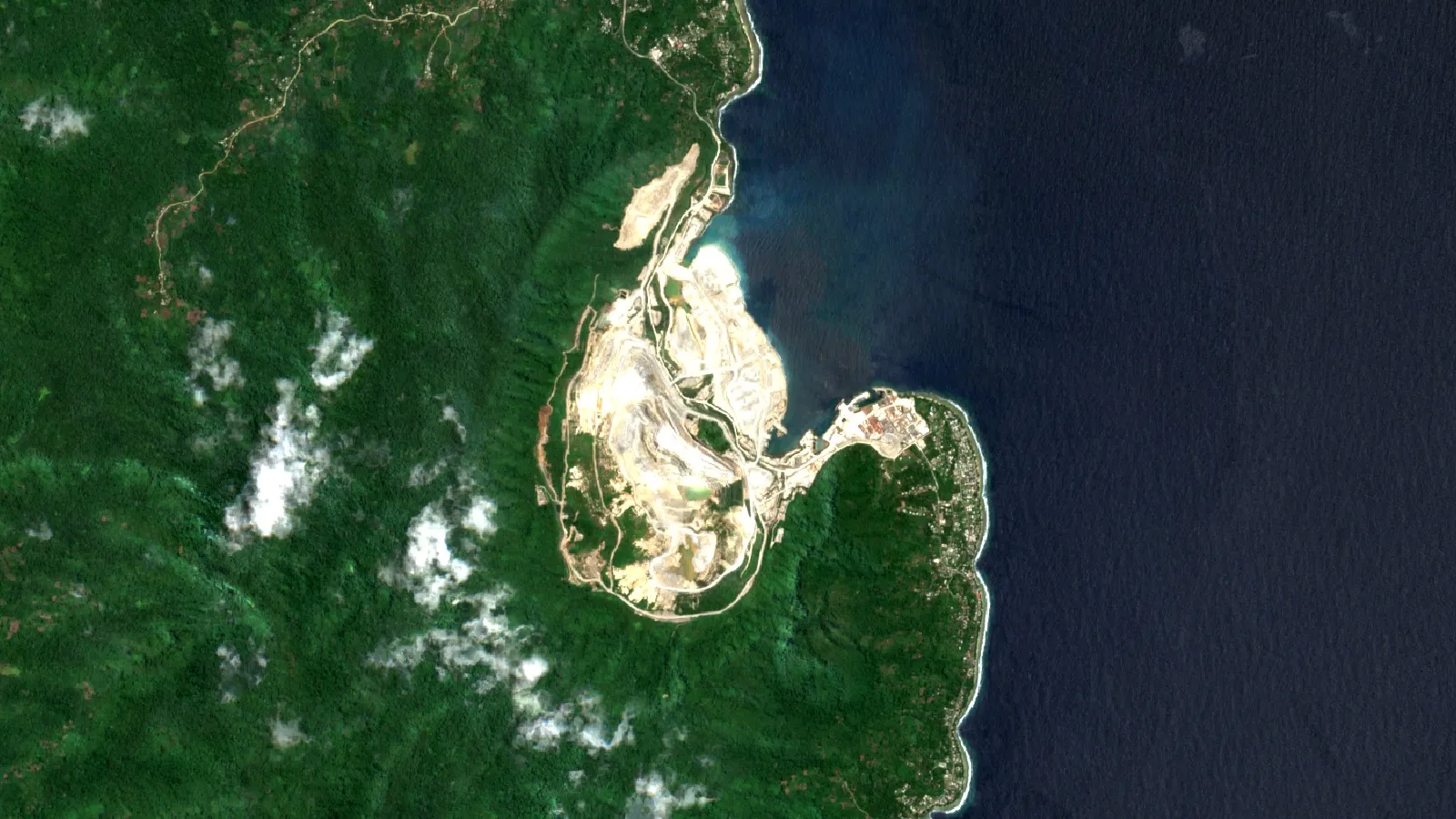
The Lihir gold mine is a 100% Newmont-owned open pit on Aniolam Island (Lihir Island) in Papua New Guinea. It produced 585,000 ounces of gold in 2025 at an all-in sustaining cost of US$1,607 per ounce, and it held 16.0 million ounces of reserves at the end of that year, according to Newmont’s 2025 annual report.
This page sets out what consultants and investors usually want first: output by quarter, unit costs, reserves, the processing route, the lease dates and the project meant to carry the operation past 2040. Mine figures come from company filings and are dated. A calculator lets you turn your own tonnes, grade and price into ounces and margin.
Some terms up front. A troy ounce is 31.1035 grams. Grade is the gold in each tonne of ore, in grams per tonne (g/t). All-in sustaining cost (AISC) is the miner’s measure of the cost of producing an ounce plus the spending needed to keep producing. Costs applicable to sales (CAS) is the narrower site cost of the ounces sold.
Lihir gold mine at a glance
| Item | Fact | Date of figure |
|---|---|---|
| Owner | Newmont, 100% | 2025 annual report |
| Location | Near Londolovit, Aniolam Island, about 900 km northeast of Port Moresby | 2025 annual report |
| Mine type | Open pit, with a plant first commissioned in 1997 | 2025 annual report |
| Deposit type | Epithermal gold, inside the Luise Caldera | 2025 annual report |
| Gold produced | 585,000 oz | Calendar 2025 |
| AISC | US$1,607 per oz | Calendar 2025 |
| Reserves | 220.2 Mt at 2.26 g/t for 16.0 Moz | 31 December 2025 |
| Licence area | About 25,700 hectares (63,506 acres) | 2025 annual report |
| Fleet | Nine hydraulic shovels and 40 haul trucks of 90 to 131 tonnes | 2025 annual report |
| Royalty and levy | 2% State royalty plus a 0.5% production levy | 2025 annual report |
Chart
Gold produced at Newmont's largest reported sites
Thousand ounces, calendar 2025; Nevada Gold Mines at Newmont's 38.5% share
Newcrest bought Lihir in 2010 and Newmont took full ownership when it acquired Newcrest in 2023. By ounces produced, MINING.COM ranks it 15th among the world’s largest gold mines on 2025 output. Within Newmont, it was the third-largest source of gold ounces in the company’s reported 2025 list. At about 18 tonnes, its 2025 output equals roughly 0.6% of the 3,300 tonnes of world mine production estimated by USGS (2026). PNG’s Ministry of Mining called it the country’s largest gold producer in an update built on 2020 figures.
Readers who want the wider picture can compare it with our ranking of gold mines by ounces and the top 20 gold mining companies. For the country context, see the Papua New Guinea economic outlook and our note on mining and GDP.
How much gold does Lihir produce
Output was 614,000 oz in 2024 and 585,000 oz in 2025. For the nine months to 30 September 2026 it was 405,000 oz, against a full-year guide of about 560,000 oz given in February 2026. That leaves roughly 155,000 oz for the fourth quarter to meet the guide, a little above any quarter of 2026 so far except the second.
Chart
Lihir gold production by quarter
Thousand ounces, first quarter 2025 to third quarter 2026
| Measure | 2024 | 2025 | Nine months to Sep 2026 |
|---|---|---|---|
| Open pit tonnes mined (kt) | 34,515 | 30,984 | 22,050 |
| Ore milled (kt) | 10,885 | 10,072 | 7,721 |
| Mill grade (g/t) | 2.334 | 2.344 | 2.102 |
| Mill recovery | 74.8% | 77.1% | 76.4% |
| Gold produced (koz) | 614 | 585 | 405 |
| CAS (US$/oz) | 1,270 | 1,297 | 1,547 |
| AISC (US$/oz) | 1,512 | 1,607 | 1,798 |
Sources: Newmont 2025 annual report and third-quarter 2026 operating statistics, published 22 October 2026. Unit costs for 2026 are by-product figures as Newmont reports them.
Quarterly numbers move around. They ran from 164,000 oz in the first quarter of 2025 down to 113,000 oz in the first quarter of 2026. The second quarter of 2026 recovered to 157,000 oz as milling rose to 3.0 Mt, per the second-quarter statistics, and the third came in at 135,000 oz.
Newmont put the third-quarter dip against the second quarter down to planned maintenance, and said the site finished its shutdown in September and is positioned to reach higher-grade ore. The same release warns that El Niño conditions are affecting water supply at the site and that the resulting drought may affect fourth-quarter production and costs. The annual report records an earlier case of this: drought in New Ireland Province cut milling rates by limiting raw water to the plant.
Lihir costs per ounce and what moves them
AISC rose from US$1,512 per oz in 2024 to US$1,607 in 2025 and US$1,798 in the first nine months of 2026. The third quarter alone was US$1,912. Newmont’s February guide for 2026 was CAS of US$1,475 and AISC of US$1,765, and it explained the increase mainly by inventory costs from processing stockpiles.
Chart
Lihir unit costs: 2025 against the first nine months of 2026
US$ per ounce of gold
Three things drive that figure. The first is grade: stockpiled ore in the reserve runs at 1.65 g/t against 2.55 g/t for open pit ore, so more stockpile feed means fewer ounces from each milled tonne. The second is ounces sold, because site costs are spread over fewer ounces in a weak quarter. The third is price-linked royalties. For scale, spot gold was US$4,122 per ounce at 12:01 p.m. ET on 5 November 2026 (Kitco), though a realized price and spot will differ.
Two payments are worth entering in any model of this asset: the 2% State royalty on realized bullion prices, less transport and refining, and the 0.5% levy to the Mineral Resources Authority on gross income from mineral sales.
Calculator: ounces and margin from your own inputs
The relationship is simple: ore milled, times grade, times recovery, gives ounces. The 2025 figures check out on that basis, since 10.072 Mt at 2.344 g/t and 77.1% recovery gives about 585,000 oz. Change the inputs to test a higher-grade or a lower-throughput year.
Calculator
How many ounces and how much margin does a year produce?
Enter your own ore tonnes, grade, recovery, price and cost.
- Margin per ounce (US$): $2,200
- Annual margin before tax and growth capital (US$): $1,252,656,453
Example values only, not a forecast for Lihir. Tonnes, grade and recovery are round figures close to Newmont's 2025 report, and the AISC is a round example. The gold price is an input: example, use today's price (US$ per ounce). The margin ignores tax, interest and growth capital.
Lihir gold reserves and resources
The whole reserve is in the probable category, which means no tonnes are classed as proven. Figures below are at 31 December 2025 and on Newmont’s 100% share, from the annual report, which gives a metallurgical recovery of 76% for the reserve.
Chart
Lihir gold by reserve and resource class
Million ounces at 31 December 2025, 100% basis
| Category | Tonnes (Mt) | Grade (g/t) | Gold (Moz) |
|---|---|---|---|
| Probable reserve: open pits | 147.9 | 2.55 | 12.1 |
| Probable reserve: stockpiles | 72.3 | 1.65 | 3.8 |
| Total reserve | 220.2 | 2.26 | 16.0 |
| Measured and indicated resource | 37.5 | 1.99 | 2.4 |
| Inferred resource | 239.8 | 2.4 | 18.3 |
A resource is mineralised rock with reasonable prospects of being mined. A reserve is the part shown to be economic under a mine plan. Inferred material has the lowest geological confidence. Newmont’s totals come to 20.7 Moz of resources, reported in addition to reserves, and the two should be read separately, not as a single recoverable figure. The open pit reserve holds about 12 Moz of gold. At 76% recovery, that would be about 9 Moz recovered.
Geology of the Ladolam deposit
Newmont describes Lihir as an example of an epithermal gold deposit, meaning gold laid down by hot fluids at fairly shallow depth. The island is part of a 250 km chain of alkalic volcanic islands, in a zone of micro-plates between the converging Australian and South Pacific plates. It is made of two older volcanic blocks and three younger volcanic centres called Huniho, Kinami and Luise.
The mine sits inside the Luise Caldera, on the east coast of the island. The caldera is still geothermally active, with hot springs and fumaroles. A 1991 AusIMM paper on the deposit, known in the literature as Ladolam, places it in altered volcanic rock on the caldera floor, part of which now forms Luise Harbour. It describes an early porphyry-style alteration, then brecciation and veining, with gold deposited as fluids boiled and mixed in open breccias.
Newmont’s filings list geothermal conditions among the site’s operating risks. Our guide to types of gold deposits shows how this style differs from others.
How Lihir mines and processes gold
The plant does not use heap leaching. The annual report describes crushing and grinding, an optional bulk sulphide flotation step, then pressure oxidation, followed by gold recovery from the washed oxidized slurry through cyanidation and electrowinning. The product is doré, a bar of mixed gold and silver sent on for refining.
Pressure oxidation is used on ore in which gold is locked inside sulphide minerals. Heating the slurry under oxygen pressure breaks down the sulphides so cyanide can reach the gold. Mill recovery here was 74.8% in 2024 and 77.1% in 2025. For a contrast with easier ore, see our note on oxidized gold ore.
- Water: the Londolovit River is the main source for the process plant, which is why drought matters here.
- Waste rock: managed on harbour platforms and at permitted barge dumping locations.
- Tailings: deep-sea tailings placement in a deep-ocean location, not a tailings dam.
- Power: steam on the island has fed geothermal generation. The previous owner, Lihir Gold, reported 56 MW of capacity in its 2008 annual report, and also noted inconsistent steam from some wells that year.
Open pit teams comparing blasting and pit-control tools may also want our review of drill and blast monitoring software.
▶ Follows gold from rock to ring: drilling, crushing, dissolving, melting and refining. · 5:27
Nearshore Barrier, Kapit and mine life beyond 2040
The main growth project is the Nearshore Barrier, a water seepage barrier that opens up further phases of the Kapit ore body. According to Newmont’s February 2026 release, it should allow production of over 5 million ounces and extend mine life beyond 2040. Estimated development capital is US$500 million to US$550 million, with completion expected in 2028.
The October 2026 release says development spending in 2027 will rise as work on this barrier and another project ramps up, and that higher-grade ore at Lihir is part of the company’s expected production growth in 2027.
One date needs watching. The Special Mining Lease and most other leases expire in March 2035 (the Exploration License and two Mining Leases are subject to renewal), while the planned life runs past 2040. Newmont’s annual report lists changes in PNG law and policy as a possible risk to extending the lease, and notes that the government has said it wants more benefit from extractive projects. A mining ministry update built on 2020 figures suggested closure around the mid-2050s, so treat any end date as a plan, not a fixed fact.
Sustainable mining at Lihir: tailings, water and community
Newmont’s 2025 sustainability report gives the most recent site-level detail. The facts below are what the company reports, not an independent audit.
- Local jobs: Lihirans made up 29.9% of employees at the end of 2025, above a 20% target.
- Health: the company runs the Lihir Medical Centre for staff and a wider community of about 30,000 people. It costs about PGK20 million a year, and its maternity ward delivered more than 30 babies a month in 2025.
- Education: a School to Mine program helps teachers upgrade qualifications and gives young people outside school work-ready skills, with scholarships through the Lihir International School.
- Marine monitoring: the site completed a five-year update to its marine environmental impact assessment, with results planned for stakeholders in 2026.
- Biodiversity: a biodiversity action plan, built with outside biologists, was submitted to regulators.
- Water: the site appointed a water lead and updated its water management plan and water balance.
- Community commitments: Lihir was the one operating site that did not complete all of its commitments by their due dates in 2025, and it had not yet put in place the tracking system reported under the complaints and grievances target.
Newmont states that deep-sea tailings placement does not qualify as a tailings storage facility under its own definition or that of the global tailings standard. The annual report also notes civil reinforcement work around the Ailaya Rock, a culturally significant site close to the mine. Our separate piece covers the mine’s biodiversity and community impact in more depth.
▶ Explains seven environmental impacts of mining in plain words. · 2:31
What consultants and investors should check
- Grade against plan: compare each quarter’s mill grade with the 2.26 g/t reserve average and see whether the promised higher-grade ore arrives.
- Stockpile share: ore feed from stockpiles lowers ounces per tonne and raises unit cost.
- Water and weather: watch for drought or heavy rain, both of which have cut performance in the past.
- Barrier schedule: track capital spent against the US$500 million to US$550 million estimate and the 2028 finish.
- Lease extension: follow progress before March 2035, and any change to PNG mining law.
- Geotechnical risk: the filings flag seismic events, tidal surge and tsunami risk, and geothermal conditions at this site.
For early-stage ground elsewhere in the same kind of volcanic belt, satellite imagery can help a consultant map alteration before drilling. It gives exploration targets, not a resource estimate. Farmonaut offers this kind of screening for a licence boundary. The company’s other pages cover carbon footprinting, fleet management, product traceability, crop loan and insurance and its weather API, with the app and home page linked here.

▶ Explains how satellites map the rock around gold rather than the gold itself. · 4:25
Frequently asked questions
Who owns the Lihir gold mine?
Newmont owns 100%. Newcrest bought the mine in 2010, and Newmont gained it through its acquisition of Newcrest in 2023 (Newmont annual report).
Where is Lihir in Papua New Guinea?
It is on Aniolam Island, also called Lihir Island, in New Ireland Province. The site is near the town of Londolovit, about 900 km northeast of Port Moresby, and Kunaye airport is about 7 km to the north.
How much gold does Lihir produce per year?
It produced 585,000 oz in 2025 and 614,000 oz in 2024. Newmont guided to about 560,000 oz for 2026 and reported 405,000 oz through 30 September.
Is the Lihir mine still operating?
Yes. Newmont reported 135,000 oz from the site in the third quarter of 2026, a period that included a planned maintenance shutdown completed in September.
Is Lihir mine built in a volcano?
It sits inside the Luise Caldera, part of a volcano on the east coast of the island. The caldera is geothermally active, with hot springs and fumaroles.
How long will the mine last?
Newmont says the Nearshore Barrier extends mine life beyond 2040. The Special Mining Lease, however, expires in March 2035, so an extension is needed.
What are the Lihir gold reserves?
Reserves were 220.2 Mt at 2.26 g/t for 16.0 million ounces at 31 December 2025, all in the probable class. Resources in addition to that were 20.7 million ounces.
Does Lihir use heap leaching?
No. The plant uses grinding, optional flotation, pressure oxidation, then cyanidation and electrowinning.
Where do Lihir tailings go?
They go to a deep-ocean location through deep-sea tailings placement. Newmont notes this is not a tailings storage facility under its own or the global standard’s definition.
What is the royalty on Lihir gold?
A 2% royalty goes to the State on realized bullion prices, less transport and refining, plus a 0.5% production levy to the Mineral Resources Authority, per the annual report.
This page is for information only. It is not investment advice. Check the company's own filings before you decide anything.
Farmonaut mining
Map your mining site from space
Consultants can screen a licence area with satellite data to find exploration targets ahead of a resource estimate.

Mining Pro sample view, synthetic data
Keep reading
Sources
- Newmont, 2025 annual report (Form 10-K): s24.q4cdn.com
- Newmont, third-quarter 2026 results release (22 October 2026): sec.gov
- Newmont, third-quarter 2026 operating statistics: s24.q4cdn.com
- Newmont, second-quarter 2026 operating statistics: s24.q4cdn.com
- Newmont, fourth-quarter 2025 operating statistics: s24.q4cdn.com
- Newmont, fourth-quarter and full-year 2025 results and 2026 guidance: sec.gov
- Newmont, 2025 Annual Sustainability Report: s24.q4cdn.com
- USGS, Mineral Commodity Summaries 2026: Gold: pubs.usgs.gov
- Kitco, gold spot price (5 November 2026): kitco.com
- MINING.COM, world's top 20 largest gold mines (2026): mining.com
- AusIMM, Geology and Mineralisation of the Ladolam Gold Deposit (1991): ausimm.com
- ThinkGeoEnergy, Update on Lihir Gold and its geothermal power plant: thinkgeoenergy.com
- PNG Ministry of Mining, Ministerial update on the mining sector: mra.gov.pg
Discussion
Questions, corrections or field experience? Share them below. First-time comments are reviewed before they appear, and your email is never published.
No comments yet. Be the first to add a question or your experience.

 Timestream Mining
 Lithspo Minerals Limited
 Tintina Mining Group
 Dalgety Minerals Pty Ltd
 Vortex Minerals Pty Ltd
 Faith At Work (Pty) Ltd
 Geotech Mining Solutions plc
 Vulcan International Limited
 Kidepo Associates
 GKY Mining
 Alkimy SARL
 Double A Trading
 GemSprout Metals Limited
 Qader Group
 Ileys General Trading
 SG Gold Mining LLC
 VRV Global Pte Ltd
 Omsri International FZE
 G.I.T.T.
 Jaunita Erss Ltd
 Almosi SARL
 SRK Consulting
 Berks Gold Limited
 Mwerezi Minerals Company Limited

 Exploration consultancy · South Africa · Gold










