

Agriculture Drones Market Analysis 2026: Key Trends
“By 2026, the global agriculture drones market is projected to surpass $6 billion, driven by rapid precision farming innovations.”
Market Overview: Agriculture Drones Market Analysis 2026
The agriculture drones market analysis for 2026 reveals a sector undergoing a true technological revolution. Drones are playing a pivotal role in enhancing productivity, resource management, and decision-making processes for farmers worldwide. Drones—and associated platforms—have emerged as one of the most critical segments within precision farming, driven by rising demand for higher-quality food, improved resource utilization, and robust crop health.
By 2026, the global agriculture drones market is projected to reach new heights in both size and sophistication. With the world facing a growing population, the need to meet food demand is more urgent than ever. Drones provide timely, accurate, and actionable data—enabling farmers to respond proactively to climate variability, resource shortages, and pest outbreaks.
Key regional leaders—including the United States, China, and India—continue to dominate adoption through favorable government initiatives, high investment, and advanced research in agriculture technology. In Europe, regulatory support for sustainability and digitization is driving significant growth in both commercial and smallholder farms.
“Over 70% of large farms worldwide are expected to implement drone-based crop monitoring by 2025, transforming farming analytics.”
Key Global Agriculture Drone Market Trends: 2021–2026
| Year | Estimated Market Size (USD Million) | Adoption Rate (% of Farms) | Major Applications | Notable Technology Trends |
|---|---|---|---|---|
| 2021 | $2,300 | 15% | Crop Monitoring, Mapping | Basic Multispectral Imaging |
| 2022 | $2,900 | 23% | Precision Spraying, Scouting | Thermal Imaging, Simple AI Integration |
| 2023 | $3,700 | 33% | Crop Health Diagnosis, Variable Rate Application | Enhanced Payloads, Data Analytics |
| 2024 | $4,600 | 46% | Irrigation Management, Planting, Seed Distribution | Cloud Integration, IoT Platforms |
| 2025 | $5,350 | 60% | Autonomous Scouting, Livestock Tracking | Advanced AI, Multi-Spectral Imaging, Edge Computing |
| 2026 (Projected) | $6,110 | 72% | Hyper-local Weather Analysis, Swarm Drones | Swarm Technology, Full Automation, Blockchain Traceability |
Key Drivers in the Agriculture Drones Market Analysis
Several factors continue to fuel the robust growth and rising adoption seen in our agriculture drones market analysis for 2026:
- Precision Agriculture and Data Analytics
- Labor Shortages and Cost Efficiency
- Rapid Technological Advancements
- Government Support, Policies, and Subsidies
- Environmental Sustainability Initiatives
By reducing input costs and maximizing operational efficiency, drones offer transformative value for all sizes of farms and increasingly for agricultural supply chain monitoring. Notably, platforms like Farmonaut now enable environmental impact monitoring and carbon footprinting, directly supporting sustainability goals via satellite data—not just drones.

Precision Agriculture & Satellite Analytics Innovation
Precision farming revolutionizes how farmers use data for efficient decision-making. In 2026, drones equipped with multispectral, thermal, and high-resolution RGB cameras provide vital data—from crop health to soil moisture—directly to precision agriculture platforms.
How Drones Enable Precision Decisions
- Crop Health Assessment: Drones collect NDVI and other vegetation health indexes, helping farmers address pests, disease, and nutrient deficiencies more accurately than ever before.
- Resource Optimization: They help implement variable-rate fertilization and irrigation schedules, reducing waste and improving yields.
- Environmental Monitoring: Real-time monitoring supports carbon footprint tracking, which is increasingly critical for sustainable farming and regulatory compliance.
Platforms like Farmonaut extend this capability even further, utilizing satellite-based monitoring for fields, delivering AI-powered insights for crop management, water usage, and resource allocation.

Major Applications in the Agriculture Drones Market
The agriculture drones market analysis for 2026 spotlights several key applications and use cases transforming modern farming practices:
- Crop Health Monitoring & Scouting:
- Drones rapidly identify plant health conditions, pest infestations, and diseases, facilitating targeted and rapid interventions.
- Large-scale farm management applications assist in monitoring thousands of hectares using satellite and drone data—helping decision-makers prioritize fields requiring attention.
- Irrigation Management:
- Drones, using thermal imaging, detect variations in soil moisture and water stress, ensuring efficient irrigation schedules and reducing water usage.
- Precision Application (Spraying & Seeding):
- Equipped with spraying systems, drones enable precise application of pesticides, herbicides, and fertilizers, directly reducing chemical drift and improving environmental outcomes.
- Emerging models perform seed distribution and even micro-planting—supporting reforestation and soil restoration projects.
- Integrate with fleet and resource management solutions for optimal use of all agricultural vehicles and machinery.
- Yield Estimation & Mapping:
- With the rise of AI-powered analytics, drones estimate yields and provide accurate mapping for harvest planning and supply chain transparency.
- Blockchain-based product traceability solutions add an extra layer of value, enhancing security and safety in supply chains.
- Insurance and Risk Assessment:
- Drone and satellite data streamline crop loan and insurance processes, validating field conditions, and reducing fraud risk for financial institutions.


Technology Trends and Advancements
The technological advancements in drone hardware, analytics platforms, and AI are defining the next generation of agriculture. Here’s what our agriculture drones market analysis reveals for 2026:
Top Technological Trends
- Longer Flight Times & Heavier Payloads: Enabling drones to cover larger farmland acreage and perform more complex tasks, such as multi-crop spraying and precision planting.
- AI-Driven Image Analysis: Machine learning algorithms identify crop and soil health anomalies from drone imagery, allowing for automated, predictive management.
- Swarm Drone Technology: Swarms of drones work collectively for massive farms, enhancing operational efficiency and reducing the time needed for monitoring and spraying.
- IoT and Cloud Integration: Real-time data from drones is instantly analyzed and visualized in the cloud. With fleet management solutions, farm operational efficiency reaches new heights.
- Blockchain-Based Traceability: Supply chain traceability systems leverage drone/satellite data to establish product authenticity.
- Edge Computing: Drones process more data onboard, reducing transmission times and providing instant feedback to farmers.
These trends echo the demand for reliable, scalable, and innovative platforms—the core mission of Farmonaut.

Challenges and Barriers in the Agriculture Drones Market
Despite impressive growth and potential, several challenges restrict wider drone adoption:
- Initial Investment & Cost Barriers: High acquisition and maintenance costs, although satellite and API-driven alternatives offer cost-effective options.
- Lack of Skilled Operators: The need for training and reliable technical support can delay deployment for small and medium farms.
- Data Security & Privacy Concerns: Confidentiality of farm data, secure ownership, and blockchain solutions are crucial for trust and transparency.
- Regulatory Restrictions: Airspace laws, especially in North America, Europe, China, and India, affect when and how drones can be operated for agriculture.
- Connectivity Challenges: Remote farmland often lacks adequate internet for cloud-based drone platforms. Here,aggregated satellite data platforms can help bridge the gap.
- Smallholder Adoption: Many developing-country smallholders face financial and educational barriers in deploying this technology—remedies include government aid, private sector partnerships, and service-based models.
In parallel, agricultural films market analysis and agricultural tires market analysis also show how drones interact with other input sectors, guiding efficient usage, maintenance, and resource allocation for associated agricultural products.
Regional Analysis: Adoption and Policies
The adoption and influence of agriculture drones are shaped deeply by local context. Here’s how the landscape looks in leading geographies:
North America
- Countries like the United States have the highest drone adoption rate, driven by supportive government policies and robust investment in agricultural research and technology.
- Large industrial farms leverage swarm drones for crop health monitoring, spraying, and logistics—optimizing operations, particularly through precision application.
Asia-Pacific: China & India
- China: With extensive government support, China has become a global leader in drone manufacturing and precision farming innovation. Adoption is rising especially among horticulture and rice farms.
- India: Growth is particularly significant due to subsidies, policies, and climate-resilient farming initiatives. Indian farmers are rapidly embracing precision spraying and seed dropping drones to address labor shortages and improve crop yields.
Europe
- Adoption is fueled by sustainability regulations, precision farming EU directives, and strict environmental compliance. Drones are widely used for environmental monitoring, soil health analysis, and water management.
Additionally, South America and Africa are seeing rising awareness and pilots for drone-based solutions. While currently limited by infrastructure and economics, these regions are rapidly closing the gap with service-based models and government support.

The Future Outlook: 2026 and Beyond
As we look towards the future of precision agriculture, drones will play an even greater role in bolstering efficiency, sustainability, and farmer profitability. Key predictions for the agriculture drones market analysis 2026 and the coming decade:
- Advanced AI & ML Integration: Automated crop scouting, predictive analytics, and personalized agronomy will become the norm, speeding up diagnosis and intervention for every crop cycle.
- Democratization of Technology: Subscription-based platforms (e.g., Farmonaut) and service models will make high-tech solutions accessible to small and medium farmers.
- Battery and Swarm Tech Revolution: Improved power storage and cooperative drone operations will extend flight range, automate more tasks, and minimize human oversight.
- Multi-Modal Platforms: Combined use of drones, satellites, IoT devices, and autonomous ground vehicles will provide holistic real-time farm management solutions, covering crop health, water use, pest risks, and yield.
- Environmental Focus: Direct measurement and reporting of carbon and sustainability impacts will become standard for regulatory bodies and supply chain partners.
- Blockchain & Traceability: Secure, transparent product journey records, from field to consumer, will reshape food safety and supply chain trust using drone and satellite insights.
These agriculture drones market trends echo what’s happening in agricultural films market analysis, agricultural tires market analysis, and input markets: connected, data-driven agriculture is the future.
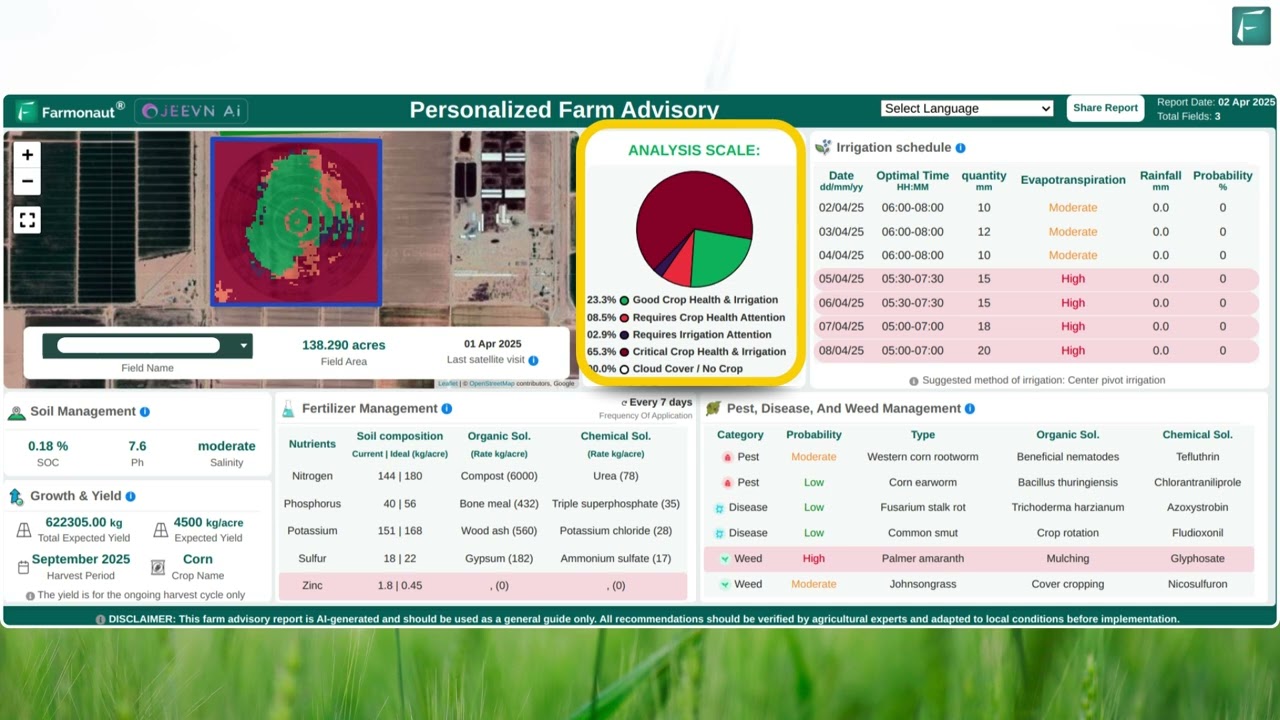



Access real-time crop health, irrigation, pest scouting, and sustainability analytics through Farmonaut’s intuitive web, Android, and iOS apps. Try the web platform here—no extra drone hardware required.
Developers and agribusinesses: Integrate advanced crop monitoring and precision farming analytics directly into your systems using the Farmonaut API and satellite weather API developer documentation. These resources provide scalable, actionable data for smarter farming fleets, from drones to harvesters.

Farmonaut’s Satellite Data: Empowering Modern Agriculture
At Farmonaut, we bring precision farming within reach using advanced satellite data, AI, and blockchain—not just drones. Our mission is to democratize access to actionable agriculture analytics, crop health monitoring, and resource management at scale.
- Satellite Imagery delivers multispectral data for field-level crop health, soil conditions, and real-time climate analysis. No drone hardware is required, but our insights integrate seamlessly with field drones and IoT platforms.
- Jeevn AI Advisory System analyzes live satellite data to provide farmers and agribusinesses with customized strategies on planting, irrigation, pest management, and yield optimization.
- Blockchain Traceability ensures food and resource authenticity. With a traceability system, every supply chain step is transparent and secure.
- Fleet & Resource Management tools optimize equipment usage, enhance operational efficiency, and reduce costs for large-scale farms, contractors, and agribusinesses.
- Environmental Impact Monitoring—track your carbon footprint and manage sustainable practices with real-time, regulatory-compliant analytics.
Our platform supports individual farmers, businesses, large landowners, and government agencies. Affordable, scalable, and easy to use—modern farming innovation is within everyone’s reach with Farmonaut.
Discover satellite-driven crop and resource management—click to access our platform.
FAQ: Agriculture Drones Market Analysis
What is driving the growth of the agriculture drones market into 2026?
The growth is fueled by demand for precision agriculture, efficiency gains, reduction in labor shortages, advanced analytics, and supportive government subsidies. Additionally, the integration of AI, blockchain, and real-time satellite data increases the utility of drones in monitoring, spraying, and resource management.
What are the main applications of drones in agriculture?
- Crop health monitoring and early pest/disease detection
- Irrigation scheduling using soil moisture and thermal imaging
- Precision application of seeds, fertilizers, and pesticides
- Yield estimation, mapping, and insurance claims validation
- Supply chain traceability and environmental impact monitoring
What are the common challenges faced by the sector?
- High initial costs and limited access for smallholders
- Data privacy/security concerns
- Regulatory hurdles and airspace restrictions
- Lack of skilled drone operators and connectivity in rural areas
How does Farmonaut empower modern agriculture?
We offer affordable, satellite-driven monitoring and AI-powered advisory for agricultural businesses, farmers, and institutions. Our cloud-based platforms deliver instant, actionable insights for crop health, irrigation, pest management, and sustainability without the need for costly on-ground hardware. Access our apps for seamless field management.
What is the role of blockchain in the agriculture drones market?
Blockchain enhances security, transparency, and trust in agricultural supply chains, allowing for secure traceability of crop origin, pesticide use, and environmental impact, all verifiable with satellite and drone data inputs. Explore more about traceability solutions by Farmonaut.
Conclusion
The agriculture drones market analysis 2026 highlights a world in which drones, supported by satellites, AI, and advanced platforms, are fundamentally transforming modern farming. As this market continues to exhibit robust growth, the leading-edge integration of data, cloud analytics, and sustainability practices positions global agriculture to address food security, climate variability, and rising demand.
As one of the fastest-growing segments in precision farming, drones enable efficient crop scouting, pest control, resource monitoring, traceability, and operational efficiencies—benefiting all stakeholders, from individual farmers to agribusiness and government agencies.
By leveraging solutions like Farmonaut, users can access real-time satellite insights, AI advisory, blockchain traceability, and comprehensive resource management tools—marking a new era for smart, sustainable, and productive agriculture.
Explore Farmonaut’s affordable, scalable platform for agricultural analytics, real-time monitoring, and sustainability at every scale—join us in building the resilient, data-driven agriculture of the future.

 Azure Clouds
 MCSOD
MCSOD Marei Nursery
 eKGIS
eKGIS Mostas Tech
 Native Seeds
 Andex
Andex FCF India
 Unifrutti Gulf
 Deluxe Conseil
 TVS Electronics
 WICO
WICO Chimera Innovation
 SkyHarvest
 Polaris Digitech
