

Farm machinery · Buyer guide
New Agriculture Equipment: 10 Machines and What Pays
Ten groups of new farm equipment, ranked by how much evidence backs them. Smart sprayers have the best independent result so far, from one season at Iowa State; full autonomy came out behind human-operated machines in Purdue’s 2026 model of a farm that can hire workers.
Key takeaways
- Smart sprayers saved 76% of post-emergence herbicide on average across five Iowa soybean fields, with a range of 43.9-90.6% (Iowa State, 2024).
- 70% of large-scale US crop farms used autosteer in 2023 (USDA ERS).
- New equipment prices rose over 20% from 2021 to 2023 (farmdoc daily, 2025).
- Purdue’s 2026 modeling found autonomy behind a human-operated baseline where labor is available.
- Hiring a contractor can beat owning at low acreage; the calculator finds your break-even.
In this article
- New agriculture equipment compared
- Why new farm machinery costs more than it did
- Ten types of new agriculture equipment, ranked by evidence
- What precision tools deliver overall
- How to choose new agricultural equipment
- Buy new farm equipment or hire a contractor?
- Where small and mid-size farms can start
- FAQ
New agriculture equipment falls into ten groups: smart sprayers, guidance and section control, satellite crop monitoring, soil sensors, spray drones, precision planters, laser weeders, autonomy kits, electric tractors and robotic harvesters. The strongest public evidence sits with tools that cut inputs, such as smart sprayers. In an Iowa State University demonstration, one sprayer system saved 76% of post-emergence herbicide on average across five soybean fields. The clearest warning on payback is for full autonomy where labor is available (Purdue, 2026).
This guide ranks each group by how much independent evidence backs it, not by how exciting it looks. It gives dated numbers, says who each machine suits, and includes a calculator to test owning a machine against hiring a contractor.
New agriculture equipment compared
This table shows what a named source says about each machine. Prices appear only where a source states them.
| Equipment | Main job | What the evidence shows | Evidence level |
|---|---|---|---|
| Smart sprayers | Spray only the weeds | 76% average saving in the post-emergence pass on five Iowa fields (Iowa State, 2024) | Best so far: one-season university demonstration |
| Guidance and section control | Cut overlap | 70% of large US crop farms used autosteer in 2023 (USDA ERS) | Strong on adoption: national survey |
| Satellite monitoring | Show crop change by zone | 10 m images about every 5 days from Sentinel-2 (ESA) | Good: public data, field checks needed |
| Soil moisture sensors | Time irrigation | US$100-700 for a single-depth sensor (University of Arizona, 2024) | Good: extension guidance |
| Spray drones | Spray hard-to-reach ground | US$20,000-40,000; drift needs care (Ohio State) | Mixed: limited operating data |
| Precision planters | Even seed placement | Part of planting tech; 3.3% overlap measured in older Iowa tests (Iowa State, 2012) | Mixed: dated local tests |
| Laser weeders | Kill weeds without herbicide | 0.5-1.5 acres per hour (maker’s figure) | Limited: maker data |
| Autonomy kits | Remove the operator | Behind human-operated machines in a model where labor is available (Purdue, 2026) | Limited: one modeled farm, weak payback |
| Electric tractors | Quiet, low-emission small jobs | 100 kWh and about 5 hours of work (Fendt e107 V Vario, maker’s figure) | Limited: maker data |
| Robotic harvesters | Pick fruit and vegetables | Results vary by crop and site | Limited: crop-specific |
Why new farm machinery costs more than it did
Price is the first filter for any purchase. Between 2021 and 2023, new agricultural equipment prices rose by over 20%, according to a farmdoc daily analysis from the University of Illinois (2025). USDA’s tractor price index moved from 100 in 2011 to 114 in 2020, then reached 138 in 2023. In other words, three years added more than the nine before them.
Chart
USDA tractor price index
Index, 2011 = 100, for the years the source states
The same analysis tracked costs on central Illinois corn farms with high-productivity land. Machinery costs rose from US$136 per acre in 2021 to US$171 in 2024, up 25%. Depreciation was the largest piece. Harvest often accounts for more than half of machinery costs, so the combine decision deserves a close look.
Chart
Machinery costs on central Illinois corn farms
US$ per acre, by cost item, 2021 and 2024
Ten types of new agriculture equipment, ranked by evidence
Each entry says what the machine does, what is known about results, and who it suits. Results depend on the crop, field and season, so treat each number as one data point.
1. Smart sprayers with cameras
Booms carry cameras and software that switch nozzles on only when they see a weed. Iowa State tested a John Deere See and Spray Ultimate machine on 415 acres of conventionally managed soybeans in one wet season, 2024. Savings by field ran from 43.9% to 90.6%, and weed pressure drove the difference. The average product saving was worth about US$15.70 per acre.
John Deere reported that its See and Spray users cut herbicide costs by nearly 60% on average in 2024, across over 1 million acres, in an AgWeb report. That is a maker’s number rather than an independent trial. One Illinois farmer in the report found he had mixed more product than he needed, so tank planning changes too.
Best for: row-crop farms with patchy weeds. Fields with heavy, even weed pressure save less. Always follow the product label and local rules.
2. Guidance, autosteer and section control
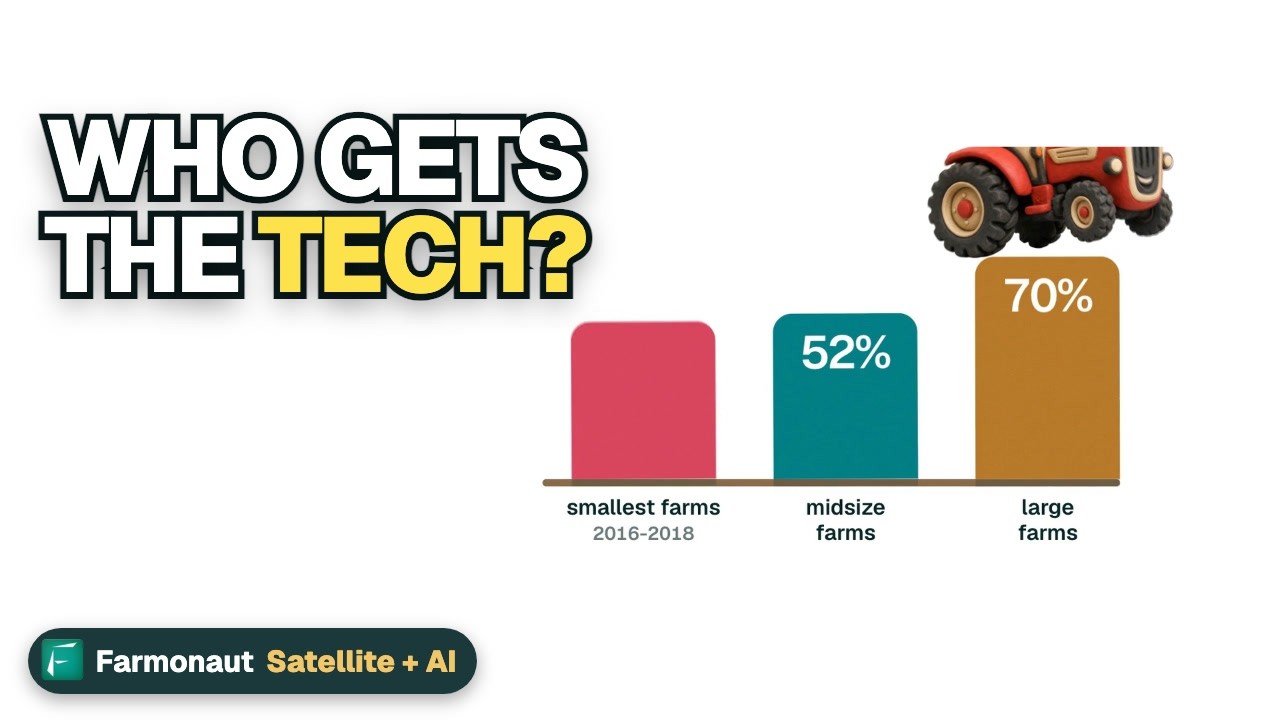
USDA ERS reports that 52% of midsize and 70% of large-scale US crop farms used autosteer in 2023, up from single digits in the early 2000s. On corn, a USDA report on digital farming shows autosteer rising from 5.3% of planted acres in 2001 to 58% in 2016.
Older Iowa State producer tests measured an average 3.3% overlap in planting and 7% in spring tillage. Those 2011 tests covered two Iowa producers and over 2,500 acres, so use them as a guide to where waste hides. Measure your own overlap from your machine’s as-applied maps.
Best for: almost any farm running large implements. It is often sold as a retrofit, so a new tractor may not be needed.
3. Satellite crop monitoring
Satellites are not machinery, but they can show where to send people and machines. ESA lists Sentinel-2 at 10 m resolution, 13 spectral bands and a 5-day revisit. Clouds reduce the number of usable images. Images show that a crop is changing; they do not name the cause, so someone still has to walk the field.
Services such as Farmonaut turn those images into vegetation maps for each field. The main value is deciding which part of a field to scout first.
Best for: farms with many scattered fields, and consultants who cover a lot of ground.
4. Soil moisture sensors and automated irrigation
Sensors show how much water sits in the root zone, so irrigation can be timed to need. The University of Arizona guide (2024) puts single-depth sensors at about US$100-700 and multi-depth units at US$600-1,750. Gateways cost about US$399-2,250, and repeaters about US$150-200. Data plans may be extra.
Placement decides whether the readings mean anything. Install in a spot that represents the field, and check the readings against soil you have dug.
Best for: irrigated crops where water or pumping is a big cost.
5. Spray drones
Drones can treat wet ground, steep slopes and small patches. An Ohio State fact sheet gives prices of US$20,000-40,000, and application rates in row crops of usually 1.5-2 gallons per acre. It warns that drift can be high with some boom designs, and that little operating data is available so far.
US rules apply. The FAA says 14 CFR Part 137 covers drones that dispense or spray substances, and it expects a Remote Pilot Certificate, drone registration, a Part 137 certificate and an exemption. It asks for exemption petitions at least 120 days ahead. Canada, the UK, the EU, Australia and New Zealand each have their own rules, so check locally and read the product label before spraying by air.
Best for: spot work and ground a sprayer cannot reach, or contractors with enough acres to justify the paperwork.
6. Precision planters
New planters combine row shutoff, individual row control and seed sensors. The aim is the same seed spacing and depth down each row, with no double planting. An older Iowa State article used a conservative estimate of 12% yield loss in double-planted areas, based on earlier research.
The USDA report found that adoption rises with farm size: at least half of larger row-crop farms used yield maps, soil maps, variable-rate technology or guidance, while under 25% of the smallest farms did (cotton excepted). Upgrading an existing planter is one way to test the idea first.
Best for: farms where seed cost is high and fields have many point rows or odd shapes.
7. Laser weeders
Carbon Robotics lists a 20 ft LaserWeeder implement that needs a tractor of at least 175 hp. It states 0.5-1.5 acres per hour and up to 99% weed kill, and says more than 100 growers across North America, Europe and Australia own and operate them. These are the maker’s figures. The slow work rate means this suits high-value crops much more than grain.
Best for: vegetable growers with high hand-weeding costs, including organic growers.
8. Autonomy kits and driverless tractors
At CES in January 2025, John Deere announced retrofit autonomy kits for model year 2022 and newer 9R and 9RX tractors and model year 20.5 and newer 8R and 8RX tractors, with 16 stereo cameras. Tillage was the first job. Dealers were to have limited kits in 2025, with a full launch planned for 2026, so ask your dealer what is available now.
The economics are harder. Purdue researchers (2026) modeled large autonomous machines on one case-study Midwest corn and soybean farm, with hired labor at about US$30 per hour. Where labor was available, autonomy came out behind a human-operated baseline: about US$3 per acre even in an ideal case, and US$63 per hectare (roughly US$25 per acre) in a realistic short-term case. They estimated labor would need to cost around US$140 per hour for autonomy to break even today. Farms that cannot find workers are the likely first users.
Best for: large farms short of operators, starting with tillage.
9. Electric and hybrid tractors
Electric tractors suit short, repeated jobs close to a charger. Fendt lists its e107 V Vario at 50 kW rated power, a 100 kWh battery and about 5 hours of operation. Fendt also says its carbon footprint falls below a comparable diesel after under 900 hours when charged from renewable power. Both are the maker’s claims.
Best for: orchards, vineyards, yards and livestock barns, where noise and fumes matter.
10. Robotic harvesters and post-harvest automation
Robot arms with machine vision are being developed for delicate crops, and automated lines sort, grade and pack produce. Costs and picking speeds vary too much by crop for a single useful figure. Ask any seller for measured picks per hour, damage rate and uptime on your crop, from a site you can visit.
Fleet software belongs here too, since it logs machine hours, fuel and maintenance. Traceability software is another neighbor. The FDA says Congress directed it not to enforce its Food Traceability Rule before July 20, 2028, which gives covered US businesses more time to set up records.
Best for: fruit, vegetable and packing operations with high seasonal labor costs.
Chart
Herbicide saved by a camera-guided sprayer
Percent saved, five soybean fields, 415 acres in total
What precision tools deliver overall
A 2021 study reported by AEM, the equipment makers’ trade group, credited precision agriculture with a 4% crop production gain, 7% better fertilizer placement, 9% less herbicide and pesticide, 6% less fossil fuel and 4% less water. Since the sponsor sells this equipment, read these as an estimate from the industry, not a promise for your farm.
Chart
Gains credited to precision agriculture
Percent change reported in a 2021 industry-sponsored study
USDA’s survey gives a useful reality check. The most common reasons farmers gave for adopting a technology were higher yields, saved labor, lower input costs, less fatigue and better soils. Robotic milking is its example of expensive equipment bought largely for labor savings.

▶ How satellites, AI and drones are used to help farmers grow food. · 13:27
How to choose new agricultural equipment
- Name the cost you want to cut. Write down the current figure per acre, whether that is herbicide, overlap, labor or water.
- Check the size of the prize. A 76% saving on a US$20 herbicide bill is worth less than it sounds on a small area.
- Try before buying. Hire a contractor, borrow a demo unit or test on one field with an untreated strip.
- Ask about repair access. In 2026 the US FTC reached a settlement with John Deere requiring it to make diagnostic and repair tools available to owners and independent shops. Ask any dealer what you can fix yourself.
- Check support and data. Find out who owns your data, whether the machine needs a subscription, and how close the nearest trained technician is.
- Get advice on the deal. Tax treatment, finance and leasing vary by country, so speak with your accountant or adviser before signing.
▶ What self-driving tractors and farm technology mean for rural towns, jobs and money. · 3:50
Buy new farm equipment or hire a contractor?
Hiring can be the cheaper way to use modern machinery at low acreage. The University of Wisconsin custom rate report (2025) shows an average boom sprayer rate of US$11.01 per acre and corn combining at US$38.47 per acre. These are survey averages for Wisconsin, so ask local contractors for current rates. Use the calculator with your own quote.
Try the numbers for your own farm below.
Calculator
Is owning cheaper than hiring a contractor?
Enter your own machine price, acres and contractor quote.
- Yearly cost of owning, before running: $12,240
- Cost per acre if you own: 20.24 US$/acre
- Break-even area: 1,020 acres
All defaults are examples near break-even, not benchmarks or forecasts; use today’s prices and your own quotes. Yearly ownership cost is straight-line depreciation plus interest on the average value. It leaves out tax, insurance, storage and timing benefits. Ignore the break-even area if your quote is at or below your running cost, because owning then never catches up.
Where small and mid-size farms can start
You do not need a robot to start. Retrofit guidance, used equipment with section control, a few soil sensors or a satellite map subscription all cost far less than a new machine. Sharing a machine with neighbors or hiring by the acre can bring bigger tools within reach, though timing can be tight when everyone needs them in the same week.

▶ Six plain steps to start precision farming without buying a robot. · 4:18
Related pages on our site: new farming techniques, US farm recession challenges, fleet management, large-scale farm management, product traceability, carbon footprint tracking, crop loan and insurance checks, satellite data API and API developer docs.
FAQ
What is the newest agriculture equipment?
Recent launches include camera-based autonomy kits, smart sprayers, laser weeders and small electric tractors. Availability differs by country and dealer, so confirm what you can actually buy locally.
What modern machines do farmers in the USA use?
Tractors with autosteer and combines with yield monitors are common on larger farms. USDA ERS found that 68% of large-scale crop farms used yield monitors, yield maps or soil maps in 2023.
Are autonomous tractors worth buying now?
For farms that can hire workers, Purdue’s 2026 modeling says not yet. They make more sense where a job would otherwise go undone because no operator is available.
How much does a spray drone cost?
Ohio State’s fact sheet gives US$20,000-40,000 for the drone. Batteries, training, certification and insurance can add to that, so get a full quote.
Which new farm equipment pays back fastest?
No single answer holds for all farms. Start with the machine that cuts your largest measured waste, then test it with the calculator and your own quotes.
Farmonaut crop monitoring
See your own fields from space
Draw your fields once and see satellite vegetation maps through the season, on web, Android or iOS.




Keep reading

Sources
- USDA ERS, Precision agriculture use increases with farm size (December 2024): ers.usda.gov
- USDA ERS, Precision Agriculture in the Digital Era, EIB-248: ers.usda.gov
- farmdoc daily, University of Illinois, Large increase in machinery costs (October 2025): farmdocdaily.illinois.edu
- Iowa State University Extension, Precision Spraying Technology (2024): crops.extension.iastate.edu
- Iowa State University Extension, Precision ag technology savings (2012): crops.extension.iastate.edu
- AgWeb, See and Spray: 5 things John Deere learned in 2024 (December 2024): agweb.com
- AgWeb, John Deere next generation perception autonomy kits (January 2025): agweb.com
- Purdue Commercial AgCast 206, When will autonomous farm equipment actually pay (2026): ag.purdue.edu
- Farm Policy News, University of Illinois, FTC settlement on right to repair (July 2026): farmpolicynews.illinois.edu
- Fendt, e100 V Vario product page: fendt.com
- Carbon Robotics, LaserWeeder product page: carbonrobotics.com
- Ohio State University, Drones for Spraying Pesticides, FABE-540: pested.osu.edu
- US FAA, Dispensing chemicals and agricultural products (Part 137) with UAS: faa.gov
- Association of Equipment Manufacturers, Environmental benefits of precision agriculture quantified (2024): aem.org
- University of Arizona Extension, Guidance on soil moisture sensor selection (2024): extension.arizona.edu
- European Space Agency, Sentinel-2 mission page: esa.int
- US FDA, FSMA Food Traceability Rule page: fda.gov
- University of Wisconsin Extension, Custom rates for 2025 Wisconsin farm operations: farms.extension.wisc.edu
Discussion
Questions, corrections or field experience? Share them below. First-time comments are reviewed before they appear, and your email is never published.
No comments yet. Be the first to add a question or your experience.

 Byju’s
 Kubota
 FFBS
 Jontra
 Kalustyan
 Tucor
 Geno
 Hayleys Agriculture
 Linx Agritech
 Adinet
 Save Your Soils
 Grandstream Algérie
 XOS Realty
 Geospatial Lab Africa

 Licence holder · Niger · Gold
 Client · Tanzania · Gold










