

Farm software · Price comparison
Best Farm Management Apps: Prices and No-Cost Plans
The right app depends on your farm. We compare nine options by farm type, no-cost plan and list price (checked 5 November 2026), with US farm technology data from USDA and a calculator to test whether a paid plan earns back its cost.
Key takeaways
- No-cost plans exist: FieldView Basic is $0 a year and Trello is $0 for up to 10 collaborators (list prices, 5 November 2026).
- Among published prices, paid entry plans run from $4.99 a month for 5 hectares of satellite monitoring to $1,795 a year for Agworld Grower Basic on its Australian price page (currency not stated).
- Publishers charge per account, user, hectare or animal, so work out one full year for your own farm.
- In USDA’s 2025 survey, 82% of US farms had a smartphone but only 55% had broadband, so test offline recording.
- Dairy farms need cow-level records, so check that a general app handles them before relying on it.
In this article
- Best farm management apps at a glance
- How we chose these apps
- Do farms actually use a farm management app?
- The nine apps, one by one
- What does a farm management app cost per year?
- Will a paid plan pay for itself?
- How to choose an app for farm management
- Do you need a dairy farm management app?
- Satellite data in a farm management app
- A simple way to start in one season
- FAQ
The best farm management app depends on what you run. For crop records with planter and combine data, Climate FieldView has a $0 Basic plan and a Plus plan from $649 a year (list price, checked 5 November 2026). For mixed farms, Farmbrite starts at $29 a month. For grazing herds, AgriWebb and Herdwatch fit better, and a Trello board costs nothing for simple jobs lists.
This guide compares nine options by farm type, list price and no-cost plan. It also shows who pays per user, per hectare or per animal, and it gives you a calculator to test whether a paid plan earns back its cost on your acres.
Best farm management apps at a glance
Prices below are the publishers’ list prices on their own pages on 5 November 2026. They exclude tax, and any dealer or first-year offers. Where a publisher asks you to enter your farm size or request a quote, the table says so.
| App | Best for | No-cost option | Paid list price |
|---|---|---|---|
| Climate FieldView | Row crops with connected machinery | Basic plan, $0 a year | Plus from $649 a year (US) |
| Farmbrite | Mixed crop and livestock farms | Trial | Essentials $29 a month or $290 a year; Complete from $59 a month |
| Bushel Farm | US grain farms that track sales | Trial | See publisher’s plans page |
| fieldmargin | Field maps and team jobs | Check publisher | See publisher’s pricing page |
| Agworld | Growers who work with an agronomist | 7-day trial | Grower Basic $1,795 a year on its Australian price page |
| AgriWebb | Beef and sheep herds | Trial | Base fee plus animal numbers; online calculator |
| Herdwatch | Cattle records in the pasture | Trial | Quote by farm type and herd size |
| Farmonaut | Satellite crop health checks | None | From $4.99 a month for 5 hectares |
| Trello | Simple task boards | $0 for up to 10 collaborators | $5 per user a month, billed yearly |
How we chose these apps
We kept apps that publish what they do on their own site and that serve farms in the US, Canada, the UK, Europe, Australia or New Zealand. We read each publisher’s product and price page on 5 November 2026. We did not run field trials, so this is a comparison of published features and prices, not a performance test.
One of the nine is our own product. We list it for the one job it does and say below where it does not fit. We left out star ratings because they change quickly and differ between app stores. We also corrected two points from older lists: FarmLogs now sits inside Bushel’s farm software, and AgriWebb is described by its publisher around cattle and sheep rather than as a dairy system.
Do farms actually use a farm management app?
The phone is already in the pocket. USDA’s Technology Use report of August 2025 found that 82% of US farms had a smartphone and 74% reached the internet through a cellular data plan. Only 55% had a broadband connection. USDA did not measure signal in the field, but check your coverage when you choose an app, because records made in the field may have to wait for signal.
Chart
Technology on US farms
Percent of US farms, 2025
Use of farm technology rises with farm size in USDA’s data, and other countries publish their own measures. USDA’s Economic Research Service says guidance autosteering was used by 52% of midsize farms and 70% of large-scale crop farms in 2023, with small family farms lowest in each technology group. In England, a third of farms used soil nutrient software in 2022/23. In Canada, 84% of field crop farms used GPS in 2021. These surveys measure different things, so do not compare them directly.
Chart
US farms with internet access
Percent of farms, selected survey years
The nine apps, one by one
1. Climate FieldView
Best for: corn, soybean and other row crop farms with connected machinery.
The FieldView price page lists Basic from $0 a year and Plus from $649 a year, billed yearly. Basic includes the cab app, account sharing and the data inbox. Script tools such as seed scripts are left out of Basic. Remember the note on the price page: features change, so read the current comparison before you buy.
2. Farmbrite
Best for: mixed farms that want crops, animals and tasks in one account.
The Farmbrite price page splits plans into Livestock and Grower, both starting at $29 a month, and Complete plans for both, starting at $59 a month. Paying yearly on Essentials costs $290 rather than $348. A separate accounting-only plan is listed at $119 a year.
3. Bushel Farm (formerly FarmLogs)
Best for: US grain farms that want field records tied to grain marketing.
The Bushel Farm page covers rainfall notifications per field, comparison with past seasons, and tracking of unsold bushels as prices change. The page offers a trial. Check the plans page for today’s price.
4. fieldmargin
Best for: teams that think in maps and jobs.
The fieldmargin site says you can map a farm in about 30 minutes, record crops and rotations, and assign field jobs to team members. It also has livestock tools and works offline in the field. That last point is useful where field signal is weak.
5. Agworld
Best for: growers who share plans and records with an agronomist.
The Agworld Australian price page lists Grower Basic at $1,795 a year, Grower Plus at $3,195 and Grower Pro at $3,995. A 7-day trial gives access to Pro features with no card needed. It is the highest published entry price here, though the page text does not state a currency, so it suits farms where shared agronomy records save real time. Ask for a local quote if you farm outside Australia.
6. AgriWebb
Best for: beef and sheep producers.
AgriWebb’s pricing help page explains the model: a base fee, plus a charge linked to your average livestock over 12 months. Cattle and sheep are priced differently, using a dry sheep equivalent of 8 for cattle and 1.5 for sheep. Enter your own numbers in its calculator, because a list price means little until you do. Mob records let you log one entry for a whole group.
7. Herdwatch
Best for: cattle farms that record at the crush or in the pasture.
The Herdwatch page describes offline recording of moves and weights, breeding and health dashboards, and grazing tracking. Your price comes from a quote based on farm type and herd size, and the page offers a trial first.
8. Farmonaut
Best for: crop growers who want to see field health from satellite data, on web or phone, without buying hardware.
This is our own product, and it does a narrower job than a full records system. It shows crop health maps at field level and includes AI advice. Plans are priced by the land you monitor: $4.99 a month for 5 hectares, $29.99 for 30 hectares and $64.99 for 80 hectares. It does not replace herd or accounting records, so pair it with one of the other tools here if you need those.
9. Trello or a spreadsheet
Best for: small teams starting out with jobs lists.
Trello’s price page lists a $0 plan for up to 10 collaborators per workspace, then Standard at $5 per user a month, billed yearly. Neither Trello nor a spreadsheet knows what a field or a withdrawal period is. You build every column yourself. They are a good test of whether your team will record anything at all, before you pay for more.
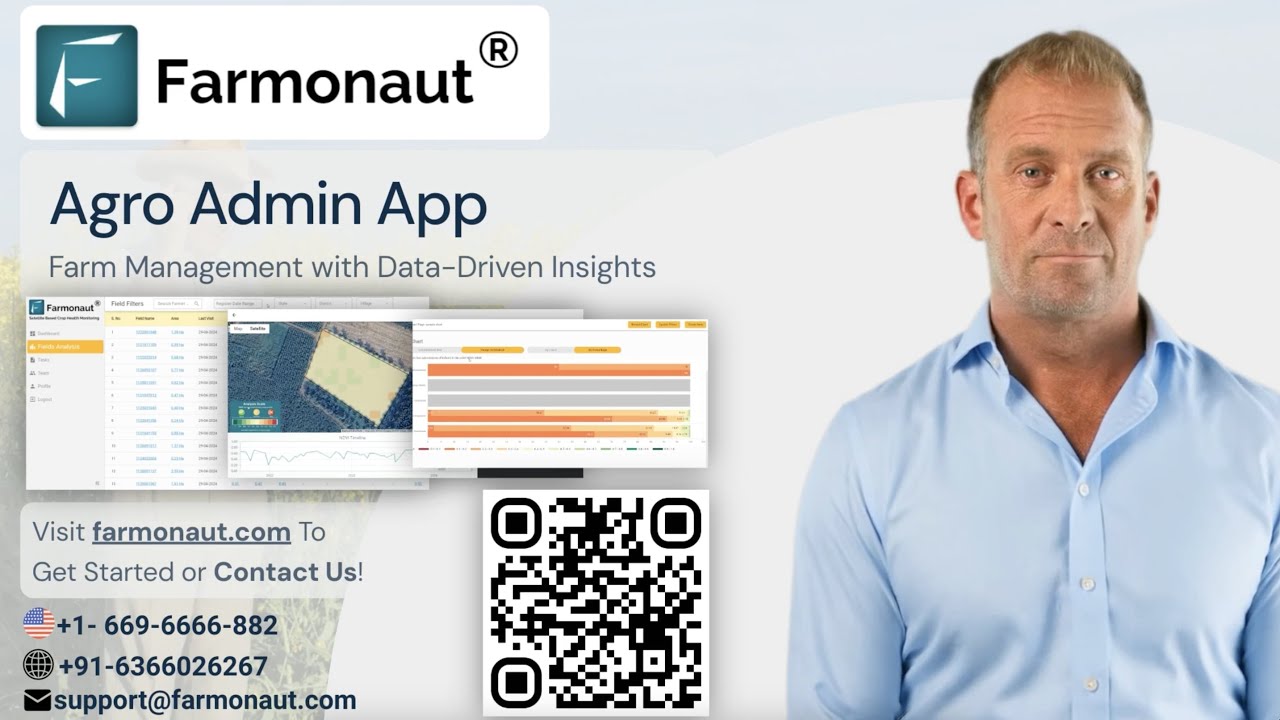
▶ How an admin app is used to manage crop health and tasks across a large operation. · 7:27
What does a farm management app cost per year?
Publishers charge in four ways: per account, per user, per hectare and per animal. That makes direct comparison hard. A plan that is cheap for one person can cost more for a team of six, and a per-animal price rises with the herd. To compare, work out one full year for your own farm. The chart shows selected entry plans, using monthly prices multiplied by 12 unless a yearly price is published.
Also count the time. Scotland’s Farm Advisory Service warns that setting up software and entering data takes time, so a purchase needs care. Those hours can cost more than a low-priced subscription, which is why the calculator below includes them.
Chart
One year of selected entry plans
US$ per year at list price, 5 November 2026, before tax
Will a paid plan pay for itself?
A paid plan has to save hours, save inputs or avoid a costly mistake. The calculator tests the first two. Use your own numbers. If the result depends on a large input saving that you cannot measure, treat it with care.
Try the numbers for your own farm below.
Calculator
Does a paid app earn back its cost in year one?
Replace every number with your own farm’s figures.
- Value of time saved: $720
- Value of inputs saved: $30
- Subscription plus setup time: $760
- Hours a month needed to break even: 3.0 h
Example values only, set near break-even; they are not benchmarks or forecasts. Every number is your input, and no saving is promised. Check the subscription with the publisher, as prices change.
How to choose an app for farm management
Start with the job, not the feature list. These six questions will narrow the options quickly.
- What must you record by law or contract? Spray, medicine and movement records come first. Check any app’s report against what your inspector or buyer asks to see, and follow local rules on what to keep.
- Who enters the data? Count the users, then check whether the price is per user.
- Where is it entered? If signal is weak, look for offline recording, and test it on your worst field.
- Does it connect to what you own? Scotland’s Farm Advisory Service notes that some packages are compatible with EID readers and others link to tractor GPS.
- What reports does it produce? University of Illinois Extension advises looking closely at reports during a trial. Its guide to farm records software also says to ask your accountant or tax preparer which type of entry system suits you.
- Who controls the data? The Ag Data Transparent principles start from the view that farmers should own information from their operations. Read how a publisher handles sharing and how you can get your data out if you leave.
Accounts are a separate question. The Illinois guide compares PC Mars and Red Wing, which are built for farms, with Quicken and QuickBooks, which are not. It also notes that the desktop version of Manager.io carries no charge, so a farm can keep its books there and use a different app in the field. Ask your accountant before you switch. Our guide to the steps of farming can help you list the jobs in your own season before you compare tools.
Do you need a dairy farm management app?
Dairy needs differ from those of a beef or arable farm. You want a record for each cow, not just each group: breeding dates, health events, treatments and milk output, often linked to parlor equipment. Check whether a general app handles that before you rely on it. Publishers such as Ever.Ag sell on-farm systems for dairy, covering herd health, calf outcomes, feed and finances. Ask each publisher for a price, and ask your milk recording body or parlor dealer what already connects to your equipment.
Before you buy, write down the five events you record every week. Ask for a demonstration of those five on a phone, with a real cow number. Then ask how treatment records and withdrawal dates are shown, and follow the medicine label and your local rules on withdrawal periods. Satellite crop tools can help with grazing and forage fields, but they do not replace a cow-level record.
Satellite data in a farm management app
Satellite imagery answers one question well: which part of the field looks different from the rest? It cannot say why. Someone still has to walk to that spot, and cloud can hide fields for days on optical images. Use the map to decide where to scout first, then record what you find in your main app.

▶ A walk-through of monitoring crops with satellite images in a web app. · 8:43
Data tools are also not a one-way trend. In USDA’s survey, the share of US farms using precision practices was 22% in 2025, against 27% in 2023. Large crop states still sit well above that level, as the chart shows. Do not buy on trend. Buy for a job you can name.
Chart
Farms using precision practices, by state
Percent of farms, selected states and US, to manage crops or livestock
A simple way to start in one season
- Pick the one record that costs you the most when it is missing.
- Try two apps on one field or one group of animals, using their trials or no-cost plans.
- Have the person who actually does the work enter the data for two weeks.
- Export a report and show it to your accountant, agronomist or vet.
- Only then add more fields, users and features. Use the calculator again with the hours you really saved.
Related pages on our site: farm apps for Australian growers, large-farm administration, farm fleet tracking, product traceability, carbon footprint tracking, crop loan and insurance checks, satellite and weather API documents, satellite data API, mobile app downloads.
▶ Six plain steps to begin digital farming without buying new machinery. · 4:18
FAQ
Is there a farm management app with no cost?
Yes. On 5 November 2026, FieldView listed a Basic plan at $0 a year and Trello a $0 plan for up to 10 collaborators. Both have limits, so check what the no-cost plan leaves out, such as FieldView’s script tools.
What is the best farm management app for a small farm?
Start with what you must record. A small crop farm can test FieldView Basic or a Trello board first. A small mixed farm can compare Farmbrite Essentials at $290 a year with the time it would save.
What is the best app for a ranch or livestock farm?
Look at AgriWebb, Herdwatch and Farmbrite’s Livestock plans. AgriWebb’s price rises with livestock numbers and Herdwatch quotes by herd size, so get a price using your own count.
Do farm apps work with no signal?
Some do. fieldmargin and Herdwatch both say they work offline. Test this yourself in your weakest spot before you pay, and check that records sync correctly afterward.
Can one app run the whole farm?
Sometimes, but you may end up with two or three tools: one for field or herd records, one for accounts, and perhaps a satellite map for scouting. Check that you can export from each one.
Who owns the data I enter in a farm app?
It depends on the contract you accept. The Ag Data Transparent principles say farmers should own data from their operations, and providers should collect it only with explicit consent. Read the terms, and get legal advice for a large or complex farm business.
Farmonaut crop monitoring
See your own fields from space
Check crop health maps for your fields on web or phone.




Keep reading
Sources
- USDA NASS, Technology Use (Farm Computer Usage and Ownership), August 2025: esmis.nal.usda.gov
- USDA NASS, Farm Computer Usage and Ownership, August 2015: esmis.nal.usda.gov
- USDA NASS, Farm Computer Usage and Ownership, August 2017 (correction): esmis.nal.usda.gov
- USDA ERS, Precision agriculture use increases with farm size (Charts of Note): ers.usda.gov
- Defra, Fertiliser usage on farm, England 2022/23: gov.uk
- Statistics Canada, The Prairies, Quebec lead the way in high-tech farm management: statcan.gc.ca
- University of Illinois Extension, Choosing your farm financial records software (2025): extension.illinois.edu
- Farm Advisory Service (Scotland), Purchasing farm software: what to consider: fas.scot
- Ag Data Transparent, Core Principles: agdatatransparent.com
- Climate FieldView, plan pricing: climate.com
- Farmbrite, pricing: farmbrite.com
- Bushel Farm, plans: bushelfarm.com
- fieldmargin, home page: fieldmargin.com
- Agworld, Australian pricing: agworld.com
- AgriWebb, pricing and subscription FAQs: help.agriwebb.com
- Herdwatch, pricing: herdwatch.com
- Trello, pricing: trello.com
- Ever.Ag, dairy solutions: ever.ag
- Farmonaut, satellite system plans: sat.farmonaut.com
Discussion
Questions, corrections or field experience? Share them below. First-time comments are reviewed before they appear, and your email is never published.
No comments yet. Be the first to add a question or your experience.

 Geospatial Lab Africa
 KhetiBuddy
 Agro La Gándara
 Global Agrifood
 HIPSAC
 ZOL Zimbabwe
 Juligerm
 AdBio
 MISE Maroc
 NWNS
 Red August Group
 Farm Inc
 WeMe Global
 Agrotoken
 Blue BearX
 Insignito
 Croptimum
 DnCubed
 Field Capacity
 Indosistim Teknologi

 Licence holder · Niger · Gold
 Licence holder · Nigeria · Gold + lithium










