

Cotton pests · Identification and control guide
American Bollworm of Cotton: ID, Thresholds and Control
The American bollworm of cotton is Helicoverpa armigera, also called the cotton bollworm or Old World bollworm. Its larvae bore into squares and bolls. Scout by the metre, act on larval thresholds, and protect Bt cotton with refuges and pupae busting.
Key takeaways
- The American bollworm of cotton is Helicoverpa armigera; US cotton’s bollworm is a different species, Helicoverpa zea.
- Crop damage from H. armigera is estimated at more than US$2 billion a year (PLOS ONE, 2013).
- Egg to adult takes 4–6 weeks in summer and 8–12 weeks in spring or autumn (Business Queensland).
- Australian Bt cotton threshold: 2 small larvae per metre on two checks, or 1 medium–large larva per metre (CPMG 2025–26).
- Bt cotton, beneficial insects, rotated selective sprays, biopesticides and pupae busting work together.
In this article
- American bollworm of cotton at a glance
- Names: American bollworm, cotton bollworm or corn earworm?
- Where the American bollworm of cotton is found
- How to identify H. armigera in cotton
- Life cycle and seasons
- Damage and yield loss in cotton
- How to scout and when to spray
- Five ways to control the American bollworm of cotton
- Resistance: why H. armigera is hard to kill
- Where satellite monitoring fits
- FAQ
The American bollworm of cotton is Helicoverpa armigera, a moth whose caterpillars bore into cotton squares, flowers and bolls. Despite the name, it is not an American native: it is also called the cotton bollworm or Old World bollworm, and a study in PLOS ONE (2013) puts crop damage from it at more than US$2 billion a year across Asia, Europe, Africa and Australasia.
This guide shows how to tell it apart from look-alike caterpillars, how fast it breeds, the spray thresholds Australian cotton growers use, and why resistance makes it hard to control. It also gives a scouting calculator that turns your field counts into larvae per metre and compares them with a threshold you choose.
American bollworm of cotton at a glance
| Item | What the sources say |
|---|---|
| Scientific name | Helicoverpa armigera (Lepidoptera: Noctuidae) |
| Other names | Cotton bollworm, Old World bollworm; formerly placed in Heliothis |
| Where it lives | Africa, Europe, Asia, Australia; established in parts of South America |
| United States | Listed as absent, pest no longer present (EPPO); three moths trapped in Florida in 2015 |
| Egg to adult | 4–6 weeks in summer, 8–12 weeks in spring or autumn (Queensland) |
| Eggs per female | About 1,000 |
| Worst damage | Squares, flowers and young bolls shed or bored |
| Main controls | Bt cotton, thresholds, beneficial insects, rotated insecticides, pupae busting |
Names: American bollworm, cotton bollworm or corn earworm?
Common names for this group of moths are confusing, so it helps to use the scientific name when you read a label or a research paper.
- Helicoverpa armigera is the species the old South Asian literature calls the “American bollworm”. Queensland’s government calls it the cotton bollworm or corn earworm, and USDA calls it the Old World bollworm.
- Helicoverpa zea is the bollworm US cotton growers deal with. In corn it is called corn earworm and in tomato it is called tomato fruitworm.
- Helicoverpa punctigera, the native budworm, shares Australian cotton fields with H. armigera.
- Earias species are the spotted and spiny bollworms, and Pectinophora gossypiella is the pink bollworm. They are different moth families or genera with different habits.
So when a US grower searches “cotton bollworm”, the answer on the farm is usually H. zea. When a grower in Australia, southern Europe, Africa, Brazil or China searches it, the answer is usually H. armigera. The two look very alike as caterpillars and are separated reliably in a lab.
Where the American bollworm of cotton is found
The EPPO Global Database lists H. armigera as present and widespread in Australia and Spain, and present with a restricted distribution in Brazil, Argentina and Puerto Rico. It lists the United States as “absent, pest no longer present” (EPPO, November 2026).
Brazil shows how fast the pest can spread. Heavy Helicoverpa outbreaks hit row crops there in the 2011/12 and 2012/13 seasons, and the same PLOS ONE paper confirmed at the molecular level that H. armigera was among them.
In the US, USDA APHIS reported three adult male moths caught in Manatee County, Florida, in late June and early July 2015. They were the first detections in the continental United States, after more than ten years of negative surveys with up to 27 state partners. The finding was also filed with the International Plant Protection Convention. APHIS lists cotton among its major hosts, with about 180 wild and cultivated host plants in more than 45 families.
A 2015 modelling study in PLOS ONE estimated that US crops worth about US$78 billion a year grow inside the climate range where the moth could live, with about US$843 million a year in climates that are best for it. That is why growers in the Americas should report any unusual Helicoverpa to their state or provincial plant protection office.
How to identify H. armigera in cotton
Business Queensland gives clear field marks for each stage. Use a hand lens for eggs and small larvae.
Eggs
Eggs are about 0.5 mm across. They turn from white to brown, then show a black head just before hatching. Eggs that turn fully black have usually been parasitised by small wasps, which is good news for you. The Australian Cotton Pest Management Guide 2025–26 says eggs are laid on plant terminals, leaves, stems and fruit bracts.
Larvae
- Newly hatched larvae are pale, with tiny dark spots and a dark head.
- Medium larvae develop stripes and vary from green to brown, so colour is not a reliable guide.
- H. armigera has a darker “saddle” on the fourth body segment, a dark patch behind the head and dark legs.
- Large H. armigera larvae have white hairs around the head; native budworm larvae have black hairs.
The cotton guide sorts larvae by length: very small (0–3 mm), small (3–7 mm), medium (7–20 mm) and large (over 20 mm). Write the size class down when you scout, because thresholds use it.
Pupae and moths
Pupae sit in the soil under the crop and wriggle hard when touched. Moths are dull light brown with dark markings and about 35 mm long. Females have brown forewings and males cream ones. H. armigera has a small pale patch in the dark band of the hindwing; in the native budworm that band is plain.
Look-alikes in cotton
Armyworms and loopers can be confused with Helicoverpa. The spotted bollworm (Earias) bores into squares and young bolls and has a different body pattern. For the pink bollworm and the full list of species, see our guide to bollworm types and life cycles in cotton. On other crops, our page on American bollworm damage in tomatoes and other crops covers fruit symptoms.
▶ Our deep dive on bollworm types in cotton and the pink bollworm life cycle. · 16:21
Life cycle and seasons
Business Queensland gives development from egg to adult as 4–6 weeks in summer and 8–12 weeks in spring or autumn. Moths live about 10 days, and females lay about 1,000 eggs. Final-stage larvae drop to the ground and dig a pupal chamber in the soil.
In cold weather the pupae go into diapause, a resting state. The cotton guide says the share of pupae entering diapause can pass 90% in late April to early May in Australian cotton regions. Moths then emerge over 6 to 8 weeks, starting in mid to late September in most regions, as the soil warms. Those overwintering pupae carry any insecticide resistance from one season into the next.
In spring the moths use faba bean, chickpea, canola, safflower, pastures and weeds. In summer they move to soybean, mungbean, sunflower, sorghum and maize, with a preference for flowering sorghum and maize. Those crops near cotton matter when you plan scouting.
Chart
Egg-to-adult time for Helicoverpa by season
Weeks, shortest and longest, Queensland field guidance
Damage and yield loss in cotton
Larvae feed on leaves but do most harm on growing tips, squares, flowers and bolls. In conventional (non-Bt) cotton the guide lists tipped-out seedlings, shedding of squares and small bolls, abnormal growth and boll rot in maturing bolls. Shed fruit and lower lint quality are both costs.
Bt cotton cuts the damage but does not remove it. The cotton guide says up to 15% of the field area in Bt cotton may carry larvae at or above threshold at some point during peak to late flowering, with chewing damage mostly on fruit. That is why scouting continues in Bt crops.
How to scout and when to spray
The Australian guide asks growers to check at least 30 plants or 3 separate metres of row for every 50 ha. Check the whole plant at least twice a week from emergence until 30–40% open bolls, in both conventional and Bt cotton. Lush patches, such as near head ditches, attract more moths, so sample them as well.
Larval thresholds are preferred over egg counts, because many eggs dry out, wash off or are eaten or parasitised. In Bt cotton, leave very small larvae (under 3 mm) out of your counts, and confirm small larvae on two checks in a row before you act.
| Crop stage | Conventional cotton | Bt cotton |
|---|---|---|
| Seedling to flowering | 2 very small–small larvae/m or 1 medium–large/m | 2 small/m on 2 checks, or 1 medium–large/m |
| Flowering to cut-out | 2 very small–small/m, 1 medium–large/m or 5 brown eggs/m | Same as above |
| Cut-out to 15% open | 3 very small–small/m, 1 medium–large/m or 5 brown eggs/m | Same as above |
| 15–40% open bolls | 5 very small–small/m, 2 medium–large/m or 5 brown eggs/m | Same as above |
These thresholds assume a mixed population of H. armigera and native budworm (Cotton Pest Management Guide 2025–26). In the US, thresholds for H. zea are set per plant instead. For example, UC IPM advises San Joaquin Valley growers to treat at 20 small bollworms per 100 plants in fields not yet sprayed with broad-spectrum insecticides, and at 8 per 100 plants in fields that were. Use the threshold set for your own region and crop.
Chart
Small-larva spray thresholds by cotton stage
Larvae per metre of row (very small–small; small only in Bt cotton), Australian cotton
Try the numbers for your own farm below.
Calculator
Are your bollworm counts at threshold?
Enter your field size, the metres of row you checked and the larvae you counted.
- Small larvae vs your threshold: 0.92 x threshold
- Medium–large larvae per metre: 0.83 per m
- Medium–large vs your threshold: 0.83 x threshold
- Minimum row to check for this field: 6.0 m
Example values only, not a benchmark. Thresholds are inputs; the defaults (2 small and 1 medium–large larvae per metre) are the Bt cotton figures in the Cotton Pest Management Guide 2025–26, and the minimum sample of 3 metres of row per 50 ha is from the same guide. A ratio of 1.00 or more means the count is at or above your threshold. Use your local guide and follow the product label and local rules before any spray.
Five ways to control the American bollworm of cotton
No single tool holds this pest for long. The five below are the main parts of the Australian cotton industry’s approach, and each one supports the others. Pesticide and dose choices must follow the product label and local rules; ask your agronomist or extension officer before you spray.
1. Grow Bt cotton and follow its resistance plan
Bt cotton makes proteins from the soil bacterium Bacillus thuringiensis that kill caterpillars that feed on it. Bollgard 3, used on over 90% of Australian cotton according to the guide, carries three proteins: Cry1Ac, Cry2Ab and Vip3A. Business Queensland notes that Helicoverpa is not usually a problem in such crops. In the US, USDA’s Economic Research Service reports that 91% of cotton acres were planted with insect-resistant seed in 2025, up from 15% in 1997.
Best for: every cotton farm where Bt varieties are approved. Each Bt licence comes with refuge crops and other rules; follow them in full.
2. Protect beneficial insects
Every Helicoverpa stage has natural enemies. Egg predators include red and blue beetles, damsel bugs, lacewings and ladybird beetles, and egg parasitoids include Trichogramma wasps. Larvae are attacked by predatory shield bugs, big-eyed bugs and assassin bugs, and by the wasp Microplitis demolitor. The guide’s beneficial-to-pest ratio says that when key beneficials reach 0.5 or more per pest, the population should stay below 2 larvae per metre.
Best for: early season, when one broad-spectrum spray can wipe out predators and set off mites or aphids.
3. Choose selective insecticides and rotate them
When counts pass threshold, pick products that spare beneficials and rotate chemical groups under the insecticide resistance management strategy. Target larvae while they are smaller than 7 mm. Stomach poisons such as indoxacarb, foliar Bt and NPV may take 5–7 days to give full control, so do not judge a spray too early.
Best for: conventional cotton, and Bt cotton where larvae survive above threshold on two checks.
4. Use biopesticides
Products based on Bt and on nucleopolyhedrovirus (NPV), a virus that infects Helicoverpa larvae, are sold commercially and have little effect on beneficial insects. Queensland notes that NPV works well in crops with a narrow flowering period, such as sorghum, which helps cut the moth population around cotton.
Best for: small larvae, and area-wide programmes with neighbours.
5. Bust pupae after harvest
Pupae busting means cultivating the soil to about 10 cm at the end of the season to destroy overwintering pupae. The guide calls it an effective non-chemical way to stop resistant pupae from carrying over. In conventional cotton it should be done as soon as possible after harvest; Bt crops follow the regional timing in the resistance management plan.
Best for: every field where H. armigera is likely to enter diapause.
Chart
US cotton acres planted with Bt seed
% of US cotton acres, selected years
Resistance: why H. armigera is hard to kill
Business Queensland ranks H. armigera as the more serious of the two Australian species because it develops insecticide resistance more readily, has a wider host range and stays in cropping areas from year to year. The cotton guide reports that resistance to indoxacarb is about 6% in the industry surveillance programme, and higher in some regions. Chlorantraniliprole and spinetoram resistance have been found in some regions at low levels, and field failures of pyrethroids and carbamates remain likely.
For Bt proteins, the guide (using Bayer’s 2024–25 monitoring) says resistance genes are present but recessive: a larva needs two copies to survive one protein, and most carriers have one. No resistance currently affects Bollgard 3 performance against H. armigera. Refuges keep it that way. The US EPA describes refuges as the main resistance safeguard for Bt crops, because they supply large numbers of susceptible moths to mate with any resistant ones.
Chart
Bt resistance gene frequency in Australian Helicoverpa
Upper estimates of the share of field insects carrying a resistance gene, %
Where satellite monitoring fits
Satellites cannot see caterpillars. What they can show is where a field’s canopy is growing more slowly or losing vigour compared with the rest, which tells you where to walk first. Farmonaut Satellite + AI Farm Monitoring System maps vegetation indices for each field you draw, so a scout can start in the patches that changed and then count larvae by hand. Our page on reading crop stress explains the other causes, such as water and nutrients, that produce the same signal.
You can open the field maps in the Farmonaut app, and developers can pull weather data through the satellite and weather API documentation.
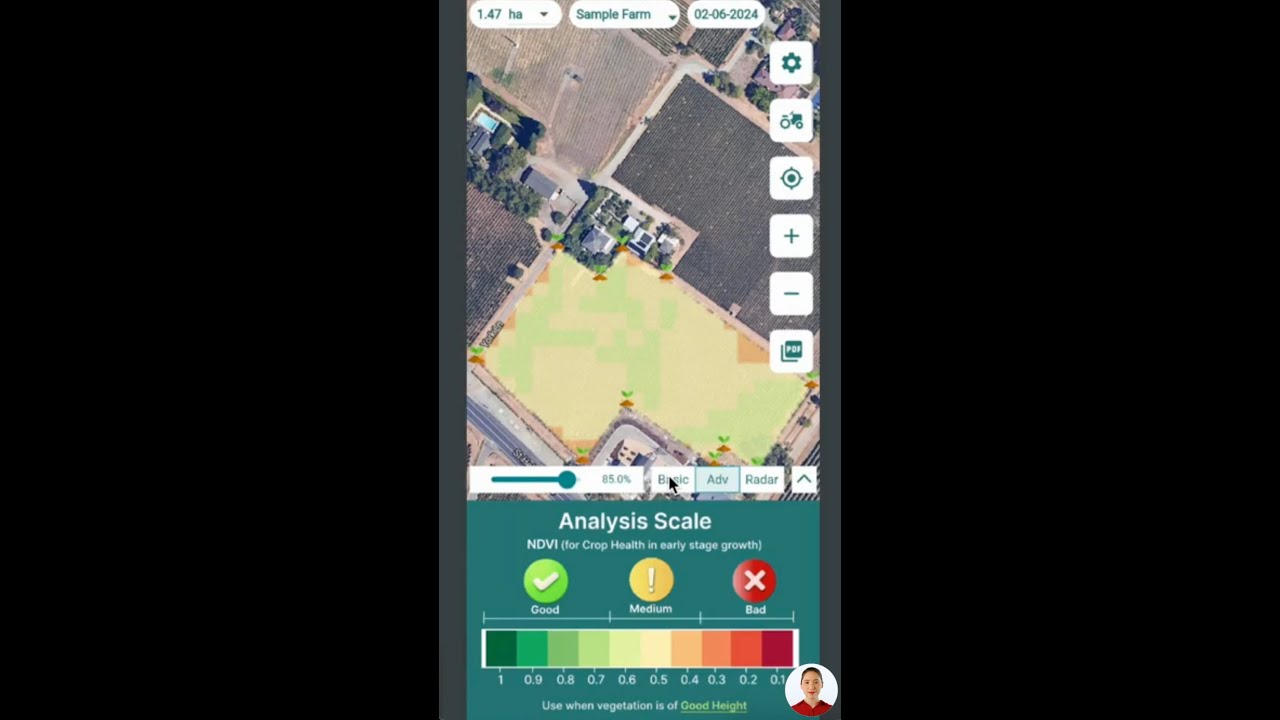
▶ How to read satellite crop-health maps in the Farmonaut app. · 4:01
FAQ
What is the scientific name of the American bollworm of cotton?
It is Helicoverpa armigera (Hübner), family Noctuidae. It is also called the cotton bollworm or the Old World bollworm. The bollworm in US cotton is a different species, Helicoverpa zea.
Is the American bollworm found in the United States?
EPPO lists the United States as “absent, pest no longer present”. USDA APHIS trapped three male moths in Florida in 2015, the first detections in the continental US. Report any suspect moth or larva to your state plant regulatory office.
How many larvae per metre justify a spray in cotton?
The Australian Cotton Pest Management Guide 2025–26 uses 2 small larvae per metre on two checks in a row, or 1 medium–large larva per metre, in Bt cotton. Conventional cotton thresholds range from 2 to 5 very small–small larvae per metre depending on crop stage. Follow your local guide.
Does Bt cotton control Helicoverpa armigera?
Yes, three-protein Bollgard 3 cotton gives strong control, and the guide reports no resistance that currently affects its performance. Some larvae still survive, and resistance genes exist at low levels, so scouting, refuges and pupae busting are still required.
What kills bollworm eggs and larvae naturally?
Trichogramma wasps parasitise eggs, and predators such as lacewings, damsel bugs, big-eyed bugs and ladybird beetles eat eggs and small larvae. NPV and Bt sprays are commercial biological options.
Related pages on our site: cotton growing factors and water needs; agricultural cooperation areas (in Russian); sustainable soil practices; regenerative agriculture basics; drill and blast monitoring software.
Farmonaut crop monitoring
See your own cotton fields from space
Draw your fields once and Farmonaut shows satellite vegetation maps for them through the season, so scouts know where to walk first.




Keep reading


Sources
- Tay et al., A Brave New World for an Old World Pest: Helicoverpa armigera in Brazil, PLOS ONE (2013): journals.plos.org
- Kriticos et al., The Potential Distribution of Invading Helicoverpa armigera in North America, PLOS ONE (2015): journals.plos.org
- Business Queensland, Helicoverpa (Queensland Government, reviewed 2020): business.qld.gov.au
- CottonInfo/CRDC, Cotton Pest Management Guide 2025–26: crdc.com.au
- EPPO Global Database, Helicoverpa armigera distribution (November 2026): gd.eppo.int
- USDA APHIS, DA-2015-43 Detection of Old World Bollworm in Florida (30 July 2015): content.govdelivery.com
- IPPC pest report, Helicoverpa armigera detection in Florida (August 2015): ippc.int
- UC Statewide IPM Program, Cotton bollworm pest management guidelines: ipm.ucanr.edu
- USDA ERS, Recent trends in GE adoption (2025): ers.usda.gov
- US EPA, Insect resistance management for Bt plant-incorporated protectants: epa.gov
Discussion
Questions, corrections or field experience? Share them below. First-time comments are reviewed before they appear, and your email is never published.
No comments yet. Be the first to add a question or your experience.

 Sayaji Group
 eKGIS
 Mostas Tech
 Native Seeds
 Andex
 FCF India
 Unifrutti Gulf
 Deluxe Conseil
 TVS Electronics
 BW Pipelines
 WICO
 Chimera Innovation
 SkyHarvest
 Polaris Digitech

 Licence holder · Niger · Gold
 Client · Tanzania · Gold
 Client · Somalia · Gold
 Client & affiliate partner · Ghana · Gold










