

Cotton pests · Field guide
Bollworms in Cotton: Types, Life Cycles and Control
Bollworms are moth caterpillars that feed inside cotton bolls: pink, cotton, American and spotted. The pink bollworm needs about a month per generation (USDA APHIS). Types, life stages, scouting, Bt resistance and control.
Key takeaways
- Four main pests share the name: pink bollworm (Pectinophora gossypiella), cotton bollworm (Helicoverpa armigera), American bollworm (Helicoverpa zea) and spotted bollworm (Earias vittella) (EPPO).
- Pink bollworm: egg 3-4 days, larva 12-15 days, pupa 7-8 days, about one month per generation (USDA APHIS identification fact sheet).
- Large American bollworm (H. zea) larvae do most damage, and sprays cannot kill many once they pass the third instar, so scout for eggs and small larvae (UC IPM).
- Bt cotton was 91% of US cotton acres in 2025 (USDA ERS); American bollworm from five southern states resisted Cry toxins in most of 95 strains tested in 2016-2021, while Vip3Aa cotton still worked in field trials (Yang et al., 2022).
- The US declared pink bollworm eradicated in 2018; before that, cotton in Arizona, California, Texas and New Mexico was sprayed 12 times a year on average, nine against it (USDA ARS).
In this article
- The four main types of bollworms in cotton
- Pink bollworm life cycle
- Cotton bollworm and American bollworm
- Spotted bollworm
- How to scout for bollworms
- Integrated pest management for bollworms
- Is it worth spraying? A break-even calculator
- Bt cotton and resistance
- What the pink bollworm eradication taught growers
- Where satellites help and where they do not
- FAQ
Bollworms are moth caterpillars that feed inside cotton squares and bolls. The main kinds are the pink bollworm, the cotton bollworm (Old World), the American bollworm (also called corn earworm) and the spotted bollworm. The pink bollworm needs about 3 to 4 days as an egg, 12 to 15 days as a larva and 7 to 8 days as a pupa (USDA APHIS identification fact sheet), so a new generation can appear in about a month.
This guide names each pest by its scientific name, shows how long each life stage lasts, and explains what to look for in the field. It also covers Bt cotton and resistance, what the US learned from clearing the pink bollworm, and a calculator that compares your scouting count and spray cost with a treatment threshold. Always follow the product label and local rules before you spray.
The four main types of bollworms in cotton
“Bollworm” is a farmers’ name, not one species. The same common name can point to different moths in different countries. The EPPO Global Database lists “cotton bollworm” as a common name of both Helicoverpa armigera and Helicoverpa zea, so always check the Latin name. “Ball worm” and “boll worm” are only spelling variants of the same word.
| Pest | Latin name | Other common names | Where it is a pest |
|---|---|---|---|
| Pink bollworm | Pectinophora gossypiella | Pink boll worm | Cotton regions in many countries; eradicated from US cotton in 2018 |
| Cotton bollworm | Helicoverpa armigera | Old World bollworm, African cotton bollworm | Old World; confirmed in Brazil in 2013 samples |
| American bollworm | Helicoverpa zea | Corn earworm, New World bollworm | North and South America |
| Spotted bollworm | Earias vittella | Spiny bollworm, rough bollworm | Asia, Australia and Pacific islands (EPPO) |
Sources: EPPO Global Database pages for each species (pink bollworm, spotted bollworm) and the Tay et al. 2013 study on Brazil. Pest ranges change, so check your national plant-health service for the current status.
The University of California describes the US cotton bollworm as a pest of squares and bolls: larvae chew holes in the base of bolls and leave moist frass around the hole. Its eggs are round and ribbed, and its larvae range from olive green to dark reddish brown.
Pink bollworm life cycle
The pink bollworm goes through four stages: egg, larva, pupa and adult moth. The adult is a small, grayish brown moth with fringed wing tips. The USDA fact sheet gives these stage lengths, and the dumbbell chart below shows them as ranges.
Chart
Pink bollworm: days spent in each stage
Range in days; temperature changes the speed
- Egg: laid under the calyx of green bolls, hatching in about 3 to 4 days.
- Larva: white with a brown head at first; it turns pinkish orange only in the fourth and last stage. It bores into the boll and feeds on seeds for 12 to 15 days.
- Pupa: the larva leaves the boll and pupates in the top layer of soil for 7 to 8 days.
- Adult: females mate within two or three days and lay most of their eggs within ten days.
The fact sheet puts the generation time at about one month, depending mostly on temperature, with one to four generations in a summer. The pest overwinters as a fourth-stage larva in the soil or in leftover bolls. Because the larva hides inside the boll, University of California guidance says to crack open bolls to find young larvae. It also says not to aim insecticides at larvae, because larvae are inside the boll or in the soil.
Humid weather makes each larva costlier. Scouting is the key habit: sample on a fixed schedule and write down each count so you can compare weeks.
The same University of California page says that with high humidity, one or two larvae can destroy a whole boll because damaged bolls are open to boll-rot fungi.
Cotton bollworm and American bollworm
The two Helicoverpa species look alike and attack many crops, including corn, tomato and soybean. In the Americas the local species is H. zea. The Old World species, H. armigera, was confirmed by DNA tests on 2013 samples from Mato Grosso, Brazil, which Tay et al. read as a recent arrival, after heavy Helicoverpa damage in the 2011/12 and 2012/13 seasons. In Europe, EPPO lists H. armigera on its A2 list (since 1975) and the UK lists it as an A1 quarantine pest (since 2020).
Timing is critical with these caterpillars. University of California guidance for the American bollworm says that large larvae do most of the damage, yet it is not possible to kill a significant share of them after the third instar. Scouting and sprays must therefore aim at eggs and small larvae. The same guide says there is no need to treat once bolls begin cracking, because most bolls are too mature to be hurt.
Spotted bollworm
The spotted bollworm (Earias vittella) is also called the spiny or rough bollworm. EPPO lists it as present across Asia, in Australia and Pacific islands, and in the Seychelles (Africa). For a field guide to this species, see our page on the spotted bollworm.
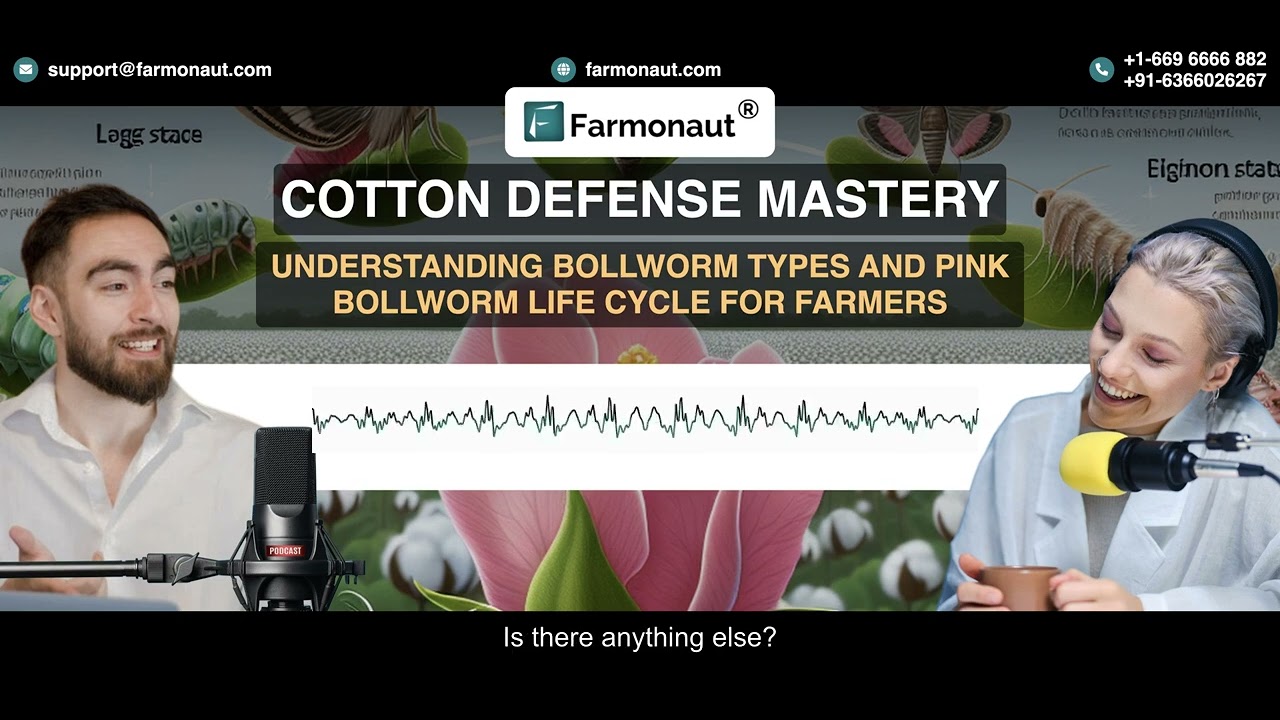
▶ A walk through bollworm types and the pink bollworm life cycle for cotton farmers. · 16:21
How to scout for bollworms
- Start early. Begin as soon as bolls are present (the UC advice for the San Joaquin Valley), and keep going until most bolls have matured.
- Sample plants, not just the field edge. The University of California method checks the main-stem terminal of five adjacent plants at each stop and at least 100 plants in a field.
- Count small larvae. Count first and second instars, since older larvae resist insecticides.
- Open bolls for pink bollworm. Crack sample bolls and look for white larvae and stained lint.
- Use traps as an early signal. Pheromone traps tell you when moths are flying; they do not tell you how many larvae are in bolls.
The University of California uses these thresholds for cotton bollworm in the San Joaquin Valley: treat at 20 small bollworms per 100 plants in fields not sprayed with broad-spectrum insecticides, and at 8 per 100 plants in fields already treated with broad-spectrum insecticides. In the desert valleys it uses 10 to 12 small budworm or bollworm larvae per 100 plants. These are local numbers. Your state or country may use a different threshold, so ask your extension agronomist.
Chart
Cotton bollworm treatment thresholds, San Joaquin Valley
Small larvae per 100 plants
Integrated pest management for bollworms
Integrated pest management (IPM) combines several tools so that no single one carries the whole job. Our general guide to crop protection explains the idea. For bollworms the main parts are:
- Crop timing (California guidance, UC IPM). The University of California advises cutting off irrigation early enough to stop green boll production by early September, and shredding plants right after harvest. This removes the food and shelter that overwintering larvae need.
- Winter irrigation and plowdown (California guidance, UC IPM). The same guide says winter irrigations can cut overwintering pink bollworms by as much as 50 to 70%, and that flooding in December works better than in November or January. It also requires cross-discing or plowing to at least 6 inches where plowdown rules apply.
- Avoid rank growth. Cotton bollworms are drawn to lush plants, so keep water, fertilizer and plant density at recommended levels.
- Protect natural enemies. Many predators and parasites hold bollworms at low levels. Sprays for other pests can break that control and cause a bollworm outbreak.
- Mating disruption and sterile moths. These work best against the overwintering generation, when plants have 6 to 8 leaves.
- Targeted insecticides. Spray only when scouting passes the threshold, rotate modes of action, and follow the product label, restricted-entry and pre-harvest intervals, and bee-protection rules.
Crop rotation and sound soil practice also lower pest pressure; see our notes on sustainable soil practices and on regenerative agriculture. For a broader list of control steps, see our guide to cotton bollworm control.
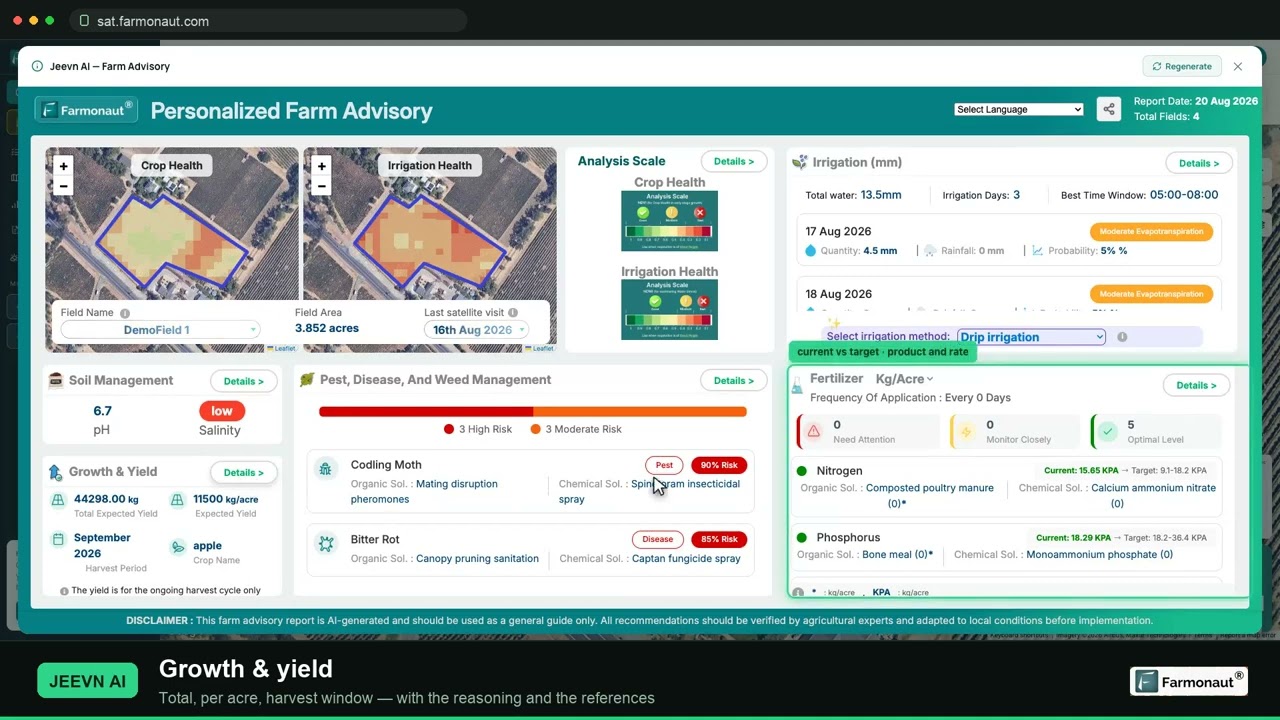
▶ How to read vegetation maps and find crop stress early, a way to choose where to scout. · 19:36
Is it worth spraying? A break-even calculator
Use the calculator below to turn your scouting count into larvae per 100 plants, compare it with a threshold, and test whether the yield you protect pays for the spray. The numbers pre-filled in it are examples, not benchmarks.
Try the numbers for your own farm below.
Calculator
Is a bollworm spray worth it on your field?
Enter your own scouting count, yield, price and spray cost.
- Larvae per 100 plants: 12.0
- Share of threshold reached: 60 %
- Break-even yield loss: 3.6 %
- Net gain for the whole field: -$50
Example values only, not benchmarks or forecasts. The default threshold of 20 small larvae per 100 plants is the University of California IPM value for San Joaquin Valley fields not treated with broad-spectrum insecticides (8 if they were); set your own local threshold. Expected loss is your own estimate if you do not spray, and the formula assumes the spray prevents all of it, so real gains are lower if control is partial. Follow the product label and local rules.
Bt cotton and resistance
Bt cotton makes insecticidal proteins from the soil bacterium Bacillus thuringiensis. The USDA Economic Research Service reports that Bt cotton grew from 15% of US cotton acres in 1997 to 37% in 2001, and that 91% of US cotton acres were planted to insect-resistant seed in 2025.
Chart
Share of US cotton acres planted to Bt cotton
Percent of upland cotton acres, selected years
Bt cotton helped clear pink bollworm from the US (see below), but Cry toxins have weakened against American bollworm in the southern US. A study in Pest Management Science tested 95 H. zea strains from five southern states in 2016 to 2021 and found resistance to Cry1Ac, Cry1Fa and Cry2Ab in most of them. Cotton that also makes Vip3Aa still performed in those 2016-2021 field trials, and the authors call for strict resistance management to protect it.
Resistance management steps
- Plant the refuge your seed company or regulator requires.
- Do not rely on the Bt trait alone; scout and use thresholds.
- Rotate insecticide modes of action, and do not repeat one group more than the label or local guide allows.
- Report unexpected survival of larvae on Bt cotton to your extension service.
What the pink bollworm eradication taught growers
The US declared the pink bollworm eradicated from commercial cotton on 19 October 2018, after five years of trapping, according to the USDA APHIS identification tool news item. Before that, USDA Agricultural Research Service reports that cotton in Arizona, California, Texas and New Mexico was sprayed an average of 12 times a year, nine of them against this pest.
Chart
Insecticide sprays on Southwest US cotton before eradication
Sprays per year; average and worst case, as reported by USDA ARS
The ARS and University of Arizona study found that Bt cotton and sterile moth releases worked together; neither alone would have been enough. Mostly Bt cotton cut the population by 90% in ten years. ARS also reports that removing the pest saved US cotton farmers $192 million from 2014 to 2019, and that overall insecticide use fell by 82%, avoiding 25 million pounds of insecticide in Arizona alone over two decades.
Where satellites help and where they do not
Satellite images show plant vigor, not caterpillars. A patch of cotton that looks weaker than its neighbors on a vegetation map is a reason to walk that spot and open bolls; it does not prove bollworm damage, because water stress, nutrient problems or disease can look the same. Farmonaut Satellite + AI Farm Monitoring System draws field maps from satellite passes so you can choose where to scout first. Use it to direct scouting, and keep traps and boll counts as the basis for spray decisions.
Developers can also pull field data through the Farmonaut API (see the developer documentation), and the web app tutorial shows how to draw a field. The app is available for Android and iOS.
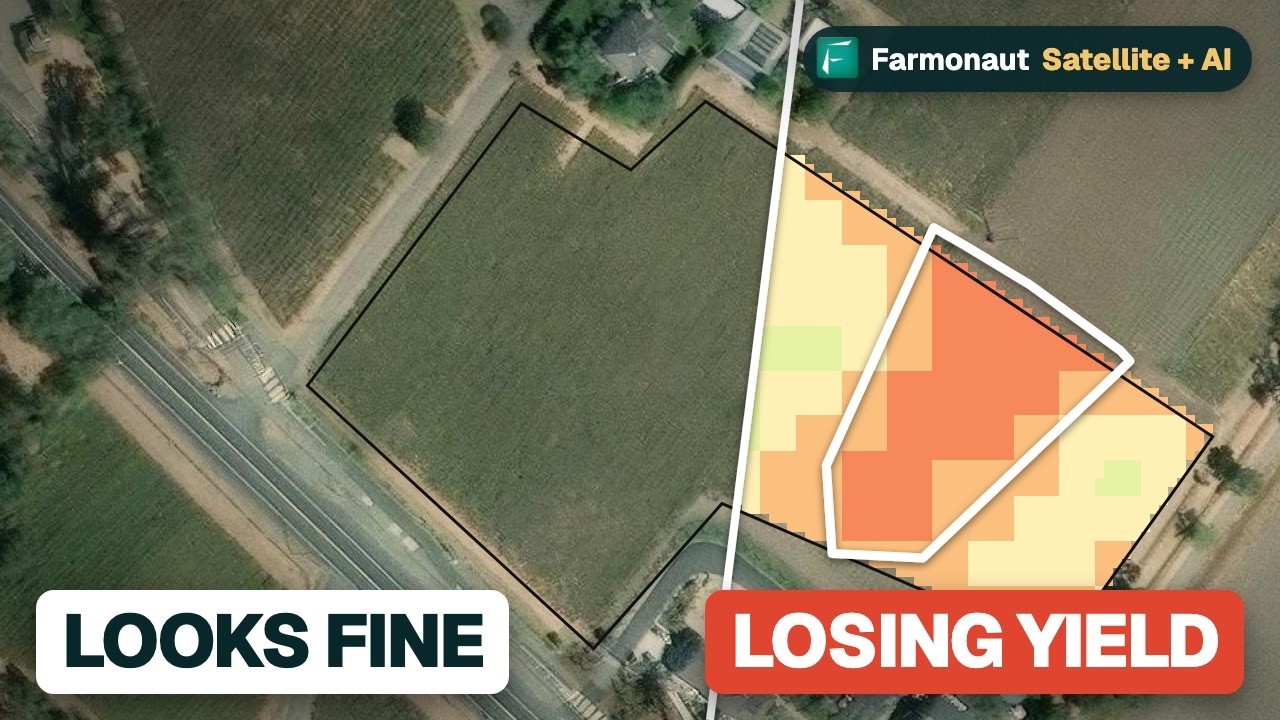
▶ A real field on satellite passes: a strip of stressed crop that looks fine from the ground. · 1:42
FAQ
Is a bollworm the same as a ball worm?
Yes. “Ball worm” and “boll worm” are spelling variants. The word comes from “boll”, the seed pod of the cotton plant.
How long is the pink bollworm life cycle?
The USDA fact sheet gives about 3 to 4 days for eggs, 12 to 15 days for larvae and 7 to 8 days for pupae, with a generation time of about a month that depends on temperature.
How do I tell a pink bollworm from other boll pests?
The larva is white with a brown head until the fourth stage, when it turns pinkish orange. Three other moth larvae can be found in bolls, so confirm the species before you spray.
Can bollworms resist Bt cotton?
Yes. American bollworm populations in the southern US show resistance to Cry toxins in most strains tested between 2016 and 2021. Vip3Aa cotton still worked in those trials.
What is the best control for bollworms?
No single tool is best. University of California guidance relies on scouting, crop timing, field sanitation, natural enemies and well-timed sprays. Follow the label and local rules, and ask an agronomist about your region.
Are there pink bollworms in US cotton today?
USDA declared the pest eradicated from commercial US cotton in 2018. Pink bollworm is still a pest in other cotton regions, so follow your local plant-health rules.
Related pages on our site: sensors in cotton farming, farmer training, farming partnerships in Africa, cotton soil, crop pests and diseases.
Farmonaut crop monitoring
See your own fields from space
Draw your cotton fields once and view satellite vegetation maps through the season to choose where to scout first.




Keep reading


Sources
- USDA APHIS ITP, Pectinophora gossypiella fact sheet: idtools.org
- USDA APHIS ITP, Pink bollworm is declared eradicated (2018): idtools.org
- UC IPM, Cotton Bollworm guidelines: ipm.ucanr.edu
- UC IPM, Pink Bollworm guidelines: ipm.ucanr.edu
- EPPO Global Database, Helicoverpa armigera: gd.eppo.int
- EPPO Global Database, Helicoverpa armigera categorization: gd.eppo.int
- EPPO Global Database, Helicoverpa zea: gd.eppo.int
- EPPO Global Database, Pectinophora gossypiella: gd.eppo.int
- EPPO Global Database, Earias vittella: gd.eppo.int
- USDA ERS, Adoption of genetically engineered crops in the US (2025): ers.usda.gov
- USDA ARS, Synergy between biotech and classical control tactics (2020): ars.usda.gov
- Yang et al., Pest Management Science (2022), Cry toxin resistance in Helicoverpa zea: experts.arizona.edu
- Tay et al., PLoS ONE (2013), Helicoverpa armigera in Brazil: journals.plos.org
Discussion
Questions, corrections or field experience? Share them below. First-time comments are reviewed before they appear, and your email is never published.
No comments yet. Be the first to add a question or your experience.

 Global Agrifood
 Cazlv
 HIPSAC
 ZOL Zimbabwe
 Juligerm
 AdBio
 MISE Maroc
 Drift-Sense
 NWNS
 Red August Group
 Farm Inc
 WeMe Global
 Agrotoken
 Blue BearX
 Insignito
 Croptimum
 DnCubed
 Field Capacity
 Indosistim Teknologi

 Licence holder · Niger · Gold
 Licence holder · Nigeria · Gold + lithium










