

IoT Drone Agriculture: Top Drone Use & Rates in 2025
Table of Contents
- Quick Trivia: The Scale of IoT Drones in 2025
- Introduction: A New Era for Modern Agriculture
- IoT Drones in Agriculture: An Overview
- Key Applications & Benefits of IoT Drone Agriculture
- Comparison Table: IoT Drone Applications in Agriculture & Estimated Cost/Benefit in 2025
- Agriculture Drone Rate, Market Trends, and Adoption in 2025
- Agriculture Drone App Technology: The Digital Command Center
- Satellite-Driven Solutions: Farmonaut’s Innovative Approach
- Explore Satellite-Based Tools for Cutting-Edge Farming
- Challenges and the Future of IoT Drone Agriculture
- Frequently Asked Questions (FAQ)
- Conclusion: Precision, Productivity, and the Next Leap Forward
“”By 2025, over 1.2 million IoT-connected agricultural drones are projected to operate globally, enhancing farm data collection.””
Introduction: A New Era for Modern Agriculture
The intersection of Internet of Things (IoT) technology and drones is redefining the landscape of modern agriculture. By 2025, IoT drone agriculture has revolutionized how farmers across the globe manage crops, monitor fields, and respond to challenges with unmatched precision and efficiency. The integration of drones into business and farming practices isn’t just an upgrade—it’s a significant leap forward for food security, costs management, and sustainability.
This comprehensive guide delves into the advanced applications of IoT drone agriculture, recent market trends, agriculture drone use rates in 2025, the power of agriculture drone apps, and how platforms like Farmonaut are making satellite and data-driven insights accessible to farmers worldwide. With soaring adoption, decreasing hardware costs, and robust data analysis tools, discover why IoT drones have rapidly become indispensable tools for optimizing resources, enhancing productivity, and promoting sustainable farming for the future.

IoT Drones in Agriculture: An Overview
At its core, IoT drone agriculture is the convergence of two transformative technologies: the Internet of Things (IoT) and unmanned aerial vehicles (drones). This integration enables the seamless collection and transmission of data from sensors, cameras, and other devices embedded in drones straight to cloud-based platforms and agriculture drone apps. The process typically involves:
- Deploying drones equipped with multispectral and thermal sensors, GPS modules, and high-resolution cameras.
- Transmitting real-time data wirelessly to remote platforms for processing.
- Applying AI-driven algorithms to produce actionable insights on crop health, soil conditions, irrigation needs, pest infestations, and more.
- Delivering recommendations through intuitive drone apps for immediate decision-making on the farm.
This convergence of data collection, advanced analysis, and user-friendly apps ensures that farmers have a near-instantaneous view of what their fields need, reducing waste, optimizing resources, and enhancing overall productivity.
Key Technologies Powering IoT Drone Agriculture
- Multispectral Cameras & Sensors: Detect subtle differences in plant health, nutrient deficiency, moisture, and temperature at scale.
- AI & Machine Learning Algorithms: Continuously analyze vast amounts of crop and soil data to predict issues and suggest targeted interventions.
- GPS & Geofencing: Enable precise drone use in agriculture for mapping, monitoring, and autonomous mission planning.
- IoT Platforms & Cloud-Based Apps: Store, sync, and visualize data collected from drones across multiple farms and regions.
“”In 2025, advanced drone apps will analyze 20% more crop data per flight compared to 2023 technology.””
Key Applications & Benefits of IoT Drone Agriculture
The applications of IoT drones are vast, offering farmers powerful tools for monitoring, analysis, and management that are faster, more precise, and increasingly affordable. Let’s explore the top use cases and their direct benefits for modern farms in 2025:
1. Crop Monitoring & Health Assessment
- Drones equipped with multispectral sensors scan fields swiftly and accurately, capturing high-resolution images.
- Early detection of disease, nutrient deficiency, or water stress—before significant yield losses occur.
- Targeted interventions, reducing chemical use and optimizing resource input.
2. Precision Spraying (Fertilizers, Herbicides, Pesticides)
- Drone use in agriculture enables precision spraying of fertilizers, herbicides, and pesticides with pinpoint accuracy.
- Sensors dynamically adjust spray volumes based on real-time data, ensuring optimal distribution while minimizing environmental impact and runoff.
- Significantly lowering costs and reducing waste compared to traditional spreaders or manual methods.
3. Soil Analysis & Resource Management
- Drones with embedded soil sensors and advanced platforms measure moisture, nutrient levels, and temperature variability across fields.
- Helps farmers tailor irrigation and fertilization schedules, optimizing water use and reducing costs.
- Promotes sustainable practices and prevents overuse of critical agricultural resources.
4. Pest Infestation Detection & Stress Mapping
- Early and accurate identification of pest infestations and crop stress conditions (heat, flooding, drought).
- Enables targeted pest control—saving costs, reducing chemical use, and supporting yield.
- AI-driven models can predict outbreaks, improving proactive farm management.
5. Automated Field Mapping & Planning
- Autonomous drones survey fields, map soil types and crop density, and generate comprehensive reports for year-round management.
- Streamlines the work of agronomists and farm managers for large and small-scale farming.
Comparison Table: IoT Drone Applications in Agriculture & Estimated Cost/Benefit in 2025
| Drone Use Case | IoT Integration | Estimated Adoption Rate in 2025 (%) | Estimated Cost per Acre ($) | Potential Yield Improvement (%) |
|---|---|---|---|---|
| Crop Monitoring & Health Assessment | Multispectral & thermal sensors, cloud analytics | 68% | 8 – 15 | 15 – 22 |
| Precision Spraying (Fertilizers/Herbicides/Pesticides) | Sensor-driven tanks, automated dosage algorithms | 55% | 9 – 20 | 10 – 16 |
| Soil Analysis & Nutrient Mapping | Moisture/temperature/EC sensors, platforms with AI analytics | 41% | 6 – 12 | 8 – 14 |
| Pest & Disease Detection | High-res imaging, AI models, alerting platforms | 60% | 7 – 14 | 12 – 19 |
| Automated Survey & Field Mapping | GPS guidance, spatial mapping apps, remote reporting | 52% | 5 – 11 | 7 – 13 |
These projections reflect the rapid adoption of IoT drone use across diverse farming regions in 2025, with each application offering compelling economic and agronomic advantages.

Agriculture Drone Rate, Market Trends, and Adoption in 2025
The agriculture drone rate in 2025 has reached impressive heights, underpinned by continuous technology improvements, competitive pricing, and institutional support for smart farming. According to recent market trends:
- Global adoption rates of IoT drone agriculture have climbed beyond 60%, with higher peaks in North America, Europe, and leading Asian agricultural economies.
- The compound annual growth rate (CAGR) for agriculture drones exceeds 20%—driven by concerns about resource scarcity, climate volatility, and the desire for data-driven productivity.
- Entry-level drones suitable for small or mid-sized farms are now available from $2,000, while advanced systems with intelligent IoT integration and multispectral cameras can top $20,000.
- Even with up-front investments, potential yield improvements, cost savings on chemicals and water, and regulatory credits for sustainable farming make the ROI highly favorable.

Diverse drone models—from compact quadcopters for scouting to large VTOL platforms for spraying—are now more affordable thanks to economies of scale and component miniaturization.
Drone Pricing in 2025 (Typical Segments):
- Small Farm Models: $2,000 – $4,500 (basic imaging, entry-level IoT connectivity)
- Precision Spraying & Mapping: $7,500 – $14,000 (integrated sensors, app-driven autopilot)
- Advanced IoT-Driven Drones: $17,000 – $22,000+ (multispectral, full automation, AI-enabled platforms)
Agriculture Drone App Technology: The Digital Command Center
As IoT drone use in agriculture matures, the backbone of real-time decision-making becomes the agriculture drone app. These digital platforms unify planning, monitoring, and actionable insights for modern farmers.
- Mission Planning: Farmers can schedule drone flights, set sensor parameters, and define field boundaries from their phone or desktop.
- Data Visualization: Apps transform vast amounts of imagery and sensor data into color-coded maps, trends, and alerts—streamlining scouting and intervention.
- Real-Time AI Insights: Machine learning models within apps predict pest outbreaks, identify crop growth stages, and recommend precise field actions.
- Collaboration & Automation: Share reports and recommendations with advisers, agronomists, or remote operators; many apps now provide cross-team digital project support.



Farmonaut’s web, iOS, and Android apps bring satellite and drone-powered field monitoring, crop health analysis, and precision agriculture insights directly to the fingertips of farmers and agribusinesses—globally and at scale.

Satellite-Driven Solutions: Farmonaut’s Innovative Approach
At Farmonaut, we believe in transforming modern agriculture with satellite and AI innovations—making advanced monitoring and analysis affordable and accessible for all. While IoT drone agriculture offers unmatched field-level precision, satellite-based solutions like ours empower farmers to optimize large-scale monitoring, tap into AI advisory systems, and leverage powerful insights for sustainable, data-driven production.


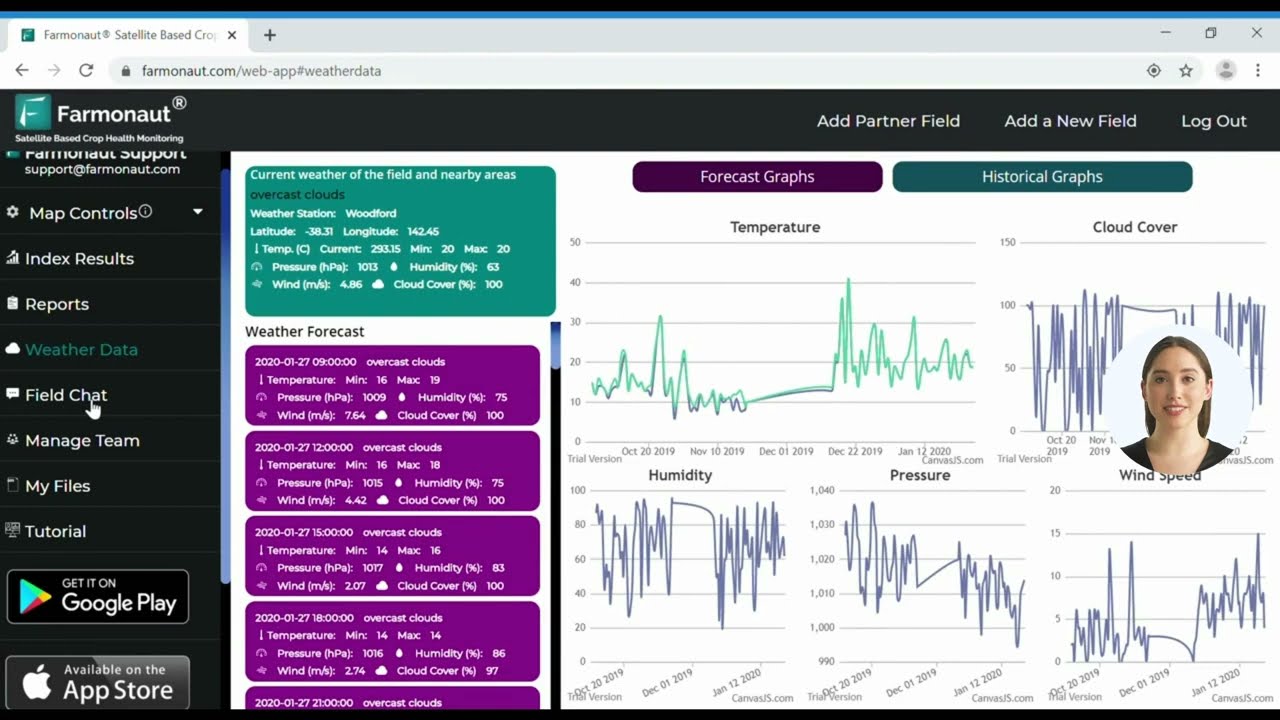
Our platform leverages:
- Multispectral Satellite Imaging: For wide-area crop health assessment, soil condition mapping, and resource monitoring at the regional scale.
- Jeevn AI Advisory System: Delivers custom insights, growth forecasts, and recommendations for smarter farm decisions.
- Blockchain-Based Traceability: Ensures supply chain authenticity, transparency, and fraud reduction for produce and resources.
Learn more about product traceability solutions for agriculture. - Environmental Impact and Carbon Footprinting: Tools for real-time carbon monitoring and regulatory compliance.
Discover carbon footprinting tools for sustainable farming. - Resource Management: Satellite-based fleet tracking for tractors, logistics optimization, and efficient operations.
Streamline operations with fleet management solutions. - AGRO Admin App: For large-scale farm management and data-driven planning by agriculture businesses and governments.
Explore large-scale farm management tools.
With subscription-based web and mobile access, automated AI-powered analysis, and API-driven integrations, our mission is to empower farmers, researchers, and agribusinesses worldwide for a data-driven, sustainable future in agriculture.
Integrate our insights directly into your own platforms via the Farmonaut API, and get detailed documentation at Developer Docs.
Explore Satellite-Based Tools for Cutting-Edge Farming
- Environmental Monitoring & Compliance: Carbon Footprinting for tracking emissions and supporting sustainable certifications.
- Supply Chain Authenticity: Blockchain-based Product Traceability across agricultural supply chains.
- Financial Solutions: Crop Loan and Insurance Verification for secure, data-backed lending in agriculture.
- Vehicle & Machinery Utilization: Fleet Management leveraging satellite and IoT data.
- Large-Scale Farm Data Tools: AGRO Admin App for enterprise and government-scale field management.
- Crop Plantation and Forest Advisory: Crop Plantation & Forest Advisory to tailor recommendations for sustainable growth.
Challenges and the Future of IoT Drone Agriculture
Despite the clear benefits of IoT drone agriculture, several challenges continue to shape the pace and impact of this technological revolution:
- Regulatory Compliance: Evolving drone usage regulations (airspace, privacy) vary across countries and require continuous education and adaptive strategies.
- Digital Divide in Rural Areas: Some farms still lack access to fast internet and modern digital infrastructure, limiting adoption.
- Data Privacy & Security: As drones transmit vast amounts of data, robust privacy and encryption protocols are essential to protect farmers and sensitive information.
- Autonomy & Battery Life: Increasing drone flight durations, AI-enabled obstacle avoidance, and seamless integration with tractors and IoT devices remain technology frontiers.
Still, the future is bright. Advances in drone autonomy, long-range 5G connectivity, and multi-sensor fusion promise to overcome these barriers—making IoT drone agriculture even more accessible and scalable.
As climate change and population growth intensify the pressures on global food systems, precision agriculture powered by IoT, drones, and AI will help safeguard our harvests, conserve vital resources, and protect the environment for future generations.
Frequently Asked Questions (FAQ) about IoT Drone Agriculture in 2025
What is IoT drone agriculture?
IoT drone agriculture combines Internet of Things (IoT) technology with drones to collect and analyze crop and soil data. This integration enables real-time monitoring, automated interventions, and precision farming for optimized yields.
How do agriculture drone apps help farmers?
Agriculture drone apps act as a digital hub where farmers can schedule drone flights, analyze field conditions, receive AI-powered alerts, and make instant decisions to improve crop management and reduce costs.
What are the main types of data collected by IoT drones?
Drones capture multispectral images for plant health, soil moisture and nutrient mapping, temperature variations, topography, pest or disease presence, and more—all integrated through IoT platforms.
How much can I expect to invest in an agriculture drone in 2025?
Pricing starts at around $2,000 for small, basic imaging models; high-end, full-featured drones can exceed $20,000. Most farmers achieve ROI via cost savings, yield improvement, and operational efficiency.
Is Farmonaut a drone manufacturer or an online marketplace?
No. Farmonaut is a satellite technology company offering advanced monitoring, AI-based advisory, blockchain traceability, and resource management platforms for agriculture, mining, infrastructure, and defense—delivered via apps and APIs.
Conclusion: Precision, Productivity, and the Next Leap Forward
By 2025, IoT drone agriculture is no longer an emerging trend—it’s the backbone of modern farm management. As drone use in agriculture grows, driven by lower costs, advanced apps, and integrated data collection, farmers worldwide gain the precision tools they need to meet the planet’s rising food demands while minimizing resource waste.
With unmatched capabilities in monitoring crops, spraying inputs with pinpoint accuracy, analyzing soil, mapping stressors, and providing actionable insights through next-generation drone apps, the future of farming is clear: data-driven, sustainable, and resilient.
At Farmonaut, we continue to pioneer the satellite-based solutions and AI-driven platforms that complement the revolution in IoT drone agriculture—empowering farmers and agribusinesses across the globe with the tools required for a more transparent, productive, and climate-smart agricultural world.
Ready to take your farming operations to the next level?
Try Farmonaut’s web and mobile apps for real-time satellite-driven crop monitoring, or integrate your management systems with the Farmonaut API for AI-powered insights—today and into the future of agriculture!

 Fyllo
Fyllo FieldZero
 Indico Company
 Kubota
 FFBS
FFBS Jontra
 Kalustyan
 Tucor
Tucor Geno
Geno Hayleys Agriculture
 Linx Agritech
 Adinet
 Save Your Soils
