
Palm crops · Grower guide
Palm Tree Farming: 7 Practices, Spacing and Costs
Two US routes this guide covers are Coachella Valley date orchards, at about 49 palms an acre, and field nurseries, at 450 to 4,000 plants an acre (UC; UF/IFAS). UC’s budget has dates bearing from age 5. Nursery palms sell in 2 to 8 or more years.
Key takeaways
- Field nurseries hold 450 to 4,000 plants an acre; mass-market palms may be ready in 2 to 3 years and specimens in 5 to 8 or more (UF/IFAS).
- A UC Coachella budget has dates bearing at age 5 and reaching 272 pounds per palm by year 10 (2005-06).
- That date budget used 8 acre-feet of water a year from age 4, and $33,637 an acre in net cash costs through year 9.
- Oil palm yields about 2.9 tonnes of oil per hectare (Our World in Data) but needs wet tropical climates.
- RSPO-certified oil was 20% of global supply in 2025 (RSPO).
In this article
- Palm tree farms compared: four kinds, four businesses
- Palm tree farming costs: what a date orchard budget shows
- Palm farm calculator: palms, yield and margin per acre
- 7 sustainable practices for palm tree farming
- 1. Test and shape the soil before planting
- 2. Match spacing to the product
- 3. Plan water by palm age
- 4. Control pests with scouting first
- 5. Return organic matter and feed on evidence
- 6. Use intercropping to earn from the space
- 7. Keep field records and monitor from above
- Responsible palm cultivation and certification
- Common risks on a palm plantation
- How to start a palm tree farm in six steps
Palm tree farming means growing palms for a product you can sell: dates, coconuts, palm oil or landscape trees. In the US, this guide focuses on two commercial routes: date orchards in California’s Coachella Valley and field nurseries in places like South Florida. A date orchard planted at UC’s 30 by 30 feet carries about 49 palms an acre, while a nursery can hold 450 to 4,000 plants an acre, according to University of California cost research and UF/IFAS Extension.
This guide compares the four main kinds of palm farm, then gives seven practices with spacing, water and cost figures from those sources. Use the calculator to test your own palms per acre, yield and price before you buy land or liners.
Palm tree farms compared: four kinds, four businesses
A date orchard and a nursery share a plant family, but little else. They differ in climate, wait time and what you actually sell. Start by choosing the row that fits your land.
| Type | Where it works | Stand density | Time to income | What you sell |
|---|---|---|---|---|
| Date palm | Hot, dry valleys such as Coachella | About 49 palms/acre (UC) | First crop at age 5; full crop by year 10 (UC) | Fruit |
| Field nursery | South Florida and other mild sites | 450 to 4,000 plants/acre (UF/IFAS) | 2 to 3 years, or 5 to 8+ for specimens (UF/IFAS) | Trees, seed, cut fronds |
| Oil palm | Wet tropics near the equator | 140 to 160 palms/ha (Agricultural Systems, 2023) | Not given here; commercial life about 25 years (Ecology and Evolution, 2019) | Fruit bunches for oil |
| Coconut | Tropical coasts | 128 to 239 palms/ha tested in one trial | Depends on variety and site | Nuts, copra, coir |
Date palm orchards
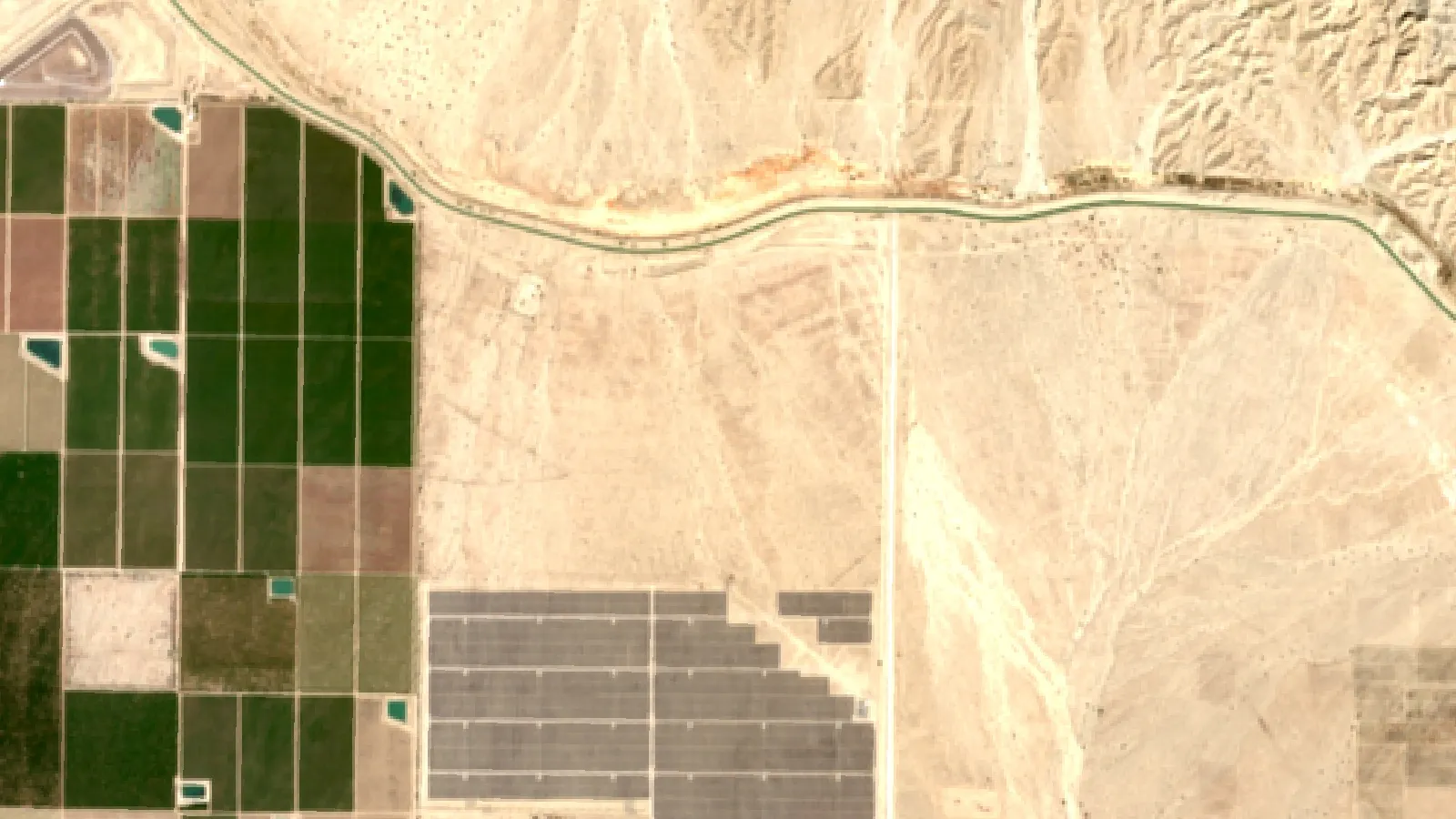
Dates suit growers who have water and patience. The UC study modelled a 25-acre Deglet Noor orchard. It noted that Deglet Noor made up about 75% of date acres in the valley at the time and Medjool about 20% (2005-06). Date palm is also unusually tolerant of salt, with a capacity that exceeds barley, according to a review in Frontiers in Plant Science (2015). Tolerance varies by variety, so test the soil and water before you choose.
World output reached 5.4 million tonnes in 2001, up from 1.8 million in 1961, per FAO’s chapter on date production and trade. That is an old figure, but it shows the crop’s long growth and its concentration in South West Asia and North Africa.
Ornamental palm nurseries
A nursery sells the tree itself. UF/IFAS lists five markets: exterior specimens, interior specimens, mass-market palms that are containerized after harvest, seed, and cut fronds. Each market has its own layout and labor costs, so UF/IFAS advises settling on the market before you plant. Seed is probably the least labor-intensive route. Mass-market stock allows the most palms per acre but carries the highest labor costs. Cut-frond growers in the US compete with offshore producers who pay much less for labor.
Slower or less common species can fetch a high price. UF/IFAS warns that fast, well-known species such as queen palm may be overproduced.
Oil palm plantations
Oil palm grows as a plantation crop where rain reaches at least 1,600 mm a year, in tropical climates within 10° of the equator, according to FAO’s oil palm chapter. That rules out the continental US. North American and European readers usually meet this crop as buyers or investors, not growers.
Output rose about 40 times between 1970 and 2020, from 2 million to around 80 million tonnes, reports Our World in Data. Its yield per hectare stands out: about 2.9 tonnes of oil, or roughly four times sunflower or rapeseed. A 2019 study in Ecology and Evolution gives a 25-year commercial lifespan, after which falling output and harder harvesting force replanting.
Coconut palms
Coconut is a tropical coastal crop sold as nuts, copra and coir. Spacing affects income here too. In a Coconut Research Institute trial comparing 128 to 239 palms per hectare, nuts per palm fell as density rose. Nut yield per hectare peaked at 171 palms, and copra per hectare at 179 palms. That is one Sri Lankan trial using 1976-1980 yields, so treat it as a guide to the trade-off rather than a target.
Chart
Land needed for one tonne of vegetable oil
Hectares per tonne, global averages by crop
Palm tree farming costs: what a date orchard budget shows
The most detailed public budget we opened for a US palm crop is the UC study for the Coachella Valley. Its prices date from 2005-06, so use it for the shape of the costs and get new quotes for every line. Land, labor and water have all changed since then.
Chart
Date yield per palm by orchard age
Pounds per palm, Deglet Noor, modelled for the Coachella Valley
| Budget line | UC figure (2005-06) |
|---|---|
| Land value | $30,000 per acre |
| Land preparation | $500 per acre |
| Fumigation | $1,200 per acre (methyl bromide in the study; check current rules) |
| Irrigation system | $1,500 per acre, including reservoir |
| Net cash cost, year 1 | $9,434 per acre |
| Net cash cost to year 9 | $33,637 per acre, after crop income |
| Cash break-even | $0.36 per pound |
| Total-cost break-even | $0.71 per pound, excluding management |
The main lesson is the wait. Income starts in year 5 at 47 pounds per palm, and the budget still shows a net cash cost in each of the first nine years. UC amortizes the establishment cost over a useful orchard life of about 40 years.
The study assumed $0.65 per pound for Grade A and B fruit and $0.27 for Grade C, with a pack-out of 65%, 30% and 5% cull. At those assumptions, full-crop fruit covered cash costs but not the $0.71 total-cost level. Those are study assumptions from 2005-06, not today’s prices, and Medjool economics will differ. Ask a packing house for its current grower prices.
Nursery budgets are harder to benchmark. We did not open a public national cost or price series for field-grown palms, so build yours from local liner quotes, labor rates and wholesale price lists. For financing or tax questions, get professional advice.
Palm farm calculator: palms, yield and margin per acre
Enter your own spacing, yield, price and cost. The result shows whether the crop pays at full production. It does not count the years of waiting, so compare it against the establishment table above.
Try the numbers for your own farm below.
Calculator
Does your palm crop cover its costs at full production?
Enter your own spacing, yield, price and yearly cost.
- Palms per acre: 48
- Yield per acre: 13,068 lb
- Break-even price: 0.69 US$/lb
Example values only, set close to break-even (30 by 30 feet gives 48 here; UC rounds to about 49); not a benchmark or forecast. 43,560 is the square feet in an acre. Excludes the unpaid years before full production.
7 sustainable practices for palm tree farming
These seven practices follow the order of the work, from site choice to records. Each one should cut waste or risk. None replaces a local agronomist or your state’s extension office.
1. Test and shape the soil before planting
Test nutrients, pH, salinity and texture first. A test costs little next to a planting mistake that lasts decades. Correct pH with lime if the soil is too acidic, or with sulfur or organic amendments if it is too alkaline, based on your lab’s advice.
Palms adapt to many soils, and Florida field nurseries succeed on sand, marl and muck. UF/IFAS still prefers well-drained land with a 1% to 2% slope. On marl or muck with high water tables, growers may need to raise planting rows 1 to 1.5 feet above the surface. Beds help drainage and hand harvest, but weak-rooted palms such as queen palm can blow over in high wind and rain. Avoid low spots that collect cold air if you plan to grow marginally hardy species.
Long-term soil records can also support environmental reporting if a buyer asks for it.
2. Match spacing to the product
Spacing depends on what you sell and how you harvest. Here are the published figures:
- Date palm: 30 by 30 feet gives about 49 palms an acre. UC’s model has one male for 48 females.
- Mass-market nursery palms: 3-foot centers are possible, per UF/IFAS.
- Specimen palms: 4-foot centers suit most species without a noticeable quality loss.
- Mexican fan palm: needs about 8-foot centers. Coconut and royal palms may also need more room.
- Oil palm: a 2023 paper in Agricultural Systems on Indonesian smallholder fields used 140 to 160 palms per hectare as the optimal range.
Row width usually follows the machine. UF/IFAS gives 8 to 12 feet between rows as common for heavy equipment. It also says one estimate puts a 25% density increase within reach of most palm field nurseries without added non-labor costs. Hand digging allows closer planting than mechanical harvest. Our separate guide to trees per acre goes deeper on the arithmetic.
Harvest timing matters as much as density. A crowded block must be sold on schedule, or shading and quality problems follow.
Chart
Years to harvest for field-grown palms
Published range by market; specimens may take longer than 8 years
3. Plan water by palm age
Young palms need little water compared with mature ones, so design for the final demand. UC’s Coachella budget rises from 1 acre-foot a year in year 1 to 8 acre-feet from year 4 onward. Each year the study irrigates for nine months, at 11-day intervals in summer. Some growers use drip until about age 6, then convert to flood.
Chart
Date palm water use by orchard age
Acre-feet per year, Coachella Valley study
Check your water right, district supply and well capacity against that last number before you plant. An acre at 8 acre-feet is a very different business from one at 2.
Nursery water looks different. The majority of Florida field nurseries use overhead irrigation, and it can also help protect against cold if run correctly. UF/IFAS suggests three or four irrigations a week in fields aged 1 to 2 years, and two to three a week in fields aged 2 to 3 years, with more frequent watering on sandy soil. Drip is a useful alternative where soil moves water sideways well, or where water is restricted or costly.
4. Control pests with scouting first
Know which pest threatens your region, then scout for it before you spray. In Florida, a serious risk named by UF/IFAS is lethal yellowing, a phytoplasma disease spread by a leafhopper bug. It is largely confined to the southern third of the state. Continuous antibiotic injections can prevent it but not cure it, and UF/IFAS says that is not economical in a field nursery. The only practical nursery control there is to avoid susceptible palms.
Other pests can kill palms outright. UF/IFAS names palmetto weevils and silky cane weevils as serious on Canary Island date palms, and banana moth larvae as a stem-tunneling pest. In California, the UC Riverside Center for Invasive Species Research tracks the South American palm weevil. USDA confirmed it in San Ysidro, San Diego County, on 9 May 2011. Larvae feed in the crown, and a palm in late decline may show a “halo” of green fronds around a collapsed top.
A workable routine looks like this:
- Walk blocks on a set schedule and log what you see.
- Trap for the weevils named in your local alerts.
- Remove and destroy infested palms quickly, following local guidance.
- Rotate active ingredients if you must spray.
Follow the product label and local rules on every pesticide. Rules differ by state and crop, and older budgets may list products or rates that no longer apply. Ask your extension office or a licensed adviser first.
5. Return organic matter and feed on evidence
Prunings and residue can go back to the field as compost or mulch where disease risk allows. Mulch holds moisture and suppresses weeds, while burning loses that value and may break local rules. Keep infested material out of the compost pile. UC’s date budget also plants cover crops in alternate rows to add organic matter and fix nitrogen.
Fertilizer needs a lab behind it. UF/IFAS says little research exists on rates for field-grown palms, so rates vary with soil and palm size. It describes granular rates starting at ½ to 1 pound for small palms, and controlled-release fertilizer on larger established palms up to 30 pounds per 1,000 square feet of canopy or bed area, four times a year for maximum growth. Potassium, magnesium and manganese deficiencies are common problems in Florida palms. UC analyzes leaf nutrients every year from a 10% sample of the palms. Check the label and local rules before you apply any product.
6. Use intercropping to earn from the space
In nurseries, intercropping has direct support. UF/IFAS says many Florida growers mix palm species or other ornamentals and raise yield per acre without much added non-labor cost. The usual pairing is a slow-growing species with a faster one. Palms on 4-foot centers have been grown with live oak or royal poinciana on 8-foot centers within the row. Time the harvest so that one crop does not shade the other, and replant empty space quickly.
In date orchards, wide rows leave room for cover crops. On any farm, check that the second crop does not compete for water, block machines or host your main pests. The added income is only real if a market for it exists. Mixed systems may also support beneficial insects and soil health, but measure the results on your own land before you count on them.
7. Keep field records and monitor from above
Good records connect the other six practices. Log planting dates, liner sizes, water, inputs, pest finds and sales by block. Palms pay back over years, so memory is not enough. Records also help with lenders, insurers, buyers and certification audits.
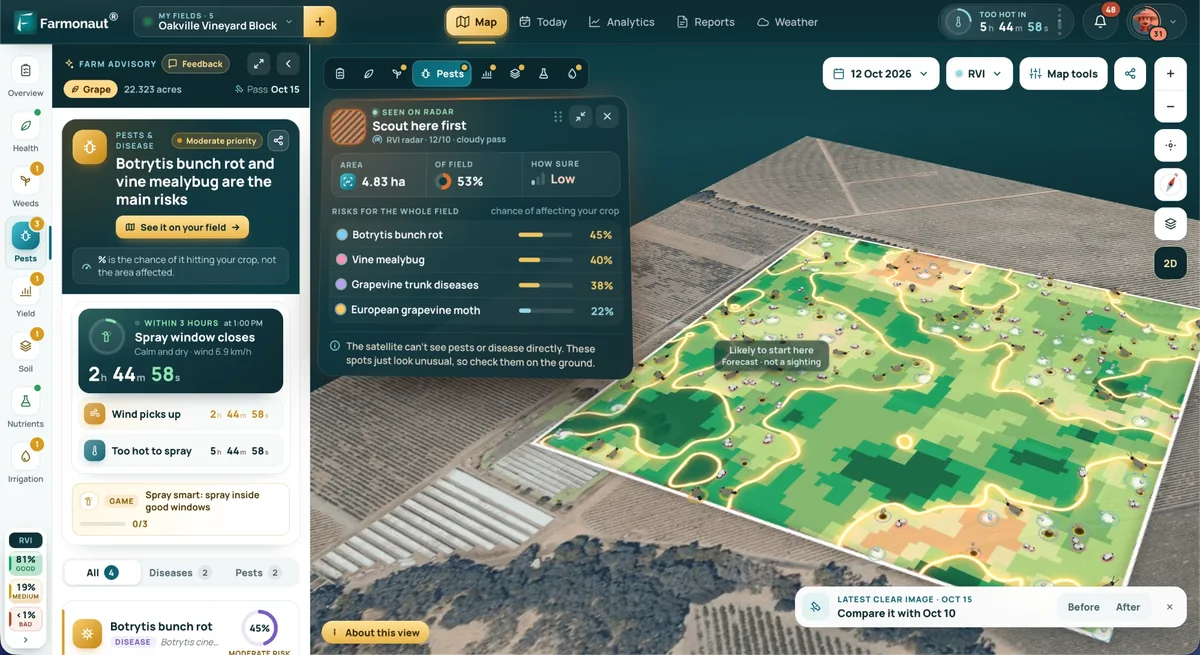
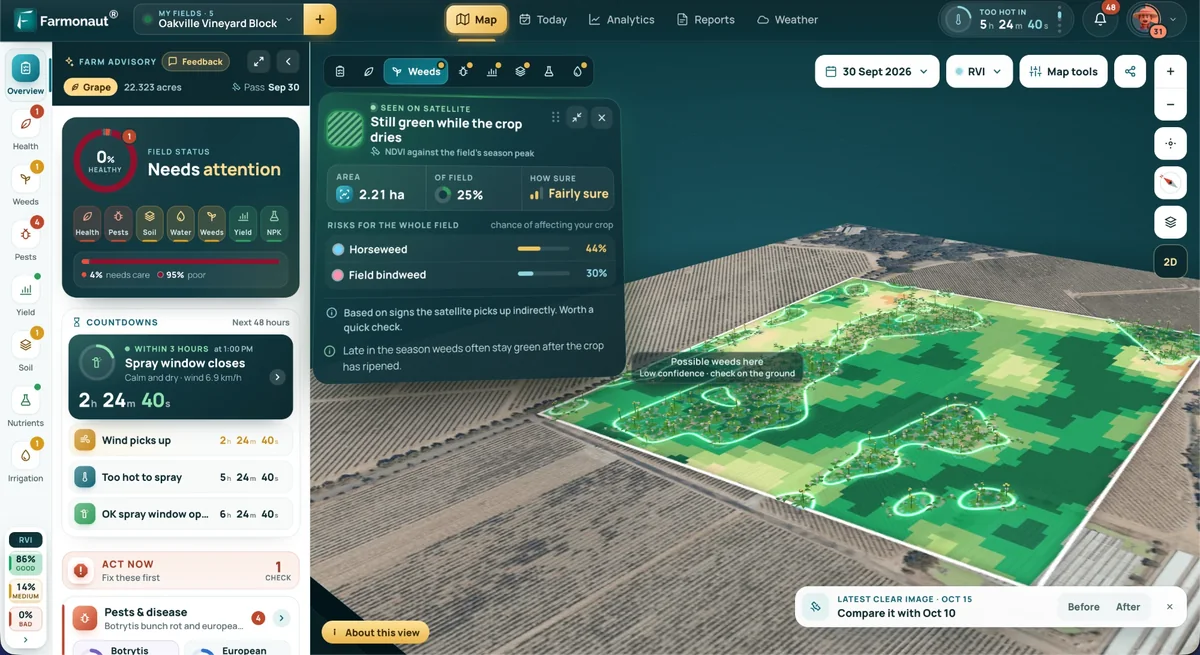
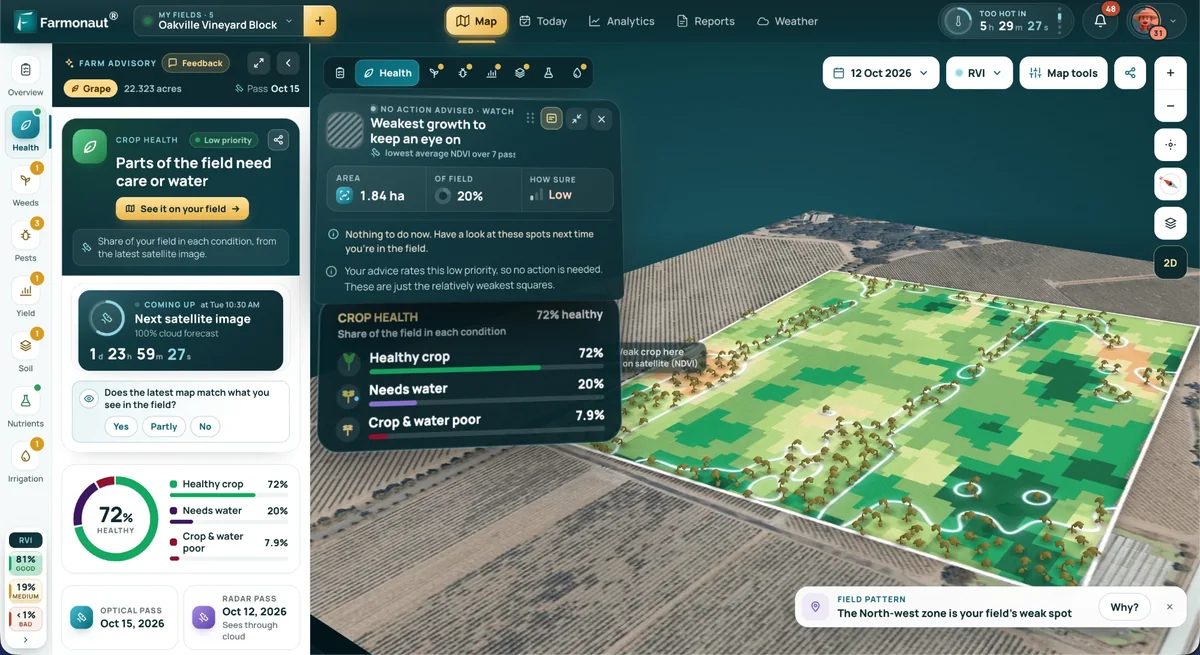
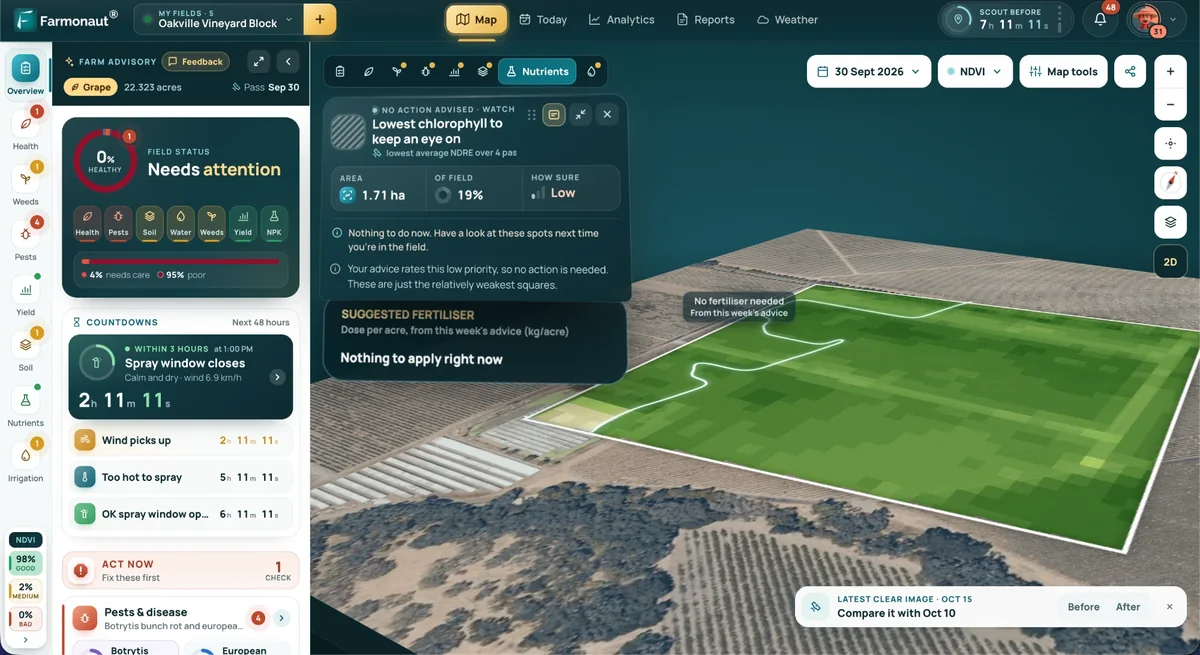
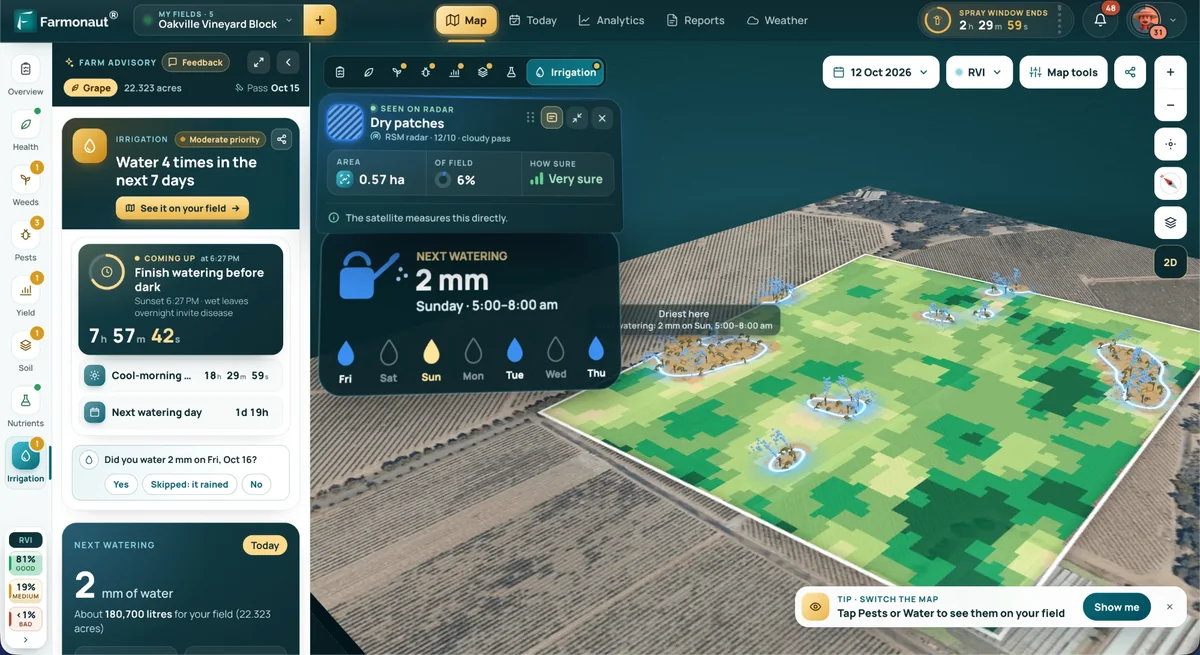
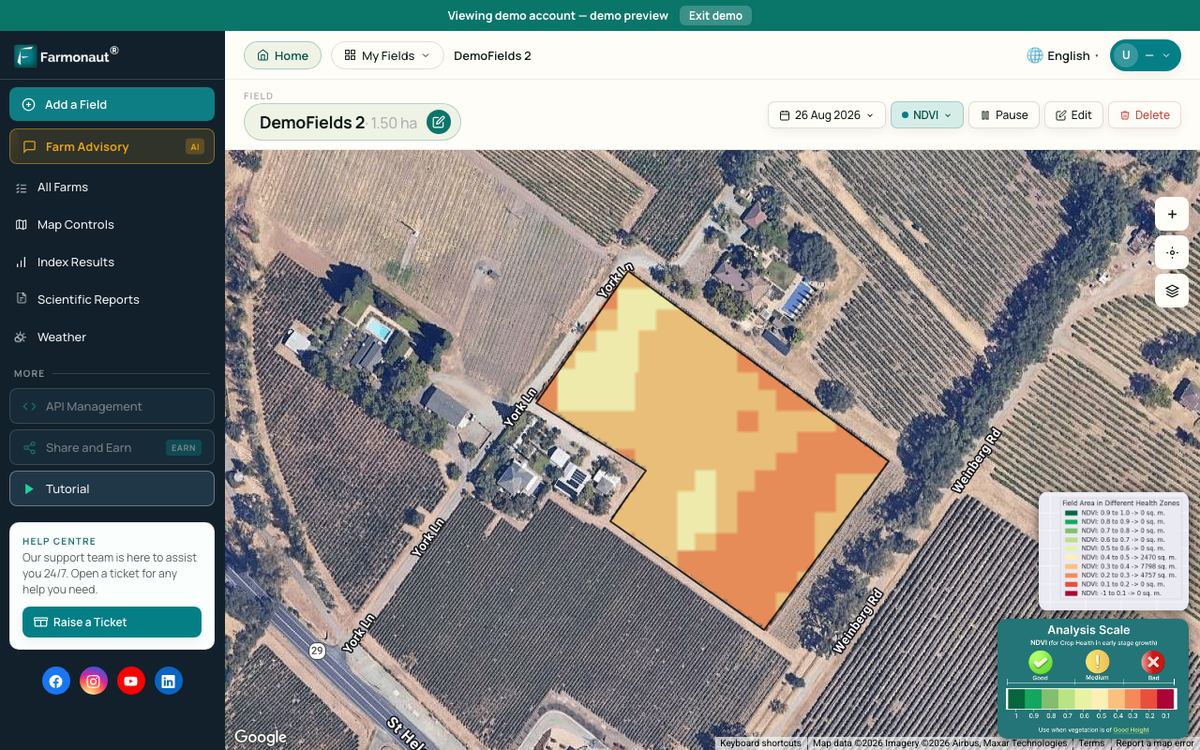
On larger holdings, satellite monitoring can flag blocks where vegetation has changed so you know where to walk first. Tools such as Farmonaut map those changes through vegetation indices. A satellite shows that something changed, not the cause, so a field check must still confirm it. Dense date and nursery blocks also vary from one row to the next, which is a reason to compare a block with its own history.
▶ How crop health monitoring from space works on a real farm. · 4:09
Responsible palm cultivation and certification
Responsible palm cultivation usually means growing oil palm to a recognised standard, such as the Roundtable on Sustainable Palm Oil (RSPO) Principles and Criteria. RSPO’s October 2024 statement says consent from affected communities and components to address deforestation remain key criteria in its 2024 standards. Its certification pages explain how growers and supply chains are audited.
Certified oil is still the minority. RSPO reports that 16.2 million tonnes of certified oil were sold in 2025, or 20% of global supply. It also reports that member growers hold 31.4 million tonnes of capacity. So capacity exists beyond current sales, and that gap is a question to raise with any buyer before paying for certification.
Europe adds a legal test. Palm oil falls under the EU Deforestation Regulation. After the latest delay, the European Parliament says large operators and traders apply it from 30 December 2026, and small operators (under 50 employees and under €10 million in related turnover) from 30 June 2027. Anyone supplying that market should ask a trade lawyer or the buyer what proof each shipment needs.
A US date or nursery grower has different questions: water rights, worker safety, pesticide records and any food-safety or organic audit a buyer requires. Ask your buyer early, because a standard is easier to meet from planting day than to retrofit.

▶ Our step-by-step video on farming high-quality palm oil. · 11:29
Common risks on a palm plantation
The biggest risks are slow to show and slow to fix, because a palm block is hard to change once planted.
- Cold: frost can kill foliage on many species. Balanced feeding in the months before the coldest weather helps survival, and fields with no irrigation are likely to suffer the greatest losses, says UF/IFAS.
- Oversupply: a fast species may be cheap by the time it reaches sale size.
- Water: a mature date orchard’s demand is fixed for decades, while supply and price are not.
- Replanting: oil palm’s clearing at about 25 years is itself a biodiversity event, as the Ecology and Evolution study found.
- Long payback: a date orchard can spend years in net cash cost, so plan your funding for the whole period.
How to start a palm tree farm in six steps
- Choose the product. Fruit, trees, seed or fronds. Talk to two or three buyers first.
- Check climate. Confirm your lowest winter temperatures and summer heat against the species.
- Test soil and water. Include salinity, and confirm your water supply for the mature crop.
- Budget the wait. Run the calculator, then add every year before full income.
- Start with a block you can manage. A trial block will show you survival and labor needs at lower risk.
- Set up records from day one. Block maps, inputs and scouting logs get harder to rebuild later.
Liner choice is a quiet cost decision. UF/IFAS says specimen growers usually start with 3- to 5-gallon stock, and mass-market growers with 1- to 3-gallon. Smaller liners cost less but die more often. Plant so the stem base sits about 1 inch below the surface, since palms do not tolerate deep planting. For nearby topics, see our guide to soil and water management.
Related pages on our site: carbon footprint records, large farm administration, product traceability, farm fleet logistics, crop loans and insurance, mobile and web app, satellite data API and API developer documentation.
FAQ
How many years does a palm tree take to reach harvest?
It depends on the product. UF/IFAS says mass-market field palms may be ready 2 to 3 years after planting, while specimens may need 5 to 8 years or more. In UC’s date study, fruit starts at age 5 and reaches a full crop by year 10.
How many palm trees fit on one acre?
A date orchard at 30 by 30 feet holds about 49 palms by UC’s figure (the sum below gives 48). Field nurseries range from 450 to 4,000 plants per acre. Divide 43,560 by the row spacing times the in-row spacing, both in feet, to get your own number.
Can you grow oil palm in the US?
Not in the continental US at commercial scale. FAO describes the plantation crop as needing at least 1,600 mm of rain a year in tropical climates within 10° of the equator.
Are palm tree farms profitable?
It depends on species, water, land cost and price. UC’s 2005-06 date budget put total-cost break-even at $0.71 per pound, above the $0.65 it assumed for top grades. Run current numbers in the calculator and get financial advice before you invest.
Can I plant other crops between my palms?
Yes, if light, water and machine access allow it. UF/IFAS reports that many Florida nurseries intercrop with other palms or ornamentals. Date orchards in UC’s budget use cover crops in alternate rows.
What share of palm oil is certified?
RSPO reports 20% of global supply, or 16.2 million tonnes sold as certified, for 2025.
Farmonaut crop monitoring
See your palm blocks from space
Compare vegetation change across your blocks and decide where to scout first.



Keep reading

Sources
- UF/IFAS Extension, Field Production of Palms, ENH1210 (revised 2019): edis.ifas.ufl.edu
- UC Cooperative Extension, Sample Costs to Establish a Date Palm Orchard, Coachella Valley (2005-06): ccfruitandnuts.ucanr.edu
- Frontiers in Plant Science, Salt tolerance research in date palm (2015): frontiersin.org
- FAO, The economic importance of date production and trade: fao.org
- FAO, Small-scale palm oil processing, oil palm chapter: fao.org
- Our World in Data, Palm Oil: ourworldindata.org
- Ecology and Evolution, Replanting of first-cycle oil palm (2019): pmc.ncbi.nlm.nih.gov
- Coconut Research Institute trial, Effect of planting density on the yield of coconut: dl.nsf.gov.lk
- Agricultural Systems 210, 103689 (2023): edepot.wur.nl
- UC Riverside CISR, South American Palm Weevil: cisr.ucr.edu
- RSPO, statement on the 2024 standards (October 2024): rspo.org
- RSPO, Certification: rspo.org
- RSPO, Impact Report 2026 release (4 August 2026): rspo.org
- European Parliament, Deforestation law changes (December 2025): europarl.europa.eu
Discussion
Questions, corrections or field experience? Share them below. First-time comments are reviewed before they appear, and your email is never published.
No comments yet. Be the first to add a question or your experience.

 Agro La Gándara
 Global Agrifood
 Cazlv
 HIPSAC
 ZOL Zimbabwe
 Juligerm
 AdBio
 MISE Maroc
 NWNS
 Red August Group
 Farm Inc
 WeMe Global
 Agrotoken
 Blue BearX
 Insignito
 Croptimum
 DnCubed
 Field Capacity
 Indosistim Teknologi

 Licence holder · Niger · Gold
 Licence holder · Nigeria · Gold + lithium