

Machinery · Used combine buyer guide
Case 2388 Combine: Specs, Auction Prices, S780 Compared
The Case IH 2388 is a single-rotor Axial-Flow combine built from the 1998 model year, with an 8.3-litre, 280 hp engine and a 73.8 hl (about 210 bu) tank (Koneviesti). Clean, pre-DEF units are back in demand: a 2006 model brought $120,000 at auction in August 2025.
Key takeaways
- Case 2388: 8.3 L six-cylinder engine, 280 hp (DIN), 73.8 hl grain tank, 680 L fuel tank (Koneviesti).
- A 2006 2388 with 2,361 engine hours sold for $120,000 in Oberlin, Ohio, in August 2025; the record is $155,000 for a 98-hour unit in 2007 (AgWeb, Machinery Pete data).
- The successor 7088 has a 9.0 L, 345 hp engine and a 105.7 hl tank; the John Deere S780 has 480 hp and a 141 hl tank (Koneviesti).
- Late-model S770 and S780 combines sold for US$375,000 to US$414,000 at auctions in December 2024 and June 2026 (Farms.com, AgWeb).
- Custom combining of corn averaged $44.00 per acre in Iowa and $38.47 in Wisconsin in 2025, against $54.40 for owning a new combine on 2,500 acres (Agweek, UW-Madison Extension, University of Illinois).
In this article
- Case 2388 specs at a glance
- Case 2388 for sale: what recent auctions paid
- How to check a used 2388 before you buy
- Case 7088: the 2388's successor
- Case 2388 vs John Deere S770 and S780
- Own a Case 2388 or hire a custom operator
- Harvest tips for an older combine
- Using field data with an older combine
- FAQ
The Case 2388 is a Case IH Axial-Flow rotary combine sold from the 1998 model year, with an 8.3-litre six-cylinder engine rated at 280 hp and a 73.8 hl (about 210 bu) grain tank, according to the Koneviesti spec database. Good ones still sell well: a 2006 Case 2388 with 2,361 engine hours brought $120,000 at an Ohio auction in August 2025.
This guide covers what to check before you buy a used 2388, what recent auctions paid, how it compares with the later Case IH 7088 and the John Deere S770 and S780, and when hiring a custom operator costs less than owning. A calculator near the end lets you test the numbers for your own acres.
Case 2388 specs at a glance
The 2300 series replaced the 2100 series for the 1998 model year. Koneviesti says the changes were small at first: new controls, automatic air conditioning, a three-speed rotor gearbox and a stronger rotor drive belt. The 2388 was the largest model in the line.
| Item | Case IH 2388 | Source |
|---|---|---|
| Model years | 1998 to 2006 (88 series took over for 2008) | Koneviesti; Machinery Pete |
| Engine | 8.3 L six-cylinder turbo diesel | Koneviesti; Ritchie Specs |
| Rated power | 280 hp (DIN) | Koneviesti |
| Grain tank | 73.8 hl, about 210 bu | Koneviesti |
| Fuel tank | 680 L, about 180 gal | Koneviesti |
| Rotor | Single rotor, 760 mm across | Ritchie Specs |
| Transmission | Hydraulic, 3 gears | Ritchie Specs |
| Weight | About 20,900 lb without header | Ritchie Specs |
In autumn 2002 Case IH added an X-Clusive version in Europe. It had a 24-valve, electronically controlled engine rated at 293 ISO hp and a slightly longer rotor. In 2004 the smaller 2366 was replaced in North America by the 2377, which used the 2388’s larger rotor. Check the serial plate and the dealer records to know which version you are looking at.
Why the single rotor matters
Every Axial-Flow combine since 1977 uses one long rotor that threshes and separates the crop, as the Case IH history notes. There are no straw walkers. Fewer moving parts make the 2388 simple to work on, and the rotor is gentle on grain. Rasp bars and separator parts can be changed to suit wheat, corn, soybeans or peas.
Case 2388 for sale: what recent auctions paid
Price depends on the model year, engine and separator hours, condition and whether a header comes with it. The sales below are auction results, not dealer asks. They show how wide the range is.
- August 2025, Oberlin, Ohio: a 2006 2388 with 2,361 engine hours and no header sold for $120,000. AgWeb’s Machinery Pete column called it the second-highest price for a used 2006 2388 since 2013.
- December 2019, Sullivan, Indiana: a 2003 2388 with 634 engine hours and 376 separator hours sold for $67,000 at a farm estate auction.
- March 2019, BigIron online sale: a 2006 2388 with 2,275 engine hours brought $70,750.
- February 2007, Henderson, Kentucky: a like-new 2388 with 98 hours and a corn head set the record at $155,000.
In the 2019 report on the Machinery Pete forum, the average dealer asking price for a 2388 was $48,090, and auction values had fallen 23.5% that year. The 2025 sale shows how far demand has come back. Machinery Pete linked it to strong demand for clean combines built before diesel exhaust fluid (DEF) systems.
Older, high-hour machines sell for far less. Treat those as projects: budget for a rotor, concaves, feeder chain and bearings.
Chart
Selected Case IH 2388 auction prices
US$, single auction results; each point is a different machine
How to check a used 2388 before you buy
A 2388 is now 20 to 28 years old. Its value depends on care, not on the badge. Work through these steps with a mechanic you trust.
- Read the hours. Compare engine and separator hours. A big gap means much road time or idle time; a small gap means hard harvest use.
- Ask for records. Look for receipts for the rotor, concaves, rasp bars, feeder house chain, bearings and the hydrostatic pump.
- Check the rotor and cage. Look for worn rasp bars, bent vanes and cracks in the cage. Uneven wear can mean the machine was set wrong for years.
- Run it under load. Listen for knocks, watch for blue or black smoke and check that the hydrostatic drive pulls well up a slope.
- Look at the unloading auger and elevators. Worn flighting and slack chains slow down harvest days.
- Check the electrics. Older monitors and yield sensors can fail. Ask whether a yield monitor works and what it will cost to upgrade.
- Confirm parts and service. Ask your local Case IH dealer which parts are still in stock and how long others take to arrive.
- Match the header. Make sure the grain or corn head fits your crops and row spacing, and price it separately if it is not included.
Get an independent inspection and a written condition report before you bid. For a loan, talk to your lender early; our page on crop loans and insurance explains how field data can support a credit file.

▶ A walk-through of the Farmonaut web app for monitoring crops by satellite. · 8:43
Case 7088: the 2388’s successor
The 88 series replaced the 2300 series for the 2008 model year, after about ten years of production. Koneviesti says the 5088 and 6088 were direct successors to the 2377 and 2388. The 7088 was the most powerful of the three, with a 9.0-litre Cummins engine instead of the 8.3-litre unit.
- Rated power: 345 hp (366 hp boost, ISO), against 280 hp for the 2388.
- Grain tank: 105.7 hl, about 300 bu, so fewer stops to unload.
- Fuel tank: 950 L, against 680 L.
- Grain elevator and unloading capacity were raised, the wheelbase grew and the front axle got stronger.
If you farm more acres than a 2388 can cover in your harvest window, a 7088 is the next step up while still costing much less than a late-model combine. We cover it in more depth in our guide to the Case IH 7120, 8120 and 7088.
Case 2388 vs John Deere S770 and S780
The John Deere S770 and S780 belong to the S700 series, sold from 2017. They are bigger, newer and much more automated than a 2388. Koneviesti lists the S770 with a 9.0-litre engine rated at 397 hp (ISO) and a 106 hl tank, and the S780 with a 13.5-litre engine rated at 480 hp and a 141 hl tank, about 400 bu.
Chart
Rated engine power by combine model
hp; 2388 rated to DIN, the others to ISO
| Model | Engine | Rated power | Grain tank | Built |
|---|---|---|---|---|
| Case IH 2388 | 8.3 L | 280 hp | 73.8 hl | 1998 to 2006 |
| Case IH 7088 | 9.0 L | 345 hp | 105.7 hl | 2008 to 2011 |
| JD S770 | 9.0 L | 397 hp | 106 hl | 2017 on |
| JD S780 | 13.5 L | 480 hp | 141 hl | 2017 on |
Power figures come from Koneviesti and mix DIN (2388) and ISO (others) ratings, so treat small gaps with care. The big gap is real: an S780 has about 70% more rated power than a 2388.
What the S770 and S780 add
The S700 series came with automation that a 2388 lacks, such as automatic setting adjustments and factory-integrated guidance and yield mapping. These features save time on large farms and help less experienced operators. They also add electronics to maintain and, on many units, subscriptions to activate.
S770 and S780 prices at auction
Late-model Deere combines sell for about three to six times the auction price of a 2388, depending on the 2388’s condition. At a BigIron auction on 18 December 2024, a 2023 S770 with 366 engine hours sold for US$400,500 and a 2022 S780 with 513 engine hours sold for US$375,000, according to Farms.com’s auction report. On 30 June 2026 in Medford, Minnesota, a 2024 S780 with 476 hours sold for $414,000, the highest auction price for that model with over 450 hours in more than two years (AgWeb, July 2026). The same column said buyers are paying up for newer machines because five- to 12-year-old combines are scarce.
For a fuller look at used Deere prices, see our guide to used John Deere and Case IH combine prices.
Which one fits your farm
- Case 2388. Best for: small and mid-size grain farms, a second combine, or farmers who do their own repairs and want low capital cost.
- Case 7088. Best for: farms that need more capacity than a 2388 but still want simple mechanics and no DEF system.
- JD S770. Best for: mid-size to large farms that want automation and a dealer warranty on a newer machine.
- JD S780. Best for: large farms or custom operators who must cover many acres in a short harvest window.
Own a Case 2388 or hire a custom operator
Buying any combine only pays if you spread its fixed costs over enough acres. A farmdoc daily article from October 2025 says new farm machinery prices rose by over 20% between 2021 and 2023, and that combines are usually the largest machinery investment on a farm.
Chart
Cost per acre to combine corn
US$ per acre, 2025 figures
Here is what the published numbers show:
- Owning new: the University of Illinois machinery cost estimates (August 2025) put combining corn at $54.40 per acre and soybeans at $47.60, for a new 470 hp combine used on 2,500 acres a year.
- Hiring in Iowa: the Iowa Farm Custom Rate Survey average for combining corn was $44.00 per acre, with a range of $25 to $80, as summarised by Agweek for 2025.
- Hiring in Wisconsin: University of Wisconsin-Madison Extension reported an average of $38.47 per acre for combining corn in 2025.
A used 2388 has a much lower purchase price, so its overhead per acre can be lower than a new machine, even on fewer acres. But repair bills climb with age, and a breakdown at harvest can cost more than the repair itself. Canadian growers can compare rental and custom rates in Manitoba Agriculture’s machinery guide.
Use the calculator below with your own figures. Prices and rates change, so get local quotes and professional financial advice before you buy.
Try the numbers for your own farm below.
Calculator
Is a used Case 2388 cheaper than hiring?
Enter your purchase price, expected resale, costs and a local custom quote.
- Yearly overhead of owning: $15,300
- Owning, cost per acre: $43
- Break-even area: 478 acres
Example values only, set near break-even; not a benchmark or a price guide. Every number is your input. Interest is charged on the average value of the machine. Running cost means fuel, labor and wear parts per acre. Get professional financial advice before a purchase.
Harvest tips for an older combine
An older machine can still do a clean job if you set it well and keep it ready.
- Service before the season. Change filters and oil, grease every point and replace worn belts and chains in the off-season, not in the field.
- Set for each crop. Adjust rotor speed, concave clearance and fan speed for each crop and moisture level, and check losses behind the machine.
- Keep spare parts on the farm. Belts, bearings, sickle sections and fuses are cheap; a lost harvest day is not.
- Plan the harvest order. Harvest the fields that are ready first. Satellite crop maps can show which fields are drying down faster.
- Watch your fleet. Tracking where trucks and grain carts are cuts waiting time; see our page on fleet management.
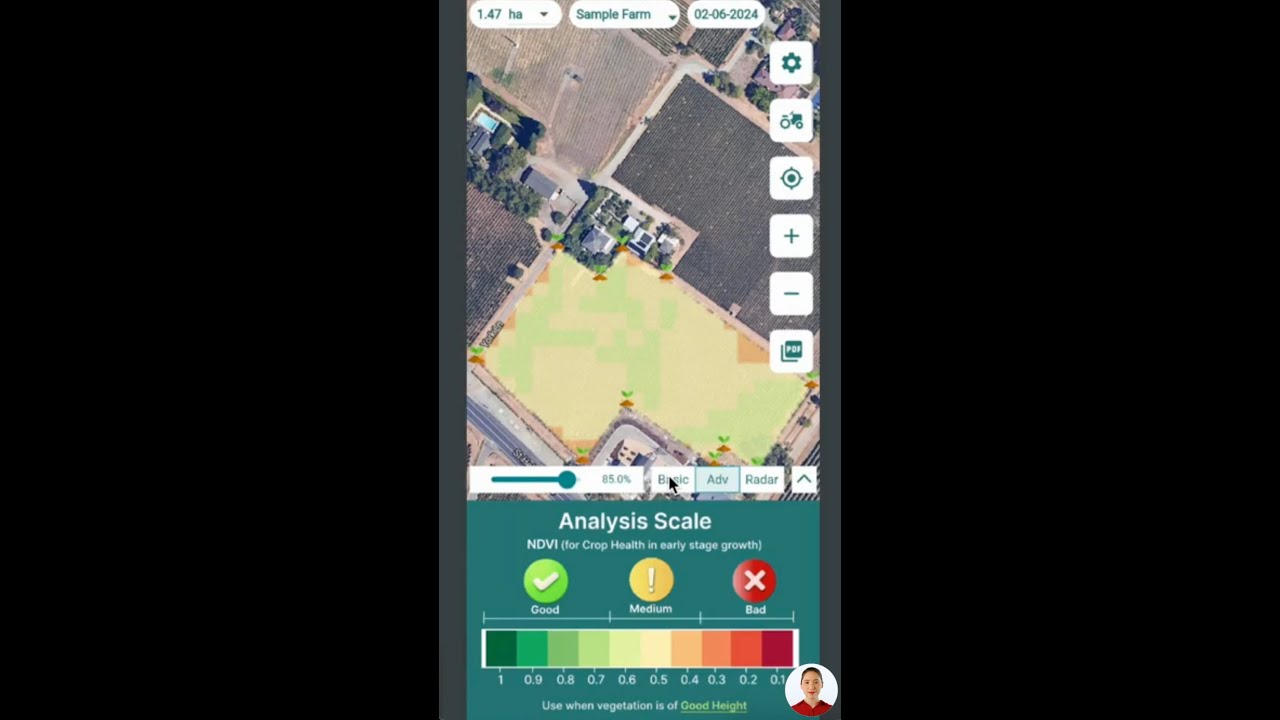
▶ How to read satellite crop maps on a phone, useful for deciding which fields to harvest first. · 4:01
Using field data with an older combine
Many 2388s have no working yield monitor, so you lose a map of which parts of a field yield best. Satellite crop monitoring can fill part of that gap. Vegetation maps taken through the season show stressed areas, uneven stands and which fields mature first. That helps you plan harvest order and decide where to scout.
A USDA Economic Research Service report (2023) found that automated guidance is used on well over 50% of US acres planted to major crops such as corn, soybeans and winter wheat, while yield maps, soil maps and variable-rate tools cover only 5% to 25% of planted acres for winter wheat, cotton, sorghum and rice. Smaller farms with older machines can still get field-level data from satellite images.
Farmonaut Satellite + AI Farm Monitoring System shows vegetation maps of your fields on web, Android and iOS, so you can compare fields before harvest even if the combine has no monitor.

▶ How satellite NDVI maps show crop stress across a large farm before you can see it. · 4:09
FAQ
What years was the Case 2388 made?
The 2300 series started with the 1998 model year. Machinery Pete calls 2006 the last model year of the 2388, and the 88 series took over for 2008, according to Koneviesti.
How much horsepower does a Case 2388 have?
Koneviesti lists 280 hp (DIN) from an 8.3-litre six-cylinder engine. The European X-Clusive version from 2002 was rated at 293 ISO hp.
How many bushels does a Case 2388 hold?
The grain tank holds 73.8 hl, which is about 210 bushels.
What is a Case 2388 worth today?
Auction results range widely. A 2006 unit with 2,361 hours sold for $120,000 in August 2025, while older, high-hour units sell for much less. Hours, records and header decide the price.
Is a Case 2388 better than a John Deere S770?
Not in capacity or automation; the S770 has more power, a bigger tank and modern controls. The 2388 wins on purchase price and simple repairs, which matters on smaller farms.
Does the Case 2388 need DEF?
No. It was built before diesel exhaust fluid systems, which is one reason Machinery Pete says clean pre-DEF combines are in demand.
Related pages on our site: large-farm management app · farm carbon footprinting · crop traceability · satellite and weather API docs · mobile app download
Farmonaut crop monitoring
See your own fields from space
Draw your fields once and Farmonaut shows satellite vegetation maps for them through the season, on web, Android or iOS.




Keep reading
Sources
- Koneviesti Konedata, Case IH 2365-2388 AF combine specifications (read November 2026): koneviesti.fi
- Koneviesti Konedata, Case IH Axial-Flow 5088-7088 specifications (read November 2026): koneviesti.fi
- Koneviesti Konedata, John Deere S760-S790 specifications (read November 2026): koneviesti.fi
- Ritchie Specs, Case IH 2388 Combine (read November 2026): ritchiespecs.com
- Wikipedia, Case IH (read November 2026): en.wikipedia.org
- AgWeb, Pete’s Pick: Almost 20-year-old Case IH Ohio combine nearly breaks record (11 August 2025): agweb.com
- Machinery Pete forum, Sale price report: 2388 with 634 engine hours, Sullivan, Indiana (14 December 2019): discuss.machinerypete.com
- Farms.com, Buyers spend green on green and red equipment (BigIron auction of 18 December 2024): m.farms.com
- AgWeb, Pete’s Pick: John Deere S780 and S670 lead record-breaking June auctions (7 July 2026): agweb.com
- farmdoc daily, University of Illinois, Large increase in machinery costs suggests need to reconsider machinery purchase decisions (October 2025): farmdocdaily.illinois.edu
- University of Illinois farmdoc, Machinery Cost Estimates: Harvesting (August 2025): farmdoc.illinois.edu
- Agweek, Farm custom rates show slight increase for 2025 (Iowa Farm Custom Rate Survey summary): agweek.com
- University of Wisconsin-Madison Extension, Custom Rates for 2025 Wisconsin Farm Operations: farms.extension.wisc.edu
- Manitoba Agriculture, Cost of Production: Farm Machinery, custom and rental guide (2026/2027): manitoba.ca
- USDA Economic Research Service, Precision Agriculture in the Digital Era: Recent Adoption on U.S. Farms, EIB-248 (2023): ers.usda.gov
Discussion
Questions, corrections or field experience? Share them below. First-time comments are reviewed before they appear, and your email is never published.
No comments yet. Be the first to add a question or your experience.

 Cresol
 Atur Kuliner
 GlobalQuant
 MDCV UK
 Zerella Group
 Etech Consulting Madagascar
 Vestlandsforsking
 Agritein
 Delicio
 WB Dev
 Sama Premium
 Prochecker
 Tres Valles
 LACOS Geoinformation
 Magrifly
 LatConnect 60
 Blickwinkel
 Agricultural Credit Policy Council
 Marei Nursery
 eKGIS
 Mostas Tech

 Exploration consultancy · South Africa · Gold
 Licence holder · Niger · Gold
 Licence holder · Nigeria · Gold + lithium
 Client · Tanzania · Gold
 Client · Somalia · Gold
 Client & affiliate partner · Ghana · Gold










