

Farmland ETF US List: Compare Every Real Option for 2026
Reviewed September 2026 against USDA NASS and NCREIF data.
Try it: Enter your numbers above to see a projected split. →
There is no pure-play “farmland ETF” listed on a US exchange — no fund that owns crop acreage directly and trades like a stock. The closest things are two publicly traded farmland REITs (Farmland Partners, ticker FPI, and Gladstone Land, ticker LAND) and a handful of broader agriculture ETFs that hold agribusiness, farm-equipment, and food-production companies rather than land itself. This is the single fact that most “farmland ETF” search results skip, and it’s why this page opens with a full comparison table instead of a definition.
If you searched “farmland etf us,” “agriculture etf list,” “best farmland etf,” or any variant, the honest answer is: pick between the two land-owning REITs for direct exposure, or a broad agriculture ETF for indirect exposure, and understand that the underlying asset — US farmland — is currently valued at an average $6,020 per acre for cropland, per USDA NASS’s 2025 Land Values and Cash Rents report covering the 2026 crop year.

Table of Contents
- What “Farmland ETF” Actually Means in the US Market
- Farmland & Agriculture ETF List: Full Comparison Table
- What the Underlying Land Is Worth: USDA NASS 2026 Data
- How Farmland Has Actually Performed: The NCREIF Index
- Farmland ETF US List: Each Option Explained
- Direct Farmland REITs vs. Broad Agriculture ETFs
- Calculator: Farmland vs. Agriculture ETF Exposure
- ESG, Traceability, and Land-Use Verification
- Verifying Farmland Investments With Satellite Data
- Related Farmonaut Resources
- FAQ
- Conclusion
- Try it: Enter your numbers above to see a projected split.
What “Farmland ETF” Actually Means in the US Market
Searches for “farmland etf,” “farm land etf,” and “farmland etf list” are usually looking for one thing: a fund you can buy on an exchange that gives you a claim on US crop and pasture acreage, the way a REIT gives you a claim on office buildings. That fund, in a pure form, doesn’t exist yet on US exchanges. What exists instead falls into two categories:
- Direct farmland REITs — publicly traded companies that own farmland outright and lease it to operators. In the US, the two of scale are Farmland Partners Inc. (FPI) and Gladstone Land Corporation (LAND). These are the closest instruments to “owning farmland” that trade like a stock.
- Broad agriculture ETFs — funds holding shares in agribusiness, agricultural equipment, seed and fertilizer companies, and food producers. They give exposure to the economics around farmland — input costs, crop prices, processing margins — without owning the acreage.
The distinction matters for anyone typing “agriculture etf list” or “farmland stocks etf”: an agriculture ETF’s returns track corporate earnings and commodity cycles, not the appraised value of farmland itself. A farmland REIT’s returns track lease income and land appraisals more directly, plus whatever premium or discount the stock trades at relative to net asset value. For a fuller breakdown of the agriculture-ETF side specifically, see our companion page: Best Agriculture ETFs US: Top Agriculture Commodity ETFs.
Farmland & Agriculture ETF List: Full Comparison Table
This is the “agriculture etf list” and “farmland etf list” most searches are actually after — every publicly traded US instrument that gives farmland or agriculture exposure, in one place, with the distinction between direct land ownership and indirect sector exposure made explicit rather than blurred.
| Ticker | Name | Instrument Type | Owns Farmland Directly? | Primary Exposure | Where to Verify Current Data |
|---|---|---|---|---|---|
| FPI | Farmland Partners Inc. | REIT (equity) | Yes | Row-crop and specialty-crop farmland leases across multiple US states | SEC EDGAR filings; company investor relations site |
| LAND | Gladstone Land Corporation | REIT (equity) | Yes | Fresh produce and permanent-crop farmland, concentrated in California and the Southeast | SEC EDGAR filings; company investor relations site |
| MOO | VanEck Agribusiness ETF | ETF | No | Global agribusiness: equipment, chemicals, seed, food logistics | VanEck fund page; issuer publishes daily holdings |
| VEGI | iShares MSCI Agriculture Producers ETF | ETF | No | Global agricultural producers and farm-input companies | iShares fund page |
| PAGG | Invesco MSCI Global Agriculture Producers ETF | ETF | No | Broad global crop producers, seed/biotech, fertilizer, equipment | Invesco fund page |
| KROP | Global X AgTech & Food Innovation ETF | ETF | No | AgTech, precision agriculture, food-innovation companies | Global X fund page |
| AGFI | AGF Agricultural Innovation ETF | ETF | No | Sustainable farming, crop science, water and soil technology firms | AGF fund page |
Note what this table does not include: fund AUM, expense ratios, dividend yields, and trailing returns change continuously and are not something this page can responsibly print as a static figure without a live feed. Pull the current numbers directly from each issuer’s fund page (linked above) or a brokerage quote before placing a trade — an AUM figure quoted from any article, including this one, is a snapshot the moment it was written and stale within a quarter.
What the Underlying Land Is Worth: USDA NASS 2026 Data
Whether you buy FPI, LAND, or a broad agriculture ETF, the asset underneath the whole category is US farmland, and the USDA National Agricultural Statistics Service publishes the authoritative annual valuation. The 2025 Land Values and Cash Rents report, covering the 2026 crop year, put the national average value of US cropland at $6,020 per acre, up 3.3% from the prior year. Pastureland averaged $2,000 per acre. Combined farm real estate — land plus buildings across all use types — averaged $4,500 per acre. Source: USDA NASS, 2025 Land Values and Cash Rents report.
These are national averages across every state NASS surveys, and actual per-acre values swing enormously by region — Corn Belt cropland trades far above the national cropland average, while range pastureland in the Mountain West trades well below it. NASS publishes the state-level breakdown in the same report and updates it via QuickStats (quickstats.nass.usda.gov) between annual releases, so if you’re evaluating a specific state’s farmland — or a REIT concentrated in one region, like Gladstone Land’s California exposure — pull the state table rather than relying on the national figure.
This is also the figure that answers “why does farmland ETF exposure matter at all”: a fund or REIT holding land that appreciated 3.3% in a single year, on top of lease income, is compounding two return streams that a pure-commodity or pure-equipment ETF doesn’t have access to.
How Farmland Has Actually Performed: The NCREIF Index
The National Council of Real Estate Investment Fiduciaries (NCREIF) Farmland Index tracks the actual investment performance of a large institutional pool of US farmland — not a public REIT’s stock price, but the appraised, income-generating return of the land itself. It’s the closest thing to a farmland “benchmark” that exists, and it’s the number that should anchor any expectation about what “farmland ETF” returns might look like if a true one launched.
For 2024, the NCREIF Farmland Index posted a total return of -1.03% — the income component alone contributed 2.49%, meaning the appreciation component was negative enough to pull the total below zero. That’s a meaningful data point against any pitch that farmland “always goes up”: it didn’t in 2024. Over the longer run, though, the index has averaged 10.15% annually from 1992 through 2024. The index tracked $16.1 billion in property value as of Q4 2024. Source: FarmTogether, “Breaking Down the 2024 NCREIF Farmland Performance”, citing NCREIF data.
Two things follow from this. First, the -1.03% 2024 print and the 10.15% long-run average are not in conflict — they’re the same series measured over very different windows, and any single year can and does deviate sharply from a multi-decade average. Second, NCREIF measures direct institutional farmland ownership, not the stock-market performance of FPI, LAND, or any agriculture ETF — those trade with their own equity-market volatility layered on top of (or sometimes decoupled from) the underlying land value. NCREIF publishes updated quarterly returns on its own site; check the current quarter before assuming either the -1.03% or the 10.15% figure still applies by the time you’re reading this.

Farmland ETF US List: Each Option Explained
Farmland Partners Inc. (FPI)
A US-based REIT that owns row-crop and specialty-crop farmland outright and leases it to farm operators, generating rental income plus land appreciation. This is direct exposure to the same asset class USDA NASS measures at $6,020/acre for cropland nationally. Check current holdings, portfolio acreage, and lease terms in FPI’s SEC filings before investing — REIT portfolios shift as they acquire and dispose of properties.
Gladstone Land Corporation (LAND)
A US farmland REIT concentrated in fresh produce and permanent crops (fruits, vegetables, nuts), with a heavier weighting toward California and Southeastern US farmland than FPI. Because permanent-crop and specialty farmland carries different valuation dynamics than commodity row-crop land, LAND’s exposure is not a substitute for FPI’s — the two REITs hold meaningfully different underlying acreage. For a deeper comparison of these and other farmland-focused REITs, see Farmonaut’s US Farmland REITs List.
VanEck Agribusiness ETF (MOO)
The largest and longest-running of the broad agriculture ETFs, holding global agribusiness companies — equipment manufacturers, agricultural chemical producers, and food-logistics firms. MOO does not own farmland; it owns equity in companies that sell inputs to farmland operators or process what farmland produces. Verify current AUM, expense ratio, and top holdings on VanEck’s fund page before comparing it against a farmland REIT — the two are different asset classes, not competing versions of the same trade.
iShares MSCI Agriculture Producers ETF (VEGI)
Tracks the MSCI Global Agriculture Producers Index, holding a global mix of crop producers and companies managing farmland operations (as operators, not necessarily as owners investors can trace 1:1 to specific acreage). Useful for diversified sector exposure; not a land-value proxy.
Invesco MSCI Global Agriculture Producers ETF (PAGG)
A comparable global agriculture-producer index fund to VEGI, covering crop producers, seed and biotech firms, fertilizer companies, and equipment manufacturers. Investors researching “agriculture etf list” queries should compare PAGG and VEGI directly since they track closely related indexes — check both funds’ current expense ratios and holdings overlap before choosing one.
Global X AgTech & Food Innovation ETF (KROP)
A newer, technology-weighted fund holding precision-agriculture, agtech, and food-innovation companies rather than traditional commodity producers. Relevant to farmland investors specifically because rising land values increasingly track which operators can adopt yield-boosting technology — see Agriculture Biotechnology: 7 Innovations and Farming Innovation Discussions: Top Advances in Agriculture for the technology side of that thesis, and Top 7 Production Technology in Agriculture for specific tool categories.
AGF Agricultural Innovation ETF (AGFI)
Targets firms in sustainable farming, crop science, and water/soil management — see 7 Ways to Boost Sustainable Resource Stewardship for the on-farm practices this fund’s holdings sell into.

Direct Farmland REITs vs. Broad Agriculture ETFs: How to Choose
The decision between FPI/LAND and a diversified agriculture ETF like MOO or VEGI comes down to what kind of exposure you actually want, and it’s worth stating plainly rather than hedging:
- Choose a farmland REIT (FPI, LAND) if you specifically want your returns tied to US cropland lease income and appraised land value — the same asset USDA NASS measures. You accept concentration risk (a handful of states, specific crop types) and REIT-specific factors like management fees and share-price premium/discount to net asset value.
- Choose a broad agriculture ETF (MOO, VEGI, PAGG, KROP, AGFI) if you want diversified exposure to the agriculture economy — equipment, inputs, processing, innovation — without land-ownership concentration risk. Your returns will correlate more with corporate earnings and commodity-price cycles than with NASS’s per-acre land values.
- Combine both if you want the diversification benefit of the broader sector plus direct exposure to the land-appreciation and lease-income dynamics that only a REIT structure provides. This is the approach most farmland-focused financial advisors describe as “barbell” positioning within an agriculture allocation.
Neither path is a substitute for the other, which is the core correction this page makes on the last version: agriculture ETFs and farmland REITs were previously listed side-by-side in one table as if interchangeable. They aren’t. A reader searching “farmland stocks etf” specifically wants to know which tickers touch land ownership and which don’t — that’s now explicit above.
Calculator: Compare Farmland REIT vs. Agriculture ETF Exposure
Use your own investment amount and assumptions to see how a direct-farmland allocation (priced off USDA’s 2026 cropland average) compares to a broad agriculture-ETF allocation under different return scenarios — enter your own expected returns rather than trusting a number printed on this page.
Enter your numbers above to see a projected split.
Assumptions: simple compound growth at the annual rate you enter, no reinvested dividends beyond that rate, no fees, taxes, or expense ratios deducted, and no account for share-price premium/discount to NAV on REIT holdings. The default REIT return (2.49%) is NCREIF's 2024 income-only component and the default ETF return (7%) is an illustrative placeholder — replace both with your own research or a financial advisor's projections before making any decision. This tool excludes commodity-ETF products entirely and does not model volatility or downside risk.
ESG, Traceability, and Land-Use Verification
Sustainability criteria increasingly factor into how agriculture ETF issuers screen holdings and how farmland REITs report to institutional investors. Three practical tools relevant to verifying that claim rather than taking a fund's ESG label at face value:
- Carbon Footprinting: Farmonaut's Carbon Footprinting module monitors on-farm carbon impact, useful for investors or asset managers wanting to verify a farmland holding's environmental claims rather than relying on issuer self-reporting.
- Blockchain Traceability: Farmonaut's traceability platform provides supply-chain transparency from farm to buyer, relevant to ESG due diligence on agriculture-ETF portfolio companies that process or source from specific farmland.
- Large-Scale Farm Management: Farmonaut's Agro Admin App is built for monitoring large land portfolios — relevant to anyone doing due diligence on a specific REIT's actual acreage rather than trusting the balance sheet alone.




Verifying Farmland Investments With Satellite Data
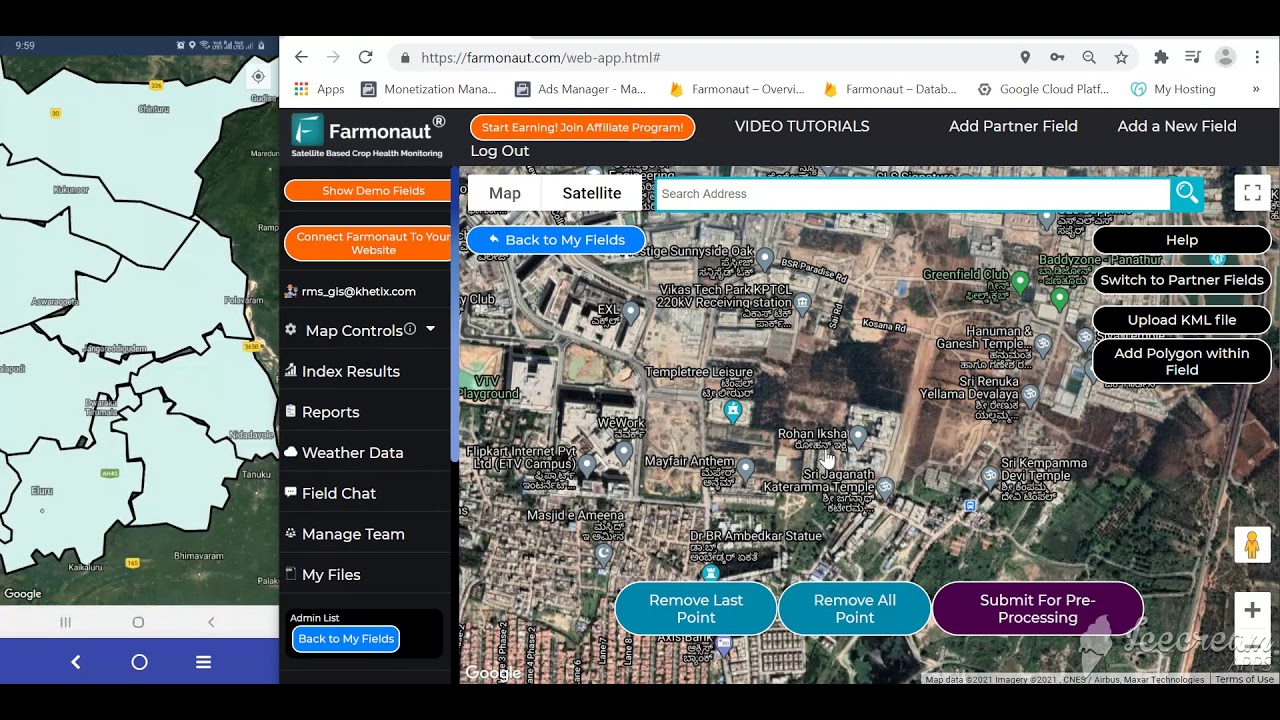
Whether you hold FPI, LAND, or a broad agriculture ETF, the underlying value of farmland assets depends on real conditions on the ground — crop health, water availability, and land use consistent with what's reported. Farmonaut's satellite-based tools give investors and asset managers a way to check that independently rather than relying solely on issuer disclosures:
- Satellite-Based Monitoring: Real-time vegetation health and land-use tracking, useful for due diligence before or after a farmland investment.
- Jeevn AI Advisory System: Weather alerts and management guidance for large-scale agricultural land, relevant for asset managers overseeing REIT-owned or ETF-linked properties.
- Crop Loan and Insurance verification: Farmonaut's Crop Loan & Insurance tools use satellite verification for lenders and insurers assessing farmland-backed risk.
- Fleet Management: Fleet tracking tools for agri-logistics oversight on large land portfolios.
Developers and analysts building their own farmland or agriculture-sector monitoring tools can integrate directly: Farmonaut Satellite API and the API Developer Docs.


Farmonaut Subscription Options
Flexible subscription packages for individuals, businesses, and government clients — real-time monitoring, ESG compliance, and resource management at any scale:
Related Farmonaut Resources
- Farmland REITs in depth: US Farmland REITs List — a full guide to FPI, LAND, and other farmland-owning REITs.
- Agriculture ETFs in depth: Best Agriculture ETFs US — commodity and agribusiness ETF coverage beyond farmland-specific instruments.
- Environmental Monitoring: Farmonaut Carbon Footprinting — carbon credit and ESG reporting for land portfolios.
- Supply Chain Trust: Farmonaut Traceability — farm-to-fork transparency for ESG due diligence.
- Crop Financing Verification: Farmonaut Crop Loan & Insurance — satellite-based verification for farm loans and insurance.
- Fleet Management: Agri-logistics and machinery tracking.
- Large-Scale Farm Management: Farmonaut Agro Admin App — monitor and report on large farmland tracts.
- Crop and Plantation Advisory: Farmonaut's advisory toolkit.
- Precision Agriculture Tools: 7 Precision Agriculture Tools.
- Innovation Coverage: Agriculture Biotechnology Innovations, Farming Innovation Discussions, Production Technology in Agriculture, and Sustainable Resource Stewardship.
FAQ: Farmland ETF US
1. Is there a true farmland ETF listed in the US?
No fund on a major US exchange holds farmland directly and trades under an ETF structure as of this review. The closest direct-ownership instruments are two farmland REITs: Farmland Partners (FPI) and Gladstone Land (LAND). Everything else commonly listed as a "farmland ETF" — MOO, VEGI, PAGG, KROP, AGFI — is a broader agriculture-sector ETF that does not own land.
2. What's the difference between a farmland ETF list and an agriculture ETF list?
A farmland-specific list should contain only instruments that own land — currently, that means FPI and LAND. An agriculture ETF list is broader: equipment makers, fertilizer producers, food processors, and agtech companies, most of which touch farmland only indirectly through the businesses they invest in. Land, REITs and agtech are the wider set of choices, and the ways to invest in agriculture explains how each option differs.
3. What is US cropland worth per acre right now?
USDA NASS's 2025 Land Values and Cash Rents report, covering the 2026 crop year, put average US cropland at $6,020/acre, up 3.3% year over year. Pastureland averaged $2,000/acre. These are national averages; state-level figures vary significantly and are published in the same report, updated via NASS QuickStats between annual releases.
4. How has farmland actually performed as an investment?
The NCREIF Farmland Index — which tracks direct institutional farmland ownership, not ETF share prices — returned -1.03% in total for 2024, with a 2.49% income component offset by negative appreciation. The index's long-run average from 1992 through 2024 is 10.15% annually. Both figures come from the same index measured over different periods; check NCREIF's site for the current quarter's release before assuming either still applies.
5. Should I buy a farmland REIT or an agriculture ETF?
A farmland REIT (FPI, LAND) gives direct exposure to land value and lease income but concentrates risk in specific states and crop types. A broad agriculture ETF diversifies across the sector's supply chain but doesn't directly track land value. Many farmland-focused allocations combine both rather than choosing one exclusively.
6. Are there farmland ETFs outside the US worth comparing?
This page covers the US market specifically, per USDA and NCREIF data. Non-US farmland investment vehicles operate under different regulatory and land-tenure frameworks and are outside this page's scope.
7. Where can I verify current ETF fund data like AUM and expense ratios?
Go directly to the issuer's fund page — VanEck for MOO, iShares for VEGI, Invesco for PAGG, Global X for KROP, AGF for AGFI — all of which publish daily or near-daily updated holdings, AUM, and expense ratios. A third-party article's snapshot of these figures is out of date within a quarter.
8. How does technology affect farmland ETF and REIT performance?
Operators using precision agriculture tools and satellite-based monitoring can improve yields and input efficiency, which factors into both the lease income farmland REITs collect and the earnings of agtech-focused funds like KROP and AGFI.







Conclusion: Building a Farmland ETF US Position
The search term "farmland etf" points to a category that doesn't yet have a pure-play answer on US exchanges — the real choice is between two land-owning REITs (FPI, LAND) and a set of broader agriculture ETFs (MOO, VEGI, PAGG, KROP, AGFI) that touch the sector without owning acreage. USDA NASS's 2026 cropland average of $6,020/acre and the NCREIF Farmland Index's -1.03% 2024 return against its 10.15% long-run 1992–2024 average give you the two reference points that matter most: what the land is worth, and how it has actually performed as a direct investment, not just as a stock-market proxy.
Use the comparison table and calculator above to separate direct-land exposure from sector exposure before deciding an allocation, verify every fund-specific figure against the issuer's own current fund page rather than any static article, and revisit USDA's annual Land Values and Cash Rents report each July for the updated per-acre baseline. Farmonaut's satellite monitoring, traceability, and advisory tools are built to support that ongoing verification — for direct farmland holdings and for the operators behind agriculture-ETF portfolio companies alike.
Discussion
Questions, corrections or field experience? Share them below. First-time comments are reviewed before they appear, and your email is never published.
No comments yet. Be the first to add a question or your experience.

 Aamoksh One Eighty
 Patrick America
 Red Dog Management
 Liquify Digital
 CU Foods
 BeyondTech Global
 Rouge VC
 AgroGreen Dynamics
 AgroRisk
 Oath Inc
 Reddane Farming
 Esri North East Africa
 Cresol
 MDCV UK
 Zerella Group
 Etech Consulting Madagascar
 Vestlandsforsking
 Delicio
 WB Dev
 Sama Premium
 Prochecker
