

Pests · Identification guide
Thrips vs Aphids: How to Tell Them Apart and What Works
Thrips are slender, fringed-winged insects up to about 2 mm that leave silvery stippling. Aphids are soft, pear-shaped insects of 1 to 7 mm with cornicles, honeydew and curled leaves (UC IPM; RHS). They also respond to different sprays.
Key takeaways
- Quick ID: two tube-like cornicles and honeydew mean aphid; silver patches, black specks and thin insects in flowers mean thrips.
- Aphids can reach adulthood in seven to eight days in warm weather (UC IPM); western flower thrips take two weeks or less in good conditions (IRAC).
- In organic trials spinosad averaged 65.6% control of thrips, but gave under 40% on green peach aphid (Insects, 2020).
- Sprays do not fully stop viruses: in Florida tomato about three-quarters of TSWV infection comes from thrips flying in (UF IFAS).
- Use crop thresholds, such as 1 western flower thrips adult per tomato flower or 250 soybean aphids per plant on 80% of plants and rising.
In this article
- Thrips vs aphids at a glance
- How to tell thrips from aphids in the field
- How fast thrips and aphids build up
- Damage and yield loss: what each pest does
- Virus risk: why killing the insect may not stop the disease
- Scouting and action thresholds
- How to control thrips and aphids
- Insecticides: the same product does not fit both
- Does a spray pay? Run your own numbers
- Using satellite maps to decide where to scout
- FAQ
The main difference between thrips and aphids is shape and feeding. Thrips are slender insects up to about 2 mm long with fringed wings, and they puncture surface cells and suck out the contents, leaving silvery stippling and black specks. Aphids are soft, pear-shaped insects of 1 to 7 mm that suck sap, usually carry two tube-like cornicles at the rear, and leave sticky honeydew and curled leaves (UC IPM; RHS).
That split matters because the two pests call for different sprays, different counts and different virus plans. This guide gives a field ID table, published action thresholds, two charts from organic spray trials and a calculator to test whether a spray pays on your own numbers.
Thrips vs aphids at a glance
Thrips and aphids are not the same insect, and they belong to different insect orders. Thrips belong to the order Thysanoptera. Aphids are true bugs in the family Aphididae. Use the table first, then the sections below for the detail behind each row.
| Feature | Thrips | Aphids |
|---|---|---|
| Group | Order Thysanoptera | True bugs, family Aphididae |
| Size | Up to about 2 mm | 1 to 7 mm |
| Body | Narrow and elongate | Soft, pear-shaped, long legs and antennae |
| Wings | Strap-like, fringed with hairs | Usually wingless; winged forms appear when crowded and in spring and fall |
| Rear end | No cornicles | Most species have two cornicles |
| Feeding | Punctures surface cells and sucks out contents | Sucks plant sap |
| Leaf signs | Silvering, stippling, black specks of frass | Curling, yellowing, honeydew, sooty mold |
| Where to look | Inside flowers, buds and shoot tips | Leaf undersides, young shoots, stems |
| Young | Hatch from eggs | Most give live birth in the growing season |
| Main viruses | Tospoviruses such as tomato spotted wilt | Many viruses of squash, melon, bean, potato and lettuce |
| Natural enemies | Minute pirate bugs, predatory mites, predatory thrips | Parasitic wasps, lady beetles, lacewings, syrphid larvae |
How to tell thrips from aphids in the field
A 10x hand lens settles most cases. Then run these four checks in order.
- Look at the shape. A thin splinter is likely a thrips. A plump, slow insect sitting in a group is likely an aphid.
- Check the rear end. Two small tubes pointing backward mean aphid. The UC IPM aphid note says most species have them, so a few do not.
- Touch the leaf. Sticky honeydew, often with black sooty mold or ants, points to aphids. Dry leaves with silver patches and tiny black dots point to thrips.
- Shake it out. Thrips often feed hidden, so tap flowers or foliage over white paper. UC IPM also suggests blue or bright yellow sticky traps to detect flying adults.
Thrips: narrow, fringed and hidden
Most adult thrips are less than 1/20 inch long, according to the UC IPM thrips note. Color runs from translucent white or yellowish to dark brown or black. Larvae look like small wingless adults. Because most pest thrips hide in buds and under sepals, you often see the damage before the insect. Harsh weather, poor plant care and other pests can leave similar marks, so confirm the insect before you act.
Not every thrips is a pest. Some feed on pollen or fungal spores, and some hunt mites and other insects. The species matters. In Florida tomato, native eastern and Florida flower thrips caused no observed damage at 20 to 25 per flower, and they compete with the more harmful western flower thrips, according to University of Florida IFAS.
Aphids: soft, grouped and sticky
Aphids may be green, yellow, brown, red or black, depending on species and host (UC IPM aphid note). A few are coated in white or gray wax. Ants climbing a plant are a clue too, since they feed on honeydew and guard aphids from predators. If waxy white insects with no cornicles are the puzzle, see our guide to aphids vs mealybugs.
Black aphids vs thrips
Color does not separate them. Black bean aphid, often called blackfly, forms dense colonies on beans and other plants in spring and summer, according to the RHS. Tobacco thrips are also dark, brown to black (NC State Extension), but they are slender like other thrips. So use shape: a dark, plump insect in a dense group on a stem is more likely an aphid, and a dark sliver in a flower is more likely a thrips.

▶ Western flower thrips damage on fruits and vegetables and how growers manage it. · 15:42
How fast thrips and aphids build up
Aphids usually win this race. In warm weather many species go from newborn to reproducing adult in seven to eight days, and most in California’s mild climate need no mating. One adult can produce up to 80 young in a week (UC IPM). Soybean aphid populations can double in two to three days under good conditions (Iowa State University).
Thrips need more steps: egg, two feeding larval stages and two nonfeeding stages, often in soil or leaf litter. That hidden stage is one reason sprays on leaves miss part of the population. Western flower thrips can go from egg to adult in two weeks or less in good conditions (IRAC). Published timing varies: the RHS, a UK source, gives a 24 to 35 day cycle for thrips under ideal conditions (RHS).
Chart
Time to develop, fastest figure in each source
Days, under warm or good conditions; species and sources differ
Damage and yield loss: what each pest does
Both pests can hurt a crop, yet neither has one reliable yield-loss figure. Loss varies with crop, species, timing and virus pressure. Treat any single percentage with care and work from local thresholds instead.
- Thrips on fruit: Western flower thrips lay eggs in small tomato fruit, leaving dimples. Larvae cause flecks that may not show until the fruit ripens (UF IFAS). On avocado and citrus, scarring harms the skin and not the flavor or inner quality (UC IPM).
- Thrips on leaves: Silvering and stippling reduce appearance. Young vegetables and soft ornamentals suffer more than trees and shrubs, which thrips rarely kill.
- Aphids on leaves: Large colonies yellow leaves and stunt shoots. Some species inject a toxin that curls growth. Honeydew and sooty mold foul leaves and fruit.
- Aphids at field scale: In soybean, detectable yield loss starts at about 485 aphids per plant, and the 2007 economic injury level was 674 per plant (South Dakota State University).
Virus risk: why killing the insect may not stop the disease
This is where the plans really diverge. Thrips carry tomato spotted wilt virus (TSWV) and other tospoviruses. The bond is unusual: a thrips must pick up the virus as a larva, and then it can pass it on as an adult for life. Aphids and whiteflies do not transmit TSWV, says UF IFAS. Also, some thrips species that look alike do not carry it. Eastern flower thrips, for example, does not.
UF IFAS attributes about three-quarters of TSWV infection in Florida tomato to adults flying in from outside, and about a quarter to spread inside the crop. UF IFAS says sprays do not prevent the first kind, since a short feed is enough to infect. They can limit the second by killing larvae. NC State reports that treating transplants with imidacloprid just before planting can cut TSWV incidence by up to 50%, and that many tomato and pepper hybrids carry a resistance gene. It also reports resistance-breaking virus variants on such tomatoes in North Carolina in 2022, so resistance is not a guarantee.
Aphid-borne viruses behave in a similar way. UC IPM lists squash, cucumber, melon, bean, potato, lettuce and beet among crops often affected. An aphid needs only a few minutes to pass a virus on, while an insecticide takes much longer to kill it. So infection happens even at low aphid numbers. Silver reflective mulch, row covers and clean seedlings do more here than a late spray. Cereal growers in the UK can use the AHDB BYDV tool for sowing-date and spray decisions on barley yellow dwarf virus. AHDB says its research shows it can cut applications and protect more yield than the older T-sum method when the virus is present.
Scouting and action thresholds
A pest count only helps if you compare it with a number tied to your crop. The table lists published thresholds. They come from specific regions and studies, so check with your local extension service before you rely on one.
| Crop | Pest | Published threshold | Source |
|---|---|---|---|
| Tomato | Western flower thrips | 1 adult per flower, or 2 larvae per fruit | UF IFAS |
| Pepper, eggplant | Western flower and melon thrips | About 6 adults per flower, or 2 larvae per fruit | UF IFAS |
| Soybean | Soybean aphid | 250 per plant on 80% of plants and rising, up to R6 | Iowa State |
| Alfalfa | Pea aphid | 30 per sweep | Insects (2020) |
To count thrips, pick flowers and tear them open over a white board, as UF IFAS describes for pepper. Also note predators: about one minute pirate bug to 180 thrips gave suppression in that work, and about one to 40 gave control.
For aphids, turn leaves over and start at the upwind edge and next to infested plants. UC IPM suggests checking at least twice a week when plants grow fast, in a garden setting. Iowa State suggests every seven to 10 days in soybean. Many aphid species do the most harm in late spring, at 65 to 80°F. Golden, crusty aphid mummies are good news. They mean parasitic wasps are at work, and numbers may fall within a week or two.
How to control thrips and aphids
Integrated pest management (IPM) means scouting first, then combining methods, and spraying last. The goal is to prevent damage, not to kill every insect. Here is how the same tools differ across the two pests.
Cultural and physical control
- Reflective mulch: It works against both while plants are small. UF IFAS calls UV-reflective mulch very effective for reducing thrips, but the effect fades as the canopy closes. One copper and mancozeb spray can cut reflectance by about 49%. UC IPM says silver mulch has reduced aphid-borne viruses in squash and melon.
- Row covers: They keep both out of young plants. Utah State University suggests using them from planting to the start of bloom in vegetables.
- Water blast: A strong stream knocks aphids off sturdy plants. It helps less with thrips hidden in buds.
- Fertilizer and water: Too much nitrogen or water can raise thrips numbers, UC IPM warns.
- Sanitation: Remove weeds and infested plant parts. Weeds can host thrips, viruses and aphids between crops.
- Ants: Keep ants off plants so aphid predators can work.
Biological control
Aphids have the easier story outdoors, since parasitic wasps, lady beetles, lacewing larvae and syrphid larvae often arrive on their own. UC IPM says naturally occurring predators work best in gardens and landscapes. For thrips, minute pirate bugs can do the job in field peppers, as noted above. UC IPM says releases of bought enemies in gardens and landscapes are unlikely to give satisfying thrips control. Glasshouses are different: the RHS lists Orius laevigatus and Amblyseius mites as options there. Avoid persistent broad-spectrum sprays, which kill these helpers.

▶ A guide to aphid biology, damage and control indoors and outdoors. · 28:21
Insecticides: the same product does not fit both
A 2020 paper in the journal Insects summed up 153 field trials of organic insecticides. Spinosad led on thrips overall, though its lead was significant for onion thrips and not for flower thrips. It did poorly on green peach aphid, at under 40% in two collard trials. Pyrethrin and azadirachtin products did better on that aphid.
Chart
Organic insecticide control of thrips
Average % control against untreated plots, weekly sprays, 18 trials on onion and zinnia
Those results come from particular products, crops and rates, so read them as a guide and not as a promise. Thrips results were from onion and zinnia, mainly onion thrips and eastern flower thrips, not western flower thrips. Aphid results were from cole crops and alfalfa. The two aphid bars in the chart also differ in spray count: green peach aphid plots got two or three weekly sprays, while pea aphid plots got one, which the authors say likely explains much of the gap. Yield barely responded in the onion plots, too. Only one of four trials showed a significant gain.
A few more rules from the sources:
- Rotate modes of action. Some spinosyn resistance is documented in Florida. UF IFAS advises using IRAC group 5 products at most twice per crop in tomato. It also lists flonicamid, spirotetramat and isocycloseram among other options that suppress western flower thrips.
- Get coverage. Soaps and oils work by contact, so wet the insect. UC IPM warns against using them on drought-stressed plants or in great heat.
- Protect bees. Systemic neonicotinoids can move into flowers. The EU banned all outdoor uses of imidacloprid, clothianidin and thiamethoxam in 2018, leaving permanent greenhouses (European Commission).
- Expect no repair. A spray does not fix scarred tissue. Plants stay marked until new growth appears.
Registrations vary by country, crop and year. Always check the product label and local rules, and ask a licensed adviser or extension agent before you spray.
Chart
Organic insecticide control of two aphids
Average % control against untreated plots; 7 alfalfa trials and 5 cole crop trials
Does a spray pay? Run your own numbers
A threshold tells you when the pest count is high. The sum below tells you if the treatment is likely to earn back its cost. The hardest input is the expected loss, so base it on your field records or an adviser’s estimate. Control is the share of the loss you expect the spray to prevent, which is often lower than the share of insects killed.
Try the numbers for your own farm below.
Calculator
Will a thrips or aphid spray pay for itself?
Enter your own field size, crop value, expected loss and treatment cost.
- Crop value saved, US$ per acre: $60
- Net result, US$ per acre: $5
- Break-even expected loss: 7.3 %
Example values only, not a benchmark or a forecast; defaults sit near break-even. Prices are examples, so use today’s price. The result ignores virus spread, harm to natural enemies, resistance and pre-harvest limits. Follow the product label and local rules, and get advice from a local adviser.
Using satellite maps to decide where to scout
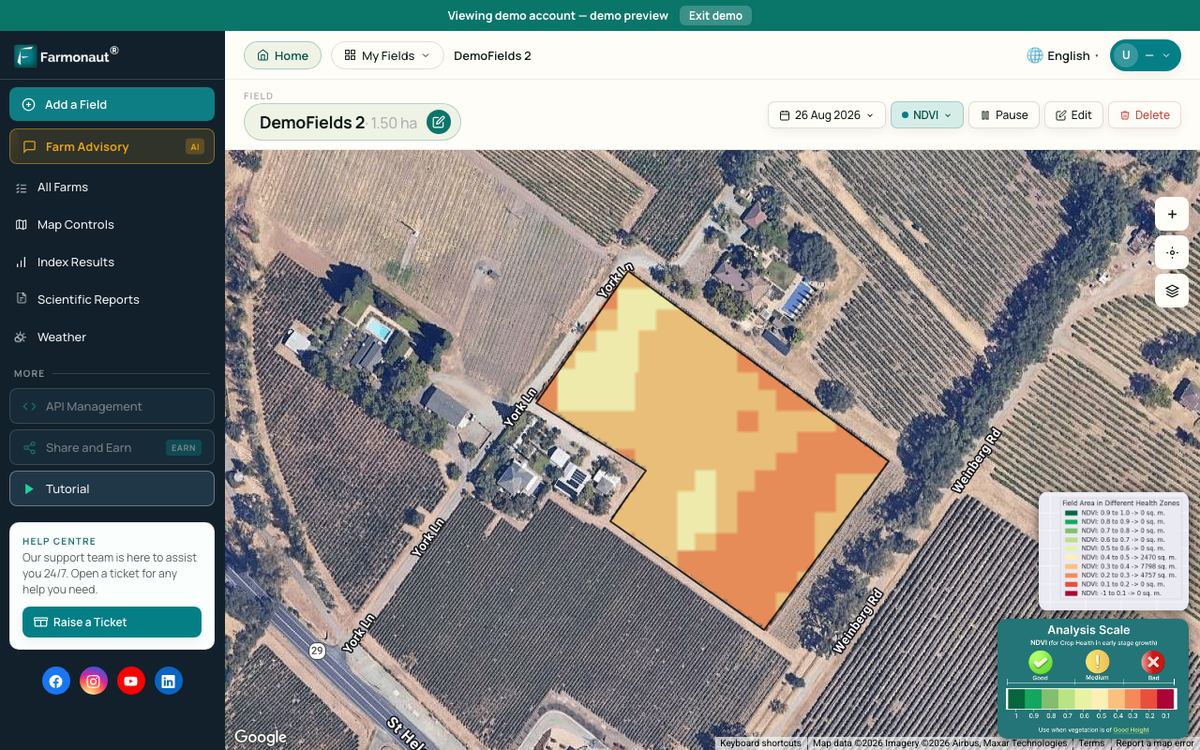
A satellite cannot see a thrips or an aphid. It can show a patch of crop whose vegetation signal has changed from the rest of the field. The cause could be pests, water, nutrients or disease, so someone still has to walk there and look. On large fields, that helps set the order of your scouting. Farmonaut provides such satellite vegetation maps.

▶ A walkthrough of the Farmonaut web system for reading crop health maps. · 8:43
FAQ
Are thrips and aphids the same?
No. Thrips are in the order Thysanoptera, and aphids are true bugs in the family Aphididae. Both are small plant feeders that can spread viruses, which is why they get confused. Their body shape, feeding marks and virus types differ.
What is the quickest way to tell aphids from thrips?
Look for two tube-like cornicles and sticky honeydew, which point to aphids. Silver patches with tiny black specks and thin insects inside flowers point to thrips. Use a hand lens, and tap flowers over white paper.
Do neem and soap kill both pests?
Not equally. In the 2020 trial summary, the neem product Neemix averaged 19.1% control of thrips and 52.6% on green peach aphid with repeat weekly sprays. UC IPM says soaps and oils solve most garden aphid problems when used well, and gives only temporary thrips control for soaps, oils and pyrethrins. Check the label and local rules.
Will killing thrips or aphids stop virus spread?
Often only partly. Infected insects can pass a virus on faster than a spray kills them. Combine resistant varieties, clean transplants, reflective mulch and weed control with any treatment.
Which pest is harder to control?
Thrips usually are, on the sources here. UC IPM states that thrips are difficult to control and that pesticides alone rarely give good control, since they hide and pupate away from the leaves. Aphids are often easier to reach, and UC IPM lists many natural enemies for them, though they breed faster and curled leaves can shelter them.
Related pages on our site: common crop pests in Illinois, alternative pest control methods, broad-spectrum insecticides, organic thrips control, forest monitoring tools, carbon footprinting, fleet management, product traceability, crop loans and insurance, satellite data API, API developer docs.
Farmonaut crop monitoring
See your own fields from space
Outline your fields once and Farmonaut shows satellite vegetation maps through the season, so you can choose which patch to scout first.



Keep reading
Sources
- UC IPM, Pest Notes: Thrips: ipm.ucanr.edu
- UC IPM, Pest Notes: Aphids: ipm.ucanr.edu
- RHS, Aphids: rhs.org.uk
- RHS, Thrips on garden plants: rhs.org.uk
- RHS, Blackfly on beans: rhs.org.uk
- UF IFAS, Managing Thrips and Tospoviruses in Tomato (ENY859): edis.ifas.ufl.edu
- UF IFAS, Managing Thrips in Pepper and Eggplant (ENY-658): edis.ifas.ufl.edu
- NC State Extension, Tomato Spotted Wilt Virus on Tomato and Pepper: content.ces.ncsu.edu
- Iowa State University, Soybean Aphid: crops.extension.iastate.edu
- South Dakota State University Extension, Why the 250 Threshold is Still Appropriate: extension.sdstate.edu
- IRAC, Western flower thrips: irac-online.org
- Insects (2020), Comparative Efficacy of Common Active Ingredients in Organic Insecticides: pmc.ncbi.nlm.nih.gov
- Utah State University, Aphids on Vegetables: extension.usu.edu
- AHDB, BYDV management tool: ahdb.org.uk
- European Commission, Neonicotinoids: food.ec.europa.eu
Discussion
Questions, corrections or field experience? Share them below. First-time comments are reviewed before they appear, and your email is never published.
No comments yet. Be the first to add a question or your experience.

 Nale Network
 Exurbia Geospatial
 FieldZero
 Indico Company
 Kubota
 FFBS
 Jontra
 Kalustyan
 Tucor
 Geno
 Hayleys Agriculture
 Linx Agritech
 Adinet
 Save Your Soils

 Licence holder · Niger · Gold
 Client · Tanzania · Gold
 Client · Somalia · Gold
 Client & affiliate partner · Ghana · Gold










