
Drone software · Buyer guide
Best Agriculture Drone Software: 6 Tools and Prices
The right drone software depends on the job: DroneDeploy for cloud mapping, PIX4Dfields for offline prescription maps, Agremo for low-cost AI plant counts. Compare prices, rules and payback below.
Key takeaways
- DroneDeploy Ag Lite lists at US$1,908 a year and Agremo Starter AI at US$349 a year (vendor pages, 13 November 2026).
- PIX4Dfields processes images offline and exports ISOXML prescription maps for ISOBUS sprayers.
- An Iowa State demonstration saved US$13.42 per acre on herbicide with drone weed maps (2024).
- Drones treated about 16.4 million US acres in 2025, up 59% on 2024 (American Farm Bureau Federation).
- Since 22 December 2025 the FCC Covered List blocks new foreign-made drone models; drones already owned can still fly.
In this article
- Best agriculture drone software at a glance
- How we chose these tools
- Ranked: the best agriculture drone software by use case
- How many farms use drone imagery
- Drone hardware and US rules to check first
- What to look for in agriculture drone software
- How to choose the best agriculture drone software for your farm
- How to run a fair software trial
- Data ownership and support questions to ask
- Does drone software pay for itself?
- Drone software and satellite data together
- Trends in agriculture drone software development
- Drone or satellite: which suits which job
- FAQ
The best agriculture drone software depends on the job. For field mapping and team sharing, DroneDeploy is a common pick. For fast offline maps and prescription files at the field edge, PIX4Dfields stands out. For automatic plant counts and weed maps at a lower yearly price, Agremo is worth a look. Each tool turns drone photos into crop maps, but they differ in price, offline use and export formats.
This guide compares six tools with “Best for” notes, list prices checked in November 2026, US rules that affect which drones you can buy, and a calculator that shows whether drone software pays for itself on your acres. Prices are the vendors’ published list prices on 13 November 2026, not dealer quotes.
Best agriculture drone software at a glance
The table sums up the tools in this guide. The ranked list below explains each one.
| Software | Best for | Works offline | List price (Nov 2026) |
|---|---|---|---|
| DroneDeploy | Mapping, stand counts and team sharing | Cloud processing | US$1,908 a year (Ag Lite plan) |
| PIX4Dfields | Offline maps and prescription files | Yes, on a laptop | Quote from vendor |
| Agremo | AI plant counts and weed maps | Cloud processing | US$349 a year (Starter AI) |
| Sentera | Weed maps ahead of a spray pass | Cloud processing | Quote from vendor |
| Taranis | Scouting reports from high-detail images | Cloud processing | Quote from vendor |
| Satellite monitoring | Whole-farm checks between drone flights | Web and phone apps | Varies by acres |
Chart
Yearly list price of selected drone software plans
US$ per year, vendor list prices on 13 November 2026
How we chose these tools
We looked for software that farm managers and agronomists in the US, Canada, Europe and Australia can buy today. Each tool had to do at least one of three things well: stitch drone photos into a field map, turn that map into a crop health or weed layer, or export a prescription file a sprayer can use. We checked features and prices on each vendor’s own page on 13 November 2026. We did not test the tools on our own fields, so treat the list as a starting point for your own trial.
Weed mapping is one of the clearest uses. In an Iowa State University extension demonstration on a soybean field, drone weed mapping and a targeted prescription cut herbicide use by close to half, saving US$13.42 per acre with no clear yield difference from a broadcast spray (Iowa State, December 2024). That was one field in one season, so your result will depend on weed pressure.
Ranked: the best agriculture drone software by use case
1. DroneDeploy
DroneDeploy is a cloud mapping platform used across farming, construction and energy. Its Ag Lite plan lists stand count analysis for corn at V2 to V3 and for soybeans, a live map during the flight, and up to 1,000 images per map. The plan costs US$1,908 a year for one pilot. The Individual Pilot plan, with up to 3,000 images per map, lists at US$4,188 a year (DroneDeploy pricing page, November 2026).
- Best for: farms and service providers that want maps shared with a team through a browser.
- Watch for: processing happens in the cloud, so you need a good upload connection.
2. PIX4Dfields
PIX4Dfields is built for agriculture. It runs on Windows and macOS and can process images on the laptop at the field edge, with no internet needed. It accepts both drone and satellite images. It makes variable rate and spot spraying maps and exports ISOXML for standard ISOBUS terminals, so the file can go straight to a sprayer or spray drone (PIX4D product page, November 2026). The vendor asks buyers to contact sales for a price.
- Best for: growers and agronomists who need a prescription map the same day, even with poor signal.
- Watch for: fast offline maps need a capable laptop.
3. Agremo
Agremo focuses on AI analysis of drone images. Its plans list stand counts, weed detection, plant vigor and canopy cover, plus RGB and multispectral stitching and vegetation indices such as NDVI. The Starter AI plan lists at US$349 a year for 10 fields, up to 10 maps and 30 AI analyses. The PRO plan lists at US$1,950 a year, shown at US$1,755 a year on an annual deal, with no field limit (Agremo pricing page, November 2026).
- Best for: smaller farms and consultants who want plant counts and weed maps at a lower entry price.
- Watch for: the Starter plan caps fields and analyses, so check your season’s needs.
4. Sentera
Sentera makes drone sensors and weed mapping software. Iowa State extension lists it among the providers that offer weed insights from drone images, and notes that Sentera reported 94% weed detection accuracy across more than 13,000 acres in its 2024 early access program. That figure is the company’s own report, not an independent trial.
- Best for: row crop growers planning a targeted post-emergence spray.
- Watch for: ask how the weed map exports to your sprayer before you buy.
5. Taranis
Taranis offers crop scouting reports built from high-detail aerial images. Iowa State extension also lists it as a weed insight provider. Pricing comes by quote.
- Best for: retailers and agronomists who scout many farms for clients.
- Watch for: the service model suits advisors more than a single grower flying a drone.
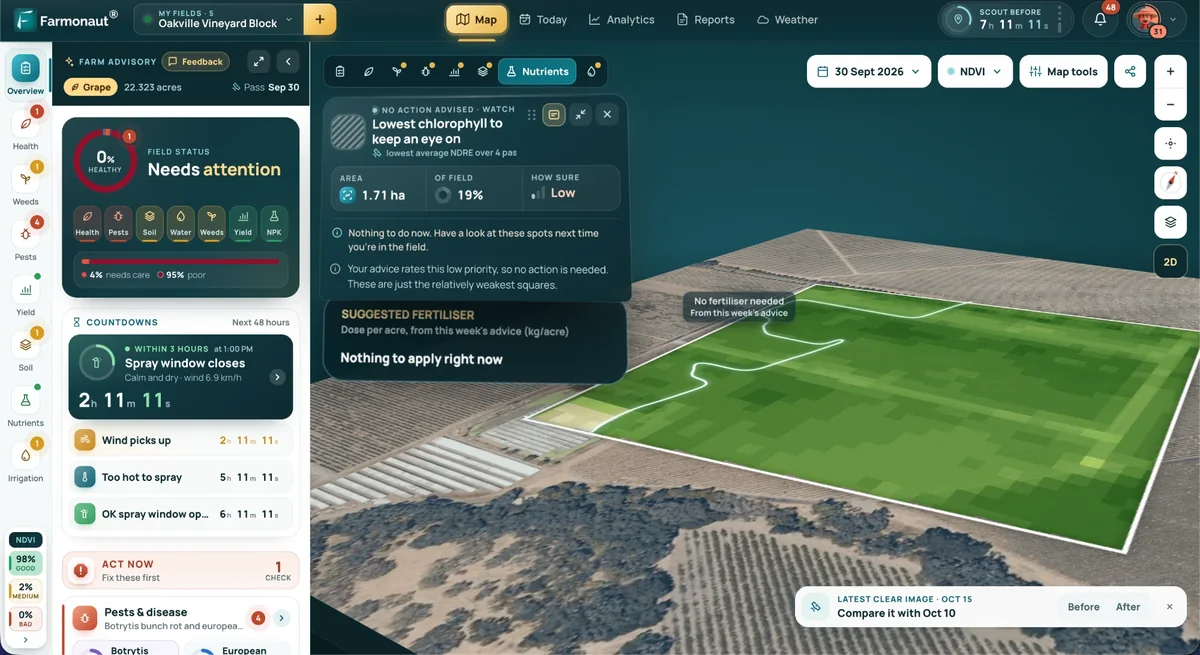
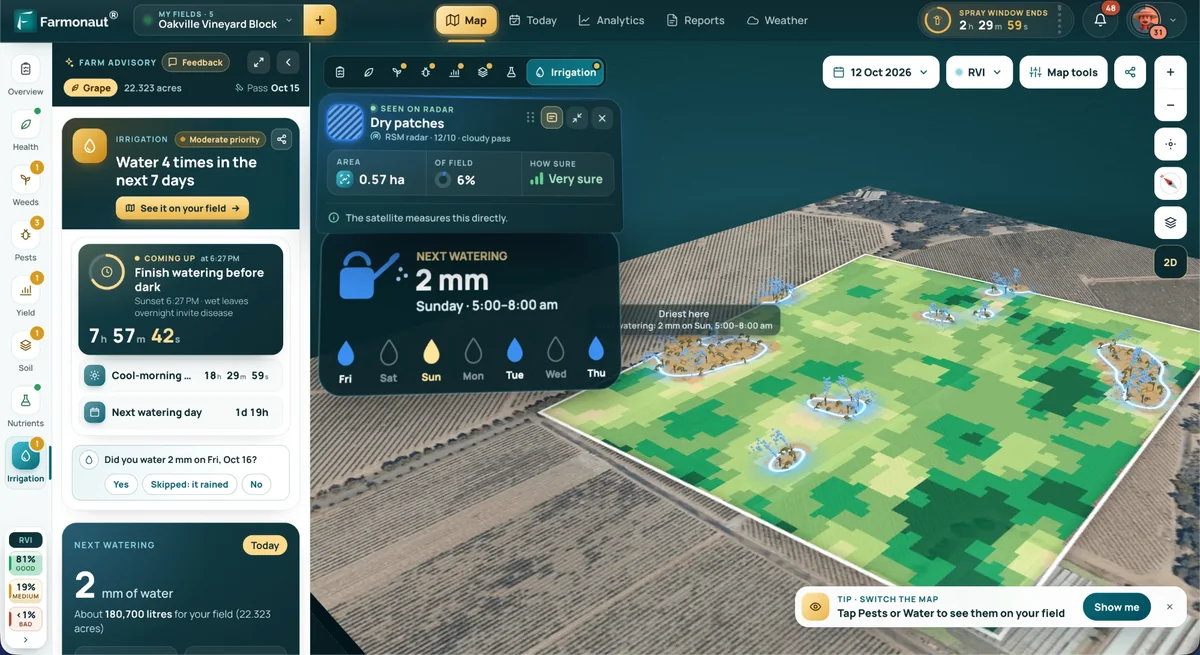
6. Satellite crop monitoring alongside drones
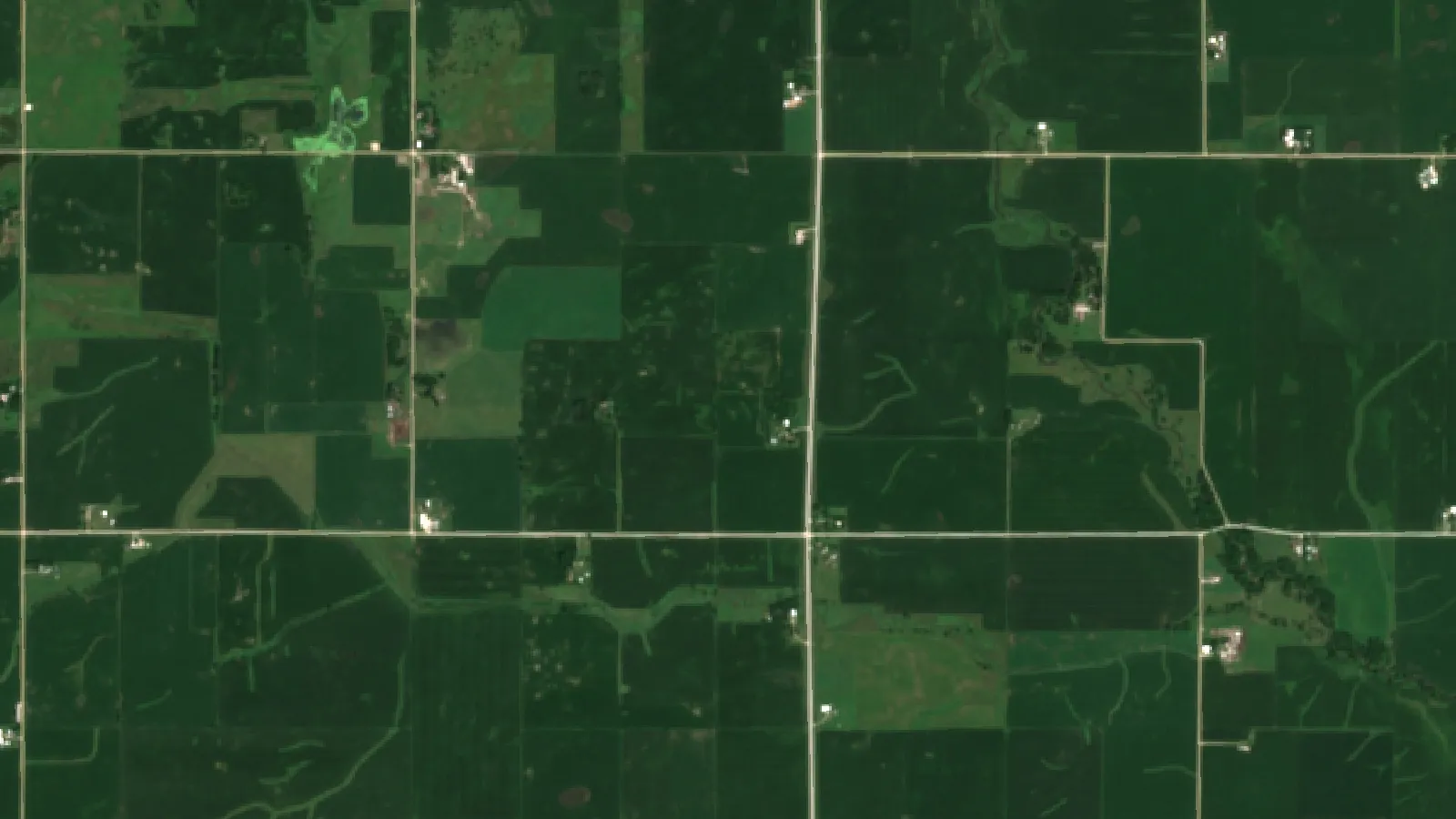
Drones give sharp images on demand, but someone has to fly every field. Satellites cover every field on a schedule with no flight, at lower detail. A University of Nebraska–Lincoln extension guide notes that satellite images need little effort to get and cover large areas, but have lower resolution and are blocked by clouds, while drones fly on demand at low height for higher detail (UNL, 2017). Many farms use satellite maps to spot a problem area, then send a drone to look closely.
- Best for: checking every field each week and choosing where a drone flight is worth the time.
- Watch for: satellites show vegetation change, not the cause. You still need to scout.
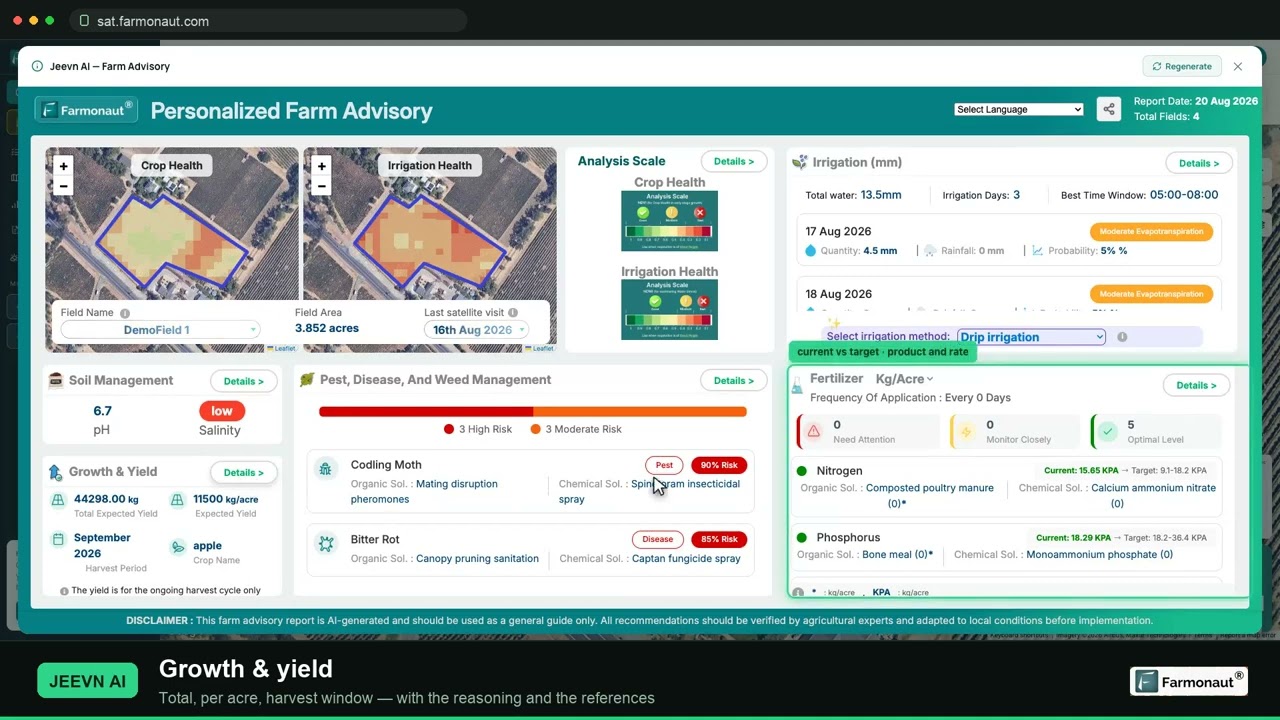
▶ A full walkthrough of satellite crop monitoring: reading NDVI and pulling a field report. · 19:36
How many farms use drone imagery
Aerial imagery is still a minority tool on US row crop farms. USDA’s Economic Research Service found that drone, aircraft or satellite imagery was used on 7.0% of corn acres in 2016 and 9.8% of soybean acres in 2018, and on 2.8% of cotton acres in 2019 (USDA ERS, EIB-248, 2023). The survey could not split drones from aircraft and satellites. ERS links the low use to cost, complexity and a view that the tools have few uses on the farm.
Chart
Share of US crop acres using drone, aircraft or satellite imagery
% of planted acres, survey year in brackets
Spraying is a different story. The American Farm Bureau Federation reports that about 16.4 million US acres were treated by drones in 2025, up 59% from 10.3 million acres in 2024 and more than four times the 3.7 million acres of 2023. These figures count sprayed acres, not mapping flights. Spray growth matters for software buyers, because a weed map is only useful if it can become a spray job.
Chart
US acres treated by spray drones
million acres per year
Drone hardware and US rules to check first
Software only works with drones it supports, so check the hardware list before you pay. DJI makes many widely used farm drones. Its Mavic 3 Enterprise, for example, lists up to 45 minutes of flight time with no wind and RTK positioning to 1 cm plus 1 ppm horizontally (DJI specs, November 2026). PIX4D publishes a demo dataset from the DJI Mavic 3 Multispectral, a model built for crop health mapping.
US buyers need to know about a December 2025 rule change. The Federal Communications Commission added drones and drone parts made abroad to its Covered List on 22 December 2025 (FCC fact sheet, 2025). The rule applies to new device models. It does not stop people using drones they already own, and retailers may keep selling models approved before that date. Check with your dealer that a model you plan to buy can still be sold, and that your software supports it.
Flying rules matter too. Under the FAA’s Part 107 rules, a drone under 55 pounds can fly for business once the pilot holds a Remote Pilot Certificate and the drone is registered; registration costs US$5 and lasts three years (FAA, November 2026). Spraying crop protection products from a drone needs more: the FAA says operators need an agricultural aircraft operator certificate under Part 137, plus the exemptions and approvals that apply (FAA, 2026). The full rule text is in 14 CFR Part 137. Canada, the UK, the EU and Australia have their own drone rules, so check your national aviation authority. For any spray job, follow the product label and local rules, and get professional advice if you are unsure.
What to look for in agriculture drone software
These are the features that separate a useful tool from a pretty map.
- Stitching and map quality: the software should build one clean field map from hundreds of photos, with RGB and multispectral support if you fly a multispectral camera.
- Crop and weed layers: look for NDVI and other vegetation indices, stand counts, and weed detection for the crops you grow.
- Prescription export: check the file formats your sprayer, spreader or spray drone reads, such as ISOXML or shapefiles.
- Offline processing: useful where field signal is weak; cloud tools need a strong upload link.
- Drone support: confirm your drone and camera are on the vendor’s list.
- Sharing: agronomists and service providers need client access and simple PDF reports.
- Data links: an API or export lets you send maps into your farm management system. Developers can see an example in our satellite and weather API developer docs.

▶ How to add, edit and manage fields through the Farmonaut API. · 6:06
How to choose the best agriculture drone software for your farm
Use these steps to narrow your shortlist.
- Name the main job. Scouting crop health, counting plants, mapping weeds for a spray pass and planning drainage each need different tools.
- Count your acres and flights. Plans cap fields, maps or images. Estimate flights per season before you compare prices.
- Check your hardware. Confirm your drone and camera are supported, and check US sale rules for any new model.
- Test the export. Send a sample prescription to your own sprayer or terminal during a trial.
- Do the sums. Use the calculator below to compare the yearly cost with what targeted spraying or earlier scouting could save.
- Plan the gaps. Decide how you will watch fields between flights; satellite maps are one option.
How to run a fair software trial
A short trial tells you more than any feature list. Plan it before the season’s key flight dates so you test the tool on real decisions.
- Pick two or three fields. Choose one field with a known problem, such as a wet corner or a weedy strip, and one that looks even. The tool should show the problem field clearly and not invent issues in the even one.
- Fly the same images through each tool. Upload one flight to every program you test. That way the map quality reflects the software, not the weather on the day.
- Time the job. Note how long it takes from landing to a usable map, and how long a prescription file takes to export.
- Walk the field. Check a few flagged spots on foot. A stress map is only useful if the zones it shows match what you find.
- Load the file into your machine. Make sure your sprayer terminal or spray drone reads the prescription with the right rates and boundaries.
- Write down the costs. Record plan price, any per-acre or per-map charge, and the time spent. These feed straight into the calculator.
Data ownership and support questions to ask
Before you sign, ask each vendor a few plain questions. Who owns the images and maps you upload? Can you download your raw images, maps and prescriptions in standard formats if you leave? Where is the data stored, and can you share access with an agronomist and remove it later? Is phone or chat support available during spraying season, when a delay costs money? Does the plan renew on its own, and at what price? Write down the answers. They matter as much as the feature list when a tool becomes part of your season plan.
Does drone software pay for itself?
The answer depends on acres, input costs and how much you can cut by treating only the areas that need it. Iowa State’s soybean demonstration saved US$13.42 per acre on herbicide; across five soybean fields using similar precision spraying technology, it measured savings from 44% to 91% (Iowa State, 2024). Use your own numbers in the calculator, and treat any saving as an estimate until you measure it on your fields.
Try the numbers for your own farm below.
Calculator
Will drone software and targeted spraying pay on your acres?
Enter your own acres, costs and expected saving.
- Herbicide saved: $4,550
- Software and drone cost: $4,900
- Cost per acre: $10
- Saving needed to break even: 37.7 %
Example values only, not a benchmark or forecast; they are set near break-even. Use today’s prices and your own measured saving. Iowa State (2024) measured US$13.42/acre on one soybean field.
Drone software and satellite data together
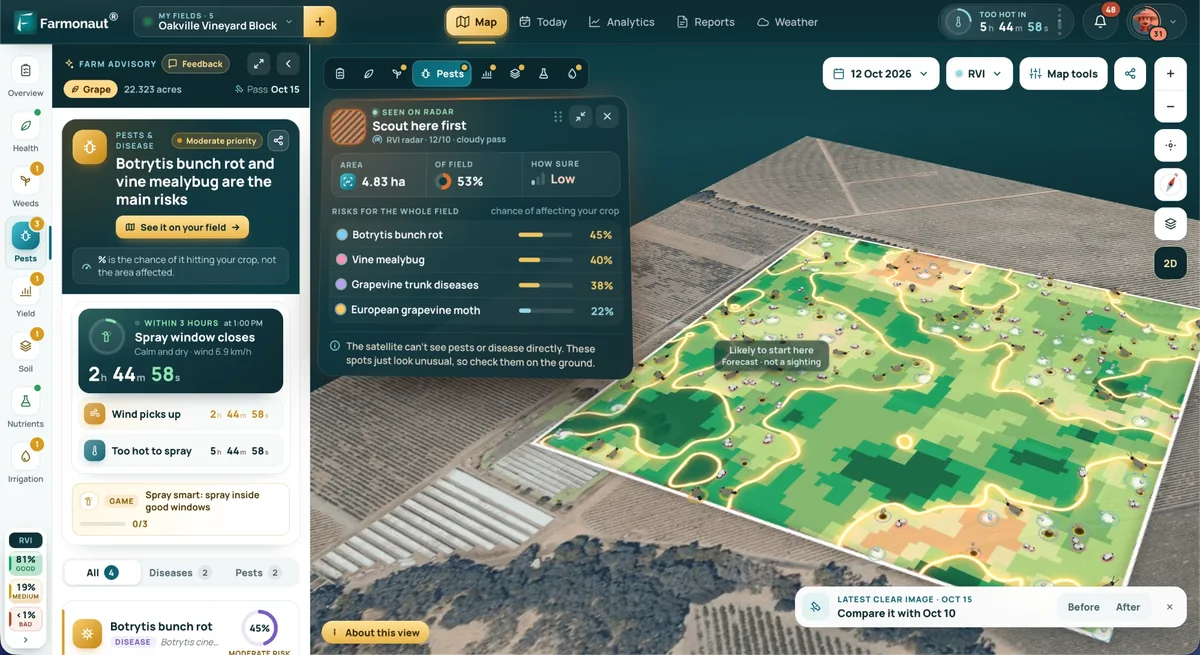
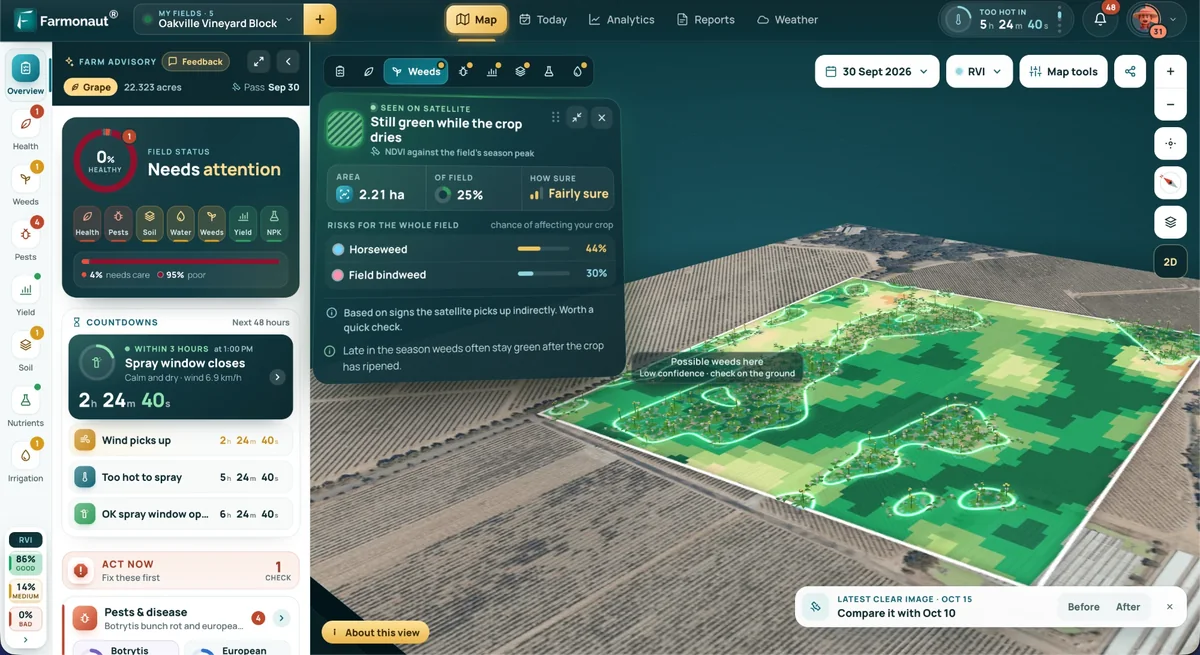
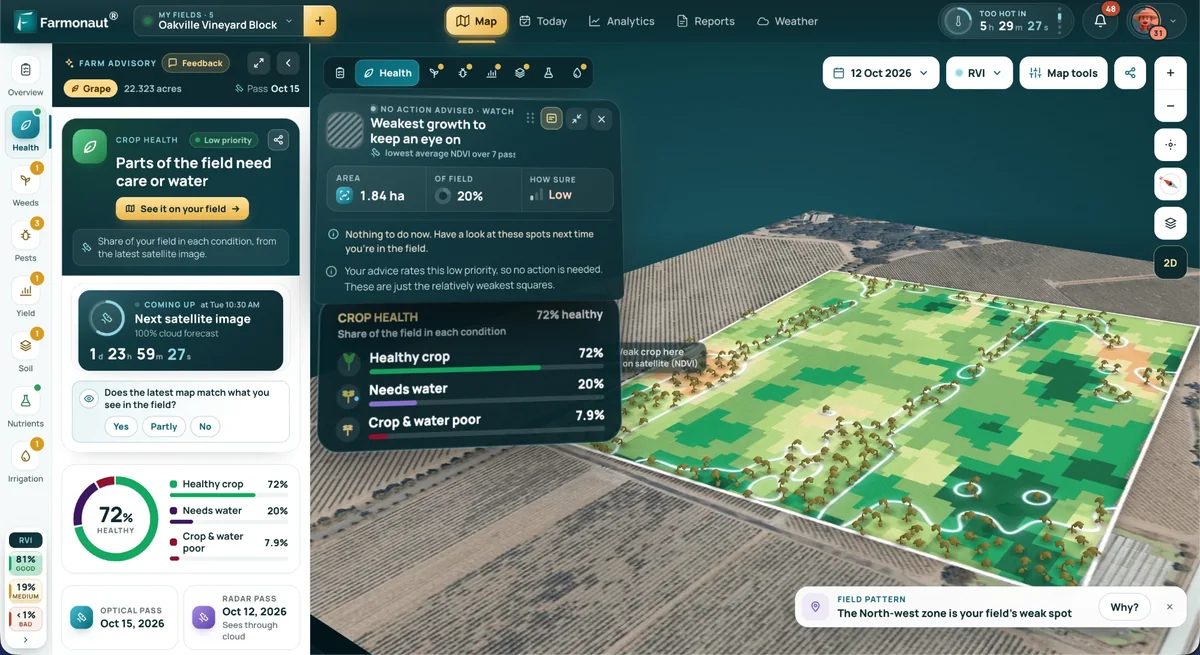
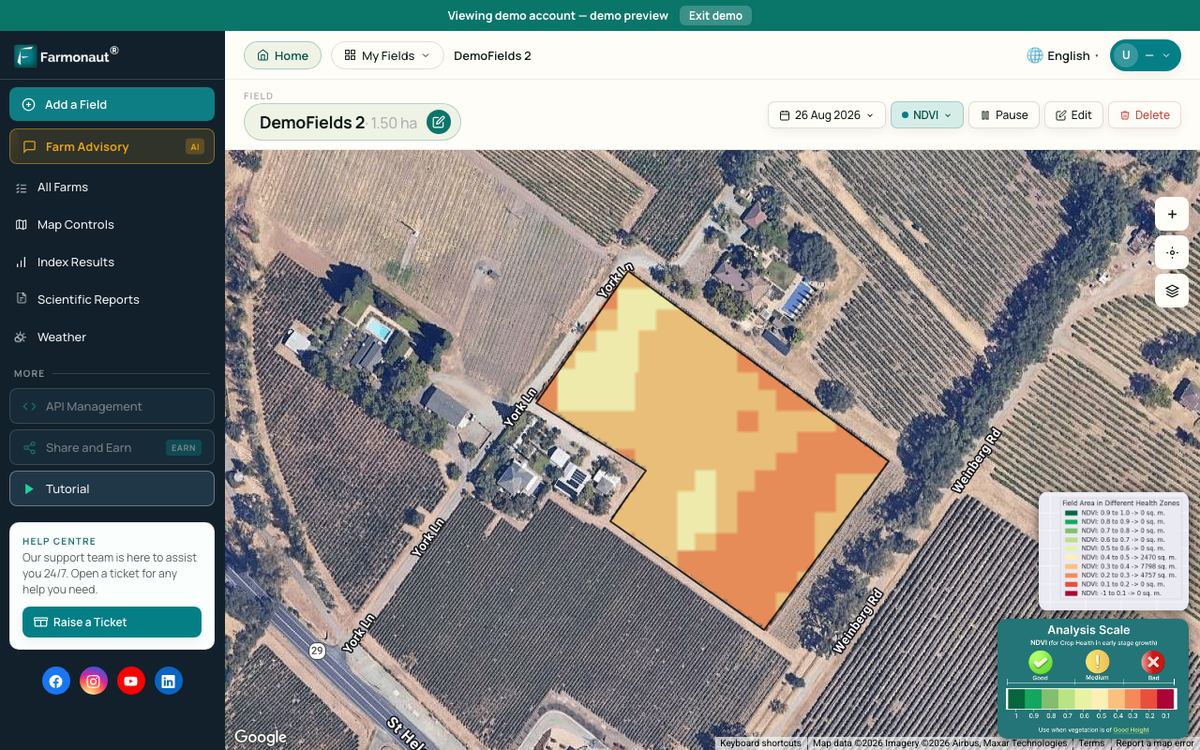
Drone and satellite data work best as a pair. Satellite maps can flag a weak zone across many fields; a drone flight then shows the detail; the software turns it into a map or prescription. The Farmonaut Satellite + AI Farm Monitoring System gives satellite vegetation maps for your fields on web, Android and iOS through its apps, and larger operations can manage many sites through the admin dashboard for large farms.
Some operations also need records beyond crop health. Teams track vehicles with fleet management tools, estimate emissions with carbon footprint tracking, keep supply chain records with product traceability, and share field history with lenders and insurers through crop loan and insurance verification. Check that any tool you choose can export the data these systems need.
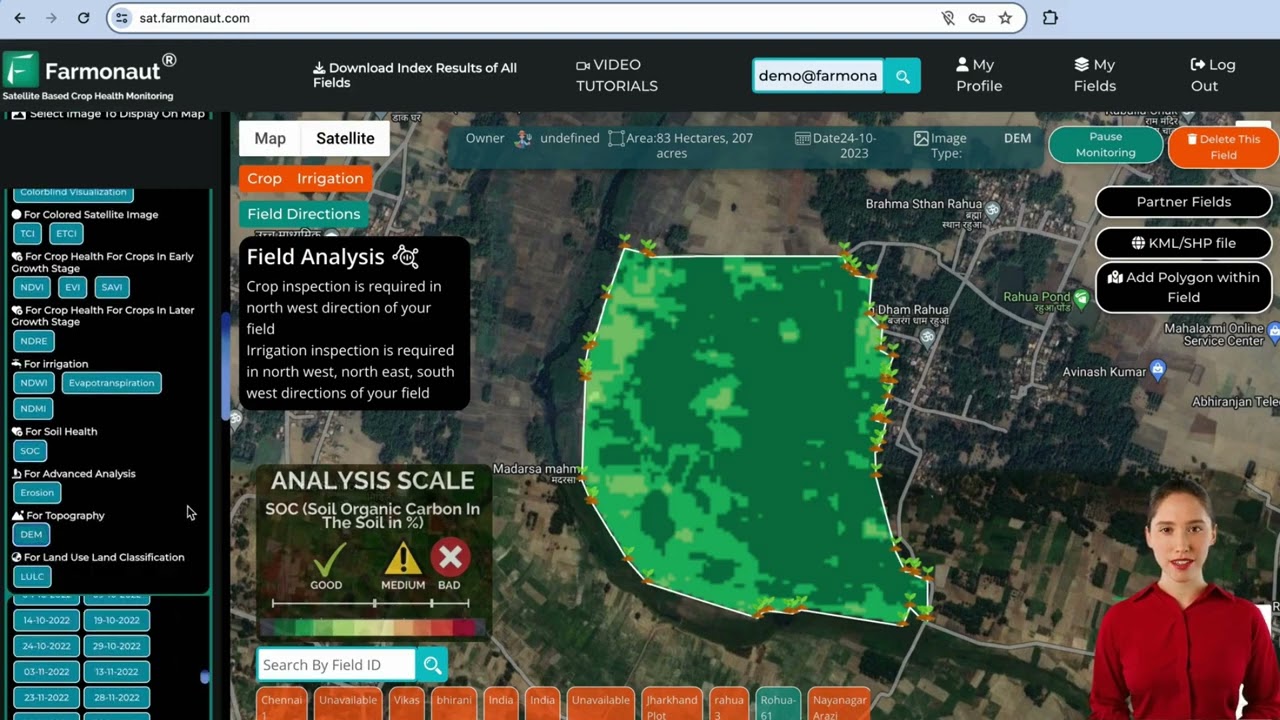
▶ A tutorial of the Farmonaut web app for satellite field monitoring. · 8:02
Trends in agriculture drone software development
Several changes are shaping the tools farmers will buy next.
- Spot spraying from maps: Iowa State notes that spray drones treat zones of about 0.1 acre at minimum, while ground sprayers with nozzle control can treat areas as small as 0.001 acre (Iowa State, 2024). Software that turns weed maps into precise jobs is growing fast.
- Hybrid drone and satellite inputs: PIX4Dfields now accepts both image types in one project.
- Automated counts: stand counts and canopy cover now come as standard in several plans.
- Open data links: APIs and standard files such as ISOXML make it easier to move maps into machines and farm records.
- Hardware rules: the FCC change of December 2025 means US buyers should confirm that new drones can be sold before choosing software tied to them.
For more on how imaging is changing, see our pages on agricultural drones and imaging and on drone images and AI in farming.
Drone or satellite: which suits which job
| Job | Drone imagery | Satellite imagery |
|---|---|---|
| Weed patch maps | Good: high detail on demand | Large patches only |
| Stand counts | Good at early growth stages | Not detailed enough |
| Whole-farm checks | Slow: each field needs a flight | Good: all fields on a schedule |
| Cloudy weeks | Can fly under cloud | Images blocked by cloud |
| Season history | Only dates you flew | Regular archive of past dates |
Related pages on our site: drone analytics software and drone and IoT sensors.
FAQ
What is the best agriculture drone software?
There is no single winner. DroneDeploy suits cloud mapping and team sharing, PIX4Dfields suits offline prescription maps, and Agremo suits AI plant counts and weed maps at a lower entry price. Pick the one that matches your main job, your drone and your sprayer.
How much does drone mapping software cost?
On 13 November 2026, list prices ranged from US$349 a year for Agremo Starter AI to US$4,188 a year for DroneDeploy Individual Pilot. PIX4Dfields, Sentera and Taranis price by quote. These are list prices, not dealer deals.
Can drone software make spray maps?
Yes. PIX4Dfields lists variable rate and spot spraying maps with ISOXML export, and Iowa State extension describes prescriptions made from drone images and loaded into spray drones or nozzle-control sprayers. Follow the product label and local rules for any application.
Do I need a license to fly a farm drone in the US?
For business use under 55 pounds, the FAA requires a Remote Pilot Certificate under Part 107 and drone registration. Spraying also needs a Part 137 agricultural aircraft operator certificate and related approvals. Check current FAA guidance before you fly.
Can I still buy DJI drones in the US?
The FCC’s December 2025 decision applies to new drone models made abroad. Drones you already own can still be used, and models approved before the decision may still be sold. Ask your dealer about a specific model.
Is satellite monitoring a replacement for drones?
Not fully. Satellites cover every field on a schedule with less effort, but at lower detail and not through cloud. Drones give high detail on demand. Many farms use both.
Farmonaut crop monitoring
Check every field between drone flights
Draw your fields once and Farmonaut shows satellite vegetation maps for them through the season, on web, Android or iOS.


Keep reading
Sources
- USDA ERS, Precision Agriculture in the Digital Era, EIB-248 (2023): ers.usda.gov
- Iowa State University Extension, Drone-based Weed Mapping for Targeted Spraying (2024): crops.extension.iastate.edu
- University of Nebraska-Lincoln Extension, G2296 Getting started with drones (2017): extensionpublications.unl.edu
- American Farm Bureau Federation, Drones Taking Off in Ag (2026): fb.org
- FCC, Fact sheet: Covered List update for foreign UAS (2025): docs.fcc.gov
- FAA, Commercial operators (Part 107): faa.gov
- FAA, Dispensing chemicals and agricultural products with UAS (Part 137): faa.gov
- eCFR, 14 CFR Part 137 Agricultural Aircraft Operations: ecfr.gov
- DroneDeploy, Pricing (accessed November 2026): dronedeploy.com
- Agremo, Pricing (accessed November 2026): agremo.com
- PIX4D, PIX4Dfields product page (accessed November 2026): pix4d.com
- DJI Enterprise, Mavic 3 Enterprise specs: enterprise.dji.com
Discussion
Questions, corrections or field experience? Share them below. First-time comments are reviewed before they appear, and your email is never published.
No comments yet. Be the first to add a question or your experience.

 SFX
 BACF Africa
 Nivia
 Doodlakine
 Exurbia Geospatial
 FieldZero
 Indico Company
 Kubota
 FFBS
 Jontra
 Tucor
 Hayleys Agriculture
 Licence holder · Niger · Gold
 Licence holder · Nigeria · Gold + lithium
 Client · Tanzania · Gold
 Client · Somalia · Gold
 Client & affiliate partner · Ghana · Gold