

Crops · North Dakota state guide
North Dakota Crops Grown: What the State Produces
Corn, soybeans and wheat lead North Dakota on value, but the state is the top US grower of canola, flaxseed, durum, spring wheat, sunflowers and dry beans. Here is every major crop with 2025 values, 2026 changes, livestock and honey, all from USDA reports.
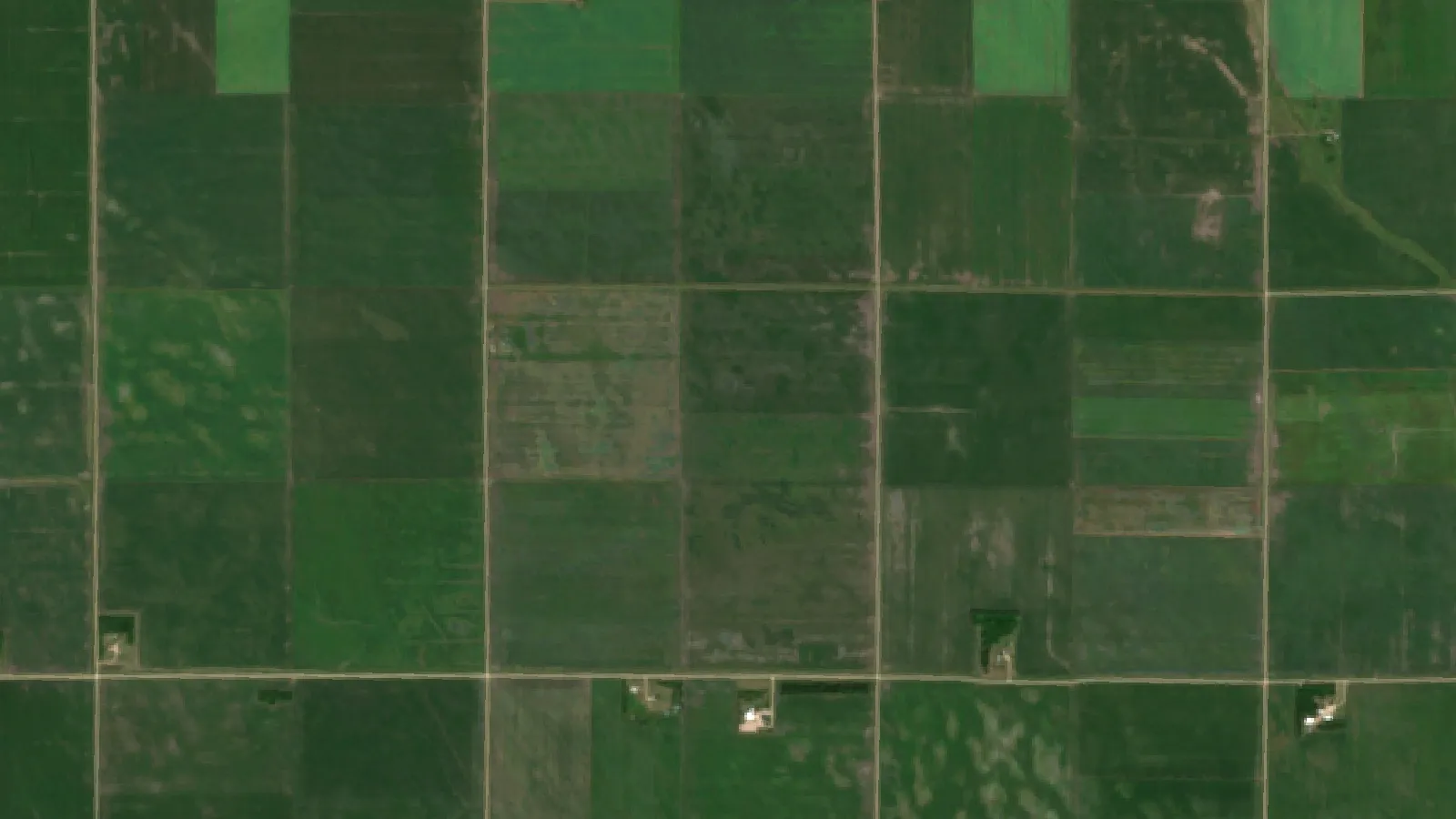
Key takeaways
- North Dakota crops were worth $9.49 billion in 2025: corn $2.70 billion, soybeans $2.16 billion, wheat $1.74 billion (NASS Crop Values, February 2026).
- By 2025 planted area the state led the US in canola (about 77% of acres), flaxseed (69%), durum (56%), spring wheat (51%), sunflowers (45%) and dry beans (42%).
- The 2026 wheat crop was 264.7 million bushels, 21% below 2025 (NASS, September 2026); canola area rose 30% to 2.35 million acres (NASS Acreage, June 2026).
- North Dakota had 1.73 million cattle on 1 January 2026 and was the top honey state in 2025 at 30.8 million pounds.
In this article
- North Dakota crops at a glance
- What does North Dakota produce the most of?
- Wheat: spring wheat and durum
- Corn and soybeans
- Canola, sunflowers and flaxseed: the oilseed belt
- Dry beans, peas and lentils
- Sugarbeets, potatoes, barley and oats
- Livestock, hay and honey
- Farms, land and climate
- How North Dakota's crop mix changed
- What a crop earns per acre
- South Dakota agriculture for comparison
- How farmers track these crops from space
- FAQ
The main crops grown in North Dakota are corn, soybeans and wheat, followed by canola, hay, potatoes, sunflowers, dry beans, sugarbeets, barley, peas, flaxseed, lentils and oats. Together they were worth $9.49 billion in 2025, according to the NASS Crop Values 2025 Summary. Corn for grain led on value at $2.70 billion, soybeans came second at $2.16 billion and all wheat third at $1.74 billion. The state is the top US grower of spring wheat, durum, canola, flaxseed, sunflowers and dry edible beans, and it also produces more honey than any other state.
This guide ranks every major North Dakota crop by value, shows the share of US planted area the state holds for its leading crops, and tracks how the 2026 season changed the picture. It also covers cattle, honey and the soils and climate behind the crop mix, and gives a per-acre margin calculator you can fill in with your own numbers. All figures come from USDA National Agricultural Statistics Service (NASS) reports and North Dakota farm groups, with the date of each.
North Dakota crops at a glance
The table lists the main field crops by 2025 value of production. Value of production is the crop harvested times the season-average price farmers received. It is not the same as cash sales, because some grain is stored or fed on the farm. The planted acres and yields come from the USDA NASS 2025 state agriculture overview for North Dakota.
| Crop (2025) | Planted acres | Yield | Production | Value of production |
|---|---|---|---|---|
| Corn for grain | 4.70 million (all purposes) | 158 bu/acre | 709.4 million bu | $2.70 billion |
| Soybeans | 6.55 million | 34.5 bu/acre | 223.9 million bu | $2.16 billion |
| All wheat | 6.43 million | 52.8 bu/acre | 334.1 million bu | $1.74 billion |
| Canola | 1.81 million | 2,120 lb/acre | 3.82 billion lb | $778 million |
| All hay | 2.39 million harvested | 1.88 tons/acre | 4.49 million tons | $364 million |
| Potatoes | 70,000 | 350 cwt/acre | 24.3 million cwt | $296 million |
| Sunflowers | 575,000 | 1,957 lb/acre | 1.10 billion lb | $247 million |
| Dry edible beans | 580,000 | see note | see note | $230 million |
| Barley | 450,000 | 78 bu/acre | 28.1 million bu | $131 million |
| Dry edible peas | 380,000 | 2,250 lb/acre | 8.24 million cwt | $94 million |
| Flaxseed | 170,000 | 24 bu/acre | 3.96 million bu | $51 million |
| Lentils | 185,000 | 1,260 lb/acre | 2.08 million cwt | $46 million |
| Oats | 335,000 | 77 bu/acre | 13.5 million bu | $42 million |
| Sugarbeets | 213,000 | 33.2 tons/acre | 6.89 million tons | 2025 value not yet published |
Note: the dry bean value is from the NASS crop values report; the state overview does not list dry bean yield. Sugarbeet values are published a year later because the beets are paid for over a long marketing season. The 2024 sugarbeet crop was worth $557 million, which would place it between canola and hay.
Chart
North Dakota crops by value of production
US$ million, 2025 crop, top 12 field crops
What does North Dakota produce the most of?
By value, North Dakota produces more corn than any other crop. By area, soybeans and wheat each cover more land than corn. In 2025, farmers planted 6.55 million acres of soybeans, 6.43 million acres of wheat and 4.70 million acres of corn. Corn wins on value because each acre yields far more bushels.
The picture changes if you ask where North Dakota stands against other states. Here the state’s strength is in cool-season and specialty crops. Using planted area from the NASS Acreage report of June 2026, North Dakota was the leading state in 2025 for:
- Canola: 1.81 million of 2.34 million US acres, about 77%.
- Flaxseed: 170,000 of 248,000 US acres, about 69%.
- Durum wheat: 1.23 million of 2.19 million US acres, about 56%.
- Other spring wheat: 5.10 million of 9.99 million US acres, about 51%.
- Sunflowers: 575,000 of 1.29 million US acres, about 45%.
- Dry edible beans: 580,000 of 1.37 million US acres, about 42%.
North Dakota ranked second in 2025 planted area for all wheat (behind Kansas), sugarbeets (behind Minnesota), oats (behind Texas), and dry peas and lentils (both behind Montana). It ranked third for barley, after Montana and Idaho, and third for potatoes, after Idaho and Washington. On soybeans it was fourth, after Illinois, Iowa and Minnesota.
Chart
North Dakota’s share of US planted area
Percent of US planted acres, 2025, crops where the state ranks first
Wheat: spring wheat and durum
Wheat is the crop most people link with North Dakota, and for good reason. Most of it is hard red spring wheat, a high-protein class used for bread flour and blending. Farmers sow it in April and May and harvest it in August, which suits the short, cool growing season. The North Dakota Wheat Commission spends grower checkoff money on market development, research and education for the state’s wheat.
In 2025, the state grew 276.7 million bushels of spring wheat (other than durum) at 55 bushels per acre, worth $1.40 billion. Durum, the hard wheat milled into semolina for pasta, added 53.2 million bushels worth $327 million. Winter wheat is small here: only 100,000 acres were planted in 2025, because the cold winters make it risky.
The 2026 crop was smaller. The NASS Small Grains 2026 Summary, released on 30 September 2026, put North Dakota all-wheat production at 264.7 million bushels. That is 21% below 2025 and 28% below the 368.3 million bushels of 2024. Spring wheat fell to 228.5 million bushels on 4.55 million planted acres and a 51-bushel yield. Durum fell to 33.7 million bushels as farmers planted 900,000 acres, down from 1.23 million.
Two forces drove the drop. Fewer acres went to wheat, and yields slipped. The June Acreage report put US other spring wheat area 6% below 2025, and North Dakota’s other spring wheat area fell about 12%, from 5.10 million to 4.50 million acres.
Chart
North Dakota wheat production
Million bushels, 2024 to 2026
Corn and soybeans
Corn and soybeans now lead the state on value. In 2025, corn for grain averaged 158 bushels per acre on 4.49 million harvested acres. Soybeans yielded 34.5 bushels per acre on 6.49 million harvested acres.
The November 2026 Crop Production report, based on conditions on 1 November, forecast North Dakota corn at 129 bushels per acre and 574.1 million bushels, down from 709.4 million in 2025. It forecast soybeans at 33.0 bushels per acre and 224.1 million bushels, about the same as 2025 because more acres made up for a lower yield. These are forecasts and will be revised in the January annual report.
Almost all soybeans planted in the state are biotech varieties: 96% in both 2025 and 2026, according to the Acreage report.
Canola, sunflowers and flaxseed: the oilseed belt
North Dakota grows most of the country’s canola, and the crop is still growing. The June 2026 Acreage report estimated North Dakota canola at 2.35 million planted acres, up 30% from 2025. In 2025, the state’s 3.82 billion pounds of canola were worth $778 million. Canola is crushed for cooking oil and meal, and growers are represented nationally by the U.S. Canola Association.
Sunflowers are the crop most visitors notice in late July, when the fields turn yellow. Farmers grow two kinds. Oil-type sunflowers are crushed for oil, while confection types are sold as in-shell seeds and kernels for snacks. In 2025, North Dakota planted 510,000 acres of oil types and 65,000 acres of confection types, and the crop was worth $247 million. The National Sunflower Association, based in the state, keeps national and world statistics for the crop.
Flaxseed is smaller but North Dakota dominates it. The state grew 3.96 million bushels in 2025 worth $51 million, and the Acreage report expected 2026 planted area to rise 9%. Flax is grown for its oil, for linseed meal and as a food ingredient.
Sunflowers also cope with some salt in the soil. The NDSU guide to managing saline soils notes that sunflower is usually called moderately salt tolerant, which helps on the saline patches common in parts of the state.
Dry beans, peas and lentils
North Dakota is the leading US state for dry edible beans. Pinto beans are the main class, with navy, black and kidney beans also grown. The Northarvest Bean Growers Association represents growers in North Dakota and Minnesota.
In 2025, the state’s dry bean crop was worth $230 million, according to the NASS crop values report. Dry peas added $94 million and lentils $46 million. Planted area for all three fell in 2026: dry beans to 445,000 acres, peas to 320,000 and lentils to 130,000. Chickpeas are a smaller pulse at 52,000 acres in 2026, up from 37,000.
Pulses fit well into wheat rotations. They fix their own nitrogen and break disease cycles for the cereal that follows. Check the label and your local extension office before choosing herbicides, since some wheat herbicides carry over and can damage pulses the next year.
Sugarbeets, potatoes, barley and oats
Sugarbeets grow mostly in the Red River Valley along the Minnesota border. North Dakota harvested 6.89 million tons of beets in 2025 from 207,500 acres. The November 2026 forecast was 5.56 million tons at 27.5 tons per acre, a lower yield than the 33.2 tons of 2025.
Potatoes are a high-value crop on a small area. In 2025, 70,000 planted acres produced 24.3 million hundredweight worth $296 million, for processing, fresh market and seed. Potato area slipped to 67,000 acres in 2026.
Barley: in 2025, North Dakota grew 28.1 million bushels on 450,000 planted acres, much of it for malting. The 2026 crop was 19.4 million bushels. Oats produced 13.5 million bushels in 2025 and 13.0 million in 2026. Rye is a small crop at 2.2 million bushels in 2025.

▶ How the NDWI water index from satellites helps track crop water stress. · 7:57
Livestock, hay and honey
Crops make up most of North Dakota farm output, but cattle are the main livestock. The NASS Cattle report of January 2026 counted 1.73 million cattle and calves on North Dakota farms and ranches on 1 January 2026, up 3% from a year earlier. Beef cows numbered 891,000. Dairy is small, with 9,000 milk cows, and the state had 58,000 sheep and lambs.
Hay supports that herd. In 2025, the state harvested 2.39 million acres of hay, about half of it alfalfa, worth $364 million in total. The calf crop for 2025 was 860,000 head.
Honey is the state’s surprise leader. According to the NASS Honey report of March 2026, North Dakota had 460,000 honey-producing colonies in 2025, which made 30.8 million pounds of honey. That was the most of any state, about 2.8 times California’s 11.0 million pounds, the next largest.
Farms, land and climate
North Dakota had 24,500 farms operating 38.5 million acres in 2025, an average of 1,571 acres per farm, according to the NASS state overview. Planted area of the principal crops was 24.2 million acres in both 2025 and 2026.
The climate is continental, with cold winters and a short frost-free season. That favors crops that grow in cool weather and mature fast, such as spring wheat, durum, canola, flax, peas and barley. The east is wetter, so corn, soybeans, dry beans, sugarbeets and potatoes are more common there. The west is drier and has more pasture, hay and small grains.
Soils in the Red River Valley are deep, dark lake-bed clays and are among the most productive in the region. Elsewhere, salinity and wet spots limit yields on some fields. NDSU advises mapping the salty areas and managing them on their own, because seeding them like the rest of the field wastes seed, fertilizer and pesticide.

▶ Six plain steps to start precision farming, from field maps to satellite monitoring. · 4:18
How North Dakota’s crop mix changed
The 2026 Acreage report showed farmers moving acres from wheat, dry beans and corn into soybeans, canola and barley. Canola gained the most in percentage terms. The chart compares planted acres in 2025 and 2026 for the main crops.
Lower yields in 2026 mean the state’s total crop value is likely to fall from the 2025 figure, though prices will decide by how much. NASS will publish 2026 crop values in February 2027.
Chart
Planted acres, 2025 vs 2026
Million acres planted in North Dakota
What a crop earns per acre
Gross value per acre is a quick way to compare crops. In 2025, using NASS yields and season-average prices, an acre of corn grossed about $600, soybeans about $338, spring wheat about $293 and canola about $449. These are gross figures before seed, fertilizer, chemicals, machinery, land and labor. Margins depend on your own costs, which is why the calculator below asks for them.
NDSU and other land-grant universities publish yearly crop budgets that list typical costs by region. Use them as a starting point, then replace each line with your own figures. For loans, insurance or land decisions, get professional advice.
Try the numbers for your own farm below.
Calculator
What does one acre of your crop return?
Enter your own yield, price and costs per acre.
- Gross revenue per acre (US$): $292
- Break-even price (US$ per bu): $5.27
- Break-even yield: 54.7 bu/acre
- Margin on all acres (US$): $1,500
Example values only, set close to break-even; they are not a forecast or a benchmark. Price inputs are examples: use today’s local price. Costs should include seed, fertilizer, chemicals, machinery, land and labor. For loans, insurance or land decisions, get professional advice.
South Dakota agriculture for comparison
South Dakota leans further toward corn, soybeans and cattle. Its crops were worth $7.51 billion in 2025, with corn at $4.13 billion, soybeans at $2.28 billion and hay at $531 million, according to the NASS crop values report. Wheat was much smaller than in North Dakota, at $296 million. South Dakota had 3.55 million cattle and calves on 1 January 2026, about twice North Dakota’s herd.
Both states grow sunflowers, and South Dakota is the second largest grower after North Dakota. Both also keep large honeybee populations through the summer.
How farmers track these crops from space
Large farms and long distances make satellite images useful on the Northern Plains. A vegetation index such as NDVI shows which parts of a field are growing well and which are falling behind, often before the difference is clear from the road. Growers use this to plan scouting trips, check drainage and salinity problems, and compare fields across a season.
Farmonaut is a US-based company that offers satellite and AI crop monitoring for fields of any size, on web, Android and iOS. You draw your field boundaries once, and the system sends vegetation, water-stress and soil-moisture maps as new images arrive.
Related pages on our site: crops for farming, farm vehicle and crop insurance, crop loan and insurance checks, carbon footprinting, product traceability, fleet management, satellite and weather API docs, large-farm admin tools, corn yield by state.

▶ A walk-through of satellite crop health maps in the Farmonaut web app. · 8:43
FAQ
What crops are grown in North Dakota?
The main crops are corn, soybeans, wheat (spring and durum), canola, hay, potatoes, sunflowers, dry edible beans, sugarbeets, barley, dry peas, flaxseed, lentils and oats. Corn, soybeans and wheat together made up about 70% of the state’s 2025 crop value.
What is North Dakota number one in?
By 2025 planted area it led the US in canola, flaxseed, durum wheat, other spring wheat, sunflowers and dry edible beans. It was also the top honey-producing state in 2025.
What is the most valuable crop in North Dakota?
Corn for grain, worth $2.70 billion in 2025, followed by soybeans at $2.16 billion and wheat at $1.74 billion (NASS).
Does North Dakota grow sunflowers?
Yes. It planted 575,000 acres in 2025, about 45% of the US total, more than any other state. Its nickname, though, is the Peace Garden State.
What livestock is raised in North Dakota?
Mainly beef cattle: 1.73 million cattle and calves on 1 January 2026, with 891,000 beef cows. Sheep, a small dairy sector and a large summer honeybee population add to it.
Farmonaut crop monitoring
See your own fields from space
Draw your fields once and Farmonaut shows satellite crop health maps for them through the season, on web, Android or iOS.




Keep reading

Sources
- USDA NASS, 2025 State Agriculture Overview for North Dakota (Quick Stats, accessed November 2026): nass.usda.gov
- USDA NASS, Crop Values 2025 Summary (February 2026): release.nass.usda.gov
- USDA NASS, Acreage (June 2026): release.nass.usda.gov
- USDA NASS, Small Grains 2026 Summary (30 September 2026): release.nass.usda.gov
- USDA NASS, Crop Production (10 November 2026): release.nass.usda.gov
- USDA NASS, Cattle (January 2026): release.nass.usda.gov
- USDA NASS, Honey (March 2026): release.nass.usda.gov
- NDSU Extension, Managing Saline Soils in North Dakota: ndsu.edu
- North Dakota Wheat Commission: ndwheat.com
- National Sunflower Association, Sunflower Statistics: sunflowernsa.com
- Northarvest Bean Growers Association: northarvestbean.org
- U.S. Canola Association: uscanola.com
- North Dakota Department of Agriculture: ndda.nd.gov
- USDA NASS, North Dakota state statistics: nass.usda.gov
Discussion
Questions, corrections or field experience? Share them below. First-time comments are reviewed before they appear, and your email is never published.
No comments yet. Be the first to add a question or your experience.

 Vestlandsforsking
 Elders
 Agritein
 Delicio
 WB Dev
 Sama Premium
 Prochecker
 Tres Valles
 LACOS Geoinformation
 Magrifly
 LatConnect 60
 WebsEdge
 Blickwinkel
 Agricultural Credit Policy Council
 Marei Nursery
 eKGIS
 Mostas Tech
 Andex
 FCF India
 Unifrutti Gulf
 Deluxe Conseil
 WICO
 Chimera Innovation
 SkyHarvest
 Polaris Digitech
 Teledarbas

 Licence holder · Niger · Gold
 Client · Tanzania · Gold
 Client · Somalia · Gold
 Client & affiliate partner · Ghana · Gold










