

Reviewed August 2026 against USDA Economic Research Service, AgFunder, and Expert Market Research.
Try it: Result: Enter values above →
An agtech incubator is a structured program that gives early-stage agricultural technology startups three things they cannot easily get alone: mentorship from people who have built and sold agtech companies, access to test environments (farms, labs, sometimes satellite or sensor infrastructure), and introductions to investors and distribution partners. Some run on equity stakes, others are non-dilutive grant-and-mentorship programs, and a few — like Farmonaut’s own program — are built around giving startups direct access to a working technology platform rather than just office space and advice. If you’re trying to find one, evaluate one, or understand what “agtech incubator” even means before applying, this is the practical version.
The short answer to “what is agtech”: it’s the application of digital, biological, and mechanical technology to farming and food production — satellite crop monitoring, precision guidance systems, IoT soil sensors, AI advisory tools, and supply-chain traceability all fall under it. The US agtech market was valued at $5.57 billion in 2024, according to Expert Market Research, which projects it growing at an 8.40% compound annual rate through 2034, reaching roughly $12.48 billion by then. That’s the market incubators exist to feed startups into.
Table of Contents
- What Agtech Incubators Actually Do
- Incubator vs. Accelerator: The Real Difference
- The Farmonaut Approach: Platform-Led Incubation
- Why Mentorship and Platform Access Move the Needle
- Where to Find an Agtech Incubator in the US or Canada
- How to Evaluate an Incubator Before You Apply
- Calculator: Is Incubator Equity Worth the Trade-Off?
- Finding Tech That Helps Farms Adapt to Changing Weather
- Incubator-Backed Startup Outcomes
- FAQ
- Try it: Result: Enter values above

What Agtech Incubators Actually Do
Agtech incubators exist because farming technology has a longer, harder validation cycle than most software. A B2B SaaS startup can iterate weekly; an agtech startup often has one growing season per year to test a claim. That’s the core problem incubators solve: they compress the feedback loop by giving startups pre-built infrastructure, farmer networks, and domain mentors instead of making them build all three from zero.
In the wider innovation landscape, this fits into the broader push toward agricultural innovation — drones, robotics, gene editing, and sustainable farming solutions that reduce input use while holding or raising yield. Incubators are the delivery mechanism that gets lab-stage ideas into a farmer’s hands faster than they’d get there on their own.
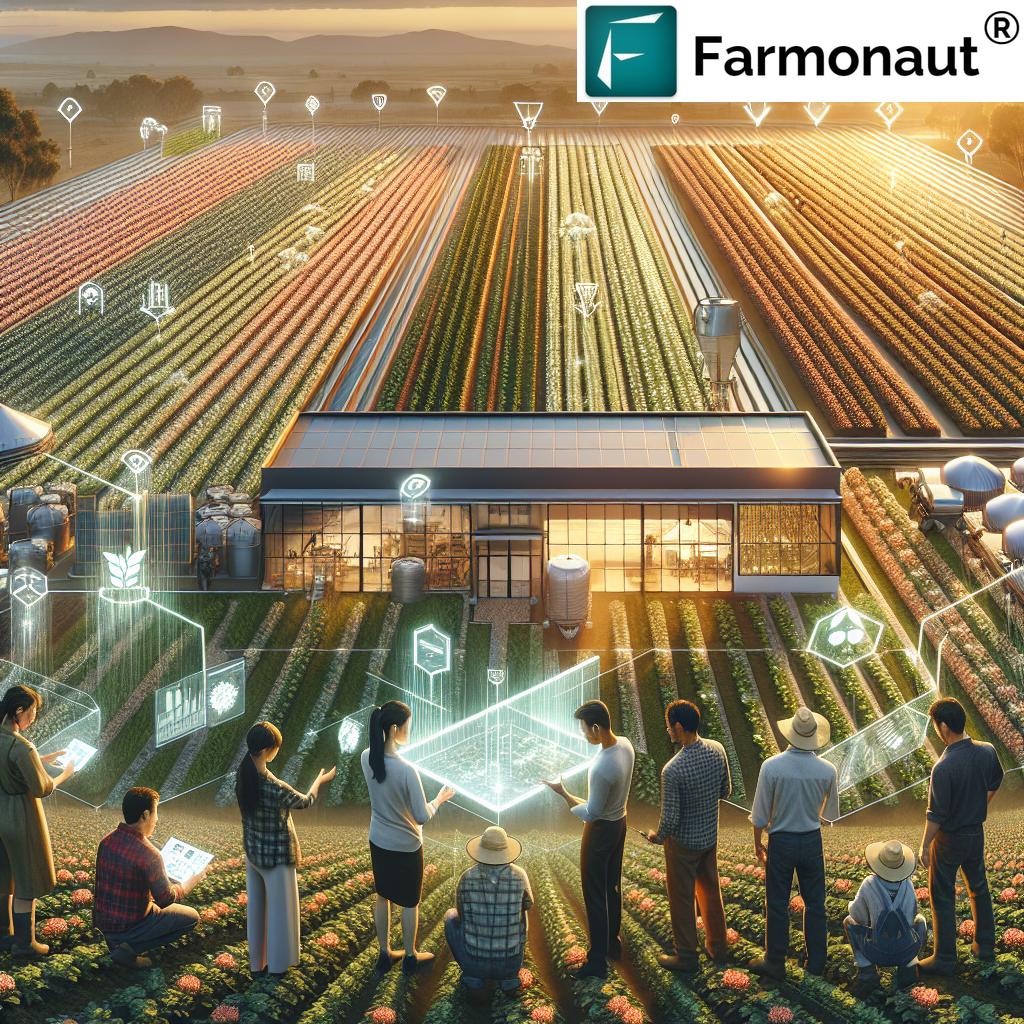
At Farmonaut, the incubator model centers on giving startups direct access to a working satellite crop-monitoring platform, AI advisory tooling, and the agricultural data analytics infrastructure behind it, rather than asking each startup to build monitoring capability from scratch before they can even test their core hypothesis.
Incubator vs. Accelerator: The Real Difference
These two terms get used interchangeably in search, but the mechanics differ enough that it changes which one you should be applying to.
| Feature | Agtech Incubator | Agtech Accelerator |
|---|---|---|
| Typical duration | 6–24 months, open-ended in some platform models | Fixed cohort, usually 12–16 weeks |
| Stage targeted | Pre-seed / idea validation | Seed / early revenue, ready to scale |
| Primary resource | Mentorship, lab/field access, infrastructure | Capital, investor demo days, structured curriculum |
| Equity taken | Often none (non-dilutive) or minimal | Commonly 4–10% for a cash investment |
| Example outcome metric | Product-market validation, pilot deployments | Follow-on funding raised, revenue growth |
A concrete North American data point: Cultivator’s AGTECH ACCELERATOR reports its portfolio companies had collectively raised $162 million in private capital and generated $118.5 million in revenue as of 2025, according to Cultivator. That’s a rare instance of a named program publishing aggregate outcomes — most incubators and accelerators do not disclose portfolio-level financials, which is worth knowing before you take marketing copy at face value when comparing programs.
The Farmonaut Approach: Platform-Led Incubation
Farmonaut’s program is built on three principles that differ from a generic co-working-plus-mentorship model:
- Cutting-edge Technology Access: Startups get access to Farmonaut’s satellite-based farm management stack instead of building monitoring infrastructure from scratch.
- Collaborative Ecosystem: A community of entrepreneurs, researchers, and industry experts for knowledge-sharing and partnership formation.
- Sustainable Focus: Priority given to innovations that reduce input use and improve resilience, not just ones that increase yield.
Startups in the program build on real-time crop health monitoring, AI-based advisory, and traceability tooling rather than each team independently re-solving the same infrastructure problem. The technology stack underneath includes:
- Satellite-Based Crop Health Monitoring: Multispectral imagery for vegetation health, soil moisture, and related metrics.
- Jeevn AI Advisory System: Personalized farm advice, weather forecasts, and crop management guidance.
- Blockchain-Based Traceability: Supply-chain transparency from farm to end buyer.
- Fleet and Resource Management: Logistics and machinery optimization tools.
- Carbon Footprinting: Emissions tracking for agribusinesses.

Why Mentorship and Platform Access Move the Needle
This isn’t just a program-design preference — there’s measurable backing for the mentorship-heavy model. Research published in the Journal of Innovation and Entrepreneurship found that startups with strong mentorship networks had a 30% higher product commercialization success rate compared to those without, based on 2025 research from Springer Open. For agtech specifically, where a failed field trial can cost a full growing season, that gap compounds: a startup that gets domain-expert feedback before a pilot avoids repeating a mistake that would otherwise cost 12 months.
The other half of the case is adoption data on the technology categories these startups build for. USDA’s Economic Research Service found that 81% of large field crop farms (5,000+ acres) had adopted new agricultural technology as of 2024, and 70% of large-scale crop farms were using precision guidance autosteering systems as of 2023, per the USDA Economic Research Service. Large operations are already primed to adopt — the market gap incubated startups are chasing is mid-size and smaller farms, where adoption lags.
On the sustainability side, the case for incubator-nurtured practices is concrete where it’s been measured. American Farmland Trust’s case study work found soil health practices produced a 198% to 553% ROI range across three California almond growers in a recent multi-farm study, and multi-year studies showed conservation agriculture practices improved soil organic carbon stocks by 10% to 30%, according to American Farmland Trust. Those aren’t incubator-specific numbers — no standardized measurement of carbon or water savings tied specifically to incubator-backed technology exists in public research yet — but they’re the closest verified proxy for the kind of outcome these programs are chasing, and they give you a real range to hold any startup’s sustainability claims against.
Where to Find an Agtech Incubator in the US or Canada
There is no single authoritative registry of every agtech incubateur or accelerator operating in North America — no government body or trade association maintains a comprehensive count, so treat any “top 20” list you find as one curator’s snapshot, not a census. That said, a few starting points work reliably:
- University extension programs — land-grant universities (a US-specific structure) frequently run ag-focused startup programs tied to their agricultural research departments.
- State department of agriculture innovation offices — several US states run or fund regional agtech innovation hubs; check your state ag department’s website directly.
- Named programs with public track records — Cultivator’s AGTECH ACCELERATOR in Canada is one of the few publishing aggregate portfolio results, making it a useful benchmark even if you’re US-based and applying elsewhere.
- Platform-based incubators — programs run by working agtech companies (like Farmonaut) that give startups infrastructure access rather than just capital and desk space.
If you’re searching in French — “incubateur agtech” or “incubateur agritech” — the same categories apply in Canada and France: university-affiliated agricultural schools, regional economic development agencies, and platform-led programs are the three places to start, though a dedicated bilingual directory for Canadian agtech incubateurs specifically was not found in the sources reviewed for this piece.
How to Evaluate an Incubator Before You Apply
Because there’s no registry and no standardized outcome reporting, the burden is on you to vet a program before committing months or equity to it. Use this checklist:
- Ask for named portfolio companies, not aggregate claims. A program that says “we’ve helped 200 startups” without naming a traceable few should raise questions. Cultivator names its $162 million capital-raised and $118.5 million revenue figures publicly — that’s the standard to hold others to.
- Check what infrastructure you actually get, not just advice. Mentorship without test infrastructure means you’re still building your MVP’s foundation from zero.
- Clarify equity terms in writing before the first meeting. Non-dilutive programs and equity-for-capital accelerators solve different problems — know which one you’re applying to.
- Ask how long the program has run and how many cohorts it’s completed. A first-cohort program isn’t disqualifying, but it means there’s no track record to check.
- Verify the mentor list is active, not historical. Ask when each named mentor last engaged with a portfolio company.
Calculator: Is Incubator Equity Worth the Trade-Off?
Before signing an equity-for-support agreement, run the numbers on what that stake could be worth against what the program actually gives you. This calculator estimates the future value of the equity you’d give up and compares it to the cash-equivalent value of the support you’re receiving.
Result: Enter values above
Finding Tech That Helps Farms Adapt to Changing Weather
If you're a farmer rather than a founder, the practical question is usually narrower: where do you find technology that helps your operation adapt to shifting weather patterns, not how incubators are structured. The most direct path is the incubated products themselves — precision monitoring, AI advisory, and climate-resilient agriculture tools are the categories agtech incubators are actively funding right now, precisely because weather volatility is the problem investors see the clearest return on solving.
USDA Economic Research Service data on adoption (cited above) shows large farms already integrating precision guidance and monitoring at 70–81% rates — that adoption curve is a reasonable signal of which tools have cleared the "does this actually work" bar rather than staying at pilot stage. If you're a mid-size or smaller operation, university extension offices and state department of agriculture programs are typically the fastest route to a vetted local tool recommendation, since they see field results across many farms in your specific region rather than a single company's marketing claims.
Incubator-Backed Startup Outcomes
Farmonaut's incubator program has supported startups building in precision agriculture, crop monitoring, and resource optimization. The table below reflects the kind of outcome categories tracked across the program's portfolio:
| Startup Name | Innovation Focus | Key Technology | Funding Raised | Market Impact |
|---|---|---|---|---|
| CropSense | Precision Agriculture | AI-powered crop monitoring drones | $5 Million | 30% increase in water efficiency for adopting farms |
| SoilTech | Sustainable Farming | IoT soil health sensors | $3.5 Million | Reduced fertilizer use by 25% in pilot programs |
| AquaGrow | Vertical Farming | Automated hydroponic systems | $7 Million | Enabled year-round crop production in urban areas |
| BioHarvest | Crop Monitoring | Satellite-based yield prediction | $4 Million | Improved harvest timing accuracy by 40% |
| FarmChain | Supply Chain Management | Blockchain-based traceability platform | $6.5 Million | Reduced food fraud by 60% in partnering supply chains |
These sit against the wider funding backdrop: global agrifoodtech venture investment totaled $16 billion in 2024, representing just 1.82% of total global venture capital funding that year, according to AgFunder's Global AgriFoodTech Investment Report. AgFunder republishes this report annually each Q4 covering the prior fiscal year, so check their research page each January for the current figure rather than treating 2024's number as static.
These startups also connect back to the broader impact of agritech on rural areas and align with the direction of current AI innovation in agriculture, plus adjacent categories like indoor vertical farming and crop-specific work such as the challenges covered in rice farming innovation.
Fostering Agribusiness Networking and Partnerships
A structural strength of incubators is the network they broker, not just the technology they hand over. At Farmonaut, that means:
- Collaborative Research: Partnerships between startups and research institutions.
- Industry Connections: Introductions between startups and established agribusinesses for mentorship, partnerships, and market access.
- Farmer Engagement: Direct links between technology developers and end-users so products get tested against real farming conditions early.
- Investor Relations: Connections to investors focused specifically on the agtech sector.
Join the Farmonaut Ecosystem
Farmonaut offers several ways to engage, depending on what you're trying to do:
- For Startups: Apply to the incubator program for technology access, mentorship, and networking.
- For Farmers: Use satellite-based monitoring and AI advisory services to optimize operations.
- For Developers: Integrate the API into your applications to use satellite and weather data. Explore the API and check the developer docs.
- For Agribusinesses: Partner to implement sustainable and efficient farming practices across operations.
Try Farmonaut's technology directly:




Farmonaut Subscription Plans
Flexible subscription plans support different scales of operation:
Frequently Asked Questions
- What is agtech?
Agtech is the application of digital, biological, and mechanical technology to farming and food production — including satellite crop monitoring, precision guidance, IoT sensors, AI advisory tools, and supply-chain traceability. The US agtech market was worth $5.57 billion in 2024, per Expert Market Research. - What is an agtech incubator?
A program that supports early-stage agricultural technology startups with mentorship, infrastructure access, and networking, typically at the pre-seed or idea-validation stage, often without requiring the equity stake an accelerator would. - What's the difference between an agtech incubator and an agtech incubateur?
None — "incubateur" is the French term for the same concept, used in Canadian and French agricultural innovation contexts. - How many agtech incubators operate in the US and Canada?
No authoritative registry publishes a verified count. Check university extension programs, state department of agriculture innovation offices, and named programs like Cultivator's AGTECH ACCELERATOR as starting points. - How does Farmonaut's incubator program work?
It gives startups access to Farmonaut's satellite-based farm management technology, mentorship from industry experts, networking opportunities, and support in product development and market strategy. - Where can I find technology that helps farms adapt to changing weather patterns?
Incubator-backed precision monitoring and AI advisory products are a direct route, alongside university extension offices and state agriculture department programs, which can point to tools already validated in your specific region. - Is Farmonaut's technology available internationally?
Yes — the satellite-based services and mobile applications are available globally.
Agtech incubators solve a specific problem: agricultural technology takes longer to validate than most software, and startups that get mentorship, infrastructure, and farmer access early avoid repeating expensive, season-long mistakes. The market they feed — $5.57 billion in the US as of 2024, growing at an 8.40% projected annual rate — rewards the ones that get this right. Whether you're a founder evaluating a program's equity terms or a farmer looking for a tool that's cleared real field validation, the checklist is the same: ask for named outcomes, verify the numbers against a public source, and treat any figure without a date and a citation as marketing until proven otherwise.

 Messina Beej
 Dirks Bros Farms
 Red August Group
 Farm Inc
 WeMe Global
 Agrotoken
 Blue BearX
 Insignito
 Croptimum
 DnCubed
 Field Capacity
 Indosistim Teknologi
 Liquify Digital
 CU Foods
 BeyondTech Global
 Rouge VC
 AgroGreen Dynamics
 AgroRisk
