

Irrigation · Water-loss guide
Water Waste in Agriculture: Losses by Method and 8 Fixes
Irrigation water is lost to canal seepage, evaporation and drift, runoff and drainage below the roots. US delivery organizations lost about 16% of the water they handled in 2019 (USDA ERS). FAO rates field efficiency at about 60% for flood, 75% for sprinklers and 90% for drip.
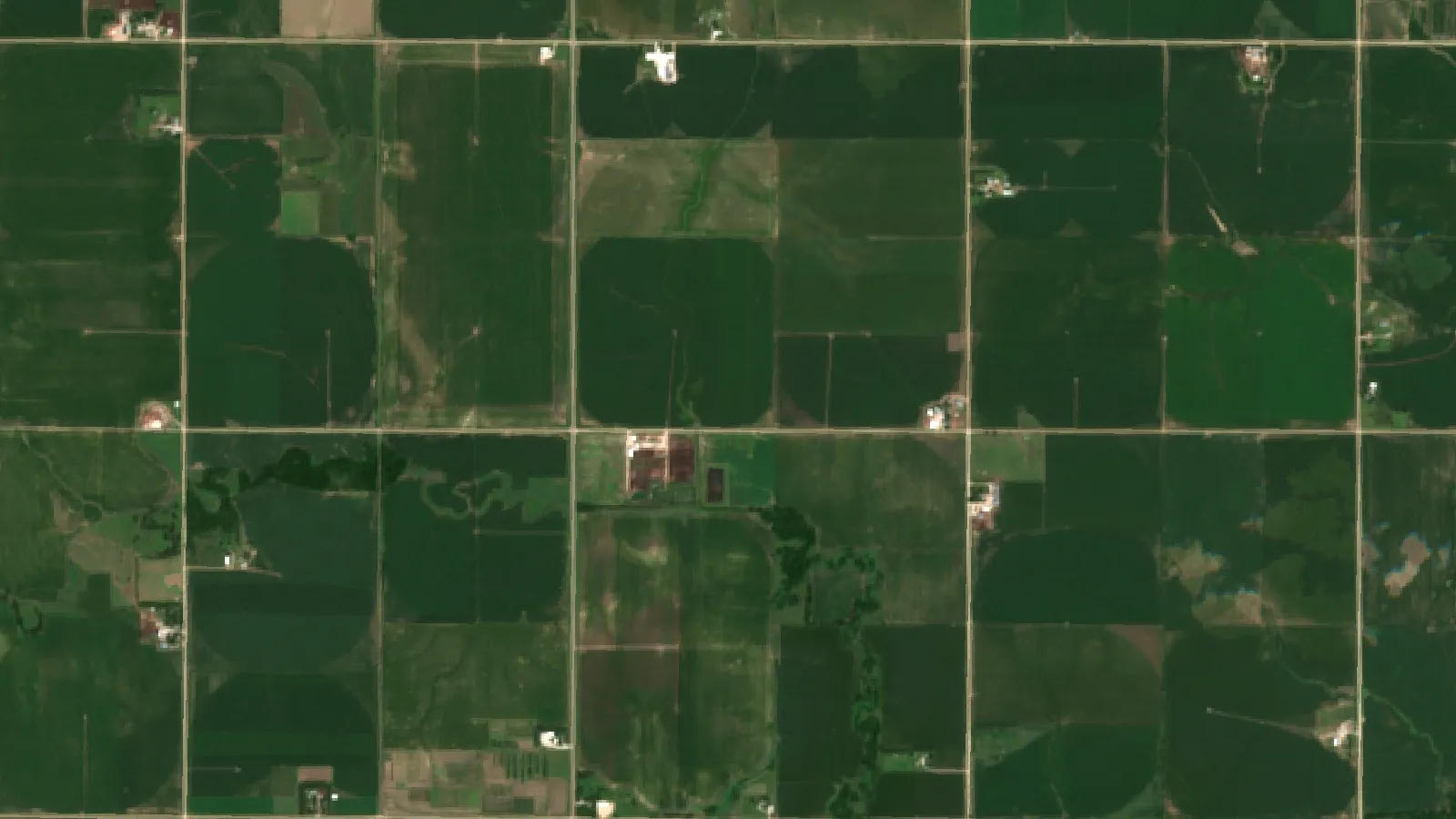
Key takeaways
- Agriculture takes 69% of global water withdrawals (FAO AQUASTAT); US irrigation withdrew 118 billion gallons a day in 2015, 42% of freshwater withdrawals (USGS).
- US irrigation delivery organizations lost about 10.7 million acre-feet, or 16% of the water they handled, to seepage and evaporation in 2019 (USDA ERS); about 72% of their canals were unlined.
- Indicative field application efficiency: 60% surface, 75% sprinkler, 90% drip (FAO); Texas A&M rated LEPA pivots at 95% and subsurface drip at 97% (2011).
- Of US farms that reported how they decide when to irrigate in 2023, 77% went by crop condition and 13% used soil moisture sensors (USDA NASS).
- Low-cost fixes come first: Arkansas trials cut water 19-27% with sensors, hole sizing and surge, with no significant yield loss (2018).
In this article
- How much irrigation water is lost?
- Where water waste in agriculture happens
- Irrigation efficiency by method: flood, sprinkler and drip
- How US farmers decide when to irrigate
- Ranked fixes for water waste in agriculture, with costs and payback
- Water-loss calculator
- What stops farms from cutting water losses
- Other water waste on farms: washing, wastewater and reuse
- How satellite monitoring helps find water losses
- How we checked the numbers
- FAQ
Water waste in agriculture is the share of irrigation water that never reaches a crop’s roots. It leaks or evaporates from canals, drifts from sprinklers, runs off the end of furrows or drains below the root zone. In the United States, irrigation delivery organizations lost an estimated 10.7 million acre-feet in conveyance alone in 2019, about 16% of the water they handled, according to the USDA Economic Research Service.
Below: where the losses happen, how flood, sprinkler and drip compare, eight fixes ranked by upfront cost with dated extension prices, and a calculator for your own losses and payback.
How much irrigation water is lost?
Farming is the largest user of fresh water. Agriculture accounts for 69% of global water withdrawals, against 19% for industry and 12% for towns and cities, according to FAO AQUASTAT. The share ranges from just over 20% in Europe to more than 80% in Africa and Asia.
In the United States, irrigation withdrawals were 118 billion gallons per day in 2015, or 42% of all freshwater withdrawals, according to the USGS report on water use in 2015. USGS estimated that 62% of that water was consumed by crops and evaporation. The rest returned to rivers or aquifers as runoff and seepage, or was lost on the way to the field.
On farms, US growers applied 80.9 million acre-feet to 53.1 million irrigated acres in 2023, an average of 1.5 acre-feet per acre, according to the 2023 Irrigation and Water Management Survey from USDA NASS. One acre-foot is 325,851 gallons.
How much of that is lost depends on two numbers. FAO splits scheme efficiency into conveyance efficiency (the share of water that survives the canals) and field application efficiency (the share applied in the field that the crop can use). Multiply the two to get the overall figure. In FAO’s worked example, a long clay canal at 80% and furrow irrigation at 60% give a scheme efficiency of 48%. The FAO irrigation efficiency annex rates 50-60% as good, 40% as reasonable and 20-30% as poor.
Chart
Where irrigation delivery organizations’ water went
Million acre-feet released by US irrigation water delivery organizations, 2019
Where water waste in agriculture happens
Water leaves an irrigation system by four main paths, each with its own fix.
| Loss path | Where it happens | Sourced size of the loss | Main fixes |
|---|---|---|---|
| Conveyance | Canals, ditches and storage before the farm gate | 16% of water handled by US delivery organizations (USDA ERS, 2019 survey) | Lining, piping, canal maintenance |
| Evaporation and drift | Sprinkler spray, wet leaves and wet soil surface | Application efficiency 78% for mid-height spray vs 95% for LEPA (Texas A&M, 2011) | Lower-pressure, lower-height nozzles; drip |
| Runoff | Tail water at the end of furrows and borders | Part of the 40% lost in furrow systems rated at 60% efficiency (FAO; Texas A&M) | Hole sizing, surge, tailwater reuse |
| Deep percolation | Water that drains below the root zone | No single national figure; rises with over-watering | Scheduling with sensors or ET data |
Conveyance losses from canals and ditches
Water moved in open canals seeps into the soil and evaporates. Delivery organizations released more than 67 million acre-feet that year and delivered about 41 million to farms and ranches. Nearly 11 million acre-feet left their systems as conveyance losses, according to the ERS Amber Waves summary of the survey.
About 72% of the main and lateral canals owned by these organizations were unlined in 2019. The same ERS summary reports that more than 75% of delivery organizations named cost as a reason for not lining them. Nearly 30% named groundwater recharge and more than 20% named soil conditions, since clay soils seep less.
FAO’s indicative values show why canal length and soil matter. For well-kept earthen canals, conveyance efficiency ranges from 60% for long canals in sand to 90% for short canals in clay. Lined canals reach about 95%. FAO notes that poor maintenance, such as unrepaired breaks and animal burrows, can lower these values by as much as 50%.
Evaporation and wind drift
Sprinklers throw water through the air, so some evaporates or blows away before it lands. More is lost from wet leaves and the soil surface. Height and pressure make a large difference. A Texas A&M AgriLife bulletin on the economics of irrigation systems (2011) assumed application efficiency of 78% for mid-elevation spray (MESA) pivots, 88% for low-elevation spray (LESA) and 95% for low energy precision application (LEPA), which places water in the furrow from drop hoses.
Runoff from furrows and borders
In furrow and flood systems, water must run the full length of the field. Rows that finish early spill tail water off the end. University of Arkansas Extension explains that sizing the holes in lay-flat poly-pipe so that every row gets water evenly reduces tail water and improves efficiency. Tailwater pits can catch the runoff for reuse.
Deep percolation below the root zone
When a field gets more water than the soil can hold, the extra drains below the roots and carries nitrate with it. A team at the University of Nebraska-Lincoln noted that farmers who rely on crop and soil appearance often feel unsure whether the crop has enough water and add extra irrigation for insurance.
Is all lost water wasted?
Not always. USGS notes that excess water from flood irrigation can return to streams or recharge groundwater, staying in the local water system. ERS makes the same point about canal seepage, which can feed aquifers and wetlands. A paper in Science by Grafton and colleagues (2018) warned that higher irrigation efficiency rarely reduces water consumption across a whole river basin, because farmers often use the saved water to irrigate more land or thirstier crops. For a single farm, though, every lost acre-inch still costs money to pump or buy.
Chart
Application efficiency by irrigation system
Assumed share of applied water the crop can use, Texas study systems
Irrigation efficiency by method: flood, sprinkler and drip
FAO gives indicative field application efficiencies of 60% for surface irrigation (border, furrow and basin), 75% for sprinklers and 90% for drip. The Texas A&M bulletin uses a similar ladder, with subsurface drip at the top at 97%.
| Method | Field efficiency (FAO) | Main loss paths | US acres, 2023 (NASS) |
|---|---|---|---|
| Surface (flood, furrow) | 60% | Runoff, deep percolation | 18.3 million |
| Sprinkler and pivot | 75% | Evaporation, drift, runoff on slopes | 30.8 million |
| Drip and micro | 90% | Leaks, over-watering if poorly scheduled | 6.4 million |
Sprinklers cover the largest area. In 2023 US farms irrigated 30.8 million acres with sprinkler systems, 18.3 million with gravity systems and 6.4 million with drip, trickle or low-flow micro sprinklers. Some farms use more than one method.
Gravity acres fell by about 1.9 million between 2018 and 2023, while drip grew by about 0.6 million, according to the NASS survey tables. USGS found a similar picture for 2015: 55% of US irrigated acres used sprinklers, and 33% of irrigated land in the Western states still used surface (flood) irrigation.
Be careful with water-per-acre averages. In 2023, farms using only sprinklers applied 1.2 acre-feet per acre, farms using only gravity systems applied 1.7, and farms using only drip applied 2.2. Drip is not wasteful here. California holds about 68% of US drip acres, mainly orchards, vines and vegetables in a dry, hot climate that needs more water. The average reflects crops and climate, not efficiency.
Chart
US irrigated acres by method, 2018 vs 2023
Million acres irrigated in the open; a farm may use more than one method
How US farmers decide when to irrigate
Timing drives deep percolation. Of 212,714 US irrigating farms in 2023, 164,779 (77%) used the condition of the crop. Only 27,831 (13%) used soil moisture sensors and 15,484 (7%) used daily evapotranspiration (ET) reports. Just 1,627 used computer simulation models, according to the NASS survey.
Chart
How US farms decide when to irrigate
Number of farms using each method, 2023; farms could report more than one
Crop condition is a late signal, so growers tend to irrigate early and heavily to be safe. Soil moisture and ET-based scheduling refill the root zone and stop there.

▶ Six plain steps to start precision farming, from field records and maps to satellite monitoring. · 4:18
Ranked fixes for water waste in agriculture, with costs and payback
The eight fixes below are ranked roughly from lowest to highest upfront cost, using published extension figures. Where we found no published cost, we say so. Costs are from the year shown and are budget estimates or study figures, not current dealer quotes.
| Fix | Upfront cost (source, year) | Measured or rated effect | Best for |
|---|---|---|---|
| 1. Pump test | Cost of a test; ask your extension office | Average saving of $511 per site in an Arkansas study (2018) | Any farm with wells or lift pumps |
| 2. Soil sensors | $680 for four sensors, reader and slide hammer (Arkansas Extension, 2024) | Part of packages that cut water 19-27% (Arkansas, 2018) | All methods |
| 3. Hole sizing | Public PHAUCET software plus time | Potential cut of 25% or more (Arkansas Extension) | Furrow with poly-pipe |
| 4. Surge valves | No published figure found; get dealer quotes | 27% less water with sensors and hole sizing (Arkansas, 2018) | Long furrow runs |
| 5. Pivot nozzles | No published figure found; get dealer quotes | 78% to 88-95% efficiency (Texas A&M, 2011) | Existing pivots |
| 6. Furrow to pivot | $556 per acre system only (Texas A&M, 2011); $1,546 per acre with new well and pump (NC State budget) | 60% to 78-95% efficiency | Square fields, sandy soils |
| 7. Subsurface drip | About $700 per acre (University of Missouri trial, 2017); $1,200 per acre (Texas A&M, 2011) | 97% efficiency (Texas A&M, 2011) | Odd-shaped fields, high water cost |
| 8. Line or pipe canals | District-level project; almost 76% of organizations cite cost as a reason not to line (ERS) | Lined canals about 95% vs 60-90% earthen (FAO) | Irrigation districts |
1. Test and tune your pumps
Best for: any farm that pumps from wells or lifts surface water.
A pump that runs at the wrong speed or has worn parts burns more energy per acre-inch. In a study of Arkansas furrow-irrigated fields by Henry, Gaspar and Horton (University of Arkansas, 2018), on-farm pump testing found savings of $511 per site. The cost of pumping water ranged from $0.10 to $1.86 per acre-inch for electric pumps and $1.35 to $2.14 for diesel pumps. Testing also tells you what each acre-inch costs, which any payback sum needs.
2. Schedule with soil moisture sensors or ET data
Best for: every irrigation method, and the first step before buying hardware.
Sensors show when the root zone actually needs water. At Arkansas Extension’s surge valve and sensor schools in 2024, the optional kit of four sensors, a reader and a slide hammer cost $680, according to the University of Arkansas Division of Agriculture. In the Arkansas study, fields using hole sizing and soil moisture monitoring used 19% less water than paired control fields. Yields on the treated fields were not significantly different from the controls.
3. Size poly-pipe holes so every furrow finishes together
Best for: furrow irrigation with lay-flat poly-pipe.
Computerized hole selection calculates the right hole size for each row from pipe friction, elevation, flow and pressure. Arkansas Extension says it has the potential to cut water use and irrigation cost by 25% or more in most cases. PHAUCET, a public software tool built by NRCS engineers in Missouri, does the design.
4. Add surge irrigation
Best for: long furrow runs and soils that take in water quickly near the pipe.
A surge valve switches water between two sets of rows in cycles. Wetted soil seals slightly, so the next surge runs down the row faster. In the Arkansas study, fields that combined surge, hole sizing and soil moisture monitoring used 27% less water than control fields, about 2.6 acre-inches per acre, with less than a 1% difference in yield. In 2023, US farms used surge flow on 317,423 acres, a small share of the 18.3 million gravity-irrigated acres.
5. Lower the pressure and height of pivot sprinklers
Best for: farms that already own center pivots.
Moving from mid-height spray to drop hoses near the canopy or the furrow reduces evaporation and drift. The Texas A&M bulletin rated MESA at 78%, LESA at 88% and LEPA at 95% application efficiency, and lower pressure also cuts pumping energy. We found no published, dated cost for a nozzle package, so ask more than one dealer for a quote.
6. Convert flood or furrow fields to center pivots
Best for: square fields of 80 acres or more, sandy soils, and farms short of labor.
The Texas A&M bulletin put the gross investment for a quarter-mile pivot at $556 per acre, against $208.56 for furrow, not counting the well, pump and engine. An NC State University cost budget for an 81-acre, 1,000-foot diesel pivot that needs a new well totals $125,243, or $1,546 per acre, of which the sprinkler system is $52,543. Large pivots cost less per acre: a half-mile pivot cut the Texas A&M figure by about 40%.
7. Install subsurface drip irrigation
Best for: odd-shaped fields, pivot corners, and farms with costly or limited water.
Subsurface drip places water at the roots and was rated at 97% application efficiency by Texas A&M, which put gross investment at $1,200 per acre in 2011. A University of Missouri trial reported in 2017 estimated about $700 per acre to install. The cost depends on the field and the design, and buried lines need careful upkeep.
8. Line or pipe canals
Best for: irrigation districts and ditch companies.
Lining with concrete or plastic membranes cuts seepage, and FAO rates lined canals at about 95% conveyance efficiency. Cost is the main barrier: almost 76% of US water delivery organizations cite expense as a reason for leaving canals unlined, according to an ERS chart on canal lining.
How payback works
Simple payback is the upfront cost divided by the yearly saving. The answer depends mostly on what each acre-inch costs you. Here is our own example from the Texas A&M tables for an intermediate water-use crop. A LEPA pivot pumps 12.97 inches per acre against 20.53 for furrow, a saving of 7.56 inches. The extra investment over furrow is about $347 per acre. At $2 per acre-inch, within the Arkansas diesel range for shallow wells, the saving is about $15 per acre a year and payback takes more than 20 years. At the Texas bulletin’s own variable pumping cost of about $11 per acre-inch (350-foot lift, 2011), the saving is about $83 per acre a year and payback is about 4 years. Labor, energy, yield and water availability change the answer, so run the sums with your own numbers.

▶ Seven green farming technologies that save water, fuel and fertilizer, ranked in a short explainer. · 2:24
Water-loss calculator
Enter your own field size, water applied and efficiency figures. If you do not know your efficiencies, start with FAO’s indicative values: 60% for surface, 75% for sprinkler and 90% for drip, and 60-95% for conveyance depending on canals. A well next to the field has conveyance close to 100%.
Try the numbers for your own farm below.
Calculator
How much water do you lose, and would an upgrade pay?
Enter your own field, water and efficiency numbers.
- Water reaching the root zone now: 162.0 acre-ft
- Water to pump after upgrade, same crop water: 204.5 acre-ft
- Water saved per season: 35.5 acre-ft
- Value of water saved per season: $1,915
- Upgrade cost: $19,200
- Simple payback: 10.0 years
- Net gain over upgrade life: -$55
Example values only, not a benchmark or forecast; every number is your input. The defaults (a 160-acre field, 18 inches applied, 90% conveyance, 75% field efficiency now, 88% after an upgrade, $4.50 per acre-inch, $120 per acre upgrade, 10-year life) are round examples set near break-even. $4.50 per acre-inch is close to the US average off-farm water cost of $54.22 per acre-foot (USDA NASS, 2023 survey); Arkansas pump tests found $0.10 to $2.14 per acre-inch for pumping energy (University of Arkansas, 2018). FAO indicative efficiencies: surface 60%, sprinkler 75%, drip 90%; conveyance 60-95%. The calculator keeps the water reaching the crop the same and assumes the upgrade changes only field efficiency. It ignores labor, energy, yield and financing, and water saved on your farm may not be saved for the river basin. 1 acre-foot = 12 acre-inches (fixed).
What stops farms from cutting water losses
The NASS survey asked irrigators what holds back improvements that would save energy or water. Of 124,043 farms that reported barriers in 2023, 39,224 said they could not finance the work, 36,382 said it was not a priority and 30,969 said the savings would not cover the cost. Another 22,164 named uncertainty about future water supplies.
Chart
Barriers to saving water or energy
Number of US irrigating farms citing each barrier, 2023 (top six of the survey list)
Help with funding exists. USDA’s Environmental Quality Incentives Program (EQIP) pays part of the cost of conservation practices, offsetting up to 90% of implementation costs, and also gives technical help, according to an ERS report on precision agriculture (2023). Rules and payment rates differ by state and change each year, so check with your local NRCS office before you plan around them.
Other water waste on farms: washing, wastewater and reuse
Water used to wash, cool and pack produce can often be captured, filtered and reused. In 2023, 2,705 US farms applied about 1.08 million acre-feet of reclaimed water to 784,757 acres in the open, up from 640,491 acre-feet in 2018, according to the NASS survey.
Reused and treated water must meet food safety and water quality rules for the crop it touches. Check local rules and get professional advice before you irrigate food crops with reclaimed water.
Fertilizer timing matters too. Nitrogen applied just before heavy irrigation leaches more easily; small doses through the system (fertigation) reduce that loss. Follow the product label and local rules for any fertilizer or chemical injected into irrigation water, including the required backflow protection.
How satellite monitoring helps find water losses
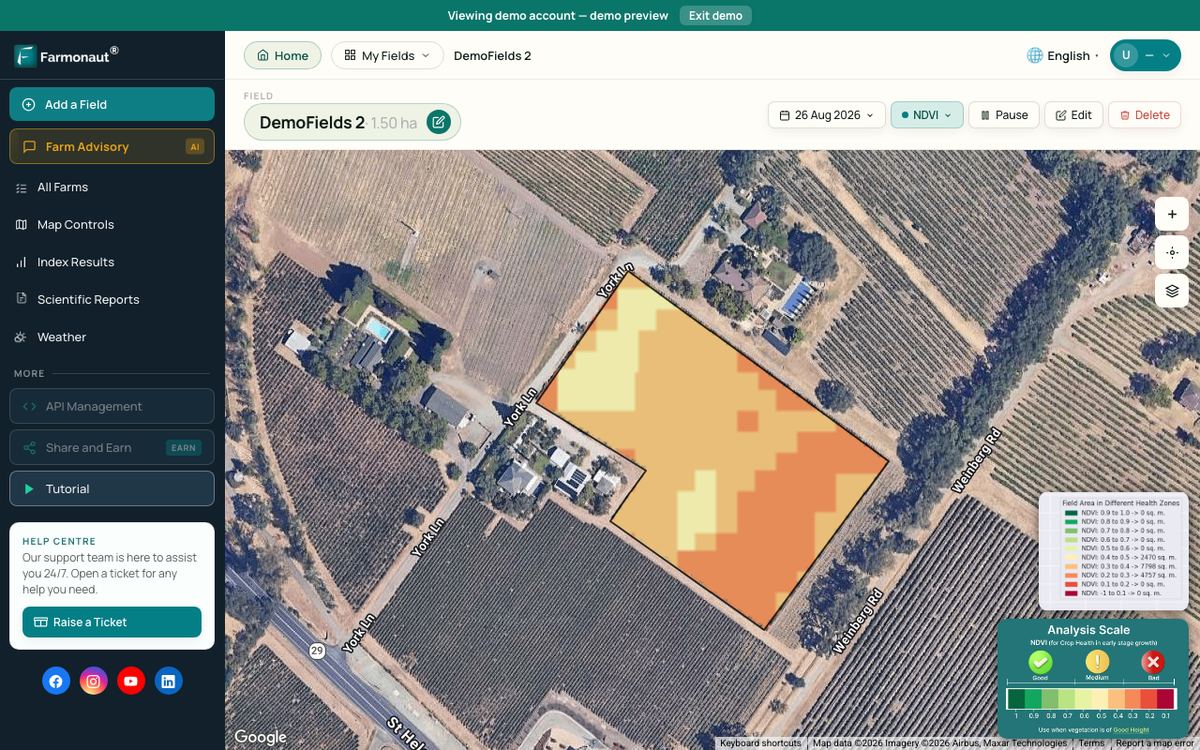
Field-scale maps can show where a crop is drier or wetter than the rest of a field. A greener ring on a pivot may point to a leak or the wrong nozzle. Vegetation and water indices from satellites show these patterns; they do not measure soil moisture directly or say why the pattern exists, so check the field before you act.
The Farmonaut Satellite + AI Farm Monitoring System gives vegetation maps such as NDVI for each field you draw, on web, Android and iOS. Farms and agencies that manage many fields can use the large-scale farm management tool, and developers can pull the same data through API-driven data tools and the developer API documentation.
Related pages on our site: fleet management, product traceability documentation, our carbon impact solutions and crop loan and insurance.
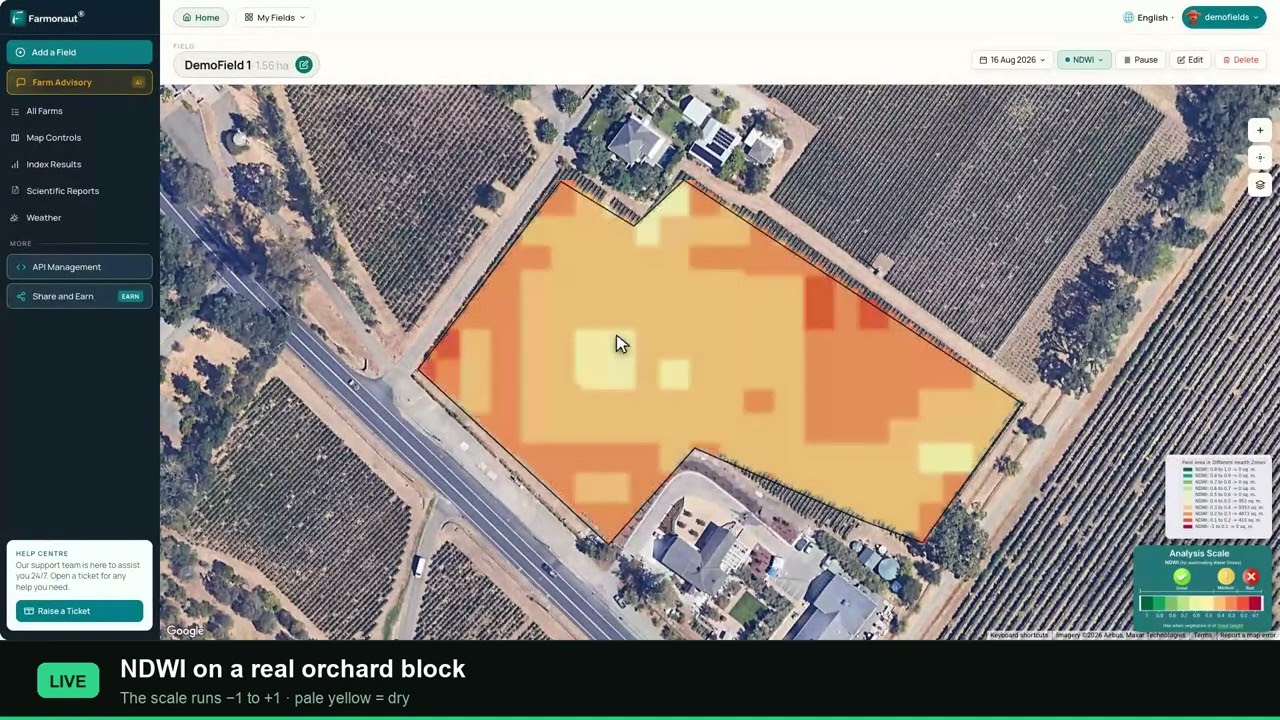
▶ NDWI vs MNDWI: what each satellite water index measures and which one suits a crop field. · 2:45
How we checked the numbers
Volumes come from FAO AQUASTAT, USGS, the USDA NASS 2023 survey and the ERS analysis of the 2019 Survey of Irrigation Organizations. Efficiency values from FAO and Texas A&M are indicative or assumed values, not field measurements. Costs come from extension budgets and studies, each with its year. We ranked fixes by upfront cost because that is the figure the sources publish; the water each saves depends on your starting point.
We cover a connected topic in Agriculture Waste Example: 5 Sustainable Solutions.
FAQ
What is water waste in agriculture?
It is irrigation water that does not reach the crop’s root zone: water lost from canals by seepage and evaporation, sprinkler drift and evaporation, runoff from the end of fields, and drainage below the roots.
Which irrigation method wastes the least water?
Drip loses the least in the field. FAO gives indicative application efficiencies of 90% for drip, 75% for sprinklers and 60% for surface irrigation, and Texas A&M rated subsurface drip at 97% and LEPA pivots at 95%.
How much water do irrigation canals lose?
US delivery organizations lost about 16% of the water in their systems to seepage and evaporation in 2019 (USDA ERS). FAO’s indicative conveyance efficiency for earthen canals ranges from 60% to 90% depending on length and soil, and about 95% for lined canals.
Does drip irrigation always save water?
It cuts losses on the field, but it does not always cut total use. Farms may use the saved water to grow more or thirstier crops, and lower runoff can mean less recharge for neighbors downstream (Grafton and colleagues, Science, 2018).
What is the cheapest way to reduce irrigation water loss?
Start with measurement: test your pump, then schedule with soil moisture sensors or ET reports. A four-sensor kit with reader cost $680 at Arkansas Extension schools in 2024, and furrow farms can add hole sizing with public PHAUCET software.
Farmonaut crop monitoring
See your irrigated fields from space
Draw your fields once and Farmonaut shows satellite vegetation maps for them through the season, so uneven watering is easier to spot.



Keep reading
Sources
- FAO AQUASTAT, Water use (methodology and global withdrawal shares): fao.org
- FAO, Irrigation Water Management: Irrigation Scheduling, Annex I: Irrigation efficiencies (1989): fao.org
- USGS, Estimated use of water in the United States in 2015, Circular 1441 (2018): pubs.usgs.gov
- USDA NASS, 2023 Irrigation and Water Management Survey, 2022 Census of Agriculture Vol. 3 (October 2024): nass.usda.gov
- USDA ERS, Irrigation delivery organizations released water from systems for a variety of users, purposes (Charts of Note, 2021): ers.usda.gov
- USDA ERS, Cost cited as major reason for not lining canals that carry water to farms, ranches in 2019 (Charts of Note, 2021): ers.usda.gov
- USDA ERS, Irrigation Organizations Use Conveyance Infrastructure To Deliver Water to Irrigated Farms and Ranches (Amber Waves, November 2021): ers.usda.gov
- USDA ERS, Hrozencik, Wallander and Aillery, Irrigation Organizations: Water Storage and Delivery Infrastructure, EB-32 (2021): ers.usda.gov
- USDA ERS, McFadden, Njuki and Griffin, Precision Agriculture in the Digital Era, EIB-248 (2023): ers.usda.gov
- Henry, Gaspar and Horton, Effectiveness of Irrigation Water Management Practices for Mid-South Furrow Irrigation, University of Arkansas (Irrigation Association technical paper, 2018): irrigation.org
- University of Arkansas Cooperative Extension, Computerized Hole Selection: uaex.uada.edu
- University of Arkansas Division of Agriculture, Surge valve, moisture sensor school sessions (February 2024): uaex.uada.edu
- Amosson and others, Economics of Irrigation Systems, Texas AgriLife Extension bulletin B-6113 (2011): agecoext.tamu.edu
- Bullen and Benson, NC State University, Irrigation cost spreadsheet: center pivot, 1,000 ft, diesel, 81 acres (posted 2024): cals.ncsu.edu
- DTN Progressive Farmer, University of Missouri research shows subsurface drip irrigation nets higher yields (September 2017): dtnpf.com
- University of Nebraska-Lincoln CropWatch, Sensors on the Pivot for Automated Irrigation Scheduling in the Great Plains (June 2022): cropwatch.unl.edu
- Grafton and others, The paradox of irrigation efficiency, Science 361 (6404) (2018): doi.org
Discussion
Questions, corrections or field experience? Share them below. First-time comments are reviewed before they appear, and your email is never published.
No comments yet. Be the first to add a question or your experience.

 AgriSavant
 Kubota
 FFBS
FFBS Jontra
 Kalustyan
 Tucor
Tucor Geno
Geno Hayleys Agriculture
 Linx Agritech
 Adinet
 Save Your Soils
 Grandstream Algérie
 XOS Realty
 Geospatial Lab Africa
 Licence holder · Niger · Gold










